


 Buy a Licensed Company
  Explore VASP Data
  Talk to an Expert

 Atis Shala
Atis is a senior analyst and community lead with four years of experience in crypto. He has a bachelor from the Rochester Institute of Technology.
Atis Shala
Atis is a senior analyst and community lead with four years of experience in crypto. He has a bachelor from the Rochester Institute of Technology.
TRON (TRX) Price Prediction: Can It Hit a New ATH in 2026?
The cryptocurrency market demands absolute clarity, and investors want a definitive answer regarding TRON and its native token, TRX. Can TRX hit a new all-time high in 2026? The verdict is a yes. TRON possesses the fundamental utility, the institutional backing, and the deflationary tokenomics required to shatter its previous 2024 peak of $0.43. While other legacy layer-one blockchains struggle to find product-market fit, TRON monopolizes the most critical sector in crypto: stablecoin settlements. This monopoly provides a strong floor price and creates a springboard for massive upward price discovery as the 2026 market cycle matures.
To understand the trajectory of TRX over the next twelve months, investors must look past the superficial market noise and examine the hard data. The network processes billions of dollars daily, operating as the financial backbone for emerging economies. This immense volume translates directly into value accrual for the TRX token. By analyzing current onchain metrics, institutional accumulation trends, and macroeconomic liquidity cycles, we can establish clear price targets for the year.
The 2026 Price Snapshot:
- Bearish Floor: $0.21. This level represents the absolute bottom, supported by whale accumulation and the persistent baseline revenue generated by daily USDT transactions.
- Consensus Target: $0.48. This target aligns with organic network growth, steady algorithmic token burning, and standard Fibonacci extensions from the previous market cycle.
- Bullish Ceiling: $0.65+. Achieving this upper bound requires specific catalysts to align perfectly, namely the approval of a spot ETF and a significant injection of global retail liquidity.
Three primary catalysts fuel this aggressive 2026 price prediction. Each of these factors operates independently, yet they combine to create a compounding effect on the value of TRX.

The “Why” in 3 Bullets:
- The Canary ETF Filing: Institutional investors actively seek yield-bearing crypto assets. The Canary Capital spot ETF application introduces TRX to traditional financial markets, opening the floodgates for billions in fresh capital and validating TRON as a blue-chip asset.
- Total USDT Dominance: TRON settled a staggering $7.9 trillion in USDT transfers during 2025. It holds roughly half of the entire global USDT supply, making it the undisputed king of stablecoin liquidity and the primary financial rail for developing nations.
- Deflationary Burn Mechanics: The TRON network operates on a net-negative issuance model. The protocol consistently burns more TRX than it creates. This constant reduction in circulating supply creates a powerful supply shock mechanism that naturally drives the price upward as demand increases.
2026 TRON (TRX) Key Metrics
| Metric | Current 2026 Valuation | 2026 Year-End Target | Potential Change |
| Market Capitalization | $27.2 Billion | $56.5 Billion | +107% |
| 24h Trading Volume | $1.2 Billion | $3.5 Billion | +191% |
| Circulating Supply | 86.5 Billion TRX | 84.1 Billion TRX | Deflationary |
| USDT on TRON Supply | $78.1 Billion | $110.0 Billion | +40% |
| 2026 ROI Potential | Baseline | Peak Projection | +170% |
The Critical Catalysts: Tron 2026 Market Drivers
The cryptocurrency landscape evolved significantly following the Bitcoin halving in 2024. Speculative fervor cooled, replaced by a demand for tangible utility and institutional-grade infrastructure. Three critical market drivers separate TRON from its competitors and position it for a massive breakout in 2026.
Institutional Inflow: Tron ETF?
For years, traditional finance viewed TRON with skepticism. That narrative shifted violently when Canary Capital submitted paperwork for a spot TRX Exchange Traded Fund. This filing represents a watershed moment for the network. An approved spot ETF provides traditional money managers with a compliant, regulated vehicle to gain exposure to the TRX token. The impact extends far beyond simple price appreciation. It legitimizes the entire TRON ecosystem in the eyes of the global financial establishment.
Furthermore, the structure of modern crypto ETFs often includes staking provisions. Institutional investors do not just want to hold the asset; they want to earn the baseline yield generated by network consensus. As Wall Street firms acquire TRX to back their ETF products, they will lock millions of tokens into the TRON staking mechanism. This institutional staking removes a massive portion of the liquid supply from the open market. When you combine increased Wall Street demand with a drastically reduced available supply, the resulting liquidity shock forces the price to accelerate upward. The Canary ETF serves as the primary gateway for this institutional capital rotation.
Tron as a Global Settlement Layer
While Western investors debate the merits of various decentralized finance protocols, users in emerging markets have already chosen their preferred financial network. TRON successfully positioned itself as the “Visa of Crypto.” In countries suffering from severe currency devaluation, such as Argentina, Turkey, and Nigeria, citizens rely on digital dollars to protect their wealth. TRON provides the infrastructure for this digital dollarization.
During 2025, the TRON network processed an astonishing $7.9 trillion in USDT transfers. To put this in perspective, this volume rivals major traditional payment processors. TRON currently hosts approximately 42% of the entire global USDT supply, boasting over $78 billion in stablecoin value on its ledger. This dominance is not an accident. It stems from a deliberate architectural choice to keep transaction fees incredibly low and confirmation times nearly instantaneous. When a user in Latin America needs to send a $50 remittance, they cannot afford a $5 Ethereum gas fee. They use TRON because it costs fractions of a cent. This sticky, real-world utility provides TRON with a defensive moat that purely speculative blockchains simply lack. As global inflation persists through 2026, the demand for USDT on TRON will only intensify, directly driving network revenue and token value.
The Revolut & Payment Integration
Retail adoption remains the holy grail for cryptocurrency projects. TRON achieved a massive victory in this arena through its deep integration with neo-banks and mainstream financial applications. The standout partnership is with Revolut, a global financial super-app boasting a user base exceeding 65 million people.
Through this integration, everyday consumers gain frictionless access to the TRX token. They do not need to navigate complex decentralized exchanges or manage cumbersome private keys. They buy, sell, and hold TRX directly within their familiar banking interface. This level of accessibility tears down the traditional barriers to entry that historically kept retail investors on the sidelines. Furthermore, as Revolut expands its crypto payment features, users actively utilize TRX for everyday purchases and cross-border transfers. This seamless fiat on-ramp transforms 65 million traditional banking customers into potential TRON network participants. The sheer scale of this user acquisition funnel provides a constant, underlying bid for the TRX token throughout 2026.
Tron Technical & Quantitative Analysis
Fundamental adoption provides the foundation, but technical analysis dictates the exact price levels we expect in 2026. By applying rigorous quantitative models to TRON’s historical price action and current tokenomics, we plot a clear roadmap to the new all-time high.
Tron Fibonacci Extensions
Technical analysts rely heavily on Fibonacci extensions to project future price targets after an asset breaks past its previous all-time high. For TRX, the crucial baseline is the December 2024 peak of $0.43. Following this peak, the market experienced a standard consolidation phase, establishing a firm bottom around the $0.21 support zone.
We apply the standard 1.618 golden ratio extension to these macro levels to find our primary 2026 breakout target. The mathematical model works as follows:

Plugging in the historical data points:
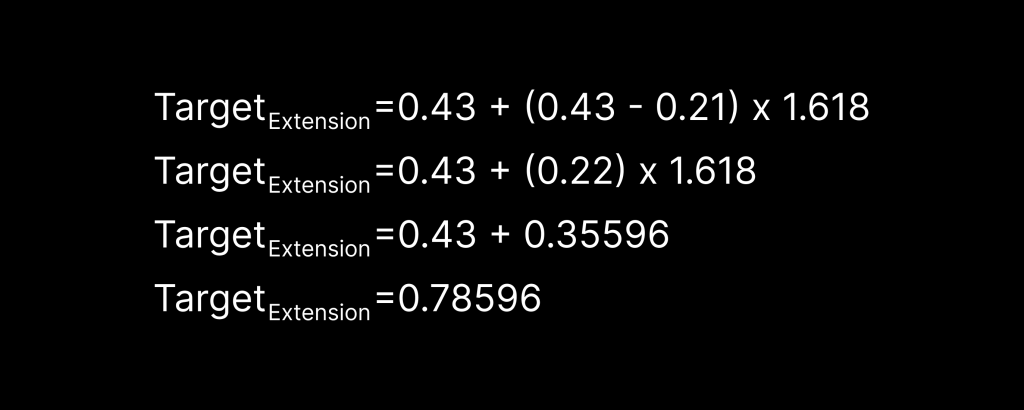
While this pure mathematical model projects a peak near $0.78, market friction and psychological resistance levels often cap these extensions slightly lower. Therefore, we establish our highly realistic bullish ceiling at $0.65+. This target remains highly achievable within the 2026 liquidity cycle, provided the network maintains its current growth trajectory.
Tron Burn Mechanism
Price predictions often fail because they ignore the supply side of the economic equation. TRON features one of the most aggressive deflationary models in the entire cryptocurrency sector. The network utilizes a mechanism that burns TRX tokens to pay for transaction fees and smart contract execution.
As the network usage scales to handle millions of daily USDT transfers, the protocol actively destroys millions of TRX tokens. This results in net-negative issuance. TRON permanently removes more tokens from circulation than it distributes to validators as block rewards. During periods of high network congestion, this burn rate accelerates dramatically. This quantitative tightening creates a persistent upward pressure on the price. Even if demand remains perfectly flat, the constantly shrinking supply ensures that each remaining TRX token becomes intrinsically more valuable. Over the course of 2026, this continuous burn removes billions of tokens from the open market, elevating the price floor and making explosive upside movements much easier to sustain.
Volume Profile
Onchain data reveals the hidden actions of major market players. Analyzing the volume profile for TRX over the past year shows massive, localized accumulation by “whale” entities. These large wallets systematically absorbed the available supply during the market downturn.
The data pinpoints an undeniable accumulation zone between $0.20 and $0.25. Millions of dollars flowed into TRX within this specific price bracket. Whales do not accumulate at these levels to secure a minor 10% gain. They build these massive positions in anticipation of a major macroeconomic shift. This $0.20 to $0.25 range now acts as an unbreakable foundation for the asset. Any temporary market panic or flash crash will likely find aggressive buyers defending their entry points. With the downside strictly limited by this whale support wall, the path of least resistance for TRX in 2026 is undoubtedly upward.
The Ecosystem Pivot: AI and BitTorrent (BTT)
A blockchain must adapt to survive. TRON refuses to rest on its laurels as a pure payment network. In 2026, the ecosystem executes a massive strategic pivot, integrating two of the most powerful narratives in the tech sector: Artificial Intelligence and decentralized infrastructure.
AI-Blockchain Convergence
Artificial intelligence requires immense computational power and secure, verifiable data pipelines. The TRON development team recognized this synergy early and executed the critical Java-tron network upgrade in January 2026. This core protocol enhancement specifically optimized the network to support AI integrations.
TRON now provides the decentralized compute architecture necessary for training complex machine learning models. Developers actively build autonomous AI agents that operate natively on the TRON blockchain. These agents execute trades, manage decentralized portfolios, and interact with smart contracts without human intervention. By providing the financial rails for these autonomous agents, TRON captures an entirely new demographic of network users: machines. As AI adoption scales exponentially globally, the TRON network stands ready to serve as the default transactional layer for the artificial intelligence economy.
Web3 Infrastructure on Tron
Handling millions of human users and thousands of AI agents requires incredible throughput. To prevent the crippling congestion that plagues Ethereum, TRON leverages the BitTorrent Chain (BTTC) as its premier Web3 scaling solution.
BTTC operates as a high-performance cross-chain scaling protocol. It allows the TRON network to seamlessly process over 10,000 transactions per second. This massive throughput ensures that fees remain negligible even during periods of extreme network demand. BTTC also bridges TRON with other major blockchains, enabling free-flowing liquidity across the fragmented crypto landscape. By utilizing the legendary BitTorrent architecture, TRON guarantees the speed and reliability required by enterprise-level applications. This infrastructure supremacy guarantees that developers will continue to choose TRON over slower, more expensive alternatives.
Tron Gaming & NFTs
The Non-Fungible Token sector suffered a severe reality check following the speculative mania of previous years. TRON recognized this shift and aggressively pivoted the ecosystem away from overpriced digital art and toward genuine utility.
The focus in 2026 shifted entirely to “Soulbound” tokens. These are non-transferable NFTs that represent digital identity, academic credentials, and onchain reputation. In the burgeoning Web3 gaming sector, TRON utilizes Soulbound tokens to track player achievements and establish verifiable digital ownership of in-game assets. This shift from speculation to utility integrates NFTs deeply into the actual mechanics of the TRON network, creating sustainable, long-term demand for the TRX token as users interact with these complex digital environments.
Competitive Landscape & Risk Factors for Tron
No investment is without risk, and a professional analysis must address the threats challenging TRON’s dominance. The 2026 crypto market is a hyper-competitive battleground, and TRON faces significant headwinds from rival technologies and external regulatory bodies.
The “Ethereum L2” Threat to Tron
Ethereum recognized its scaling issues and unleashed a swarm of Layer 2 solutions, primarily Arbitrum and Base. These networks aim to steal TRON’s market share by offering fast, cheap transactions secured by the Ethereum mainnet.
This represents the most direct technological threat to TRON. Arbitrum and Base boast massive developer ecosystems and significant venture capital backing. They actively target the lucrative stablecoin settlement market that TRON currently controls. However, TRON maintains a distinct advantage in the sheer simplicity of its user experience. Moving assets to an Ethereum L2 still requires bridging, which introduces complexity and security risks for the average retail user. TRON remains a native, single-layer solution. While the L2 threat is severe, TRON’s entrenched dominance in emerging markets and its superior user interface provide a strong defense against these aggressive newcomers.
Tron Regulatory Clouds
The regulatory environment remains the most unpredictable variable in the 2026 price prediction. Justin Sun, the founder of TRON, continues to navigate a complex legal landscape. Any adverse legal developments regarding his standing could trigger short-term market panic and negatively impact the TRX token price.
Furthermore, the United States Securities and Exchange Commission maintains a hawkish stance on Proof of Stake assets. While the SEC dropped certain appeals in other high-profile crypto cases, the regulatory framework governing assets that generate yield through staking remains murky in 2026. A sudden regulatory crackdown on DeFi protocols or a move to classify TRX as an unregistered security would create massive friction for institutional adoption and severely delay the projected price targets. Investors must monitor the regulatory climate closely, as it wields the power to invalidate even the strongest technical setups.
Market Cycles
Cryptocurrency markets operate in distinct, predictable cycles, largely governed by the Bitcoin halving events. We are currently navigating the post-halving phase of the 2024 cycle. Historically, this specific timeframe introduces a dangerous phenomenon known as the “Mid-Cycle Correction.”
Even during a raging bull market, assets rarely move in a straight line. The market routinely flushes out over-leveraged traders with violent, sudden drawdowns. Investors must prepare for the possibility of a severe mid-cycle correction in 2026 that could temporarily drag TRX down toward its $0.21 support floor. Understanding where we sit in the broader macroeconomic cycle is crucial for managing risk. A disciplined investor views these inevitable corrections as strategic opportunities to accumulate TRX before the final parabolic blow-off top.
Historical Context & Project Foundation
To truly grasp where TRON is heading in 2026, we must acknowledge the journey that brought it here. TRON did not appear overnight; it survived multiple brutal bear markets through relentless iteration and ruthless execution.
The legacy from 2017 to 2024 tells a story of aggressive evolution. TRON famously began its life as an ERC-20 token living on the Ethereum network. It was largely dismissed by the crypto elite as a mere marketing gimmick. However, the development team quickly executed a flawless mainnet launch, migrating away from Ethereum and establishing an independent, sovereign blockchain. From that moment, TRON transformed from a simple fork into an independent powerhouse, consistently outperforming its critics and absorbing massive market share.
This dominance builds upon continuous protocol evolution. The network progressed through distinct, meticulously planned phases, from the early days of “Odyssey” to the mature, decentralized architecture of the “Great Voyage” era. These technical milestones transitioned the network from a founder-centric project into a robust, community-governed Decentralized Autonomous Organization (DAO). This foundational stability proves that TRON possesses the technical pedigree and the institutional resilience to dominate the financial landscape of 2026 and beyond.
Tron Price Prediction 2026 and Beyond
The cryptocurrency market rewards patience and punishes impulsivity. While 2026 serves as a critical pivot point for the current liquidity cycle, investors with a multi-year horizon need to look further ahead. The trajectory of TRON (TRX) from 2026 to 2030 will not be defined by short-term speculation, but by its entrenchment as a global financial utility.
We are moving away from the era of “crypto as a casino” and into the era of “crypto as infrastructure.” The following analysis breaks down the price potential for TRX year by year, grounded in the four-year Bitcoin halving cycles, macro-economic shifts, and the technological roadmap of the TRON DAO.
Tron Price Prediction 2026
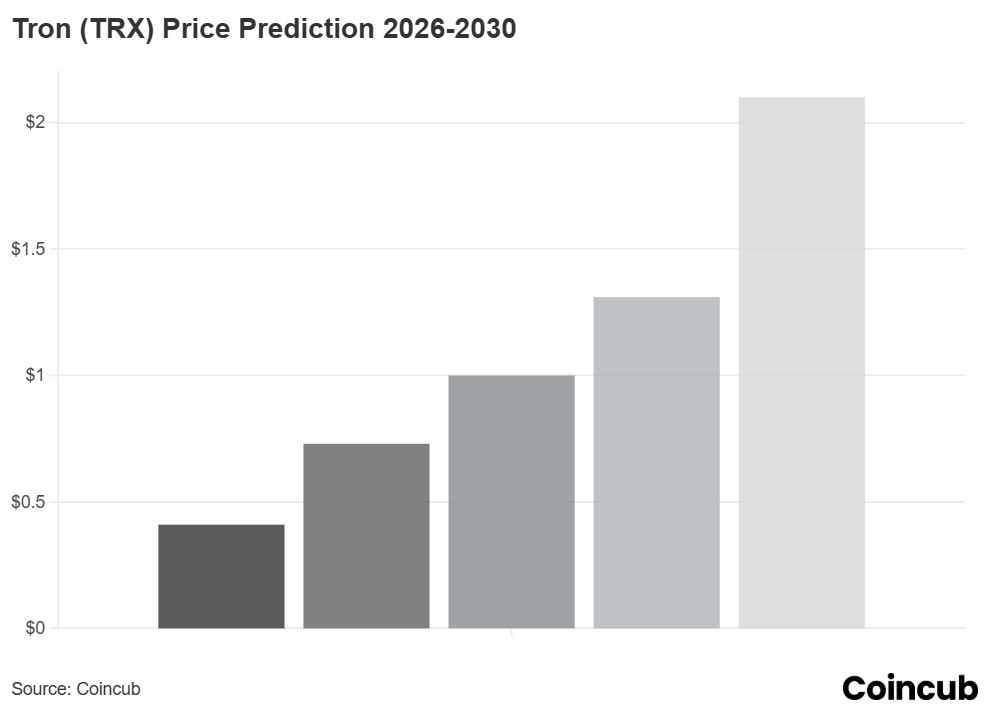
Projected Range: $0.21 – $0.65
2026 represents the “Mid-Cycle Correction” phase. Historically, the year following a massive bull run (2025) often sees significant volatility as the market digests gains. However, TRX differs from volatile meme coins because of its massive USDT revenue stream.
The Narrative: This year serves as the ultimate stress test. While Bitcoin and Ethereum may retrace significantly from their cycle peaks, TRX will likely decouple due to its utility in emerging markets. We expect a “flight to utility” where investors exit speculative assets and rotate into cash-flow-generating protocols.
Key Driver: The Canary Capital ETF approval (anticipated late 2025 or early 2026) acts as a stabilizing force, creating a higher price floor than in previous cycles.
Verdict: Expect a volatile start to the year followed by a strong recovery in Q4. The bearish floor sits at $0.21, while a bullish breakout could see $0.65 if global inflation forces more users into USDT-on-TRON.
Tron Price Prediction 2027
Projected Range: $0.55 – $0.82
By 2027, the “crypto winter” narrative will have faded, replaced by the accumulation phase leading up to the next Bitcoin halving. For TRON, this year marks the maturity of its AI and Soulbound token initiatives.
- The Narrative: Integration becomes invisible. By 2027, millions of users will interact with the TRON blockchain without realizing it, thanks to “gasless” transactions sponsored by major payment processors like PayPal or Revolut. The friction of buying TRX to pay for gas disappears for the average user, driving massive backend volume.
- Key Driver: Deflation accelerates. After two years of high network usage, the total supply of TRX will have decreased significantly due to the burn mechanism. This supply shock begins to manifest in the price action, pushing the token steadily upward even without explosive hype.
- Verdict: A year of slow, grinding upward momentum. We project a steady climb toward $0.80 as the supply crunch takes hold.
Tron Price Prediction 2028
Projected Range: $0.75 – $1.15
2028 is a Bitcoin Halving year. These years historically ignite the most aggressive bull runs in the crypto space.
- The Narrative: The “Golden Bull.” As Bitcoin’s block reward gets cut in half, the entire market reprices scarcity. TRON, having proven its resilience over a decade, enters this cycle as a “Blue Chip” legacy asset. Institutional pension funds and sovereign wealth funds begin allocating to TRX not just for growth, but for the staking yield which rivals traditional bond rates.
- Key Driver: The BitTorrent Bridge. By 2028, the interoperability between TRON and other chains via BTTC will be seamless. TRON becomes the liquidity hub for the entire Asian crypto market, absorbing capital flows from Hong Kong and Singapore.
- Verdict: TRX likely shatters the $1.00 psychological barrier. The combination of halving-induced mania and legitimate institutional yield-hunting drives the price to new heights.
Tron Price Prediction 2029
Projected Range: $1.10 – $1.45
Following the 2028 halving, 2029 typically represents the “euphoria phase” where retail FOMO (Fear Of Missing Out) hits its peak.
- The Narrative: Global Saturation. In this stage, TRON functions as the primary settlement layer for a significant portion of global e-commerce. Decentralized social media platforms built on TRON begin to rival traditional tech giants, creating a new demand vector for the token beyond finance.
- Key Driver: RWA (Real World Assets). By 2029, tokenized real estate and government bonds living on the TRON blockchain will likely hold billions in TVL (Total Value Locked). TRX becomes the collateral for these real-world assets.
- Verdict: Prices extend into uncharted territory. While volatility will be extreme, the sheer volume of capital locked in the ecosystem supports valuations north of $1.40.
Tron Price Prediction 2030
Projected Range: $1.35 – $2.50
2030 marks the end of the decade and the establishment of a regulated, mature digital asset class.
- The Narrative: Standardization. The wild speculation of the 2020s retires. TRON operates like a digital nation-state with a GDP larger than many small countries. The price action stabilizes, behaving less like a tech stock and more like a global currency.
- Key Driver: The Digital Dollar Standard. If USDT (or a successor stablecoin) becomes a de facto global reserve currency, TRON, as its primary transport rail, becomes one of the most valuable software networks on Earth.
- Verdict: A wide range depends on regulatory outcomes. In a hostile regulatory world, TRX holds $1.35. In a fully integrated global economy, TRX could realistically trade between $2.00 and $2.50, cementing its place as a top-3 global cryptocurrency.
Final Thoughts on Tron Price Prediction
The evidence points to a highly lucrative 2026 for TRON. The risk/reward ratio skews heavily in favor of the bulls. The network’s absolute dominance in global stablecoin settlements provides an impenetrable price floor, while the deflationary tokenomics and looming institutional ETF inflows create the perfect storm for a massive breakout. Hitting a new all-time high above $0.48 is the most probable outcome for the current market cycle.
Frequently Asked Questions (FAQs)
Is TRON a better investment than Solana in 2026?
Solana targets high-frequency DeFi and complex applications, while TRON dominates global payments and stablecoin transfers. TRON offers less volatility and a more established, real-world user base in emerging markets, making it a stronger play for investors seeking consistent utility over speculative hype.
How does the TRON energy model work for free transactions?
Users stake their TRX tokens to generate two resources: Bandwidth and Energy. Smart contracts consume Energy, while standard transfers consume Bandwidth. By holding and staking TRX, users generate enough of these resources to conduct daily transactions entirely for free, bypassing standard network fees.
Where can I safely stake TRX for maximum 2026 yield?
The safest method is native onchain staking through the official TronLink wallet. You delegate your TRX directly to a Super Representative of your choice, retaining full custody of your private keys while earning an average yield directly from the protocol.