


 Buy a Licensed Company
 Explore VASP Data
 Talk to an Expert

Spain to Let Officials Freeze Crypto Accounts Without a Judge
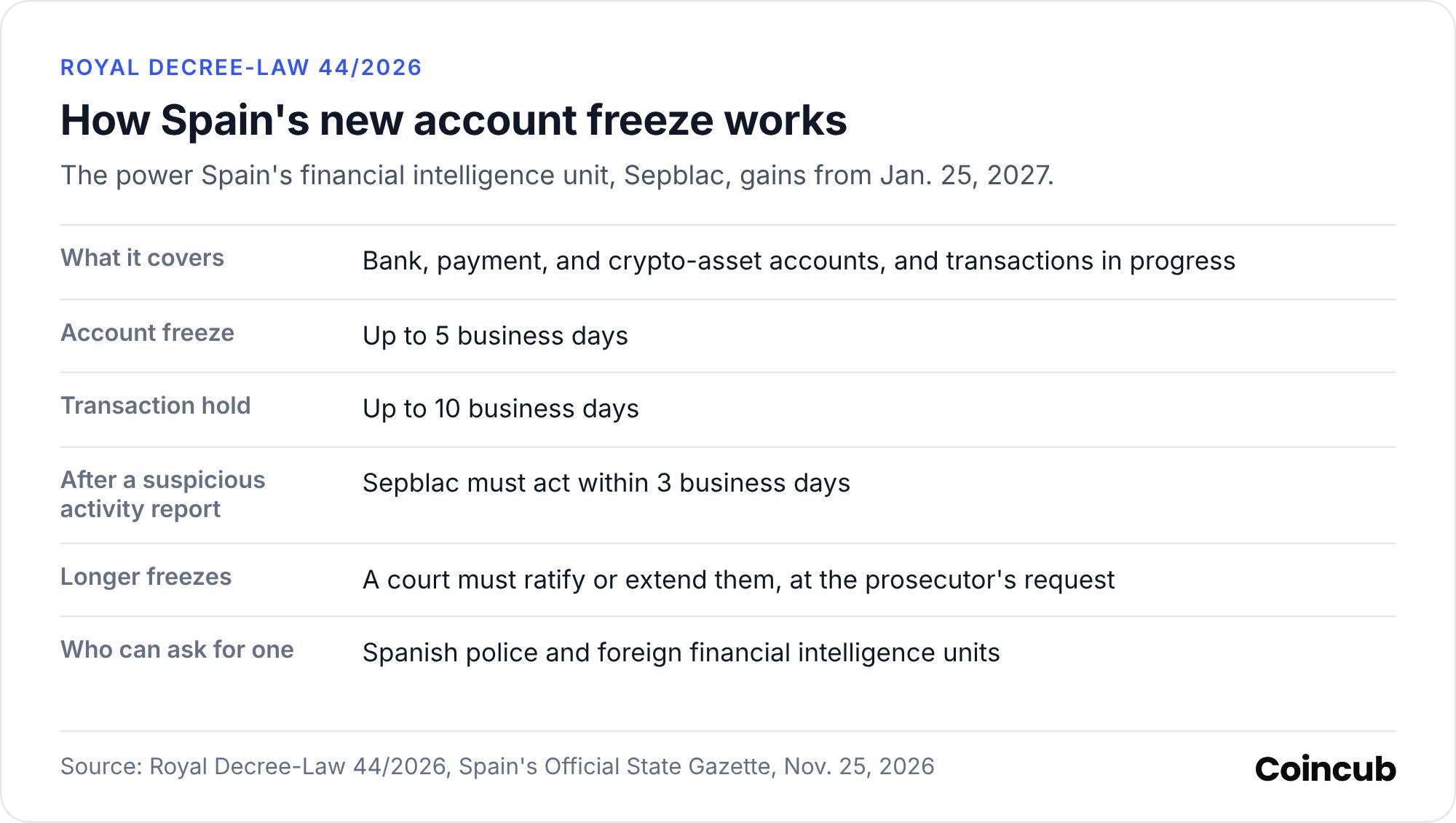
Spain has given its financial intelligence unit, Sepblac, power to freeze crypto, bank and payment accounts for up to five business days without a judge’s approval, starting January 25, 2027.
Spain will let its financial intelligence unit, Sepblac, freeze crypto, bank, and payment accounts without a court order when it suspects money laundering or terrorist financing. The power takes effect on Jan. 25, 2027, and covers banks, payment firms, and crypto platforms operating in Spain.
- Royal Decree-Law 44/2026 adds a new Article 46 bis to Spain’s 2010 anti-money laundering law.
- Sepblac can freeze an account for up to five business days and hold a transaction in progress for up to 10 business days.
- Parliament has 30 days to approve or repeal the decree, and Spain holds a general election on Nov. 29.
What the Spanish decree allows Sepblac to do
The Council of Ministers approved Royal Decree-Law 44/2026 on Nov. 24, and Spain’s Official State Gazette published it the next day. The decree mostly covers consumer credit contracts and the sale of bad loan portfolios. Its sixth final provision amends the anti-money laundering law.
Under the new Article 46 bis, Sepblac can suspend or refuse to authorize a transaction in progress. It can also suspend the use of a bank, payment, or crypto-asset account, or a business relationship. It can do so when there are signs of a link to money laundering or terrorist financing.
Deadlines and duties for banks and crypto firms
When the suspicion comes from a suspicious activity report filed by a regulated firm, Sepblac must issue the suspension within three business days of that report. When it comes from the unit’s own analysis, the decree requires it to act as soon as possible.
Once the time limit runs out, the freeze lapses unless a court ratifies or extends it. The public prosecutor’s office must ask for that before the deadline, and appeals follow Spain’s criminal procedure law.
Ignoring a suspension order counts as a very serious infraction under the anti-money laundering law. The decree shields Sepblac, its managers, and its staff from liability for a suspension, and firms that carry out its orders are covered too. Sepblac can also act at the request of Spanish police and security forces or of foreign financial intelligence units.
Why the Spanish government made the change
Until now, Sepblac could use this power only when another country’s financial intelligence unit asked. The government tied the change to the standards of the Financial Action Task Force (FATF), the global anti-money laundering standard setter. It also said the speed of transfers should not undermine later investigations.
Spain’s FATF mutual evaluation began in 2026, according to Sepblac’s annual report. The provision also transposes Article 24 of Directive (EU) 2024/1640, an EU anti-money laundering directive adopted in May 2024.
What is still unclear
The decree names no crypto platforms. It does not say how exchanges will receive and carry out the orders, and it does not require Sepblac to tell account holders their accounts have been frozen.
Parliament has 30 days to approve or repeal the decree. Spain holds a snap general election on Nov. 29, and while parliament is dissolved, a standing committee of lawmakers can hold that vote.