


 Buy a Licensed Company
 Explore VASP Data
 Talk to an Expert

 Atis Shala
Atis is a senior analyst and community lead with four years of experience in crypto. He has a bachelor from the Rochester Institute of Technology.
Crypto Airdrop Taxes in 2026: When Free Tokens Become Taxable

- United States: Airdropped tokens are ordinary income at their fair market value once the recipient has dominion and control over them, under Revenue Ruling 2019-24. That value becomes the cost basis for a later sale.
- United Kingdom: HMRC does not charge Income Tax on airdrops received without doing anything in return, but tokens received for a service are taxable as income. Capital Gains Tax can apply on a later disposal either way.
- Germany: An airdrop is taxable on receipt only if the recipient performed a service for it, with a €256 annual exemption threshold for this kind of income. A sale within one year of receipt is taxable.
- Australia: A draft ruling released on 19 August 2026 proposes that most individual recipients are not taxed on receipt, with the market value at receipt becoming the cost base.
- Canada: The CRA has no airdrop-specific guidance, so the general rules on business income and capital property decide the outcome.
A crypto airdrop becomes taxable at one of two moments: when the tokens arrive, or when they are later sold. Which moment applies depends mainly on where the recipient is tax resident and on whether the tokens were given for nothing or in return for something the recipient did. The United States taxes most airdrops as income on arrival, while the UK, Germany and, under new draft guidance, Australia generally leave unsolicited airdrops alone until the tokens are disposed of.
Among the crypto launches of 2025, the five biggest airdrops, led by Story Protocol and Berachain, reached about $4.5 billion in combined value at their peak prices. The rules below cover five tax systems as they stand in 2026.
What counts as an airdrop for tax purposes
An airdrop is a distribution of tokens to many wallet addresses, usually free of charge, to reward early users, decentralise ownership or market a new project. HMRC’s manual describes the main types: tokens allocated as part of a marketing campaign, tokens sent automatically because the recipient holds another token, and tokens received after the recipient registers to become eligible.
The central question is whether the recipient gave anything in return, whether that means completing tasks, promoting a project or using a protocol to earn points. A token that simply lands in a wallet tends to be treated more leniently than one earned through a points program or a set of social media tasks.
The size of individual drops makes the classification worth getting right. Uniswap’s 2020 distribution remains the largest on record at $6.43 billion, according to CoinGecko, and the $675 million Lighter airdrop at the end of 2025 entered the all-time top ten. For a recipient in a high tax bracket, the difference between income on receipt and tax only on sale can be a large share of the allocation.
United States: income on receipt
The United States applies the strictest rule of the five countries, and it has done so since 2019.
Dominion and control
Revenue Ruling 2019-24 holds that a taxpayer who receives new tokens through an airdrop has ordinary income equal to their fair market value at the time the airdrop is recorded on the blockchain, provided the taxpayer has dominion and control over them. In the ruling’s own example, a holder receives 25 units worth $50 in total, includes $50 in gross income and takes a $50 basis in the new tokens.
Dominion and control means the practical ability to sell, exchange or transfer the tokens. That test explains a timing wrinkle for tokens held on an exchange. In Chief Counsel Advice 202114020, which looked at Bitcoin Cash from the 2017 hard fork, the IRS said a holder controlling the private key had income at the fork, while an exchange customer had income only once the exchange began supporting the new coin.
Hard forks without new tokens
A hard fork that does not deliver new tokens to the holder creates no income, because nothing has been received. Income arises only when an airdrop following the fork puts new units under the holder’s control, which is why a fork announced in one tax year can produce income in a later one.
Sale and reporting
The income recognised on receipt becomes the cost basis, so a later sale produces a capital gain or loss measured from that value. If the token falls after the airdrop, the recipient can owe income tax on a value that no longer exists and is left with a capital loss that offsets only capital gains and up to $3,000 of ordinary income a year.
Information reporting adds a practical risk. Form 1099-DA, issued by custodial brokers for the first time for 2025 transactions, reports gross proceeds from sales, and income events such as airdrops may not appear on it. Recipients have to track airdrop income themselves, including the date, the token amount and the value when control began.
The open questions
Joshua and Jessica Jarrett argued that Tezos staking rewards are newly created property that should be taxed only on sale. Their first case was dismissed as moot after the IRS refunded the tax, and they filed a new complaint in October 2024. The case concerns staking, but a ruling in their favour would raise the same question for airdrops, which the IRS treats under the same dominion and control logic.
United Kingdom: it depends on what you did
The UK draws its line at the reason the tokens were received.
When Income Tax applies
HMRC’s Cryptoassets Manual says Income Tax may not apply to airdropped tokens received in a personal capacity without doing anything in return and outside any trade involving exchange tokens or mining. Airdrops given in return for a service, or in expectation of one, are taxable either as miscellaneous income or as receipts of an existing trade. Completing promotional tasks in exchange for an allocation can therefore turn a free token into taxable income.
Capital Gains Tax on disposal
A disposal of airdropped tokens may produce a chargeable gain even where no Income Tax applied on receipt, HMRC says. The manual page does not state how the base cost of an untaxed airdrop is set, so recipients should agree an approach with an adviser before filing. The tokens also join the UK’s pooling rules, including the 30-day matching rule, once they are held alongside purchased tokens of the same kind.
Germany: the service test and the €256 threshold
Germany follows the Federal Ministry of Finance letter of 6 March 2025, which applies a test similar to the UK’s.
Taxation on receipt
An airdrop received without any action by the recipient is generally outside the scope of section 22 number 3 of the Income Tax Act, which taxes income from services. Where the tokens are given in return for an action, such as mentioning a project on social media, the ministry treats the receipt as income from a service, valued at market price when received. The ministry also accepts that an element of chance can break the link between service and reward, which is why practitioner guides treat a random allocation after registration as untaxed on receipt.
Income from services benefits from a €256 annual exemption threshold. If total income of this kind, including airdrops and bounties, stays below €256, none of it is taxed, but once the threshold is exceeded the whole amount becomes taxable.
Sale within the year
A later sale falls under the private sale rules in section 23 of the Income Tax Act. Practitioner guides reviewed by tax advisers treat a sale within one year of receipt as taxable and a sale after that as tax-free, the same one-year holding rule that applies to purchased crypto. If the airdrop was taxed on receipt, the market value at that time serves as the acquisition cost; if it was received at no value, the whole sale price counts as gain.
Australia: a draft ruling changes the default
Australia is in the middle of a policy shift, and recipients should watch for the final ruling.
Draft Taxation Ruling TR 2026/D1
The ATO released Draft Taxation Ruling TR 2026/D1 on 19 August 2026, with consultation open until 2 October 2026. Under the draft, taxpayers who do not carry on a crypto trading business and do not receive airdrops as a reward for services are not taxed on the value of the tokens received. The market value at receipt becomes the first element of the cost base, which reduces the capital gain on a later sale.
The ATO’s updated web guidance, revised on the same day, already reflects that approach. Tokens received as a reward for goods or services remain ordinary income, valued at market value in the year received, and that value becomes the cost base.
Edge cases in the guidance
A recipient who never claims a token sent through a phishing link receives no income and acquires no asset. Airdrops connected to a hobby or entertainment activity are not income, and related costs are not deductible. The earlier distinction between established tokens and initial allocation airdrops, which many Australian guides still describe, is not used in the revised page.
Canada: general principles only
Canada has not published a dedicated page on airdrops or forks, so recipients apply the CRA’s general framework for crypto. That framework sorts results into business income or capital gains, depending on factors such as trading frequency, holding periods and organised activity.
Tokens received for services, promotion or as part of a business are likely to be income on receipt, valued at fair market value. Unsolicited airdrops to a passive investor are often treated as having a nil cost, so the full proceeds become a capital gain on sale, half of which is taxable. Capital dispositions are reported on Schedule 3, while business results go on Form T2125. Until the CRA publishes guidance, recipients should document why they chose one treatment and apply it consistently.
How the five countries compare
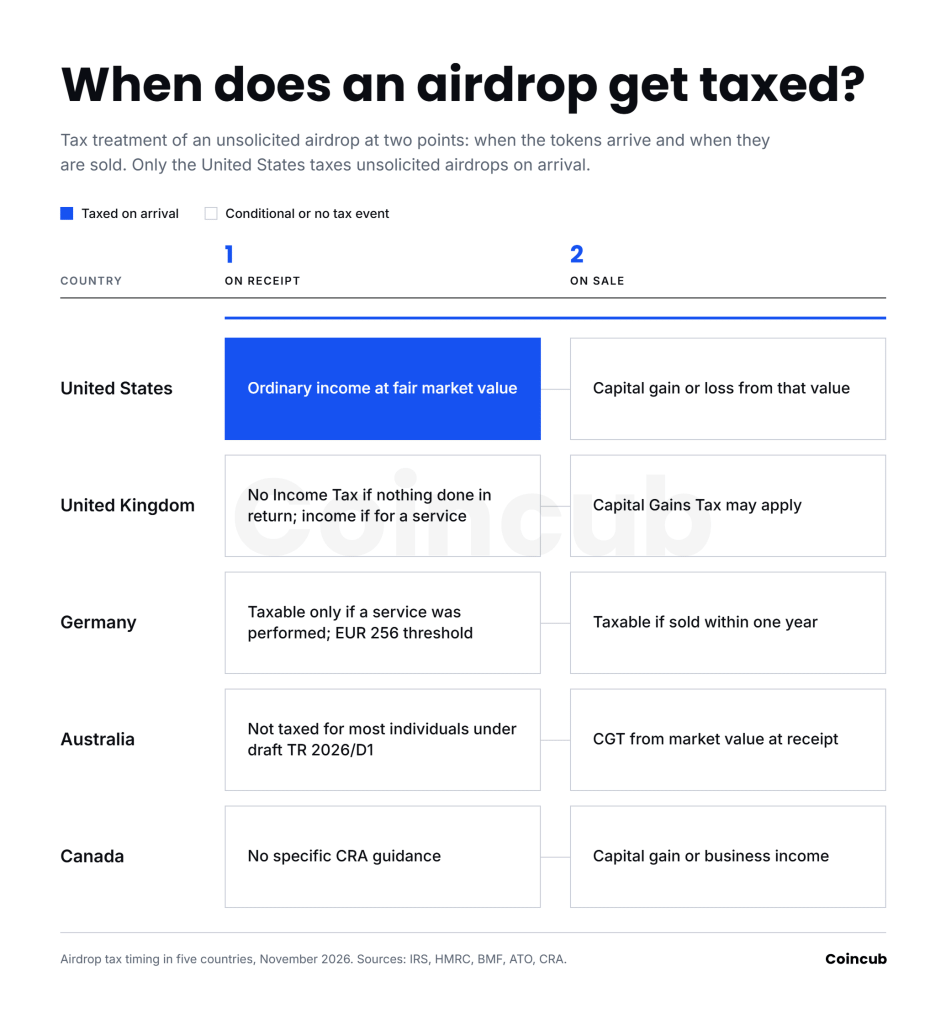
The United States stands alone in taxing an unsolicited token on arrival. Everywhere else, a recipient who does nothing to earn an airdrop usually pays tax only when the tokens are sold.
One airdrop, two tax bills
Suppose an individual investor receives 1,000 tokens without doing anything to earn them, worth 2 units of local currency each when they become transferable, and sells them six months later at 3 each.
In the United States, the investor reports 2,000 of ordinary income in the year of receipt, then a short-term capital gain of 1,000 on the sale, for 3,000 of taxable amounts in total. If the token had fallen to 1 instead, the investor would still owe tax on 2,000 of income and would hold a capital loss of 1,000 that offsets ordinary income only up to the $3,000 annual limit.
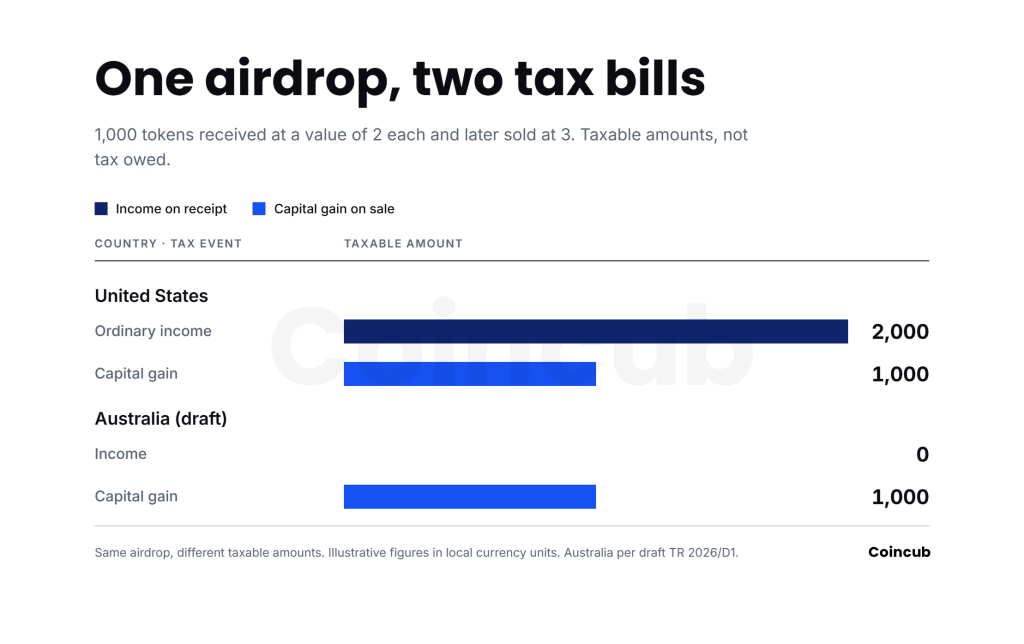
Under Australia’s draft ruling, the same investor reports nothing on receipt. The cost base is 2,000, so the sale produces a capital gain of 1,000, with no CGT discount because the tokens were held for less than 12 months. If the token had fallen to 1, the investor would have a capital loss of 1,000 and no income to report at all. The UK and German results depend on how the base cost of an untaxed airdrop is set, which is the question recipients there most need an adviser to settle.
Practical steps for airdrop recipients
Records decide most airdrop disputes, so the work starts when the tokens arrive.
Value and record each airdrop
Recipients should note the date and time of receipt, the number of tokens, the wallet address, any action taken to qualify and the market price when the tokens became transferable. Thinly traded tokens can be hard to value, and a consistent, documented pricing source matters more than precision to the cent.
Treat unexpected tokens with caution
Unsolicited tokens that appear in a wallet are a common lure for scams, because interacting with them can grant a malicious contract permission to move other assets. Farming airdrops without getting drained requires burner wallets and careful approvals, and the ATO’s phishing example shows that a token never claimed creates no tax event in Australia. Tax rules differ more widely on income than on gains, a pattern the Global Crypto Tax Report 2025 maps country by country.
Frequently Asked Questions (FAQ)
Are crypto airdrops taxable in the US? +
Yes. Under Revenue Ruling 2019-24, airdropped tokens are ordinary income at their fair market value when you gain dominion and control over them. That value becomes your cost basis, and a later sale produces a capital gain or loss.
Do I pay tax on an airdrop I did nothing for in the UK? +
Generally not on receipt. HMRC says Income Tax may not apply to tokens received without doing anything in return, outside a trade. Capital Gains Tax can still apply when you dispose of them.
Are airdrops tax-free in Germany? +
Airdrops received without any service are not taxable on receipt. Airdrops given for an action, such as promoting a project, count as income from services, with a €256 annual exemption threshold. A sale within one year is taxable.
Has Australia changed its airdrop rules? +
The ATO's Draft Taxation Ruling TR 2026/D1, released on 19 August 2026, proposes that individuals who are not traders and who receive airdrops other than as a reward for services are not taxed on receipt.
What if an airdropped token loses value before I sell it? +
In the US, you still owe income tax on the value at receipt and can claim a capital loss on sale. In countries that tax only on disposal, a fall in value simply reduces the gain.