



 Buy a Licensed Company
  Explore VASP Data
  Talk to an Expert

 Dren Hima
 is Head of Research at Coincub, leading research across digital asset regulation, licensing, market structure, tokenization and institutional adoption.
Dren Hima
Dren Hima is Head of Research at Coincub, leading research across digital asset regulation, licensing, market structure, tokenization and institutional adoption.
Canada Stablecoin Act Has a Trust Issue

- The Stablecoin Act received Royal Assent on 26 March 2026 and is still tagged “[Act not in force]”, with commencement left to a Governor in Council order that has not been made and Finance Canada pointing at 2027.
- Section 12 excludes financial institutions, and the Act borrows the Bank Act definition, which covers provincially chartered trust companies. Tetra Trust launched CADD out of an Alberta trust charter on 4 May 2026, six weeks after Royal Assent, through the one structure the statute says it does not reach.
- Section 37 requires high-quality liquid assets that are “provided for in the regulations or, if no regulations are made, approved by the Bank,” so the eligible reserve list may be supervisory discretion at commencement, while CSA Staff Notice 21-333 already names cash, short-term government debt and money market funds with daily coverage.
- The yield ban in section 32 binds the issuer only. MiCA Article 50 also binds crypto-asset service providers, and the OCC is proposing a presumption to catch affiliates. Regulations under the Canadian Act cannot close that gap because section 32 is an issuer duty.
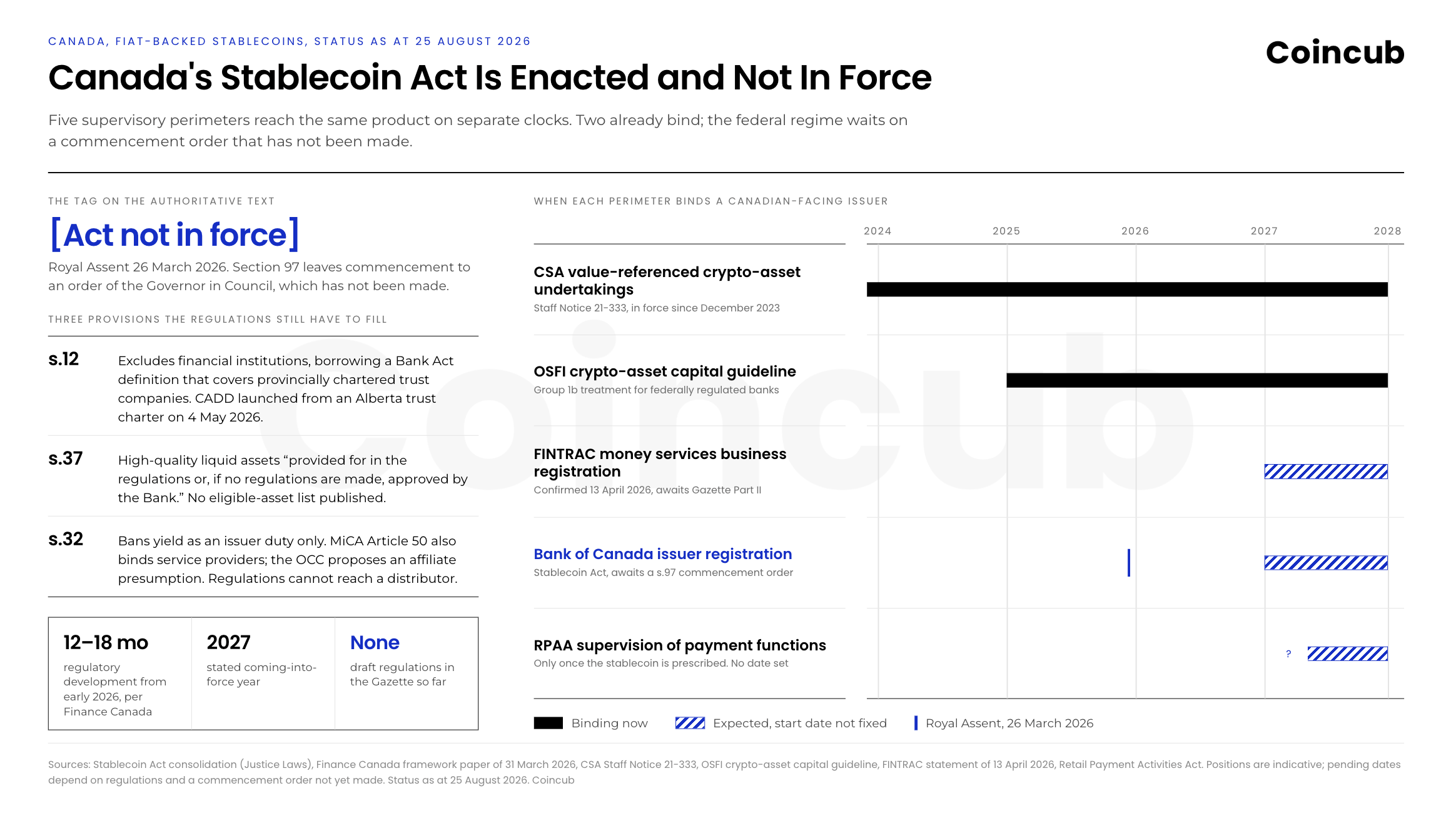
- Bank of Canada registration is one of four perimeters. FINTRAC MSB registration, RPAA supervision of payment functions, CSA value-referenced crypto-asset undertakings and OSFI’s Group 1b capital treatment all run separately, and federal registration confers no right to be listed.
Canada’s Stablecoin Act has been law since 26 March 2026 and nobody can comply with it, because the consolidated text still carries the “[Act not in force]” tag and section 97 hands commencement to an order of the Governor in Council that has not been made. Finance Canada put a rough clock on the wait in the framework paper it published five days after Royal Assent, saying regulatory development would run 12 to 18 months from early 2026 with the regime coming into force in 2027. Some of the law firm coverage has described the supervisory provisions as live from Royal Assent, and DLA Piper’s April note reads that way, but the Justice Laws consolidation is the authoritative text and it says otherwise. Treat the Act as enacted and dormant.
Most of what has been written since March walks through obligations nobody found surprising, since reserves at or above par value, reference-currency high-quality liquid assets, qualified custodians, segregation, at-par redemption and a ban on paying holders yield are where every serious jurisdiction has landed. Reading Canada’s version against MiCA or the GENIUS Act tells you almost nothing you did not already know in 2024. The interesting material sits in three or four places where the drafters left a door open, and the market has already walked through one of them.

Section 12 quietly decides who issues in Canada
Section 12 says, in a single line and subject to the regulations, that the Act does not apply to an issuer that is a financial institution. Section 2 borrows that definition wholesale from the Bank Act, and the Bank Act definition is a great deal wider than “bank.” It covers banks and authorized foreign banks, federal trust and loan companies, cooperative credit associations, insurers under the Insurance Companies Act, securities dealers, foreign institutions, and, in paragraph (e), a trust, loan or insurance corporation incorporated by or under an Act of the legislature of a province.
Paragraph (e) is the one that changes the commercial map, because a provincially chartered trust company is a financial institution for the purposes of the Stablecoin Act, which puts a stablecoin issued out of that charter outside the federal issuer regime before the regime has opened its doors. On 4 May 2026 Tetra Digital Group launched CADD, issued by Tetra Trust Company under Alberta’s Loan and Trust Corporations Act, with a cap table that reads like a roll call of the Canadian financial establishment (National Bank of Canada, Shopify, Wealthsimple, ATB Financial, Shakepay, Purpose Unlimited and Urbana Corporation). Six weeks after Royal Assent, the country’s most institutionally backed CAD stablecoin came to market through the one structure the new federal statute says it does not reach.
None of that is a loophole in the pejorative sense, since a provincial trust charter carries its own capital, custody and supervisory burden, and Alberta Treasury Board and Finance had to approve the arrangement. But it does mean the section 12 regulations are the single most commercially consequential unwritten line in the whole framework. Drafted narrowly, so that only federally regulated institutions escape, they pull every provincial trust structure back into Bank of Canada registration on short notice. Drafted to track the Bank Act definition as written, they leave the fastest route to issuing a Canadian stablecoin running through a provincial trust charter rather than a federal registration file, which is not obviously what Finance Canada meant when it said prudentially regulated institutions are excluded because their broader businesses are already comprehensively regulated.
And the same definition does a second job that has attracted almost no comment, because a qualified custodian under the Act means a financial institution plus any other person provided for in the regulations. Absent a regulation broadening it, reserve custody for registered issuers defaults to that same Bank Act list, which hands the domestic custody market to banks, federal trust and loan companies and provincial trust companies by operation of a borrowed definition rather than by any policy choice debated in public.
The perimeter stops at the constitutional line
The Act reaches only a stablecoin that has, or could reasonably be expected to have, interprovincial or international applications, which is the federal trade and commerce power doing visible work in section 10. Almost any token on a public chain clears that bar without effort, so the practical effect is thin, and the drafting reads as a signal that Ottawa did not claim the whole field. Put section 10 alongside section 11’s exclusion for closed-loop stablecoins (undefined in the Act and left to regulation) and you get a federal perimeter with two soft edges, both of which will be tested by anyone designing a merchant-network token, a domestic settlement instrument for a single provincial market, or a limited-purpose corporate credit.
The reserve rule is a blank the Bank of Canada fills in
Section 37 requires reserves at or above the par value of outstanding coins, composed of reference-currency cash or high-quality liquid assets denominated in the reference currency that are either provided for in the regulations or, and this is the part people skim, approved by the Bank if no regulations are made. Canada has legislated the principle of a high-quality reserve and left the instrument list to a supervisor’s discretion, which means that at commencement the eligible asset universe could be a supervisory conversation rather than a published rule.
CSA Staff Notice 21-333 has, since December 2023, required issuers giving undertakings to hold reserves that equal or exceed the aggregate nominal value of outstanding units on a daily basis, limited to cash, short-term government debt or money market fund securities, held with qualified custodians in segregated accounts, with monthly assurance reports and annual audited financial statements on top. The interim provincial regime is more prescriptive about reserve composition and reporting frequency than the enacted federal statute, which is an odd place for a country to be after passing primary legislation, and it means the firms already operating under a CSA undertaking have a working template that the Bank of Canada does not yet have a published alternative to.
The Bank of England put hard numbers on the same balance sheet in its 22 June 2026 policy statement on sterling systemic stablecoins, capping interest-bearing short-term UK government debt at 70% of backing assets with the remainder in unremunerated central bank deposits (raised from an earlier 60% ceiling), and layering on a temporary issuance guardrail of £40 billion per systemic coin. The OCC’s proposed GENIUS Act rules, published 2 March 2026 with comments closing 1 May, work off an enumerated statutory asset list and add custodian diversification to manage concentration risk. Canada keeps the flexibility to calibrate later and pays for it with a treasurer who cannot yet model the yield on a compliant book, which bites when the reserve spread is one of the few revenue lines the statute leaves open.
Canada does get comparatively demanding at section 46, where an issuer has to produce not only the certified accountant’s statement on financial condition, outstanding supply, reserve composition and fair value but an independent lawyer’s opinion on compliance with the encumbrance and custody provisions, with the financial and reserve data going to the Bank at least monthly. Recurring legal opinions on custody structure are unusual in payments supervision, and they turn account titling, lien and set-off wording, control agreements and bankruptcy analysis into a standing control that has to be re-provable every reporting cycle.
The yield ban has a hole and the regulations cannot patch it
Section 32 stops an issuer from granting or paying any form of interest or yield, directly or indirectly, and the operative word is issuer, since the prohibition never reaches the exchange, the wallet, the broker or the distribution partner. That gap is the entire competitive question for Canadian-dollar stablecoins.
MiCA closed the same gap on the first pass. Article 50 prohibits issuers of e-money tokens from granting interest and then, in its second paragraph, prohibits crypto-asset service providers from granting interest when providing services related to e-money tokens, with a definition of interest broad enough to catch any remuneration or benefit tied to holding period, whether it comes from the issuer or a third party. The United States wrote the narrower version, and the OCC is now trying to fix it by rule rather than by statute, proposing a presumption that an issuer breaches the prohibition where it contracts with an affiliate or related party that then pays yield to holders. Canada has copied the American drafting and, so far, none of the American repair work.
Zelmer and MacKenzie flagged the consequence in a C.D. Howe commentary on 27 January 2026, arguing that the interest prohibition may limit the competitive appeal of Canadian-dollar stablecoins against foreign alternatives whose distributors pay rewards, and pointing at platform yield on USDC as the live example. Their broader argument is that network effects lock in first movers and that the window for a domestic alternative narrows every month foreign coins accumulate Canadian users, which is contestable as a forecast and hard to dismiss as a mechanism.
The drafting problem is harder to argue with, since regulations under the Stablecoin Act cannot reach a distributor’s rewards program when section 32 is an issuer duty and the regulation-making power hangs off the obligations the Act created. Closing the gap here would have to run through securities regulators tightening platform terms and conditions, or through the Retail Payment Activities Act once fiat-backed stablecoins are prescribed as payment functions, and neither route is currently pointed at yield. A registered Canadian issuer that has done everything the Bank asks will still be selling a zero-yield instrument into a market where the alternative arrives with a rewards rate attached.
Every dollar coin sold into Canada is in scope
The Act defines issuing as creating a stablecoin and making it available for purchase, directly or indirectly, by a person in Canada, and Finance Canada confirmed the framework reaches domestic and foreign issuers alike without distinguishing between Canadian-dollar and foreign-currency coins. Circle and anyone else whose token clears through a Canadian venue is therefore looking at a Bank of Canada registration file on top of whatever they hold at home, complete with the section 17 disclosure package covering ownership, group structure, affiliates and third parties, the technology used to issue and redeem, the redemption policy, governance, risk, data security and recovery policies, historical enforcement actions and an application fee.
“Directly or indirectly” is the phrase that will generate the arguments. A global issuer that never markets in Canada, never onboards a Canadian client and never runs a Canadian redemption channel can still find its token listed on a registered Canadian platform through a market maker it does not control, and on the plain words that looks like making the coin available indirectly to a person in Canada. Finance Canada has said the framework is designed for compatibility with the US, EU and Financial Stability Board approaches and contemplates future interoperability or reciprocity arrangements, which is the diplomatic version of conceding the duplication problem. No such arrangement exists, so nobody should build a 2027 plan around substituted compliance that has not been offered.
Sitting over all of it, the Minister of Finance holds a public interest and national security review of applications, with power to impose conditions, issue directives or prohibit an issuer from issuing at all. For a foreign issuer with a complicated ownership chain, that review is a more realistic gating risk than any of the reserve mechanics.
Registration will not get you listed
Finance Canada was explicit that securities regulators keep jurisdiction over exchange and trading of fiat-backed stablecoins on securities exchanges and crypto-asset trading platforms, which leaves the CSA’s value-referenced crypto-asset regime standing after the federal framework commences. That regime has been consequential in practice, since Circle’s undertaking is why USDC trades on Canadian platforms while Tether, the largest value-referenced asset by market capitalization, is not offered by regulated Canadian venues at all. The CSA has also been careful to say that satisfying the conditions is not endorsement, approval, or any indication the asset is risk-free.
The unresolved sequencing question for 2027 is whether a Bank of Canada registration discharges, duplicates or simply coexists with a provincial undertaking, and nothing published so far answers it. Until it is answered, an issuer needs both tracks funded, because federal registration confers the right to issue and says nothing about the right to be listed.
The rest of the perimeter adds three more supervisors to the same product. Section 5 makes an issuer a person dealing in virtual currencies for anti-money laundering purposes, and FINTRAC confirmed on 13 April 2026 that issuers will register as money services businesses dealing in virtual currency in line with regulations still to be published in the Canada Gazette, Part II. The Bank supervises payment service providers performing payment functions in a fiat-backed stablecoin under the RPAA, but only once that stablecoin has been prescribed by regulation. And a federally regulated bank taking exposure to any of this is working from OSFI’s crypto-asset capital guideline, which puts qualifying stablecoins in Group 1b subject to a redemption risk test requiring reserves to equal or exceed the aggregate peg value at all times including under extreme stress, and caps total Group 2 exposures at 5% of Net Tier 1 capital.
The fiat rail arrives first
Payments Canada’s Real-Time Rail by-law and rules come into force today, 24 August 2026, with the system itself targeted to launch in the fourth quarter. Instant, data-rich Canadian dollar settlement lands roughly a year before the stablecoin framework does, and that ordering changes the domestic pitch, because the easiest argument for a CAD stablecoin in 2025 was that account-to-account settlement was slow and batch-bound. By the time an issuer can register with the Bank of Canada, that argument will be weaker for purely domestic account-to-account flows and unchanged for the cases the RTR does not touch, which are programmable settlement, on-chain collateral movement, cross-border legs and anything that needs to clear outside banking hours in a currency other than Canadian dollars.
So build the treasury systems now to let the token ledger and the fiat leg exchange deterministic identifiers and ISO 20022 data, and stop pitching stablecoins against a domestic rail they are about to be able to settle on.
The code sits inside the regulated file
An applicant has to describe the technological systems used to issue and redeem the stablecoin under section 17, including the distributed ledger, the smart contracts and the computer code, which pulls the token stack inside the regulatory perimeter instead of leaving it as a vendor decision documented somewhere in engineering. Section 41 then requires the risk management policy to cover operational resilience, incident response, continuity of critical functions, third-party risk and cybersecurity alongside money laundering and terrorist financing risk, and the two provisions read together make contract-level controls a supervisory question.
The exposure most issuers underprice is administrative privilege. Mint, burn, pause, freeze, blacklist, upgrade and recovery functions are operationally necessary, and each one concentrates the ability to break the reserve relationship into a small number of keys, which is how a fully collateralized coin fails without a single reserve asset losing a cent of value. Canada’s framework is technology-neutral about token standards, so nobody is being pushed toward a particular chain, and every additional chain, bridge and privileged role becomes another item in the section 41 policy and another dependency in the section 49 incident matrix. Multi-chain by default has quietly become a compliance cost that needs a business case behind it.
Enforcement gives all of this some weight, since violations under the Act are expressly non-criminal and administrative monetary penalties are set by regulation rather than by any statutory maximum, which leaves the ceiling on a reserve or reporting failure as one more number that does not exist yet.
What to build while the text is still blank
The statutory obligations are detailed enough that waiting for regulations is a choice to be late rather than a choice to be careful. Reserve segregation, custody documentation and the insolvency analysis behind section 46’s lawyer’s opinion take months and cannot be retrofitted during an application. Daily reconciliation across on-chain supply, the internal ledger and custodian records has to run for a while before anyone will certify it. Section 49’s requirement to notify the Bank without delay of an incident presumes a classification matrix and an escalation path that exist before the incident. And the recovery and resolution policy, which asks how outstanding coins get redeemed and reserve claims get honored if issuance stops, is a day-one design constraint on key custody and successor signing rather than an insolvency afterthought.
Everything the regulations will fix should be a configuration value. Eligible reserve assets, maturity and concentration limits, redemption timing and fees, reporting fields and frequency, incident thresholds and custodian eligibility will all be set by instruments nobody has read, and any of them hard-coded into treasury logic or a token contract turns a regulatory update into an engineering migration. Running a provisional reserve book that is more conservative than the widest plausible eligible list is the cheaper error, since narrowing a portfolio later costs less than rebuilding one.
There is a version of the next eighteen months in which Canada arrives on time and a version in which it does not. The United States is racing its own clock, with the GENIUS Act effective on the earlier of 18 January 2027 or 120 days after final rules, and Comptroller Gould publicly committing to a final rule out by November so applications can be processed in the new year. The UK published its final crypto rules and guidance on 30 June 2026, sixteen months ahead of a regime that applies to firms authorized under FSMA on or after 25 October 2027. Canada has an enacted statute, no draft regulations in the Gazette as of late August 2026, and a stated intention to consult before finalizing, which is difficult to reconcile with a 2027 commencement unless drafts appear this autumn. A firm that spends the wait building the operating model will be adjusting parameters when the rules land, while one that spends it waiting will be building the whole business against a commencement date somebody else picked.
Frequently Asked Questions (FAQ)
Is Canada's Stablecoin Act in force? +
No. It received Royal Assent on 26 March 2026, but the Justice Laws consolidation still carries the "[Act not in force]" tag and section 97 leaves commencement to an order of the Governor in Council. Finance Canada expects the framework to come into force in 2027.
Who has to register with the Bank of Canada? +
Non-financial-institution issuers of fiat-backed stablecoins, domestic and foreign, that make those coins available directly or indirectly to persons in Canada. The Act does not distinguish between Canadian-dollar and foreign-currency coins.
Can a bank or trust company issue a stablecoin without registering? +
Section 12 says the Act does not apply to an issuer that is a financial institution, subject to the regulations, and the Act borrows the Bank Act definition, which includes trust, loan and insurance corporations incorporated under provincial legislation. Those regulations have not been made, so the scope of the exclusion is not final.
What can go into the reserve? +
Cash in the reference currency, or high-quality liquid assets denominated in the reference currency that are provided for in the regulations or, if no regulations are made, approved by the Bank. The eligible instrument list has not been published.
Can a Canadian issuer pay interest on its stablecoin? +
No. Section 32 prohibits an issuer from granting or paying any form of interest or yield, directly or indirectly. The prohibition binds the issuer and does not on its face extend to exchanges or other distributors, unlike MiCA Article 50, which also binds crypto-asset service providers.
Does Bank of Canada registration allow trading on a Canadian platform? +
No. Finance Canada preserved securities-regulator jurisdiction over exchange and trading, so the CSA's value-referenced crypto-asset regime and its issuer undertakings continue to apply to listing and distribution.
When does a stablecoin issuer have to register with FINTRAC? +
Section 5 treats an issuer as dealing in virtual currencies for anti-money laundering purposes, and FINTRAC confirmed on 13 April 2026 that issuers will register as money services businesses dealing in virtual currency in line with regulations still to be published in the Canada Gazette, Part II.









