

 Buy a Licensed Company
  Explore VASP Data
  Talk to an Expert

 Atis Shala
Atis is a senior analyst and community lead with four years of experience in crypto. He has a bachelor from the Rochester Institute of Technology.
Atis Shala
Atis is a senior analyst and community lead with four years of experience in crypto. He has a bachelor from the Rochester Institute of Technology.
Chainlink (LINK) Price Prediction 2026-2030
- Chainlink has evolved far beyond a simple DeFi price ticker. It is now the universal middleware connecting the deterministic world of public blockchains with legacy $150 trillion TradFi infrastructures like Swift and the DTCC.
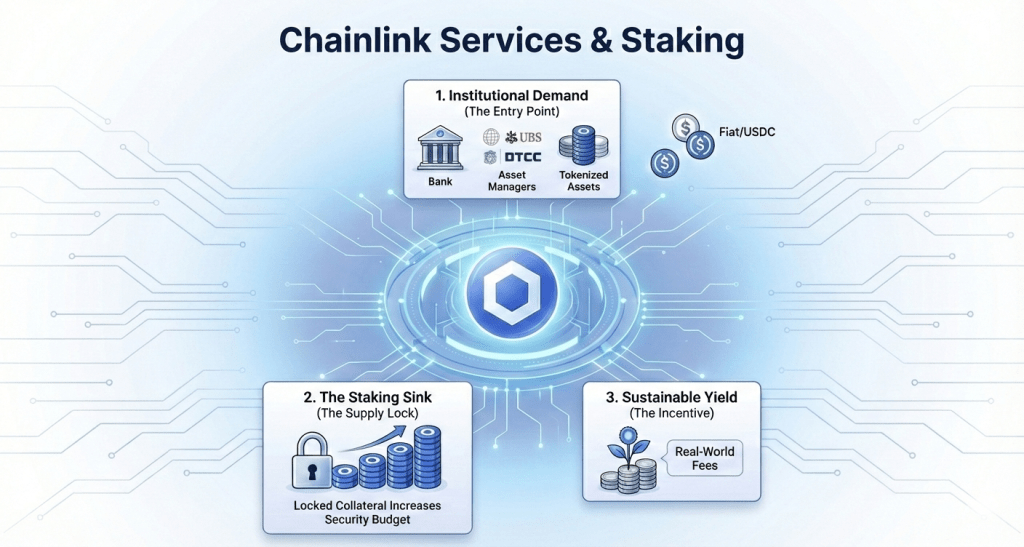
- The Cross-Chain Interoperability Protocol (CCIP) fundamentally changes LINK’s tokenomics. Through “Universal Gas,” institutional users can pay for services in fiat or stablecoins while the protocol automatically converts those fees into LINK, driving constant network demand.
- As the market transitions into the “Settlement Era” dominated by tokenized Real-World Assets (Treasuries, Gold), Chainlink’s Proof of Reserve acts as the mandatory, automated circuit breaker against fractional reserve disasters.
- Staking rewards are shifting from inflationary token emissions to real, sustainable user fees. As the Total Value Secured (TVS) scales, more LINK must be locked by professional node operators as collateral, creating a supply shock against a hard-capped token.
- The network’s true valuation is decoupling from Bitcoin’s beta. Investors must monitor institutional production metrics: Total Value Executed (TVE), CCIP cross-chain message counts, and the migration of derivatives markets to low-latency Data Streams.
- While the base case forecasts significant multi-year price appreciation driven by institutional utility, the primary headwind remains “pilot fatigue” or the risk of banks successfully lobbying for fee-less, private versions of the protocol that bypass the LINK token entirely.
Chainlink in 2026
By January 2026, the cryptocurrency market has fundamentally altered its character. We have transitioned out of the “Casino Era”, dominated by meme coins and yield farming Ponzi schemes, and firmly into the “Settlement Era.” In this new regime, cryptocurrencies are no longer just tickers on a screen; they are the modernized format for the world’s financial collateral.
Chainlink is often misunderstood as merely a “price ticker.” That view is three years outdated. In 2026, Chainlink acts as the standardized interoperability and data verification layer for the onchain economy. It is the middleware that allows a smart contract on Ethereum to settle a transaction using tokenized Gold on a private bank ledger, triggered by data from the New York Stock Exchange. It enables “Onchain Finance”, a state where financial agreements are deterministic, automated, and transparent.
Unlike 2021, where LINK price correlated strictly with Bitcoin’s beta, the 2026 valuation model depends on:

- Adoption Density: The number of dApps and institutions paying for services.
- Staking Economics: The amount of supply locked by node operators to secure high-value feeds.
- Market Regime: The regulatory clarity surrounding Real-World Assets (RWAs).
| Metric | Description |
| Primary Network Role | Decentralized Computing Platform & Global Interoperability Standard |
| Market Positioning | The “HTTP” of the Blockchain Value Web. Neutral middleware connecting private bank chains and public ledgers. |
| Flagship Products | CCIP (Cross-Chain Messaging & Value Transfer)
Data Streams (Low-latency “Pull” Oracles for Derivatives) Functions (Trust-minimized API connectivity) Proof of Reserve (Real-time auditing) DECO (Privacy-preserving data attestation) |
| Adoption Arenas | DeFi: Derivatives, Lending, Stablecoins.
TradFi: Tokenized Treasuries, Carbon Credits, Cross-Border Payments, Corporate Actions. |
| LINK Token Utility | Payment: Used to purchase oracle services.
Security: Staked by nodes as collateral against malicious behavior. Gas: Universal gas token for cross-chain CCIP transactions. |
| Core Investment Thesis | As the world’s $80 trillion economy migrates onchain, Chainlink captures value by securing the data and bridging the liquidity between fragmented markets. |
What Is Chainlink?
To understand why Chainlink commands a monetary premium, you must understand the fundamental limitation of blockchain technology: isolation.
Blockchains are deterministic systems. They are brilliant at agreeing on the state of their own ledger (i.e., Alice sent 5 ETH to Bob). However, they are mathematically incapable of knowing anything outside their own network. An Ethereum smart contract cannot natively “know” the price of Apple stock, the result of the Super Bowl, or whether a Swift payment has settled in a bank account.
This is the Oracle Problem. If a blockchain relies on a single centralized server to input this data, it loses all security properties. If that one server is hacked or bribed, the entire smart contract is compromised.
The Solution: Decentralized Truth
Chainlink solves this by generating “decentralized truth.” Instead of relying on one server, Chainlink utilizes a Decentralized Oracle Network (DON). Dozens or hundreds of independent node operators (run by professional DevOps teams like Deutsche Telekom, Swisscom, and reputable crypto-native firms) fetch the same data point from different sources.
They aggregate this data offchain and deliver a single, verified update onchain. This process ensures:
- Availability: If five nodes go offline, the network still delivers the data.
- Accuracy: Outliers and API errors are filtered out.
- Tamper-Resistance: Corrupting the data would require bribing a majority of independent operators simultaneously, which is mathematically and economically prohibitive.
The Connectivity Problem Chainlink Solves
By 2026, Chainlink has moved beyond just “reading” data. It now solves the Connectivity Problem.
- Data Delivery: Price Feeds and Data Streams ensure markets have accurate pricing.
- Computation: Chainlink Functions allow smart contracts to run complex code offchain (to save gas) and verify the result onchain.
- Interoperability: CCIP allows contracts to send instructions and value across different chains.
In simple terms, if Blockchains are the “computers” of the new financial internet, Chainlink is the “Internet connection” that gives them access to the world. Without Chainlink, a blockchain is just a glorified calculator disconnected from reality. With Chainlink, it becomes an automated financial executive capable of managing real-world value.
Chainlink Tech Stack That Impacts Value
The price of LINK is not driven by magic; it is driven by the utilization of its tech stack. Each module below represents a specific addressable market and a revenue driver for the network.
Price Feeds are the legacy product that secured DeFi Summer. They are “Push” oracles, nodes push updates onchain whenever prices deviate by a certain percentage (i.e., 0.5%). This powers Aave, Compound, and Synthetix.
To capture the massive derivatives market (perpetual futures, options), Chainlink introduced Data Streams. These are “Pull” oracles.
- How it works: Data is kept offchain in a high-frequency buffer. When a trader executes a trade, the transaction “pulls” the precise price data onto the chain in the same block.
- Why it matters: This reduces latency to sub-seconds, enabling high-leverage trading that rivals centralized exchanges like Binance or Coinbase.
- Adoption Signal: Watch for the migration of dYdX, GMX, or other major perp DEXs to Chainlink Data Streams. This dominance in the derivatives layer creates high-frequency fees for the network.
CCIP: The “TCP/IP” of Finance
The early era of blockchain interoperability was essentially a multi-billion dollar lesson in what not to do. Most bridges relied on centralized multisigs, creating massive single points of failure that were systematically dismantled by hackers. High-profile exploits like Ronin, Nomad, and Wormhole proved that the “move fast and break things” approach doesn’t work when you’re moving the world’s money.
Chainlink CCIP fundamentally changes the game by introducing a Risk Management Network. This is a secondary, entirely independent layer of nodes that serves as a dedicated watchdog for the primary network. It doesn’t facilitate the transfers; it simply monitors for anomalies like infinite minting or suspicious activity. If it detects anything off, it triggers an emergency halt. This dual-layer security is the specific benchmark that banks and large institutions require before they’ll even consider moving significant capital onchain.
From a banking perspective, building custom bridges for every emerging blockchain is a logistical nightmare. Institutions need a single, battle-tested interface that can connect their private bank-led chains to the entire public ecosystem, including Ethereum, Optimism, Solana, and Base. CCIP acts as that universal standard, allowing banks to plug in once and reach every relevant network without rebuilding their infrastructure every time a new chain gains traction.
The protocol also introduces a massive shift in how value flows through the LINK token via a feature called Universal Gas. While users can pay transaction fees in assets like USDC for convenience, the network automatically converts those payments into LINK to compensate node operators. This creates a constant, programmatic buy pressure on the LINK token that scales directly with the total volume of cross-chain activity.
Chainlink’s Proof of Reserve (PoR)
PoR is the “circuit breaker” for the tokenized economy. It verifies that onchain tokens are backed by real assets.
- Use Case: A stablecoin issuer claims to have $1 billion in T-Bills. Chainlink nodes connect to the custodian’s bank API, verify the balance, and publish the proof onchain.
- Adoption: By 2026, we expect PoR to be mandatory for major regulated stablecoins and tokenized Gold products (like Paxos or Tether Gold).
- Why it matters: It prevents “paper Bitcoin” and fractional reserve disasters like FTX. It turns “don’t be evil” into “can’t be evil.”
Automation, Functions, and DECO
- Automation: Smart contracts are “asleep” until poked. Automation nodes “poke” them to execute liquidations, rebalance portfolios, or vest tokens. This creates a service economy around network maintenance.
- Functions: This allows developers to connect a smart contract to any API (weather, sports, AI inference) in a trust-minimized way. It opens the door for “AI x Crypto” use cases.
- DECO (Privacy): This is the sleeper giant. DECO utilizes Zero-Knowledge proofs to prove data provenance without revealing the data itself.
- Example: You can prove to a DeFi protocol that you are over 18 and a US citizen without revealing your name or birthdate.
- Institution Impact: Banks need this to transact on public chains without leaking sensitive client trade data to competitors.
The investment thesis relies on the fact that Chainlink is not a single product. It is a platform. A developer uses Price Feeds for value, Automation to trigger the trade, and CCIP to settle it on another chain. This stickiness creates a network moat that is incredibly difficult for competitors to breach.
Institutional Partnerships and TradFi Integration
The most compelling argument for Chainlink’s valuation in 2026 is its “Institutional Moat.” While other oracle projects focus primarily on crypto-native niche markets, Chainlink has spent years building the legal, technical, and compliance rails required by Global Systemically Important Banks (GSIBs). This is no longer a collection of “experiments”; it is a production-grade infrastructure rollout.
The Swift Connection: Bridging the $150 Trillion Gap
In late 2025, the relationship between Swift and Chainlink moved from pilot to pre-production. Swift is the backbone of the global financial system, connecting 11,000+ banks. However, these banks face a massive barrier: they cannot easily interact with the hundreds of public and private blockchains without a standardized interface.
The Solution: Using CCIP, banks can send traditional Swift messages to trigger smart contract actions.
- Significance: Banks do not need to rewrite their legacy backend code. They use their existing Swift infrastructure as an “API” for the blockchain world.
- UBS Pilot: In 2024 and 2025, UBS demonstrated how this allows for the subscription and redemption of tokenized fund shares settled in fiat via the Swift network.
- The Multiplier Effect: If Swift moves even 0.1% of its $150 trillion in annual settlement volume onto CCIP-enabled rails, the “Universal Gas” demand for LINK would create a permanent floor for the token’s value.
Market Infrastructure: DTCC, Euroclear, and the “Golden Record”
In 2025, Chainlink completed a landmark initiative with 24 major financial institutions, including the DTCC (which processes $2 quadrillion annually) and Euroclear.
- Corporate Actions: Processing stock splits, mergers, and dividends currently costs the industry $58 billion per year due to manual errors.
- The Chainlink Solution: Using AI-powered LLMs and the Chainlink Runtime Environment (CRE), unstructured data from issuers is transformed into a “Unified Golden Record.” This record is then distributed across all relevant blockchains via CCIP.
- The Result: A single source of truth that reduces settlement times from “T+2” (two days) to “T+0” (instant). This is the “onchain coordination” that allows tokenized equities to scale.
Digital Transfer Agents and Asset Management
Chainlink introduced the Digital Transfer Agent (DTA) standard in 2025, with UBS as the first global manager to adopt it.
Traditional transfer agents are slow and expensive. A DTA allows an asset manager to handle the entire lifecycle of a fund, from issuance to redemption, onchain, while still keeping the cash settlement in the traditional banking system. Fidelity International, ANZ Bank, and J.P. Morgan’s Onyx have all engaged in similar initiatives utilizing Chainlink’s interoperability standards.
LINK Token Utility and Tokenomics
To evaluate the LINK token as an investment, we must look past the “Partnership” headlines and into the actual supply/demand mechanics. Chainlink Economics 2.0 is designed to create a “virtuous cycle” where adoption leads directly to token scarcity and security.
LINK as a Strategic Asset
The LINK token serves three primary roles in the 2026 ecosystem:
- Payment Unit: Developers pay for Price Feeds, VRF (randomness), and Functions in LINK.
- Staking (Security): Nodes must stake LINK as collateral. If a node operator provides fraudulent data, their stake is slashed (destroyed or redistributed), providing a massive economic disincentive for dishonesty.
- Payment Abstraction (The “Stealth” Demand): Users can now pay for services in other assets (like USDC or ETH). However, the Chainlink Reserve program automatically converts these fees into LINK on the back end. This means institutional users don’t need to hold “volatile” crypto, yet the LINK token still captures 100% of the value.
Staking v0.2 and Beyond
As of 2026, Chainlink Staking has evolved into a sophisticated yield-bearing mechanism. One of the biggest moves they made is that the pool has expanded from its initial 25 million LINK to over 45 million LINK (approx. 8% of circulating supply). When it comes to yield, initially, rewards were funded by token emissions. In 2026, the shift toward User-Fee Rewards is in full swing. Stakers now receive a cut of the fees generated by real network usage. Moreover, a 28-day cooldown period prevents “mercenary capital” from jumping in and out, ensuring that the network’s security remains stable during market volatility.
Supply Dynamics
- Total Supply: Hard-capped at 1,000,000,000 LINK.
- Circulating Supply: In 2026, roughly 727 million LINK are in circulation.
- The “Supply Shock” Thesis: As more institutions require high-value data feeds, the “Security Budget” must increase. This means more LINK must be locked in staking. When you combine a capped supply with a rising “locked” percentage and constant programmatic buy pressure from fee abstraction, the result is a supply-demand imbalance that typically resolves with a higher price.
The next five years will be defined by the transition from hype to institutional utility.
Bullish Drivers
- RWA Narrative Peak: As tokenized Treasuries and Gold become standard collateral in DeFi, Chainlink becomes the “auditor of choice” via Proof of Reserve.
- CCIP as the Standard: If CCIP becomes the default messaging protocol for the Swift network, it enters the realm of “Global Critical Infrastructure.”
- DeFi 2.0 Recovery: The growth of onchain derivatives (perps) requiring low-latency Data Streams creates a high-velocity fee environment.
Bearish Headwinds
- Pilot Fatigue: The risk that banks remain in “testing mode” for several more years without moving to full-scale production.
- Competition: Competitors like Pyth (focusing on low-latency trading) or LayerZero (focusing on simple bridging) could capture specific niches.
- Regulatory Friction: If the U.S. or EU introduces restrictive “middleware” regulations that require node operators to register as money transmitters, the cost of operation would spike.
Adoption Metrics to Watch
A professional investor should ignore “Price Predictions” on Twitter and instead monitor these four Key Performance Indicators (KPIs):
- Total Value Executed (TVE): The cumulative dollar amount of transactions triggered by Chainlink oracles. In late 2025, this hit $27 trillion. Continued growth here is the single best indicator of health.
- CCIP Transaction Count: Monitor the number of cross-chain messages. This is the “bandwidth” of the new financial internet.
- Staking Pool Fill Rate: If the pool is consistently full with a long “waitlist,” it indicates high demand for the token’s yield and a low willingness to sell.
- Active Chainlink Functions: The number of dApps connecting to Web2 APIs. This shows the growth of the broader application ecosystem.
Methodology for the Forecast
Predicting the price of a decentralized infrastructure token like LINK requires a multi-dimensional approach. We avoid simple “hopium” charts and instead focus on three rigorous frameworks that institutions use to value network-based assets.
Scenario-Based Valuation (S-BV)
This is our primary framework. We do not assume a single linear path. Instead, we model three distinct futures:
- The Bear Case: Institutional adoption remains siloed in private ledgers, and CCIP volume stays retail-heavy.
- The Base Case: Chainlink becomes the standard middleware for tokenized funds and stablecoins, capturing a steady percentage of global messaging fees.
- The Bull Case: The “Chainlink Ubiquity” scenario, where CCIP and the Chainlink Runtime Environment (CRE) act as the mandatory bridge for the $150 trillion Swift network.
The Security Budget Heuristic
We also look at the relationship between Total Value Secured (TVS) and token market cap. Historically, as the value secured by an oracle network increases, the value of the collateral (LINK) must arguably increase to maintain the cryptoeconomic cost of attack. If a network secures $1 trillion in value with only $10 billion in collateral, the incentive to corrupt the network rises. To maintain a safe “Overcollateralization Ratio,” the price of LINK must reflect the scale of the value it protects.
Market-Cycle Overlay
Finally, we overlay the 4-year liquidity cycles typical of the crypto market. We assume that while utility provides a price floor, market-wide sentiment and liquidity still dictate the volatility of the ceiling.
Chainlink (LINK) Price Prediction 2026-2030
Summary Forecast Table (Targets in USD)
| Year | Bear Case | Base Case | Bull Case | Primary Narrative |
| 2026 | $9.50 – $14.00 | $28.00 – $42.00 | $65.00 – $85.00 | Institutional Production Phase |
| 2027 | $12.00 – $18.00 | $40.00- $65.00 | $110.00 – $145.00 | The RWA Standard Breakout |
| 2028 | $15.00 – $22.00 | $55.00 – $85.00 | $160.00 – $210.00 | Infrastructure Premium Cycle |
| 2029 | $20.00 – $30.00 | $75.00 – $110.00 | $240.00 – $320.00 | Maturity & Fee-Based Yield |
| 2030 | $25.00 – $45.00 | $120.00 – $180.00 | $450.00 – $600.00 | The Internet of Value |
2026 Price Prediction: The Production Rollout
In early 2026, we see the transition from pilots to production. The launch of 24/5 Equities Data Streams in January 2026 marks the first time DeFi has real-time access to the $80 trillion U.S. stock market.
This outlook hinges on a few core assumptions: that Swift successfully transitions its first group of banks to live CCIP messaging for cross-border settlements, the NYSE begins utilizing Chainlink-verified data for tokenized share settlement, and global macro liquidity remains stable or grows as central banks hold interest rates steady.
Several catalysts could drive significant momentum, including the launch of a LINK Staking ETP in European or Asian markets and the expansion of CCIP into high-speed ecosystems like Solana and Monad. Furthermore, adoption of the Chainlink Runtime Environment (CRE) by a major global asset manager, such as BlackRock or Fidelity, would mark a major milestone.
However, certain risks remain. Regulatory scrutiny in the U.S. regarding the legal status of oracle nodes could create friction, and a broader market correction could still pull down high-beta infrastructure tokens regardless of their individual fundamental progress.
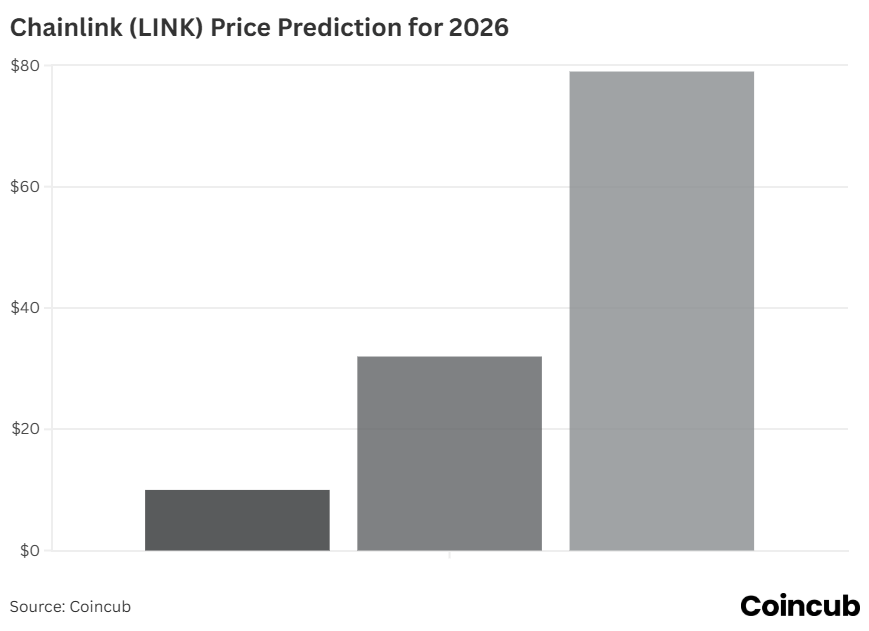
Targets: Bear: $9.50 – $14.00 | Base: $28.00 – $42.00 | Bull: $65.00 – $85.00
2027 Price Prediction: The Chainlink as the RWA Standard
By 2027, RWAs are no longer a sub-sector of crypto. They are simply the way modern finance operates. Chainlink’s Proof of Reserve becomes a global regulatory requirement for all tokenized gold and treasury products.
The transition toward a fully integrated onchain financial system rests on several critical industry milestones. First, the adoption of a Unified Golden Record for corporate actions like dividends and splits by at least three major Financial Market Infrastructures would solve the long-standing issue of data fragmentation. This foundational shift, combined with the integration of low-latency Data Streams, provides the infrastructure necessary to push onchain DeFi derivatives volume past the $10 trillion annual mark. Together, these elements transform the blockchain from a niche experiment into a primary venue for global finance.
The most significant catalyst for this evolution will likely be the launch of the first Cross-Chain Mutual Fund. By utilizing CCIP to manage atomic redemptions across five distinct blockchains, these funds can finally offer the seamless liquidity and settlement speed that traditional finance currently lacks. This isn’t just a technical upgrade; it represents a fundamental shift in how capital is managed and moved between previously siloed networks.
Ultimately, these developments lead to a pivotal turning point for the network’s internal economy. As the volume of institutional activity scales, Chainlink Staking rewards will begin to shift away from token emissions and toward organic user fees. This transition marks the beginning of a sustainable yield era, where the network’s value is directly fueled by its utility and the programmatic “buy pressure” of global cross-chain traffic.
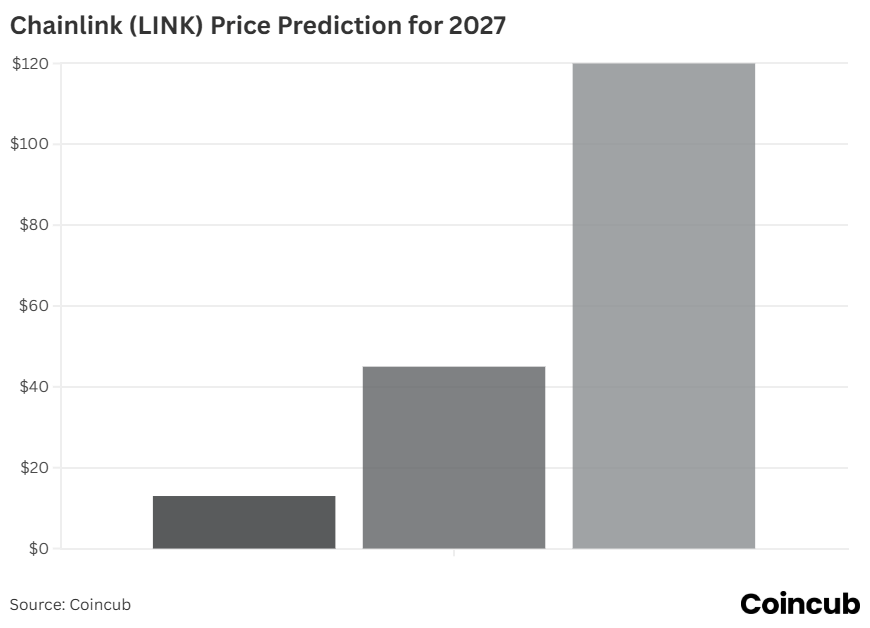
Targets: Bear: $12.00 – $18.00 | Base: $40.00 – $65.00 | Bull: $110.00 – $145.00
2028 Price Prediction: The Infrastructure Premium
Looking at the horizon for 2028, we are likely entering the expected peak of the next major liquidity cycle. By this point, the market’s perception of Chainlink will have shifted fundamentally: it is no longer valued as a speculative “cryptocurrency” but as a piece of critical global utility infrastructure, occupying the same essential status as the Visa network or the Swift messaging system.
This transition is anchored by several core assumptions that have now become reality. Chief among them is the integration of multiple Central Bank Digital Currency (CBDC) projects, which utilize CCIP as the necessary bridge for cross-border interoperability. This success serves as the definitive proof for the “Internet of Contracts” thesis, with automated smart contracts now settling approximately 5% of all global trade, effectively modernizing the backbone of the legacy financial system.
The primary catalyst for this mass adoption is the move toward frictionless enterprise development. In this scenario, a major tech conglomerate, such as AWS or Google Cloud, has natively integrated the Chainlink Runtime Environment (CRE) directly into its cloud console. This allows mainstream developers to build and deploy secure, data-connected workflows as easily as they would launch a standard web application, removing the technical barriers that previously kept blockchain at the margins of business.
From an economic standpoint, these developments converge to create a massive supply sink for the native token. With the network securing a significant portion of global finance, the total amount of LINK staked has surpassed 100 million tokens. This deep level of participation not only secures the protocol but also removes a massive portion of the circulating supply from the market, aligning the token’s scarcity directly with its real-world utility.
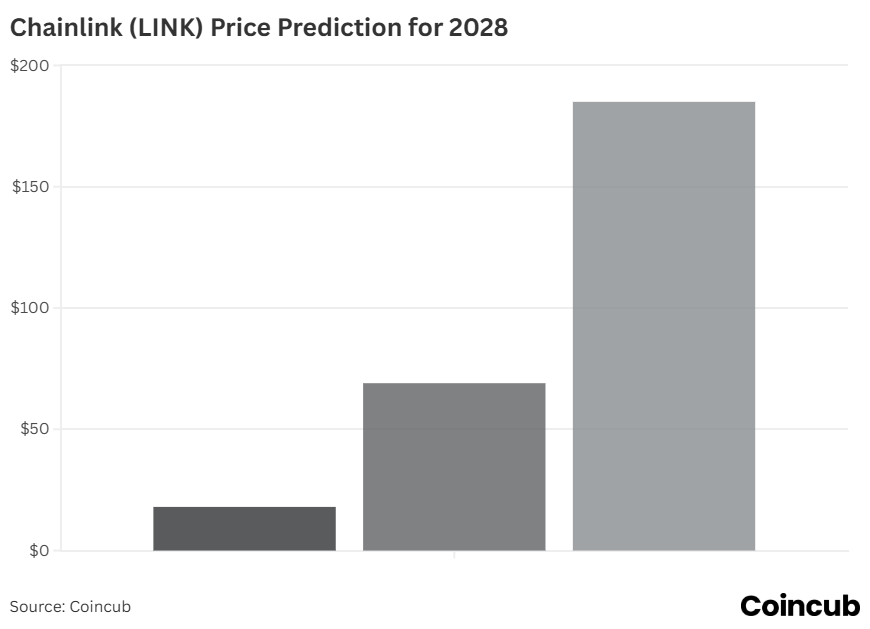
Targets: Bear: $15.00 – $22.00 | Base: $55.00 – $85.00 | Bull: $160.00 – $210.00
2029 Price Prediction: Maturation & Stability
As the market matures into a phase of price efficiency, the primary focus for participants shifts from speculative capital appreciation toward consistent fee generation and yield. In this environment, LINK evolves into a foundational asset within institutional infrastructure portfolios, valued for its role as a reliable, cash-flowing utility rather than a volatile asset.
This transition assumes that the once-rigid boundaries between private bank chains and public blockchains have effectively blurred, with CCIP serving as the connective tissue that links them into a single, cohesive network. Within this unified ecosystem, staking yields have settled into a predictable range of 4% to 6%, fully supported by real-world service fees rather than inflationary rewards.
The momentum for this shift is driven by a new era of global standardization, particularly the adoption of “Smart NAV” for all regulated tokenized funds, which ensures real-time transparency and valuation. This is further accelerated by the rise of programmable payments, where AI agents autonomously utilize Chainlink Functions to purchase onchain services. Together, these developments create a self-sustaining economy where the network’s value is intrinsically tied to the continuous flow of global digital commerce.
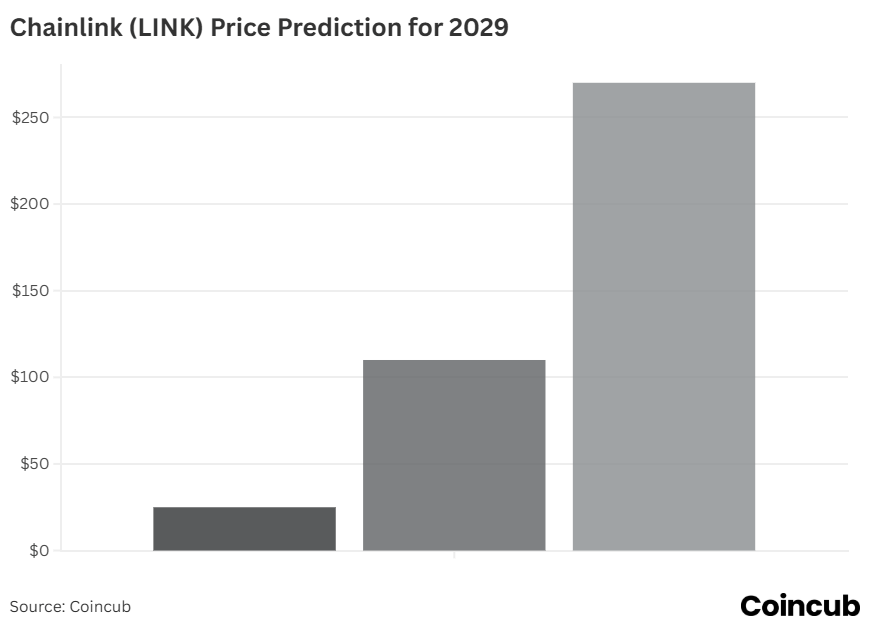
Targets: Bear: $20.00 – $30.00 | Base: $75.00 – $110.00 | Bull: $240.00 – $320.00
2030 Price Prediction: The Global Standard
Chainlink is evolving into the universal translator of value, functioning as the invisible infrastructure of global finance. Just as the world uses TCP/IP to send emails without thinking about the underlying protocol, banks will eventually settle trades using this standard as a matter of course. In this landscape, the majority of global financial data flows through decentralized oracle networks for verification, establishing LINK as a top-five asset backed by a monetary premium for its role in securing the world’s financial systems.
This transition is driven by Chainlink becoming the default interoperability layer for Global Digital Finance standards. As the tokenization of the $300 trillion real estate market reaches critical mass, the industry will rely on these networks for the real-time valuation updates necessary to keep global markets functioning.
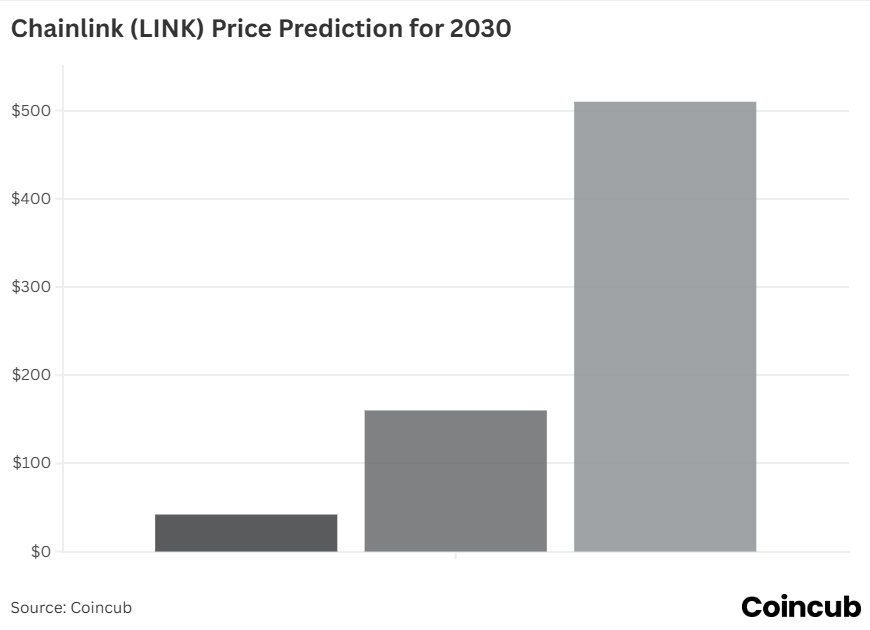
Targets: Bear: $25.00 – $45.00 | Base: $120.00 – $180.00 | Bull: $450.00 – $600.00
What Could Move LINK Faster Than Expected?
Markets often move in non-linear bursts. Several “accelerants” could pull these 2030 targets into the 2027-2028 window:
- The “Burn” Mechanism: If the “Smart Value Recapture” (SVR) and fee-burn mechanisms are more aggressive than modeled, LINK could become net-deflationary as early as late 2026.
- Major Stablecoin Dominance: If a top-3 stablecoin (like USDC) adopts CCIP as its exclusive mint-and-burn bridge, the volume spike would be instantaneous.
- Sovereign Wealth Interest: If national treasuries begin holding LINK to “secure their domestic digital infrastructure,” the demand would be inelastic.
- AI Agent Economy: A breakout in AI agents that require “verifiable data” to operate would create a 24/7, high-frequency demand for Chainlink Functions.
Risks, Red Flags, and DYOR Checklist
We must balance this optimism with a cold assessment of the risks.
- The “Good Tech, Bad Token” Trap: The greatest risk is that Chainlink succeeds as a technology, but the LINK token fails to capture that value. This would happen if institutions successfully lobby for “fee-less” private versions of the protocol.
- Regulatory Overreach: Governments might view CCIP as a “bridge” and regulate it under the same harsh rules as centralized exchanges, stifling adoption.
- Technological Displacement: New cryptographic primitives (like advanced ZK-proofs) might eventually allow chains to “see” each other without a middleware network, though this remains theoretically distant.
The LINK DYOR Checklist
- Monitor CCIP Revenue on Token Terminal.
- Track Staking Pool updates (is it expanding?).
- Look for “Production” announcements, not just “Pilot” or “Collaboration” news.
- Watch for competitors gaining more than 10% market share in the RWA data space.
Final Thoughts on Chainlink: The Infrastructure of the Next Decade
Chainlink has spent the last seven years building the plumbing for a world that didn’t exist yet. In 2026, that world is finally arriving. The convergence of TradFi, AI, and Blockchains requires a neutral, secure, and decentralized coordination layer.
Our forecast suggests that Chainlink (LINK) is uniquely positioned to be that layer. If it maintains its status as the global standard, the move from a “data oracle” to a “universal interoperability platform” will be the defining investment story of the decade. The path will be volatile, but the destination, the “Internet of Value”, remains the most compelling thesis in the crypto space.
Frequently Asked Questions (FAQs)
Is LINK a good long-term hold?
If you believe that the world’s assets will eventually move onto blockchains, Chainlink is the most direct “infrastructure bet” on that outcome.
How does CCIP affect the price of LINK?
CCIP requires fees. Even if users pay in stablecoins, the protocol converts those fees into LINK to reward node operators. This creates programmatic buy pressure.
What is the biggest threat to Chainlink?
“Institutional Inertia.” If banks decide to stick with their legacy, siloed systems for another decade, the growth of the onchain economy will stall.