



 Buy a Licensed Company
  Explore VASP Data
  Talk to an Expert


Best Crypto Launches of 2025 ranks token launches by execution quality, highlighting Canton (best institutional launch), Kaito (best AI-native platform), and Zora (best social launch) as top winners, supported by utility, adoption, and transparent distribution.
Foreword
A token launch is a stress test. Nothing else in crypto forces the same level of exposure, because suddenly, everything has a number attached to it. The market decides what it thinks of the project, but users decide whether it survives.
That is why launches fail in predictable ways. Some projects nail listings and marketing, then you check usage, and it’s a ghost town. Others ship something real but launch like amateurs, so liquidity stays thin, and the token becomes a pain to hold. Then, there’s the third bucket, the projects with decent product and decent distribution that ruin it with bad communication, weird unlocks, or a launch structure that looks like insiders eating first.
Last year made those differences sharper. Regulators got louder, exchanges got pickier, and retail attention got more fragmented. The winning launches were the ones that looked coherent from multiple angles at once. Adoption didn’t look fake. Utility didn’t rely on a future roadmap. The story matched the mechanics, and the token had an actual job.
This ranking tries to capture that. It’s not intended to be a moral scoreboard or a “who has the best tech.” It’s closer to “who entered” the market in 2025 and held up under scrutiny.

Introduction
“Best crypto launches” usually means “what pumped the hardest.” That’s fine if you’re trading headlines, but it’s useless if you’re trying to understand what actually worked.
This report ranks 2025 launches on launch quality. A good launch is the moment a token meets reality. Product, distribution, liquidity, credibility, and how fast the team proves it can execute in public. Price matters, but it’s the loudest signal and often not the cleanest one.
Some of the winners here look obvious after the fact. Others look dull until you inspect the mechanics. The market can price narratives in a week. It takes longer to price execution, and you can usually see it earlier in adoption and behavior than in price charts.
The year 2025 didn’t have one “meta” for launches. It had several. Institutional tokenization, InfoFi and AI tooling, SocialFi, privacy chains trying to be compliance-compatible, DeFi apps hiding gas and bridges, DePIN showing up as real infrastructure, meme economies becoming structured products. If you want a clean picture of what the next cycle rewards, this is a better lens than another list of the most tweeted tickers.
In this report, “launch” refers specifically to a token launch, not the launch of a company, product, or protocol. Many of the most successful crypto-native platforms in 2025, including major prediction markets and financial infrastructure providers, did not issue a token at all and are therefore outside the scope of this ranking. This report does not attempt to measure which products or companies performed best overall. It evaluates how well a token was introduced to the market, and whether that token launch was supported by real utility, adoption, execution quality, and credible delivery.
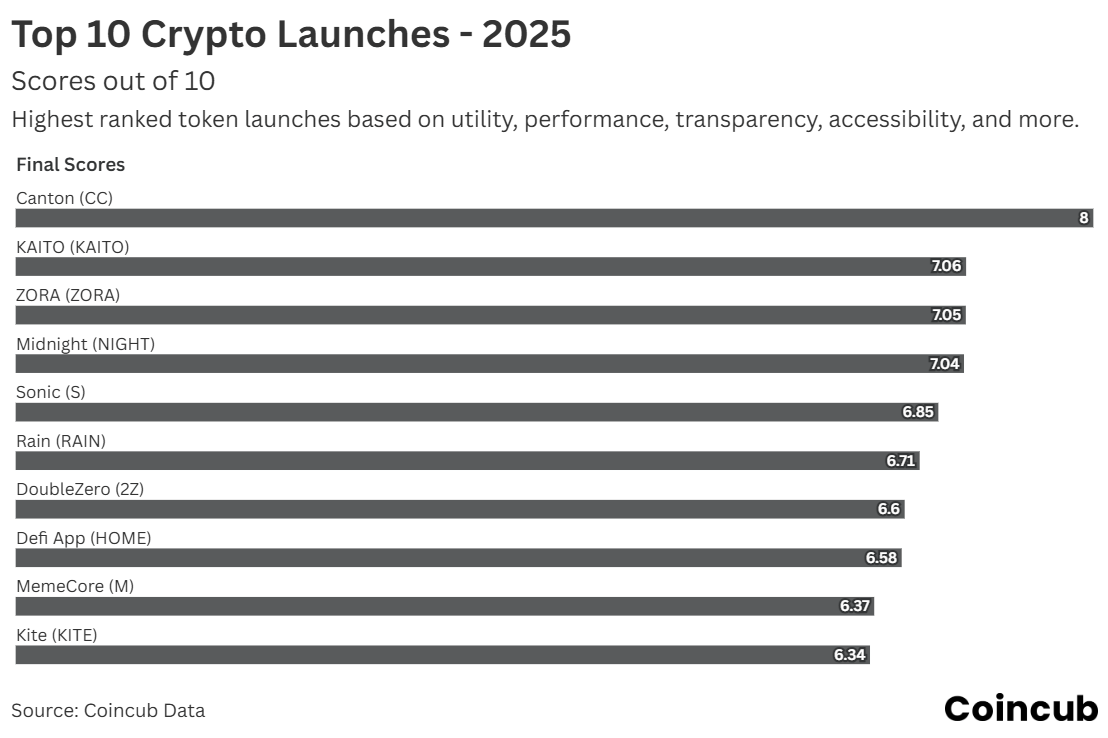
The ranking below reflects the composite outcome of all scoring categories. The differences are narrow by design. This was not a year with one runaway winner, but a cohort where execution quality separated the top tier from the rest.
Methodology
A launch is strong when it creates a token market that’s supported by real behavior. So we scored projects across a handful of categories that cover the full launch surface area: market recognition, adoption, execution quality, product utility, transparency, liquidity access, and a practical view of regulatory posture. Then we weighted them so the ranking doesn’t get hijacked by any single kind of signal.
Adoption and execution carry the most influence because they’re harder to fake for long. Market cap and price matter, but they’re deliberately kept in check because they’re the most sensitive to timing and narrative cycles. Social presence matters because attention is a real asset in crypto, but it’s treated as supporting evidence rather than a foundation.
Utility is where the research work shows up. We didn’t score “utility” by repeating marketing claims. We scored it by looking for shipped features, clear user flows, and evidence that the token links to the product in a way that makes sense. If a token exists and the product is still mostly hypothetical, it doesn’t score like a real launch.
Transparency is treated as a risk filter. Projects get punished when the launch looks designed to hide important information, or when the communication pattern creates unnecessary asymmetry between insiders and users.
Regulatory execution is not a “good person” badge. It’s a practical signal about how a project presents itself for listings, partnerships, and longevity. The MiCA angle is important because 2025 was the year a lot of teams stopped treating compliance as optional, at least on paper. Where teams chose to domicile and publish documentation tells you what kind of market they want access to.
| Category | What it measures |
| Market Cap and Volume Score | Market recognition, valuation |
| Market Cap / Fundraising Efficiency | Value created per $ raised |
| Holders / Active Wallets | Real adoption and distribution |
| Sentiment | Community bullish vs bearish |
| Transparency | Disclosure quality, fairness signals |
| Utility | Shipped product and real usage |
| Price Performance & Potential | Price structure vs ATH/ATL |
| Social Media Presence | Mindshare and engagement |
| CEX Listings | Accessibility and due diligence signals |
| Supply Structure | Dilution risk and clarity |
| RES (Regulatory Execution Score) | MiCA readiness and entity clarity |
Lastly, because this analysis focuses on token launches, projects without a native token were excluded by design, regardless of product quality or market impact. Snapshot of the data was on the first week of January, 2026.
Limitations and Interpretation
This report reflects a snapshot in time. Crypto markets move fast, and many of the indicators used here, including market capitalization, active wallets, sentiment, listings, and liquidity conditions, can change meaningfully in short periods. Rankings and scores should therefore be read as an assessment of launch quality as observed during the data collection window, not as permanent judgments about a project’s future trajectory.
The analysis relies on a combination of on-chain data, exchange data, public disclosures, project documentation, and third-party aggregators. While these sources are widely used across the industry, they are not perfect. On-chain data can be incomplete or interpreted differently depending on methodology. Exchange-reported figures may vary across platforms. Social and sentiment data can be influenced by bot activity, coordinated campaigns, or platform-specific dynamics. Where data was missing or unclear, neutral assumptions were applied to avoid over-penalizing projects, but this inevitably introduces estimation risk.
The scoring framework itself is a model designed by Coincub. Category selection, weighting, and normalization choices reflect our view of what constitutes a high-quality crypto launch in 2025. Adoption, utility, transparency, and execution were deliberately weighted more heavily than short-term price performance or narrative-driven attention. While this approach aims to reduce noise and speculation bias, it is not immune to structural or statistical bias. Different weighting choices, alternative definitions of adoption, or different interpretations of utility could produce different rankings.
Some metrics, particularly those related to utility and regulatory execution, require judgment calls rather than purely mechanical scoring. In those cases, the assessment reflects observable product delivery, documented use cases, and external validation rather than forward-looking promises. Even so, interpretation plays a role, and reasonable analysts may disagree on how certain features or disclosures should be scored.
This report is not investment advice. It does not make recommendations to buy, sell, or hold any digital asset. The rankings are not forecasts of price performance, nor are they endorsements of any project. They are intended to help readers understand how different launches executed across a broad set of practical dimensions, not to predict returns or assess individual risk tolerance.
Finally, crypto markets remain experimental by nature. Projects evolve, fail, pivot, or outperform expectations in ways that no static model can fully capture. This report should be read as a structured analytical lens, not as a definitive truth. Its value lies in how it frames launch quality, trade-offs, and execution patterns, not in treating any score as absolute.
Key Patterns in 2025
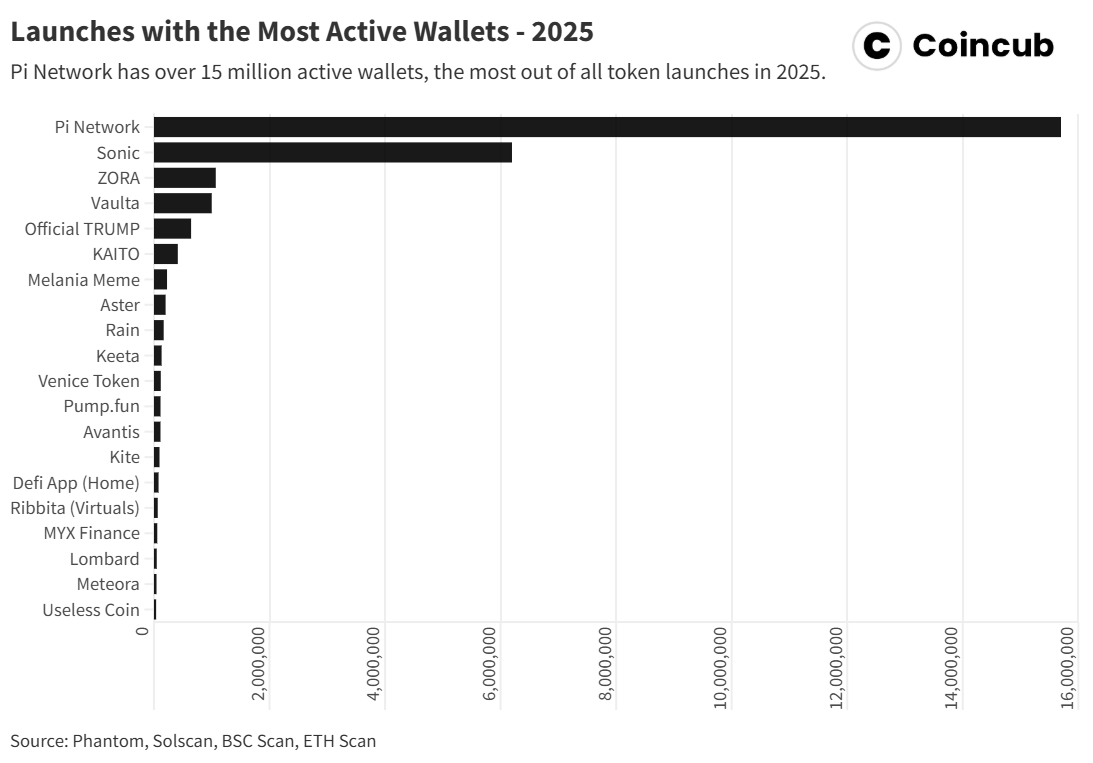
Adoption is the first reality check. Before rankings, narratives, or awards, it helps to see where users actually showed up. Active wallets are not perfect, but at scale they’re harder to fake than volume or social noise. The gap between the leaders and the long tail is not subtle, and it sets the tone for the rest of the report. Though having the most adoption in absolute terms does not translate to having the bigger impact in the industry, as seen with Pi Network.
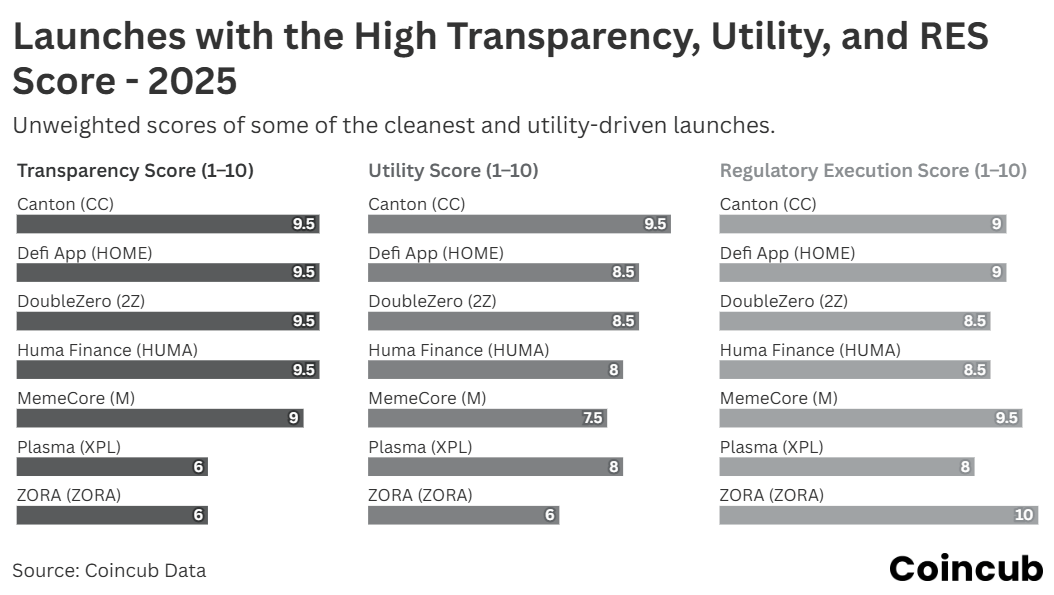
Not all launches fail for the same reason. Some underperform because of timing. Others because the product is thin. Others because execution creates unnecessary risk. When transparency, utility, and regulatory execution line up, the profile looks very different from narrative-driven launches.
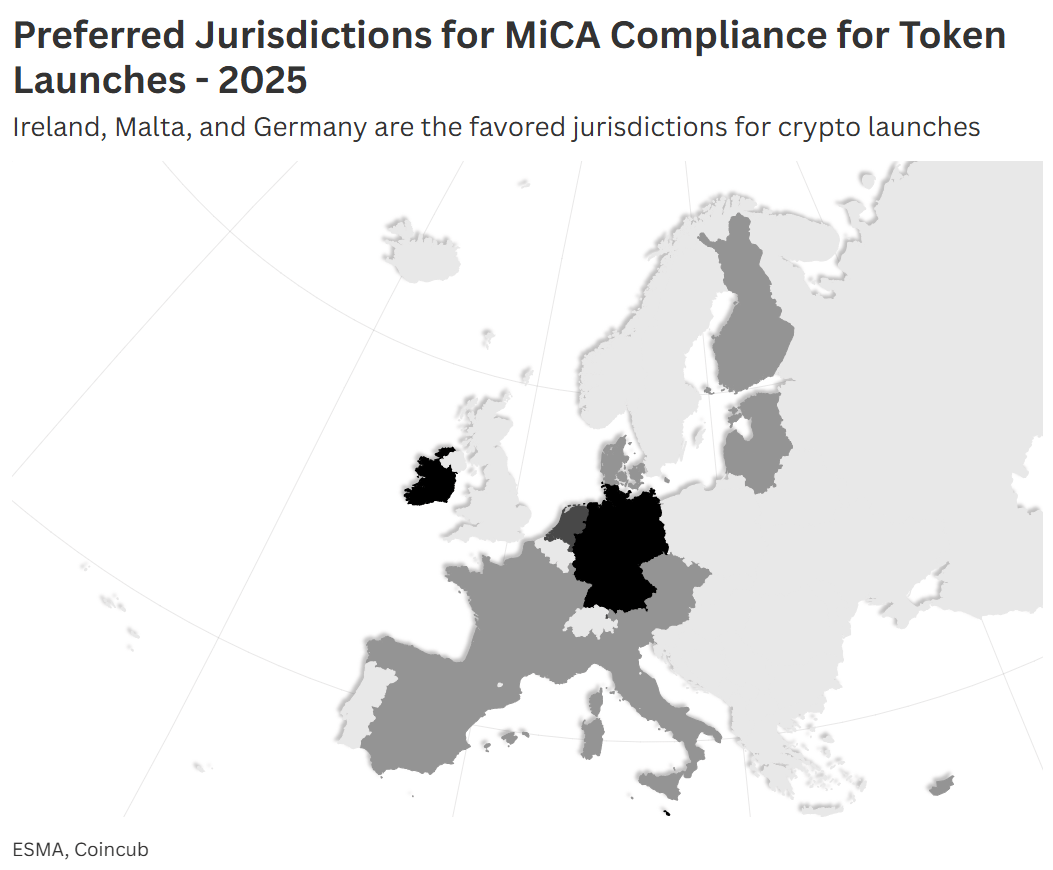
Regulatory execution is not evenly distributed. Launches cluster where access to liquidity, listings, and institutional partners is easiest. The concentration around a small number of EU jurisdictions reflects how teams think about credibility and future access.
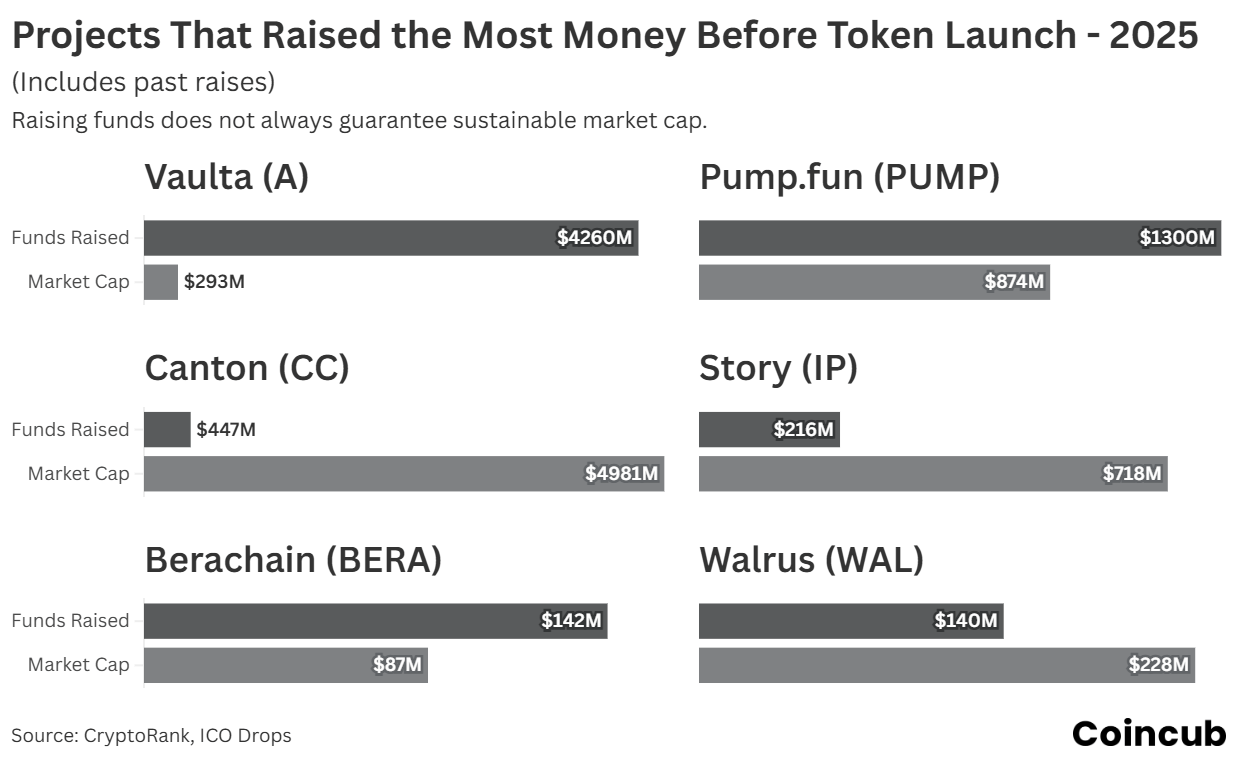
Capital helps, but it doesn’t guarantee launch quality. Some of the most heavily funded projects struggled to translate capital into sustained value. Others did more with less. Fundraising is an input, so never look at it as the end goal.
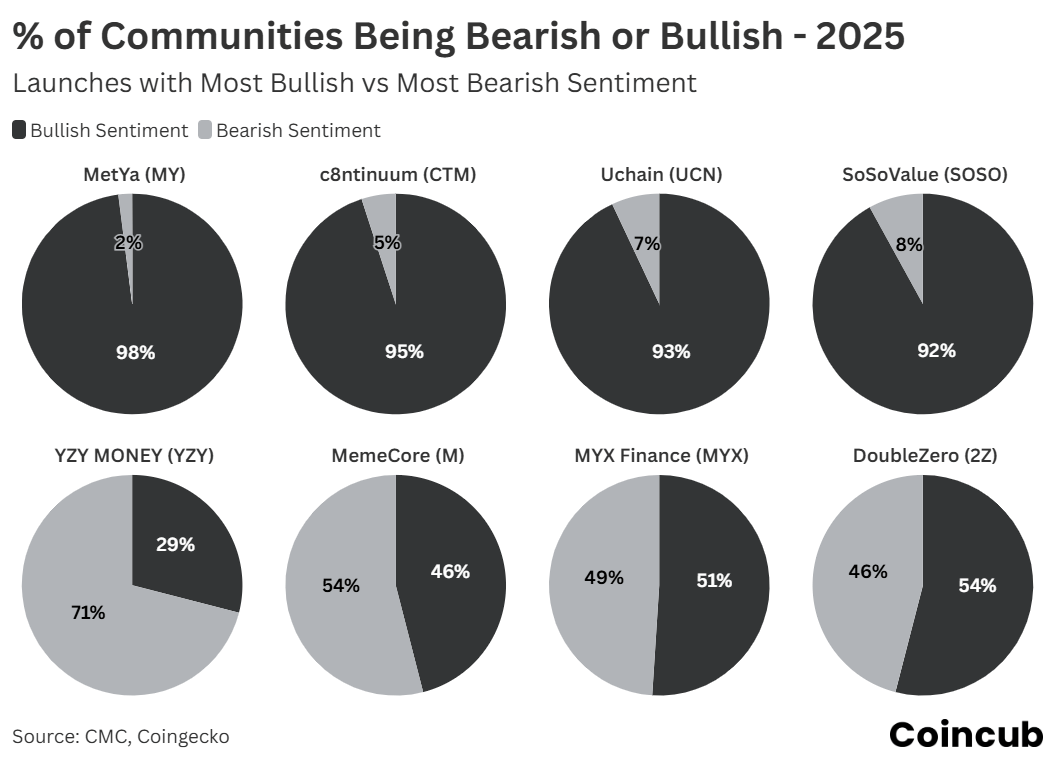
Last but not least, sentiment is informative, and rarely decisive. Highly bullish communities can coexist with weak fundamentals, and strong execution can exist without loud optimism. Sentiment amplifies outcomes, it doesn’t create them. MemeCore, DoubleZero, and Canton did more with bearish sentiment at the time of the snapshot than tokens with astonishingly bullish sentiment that have dead volume levels.
Best Crypto Launches of 2025
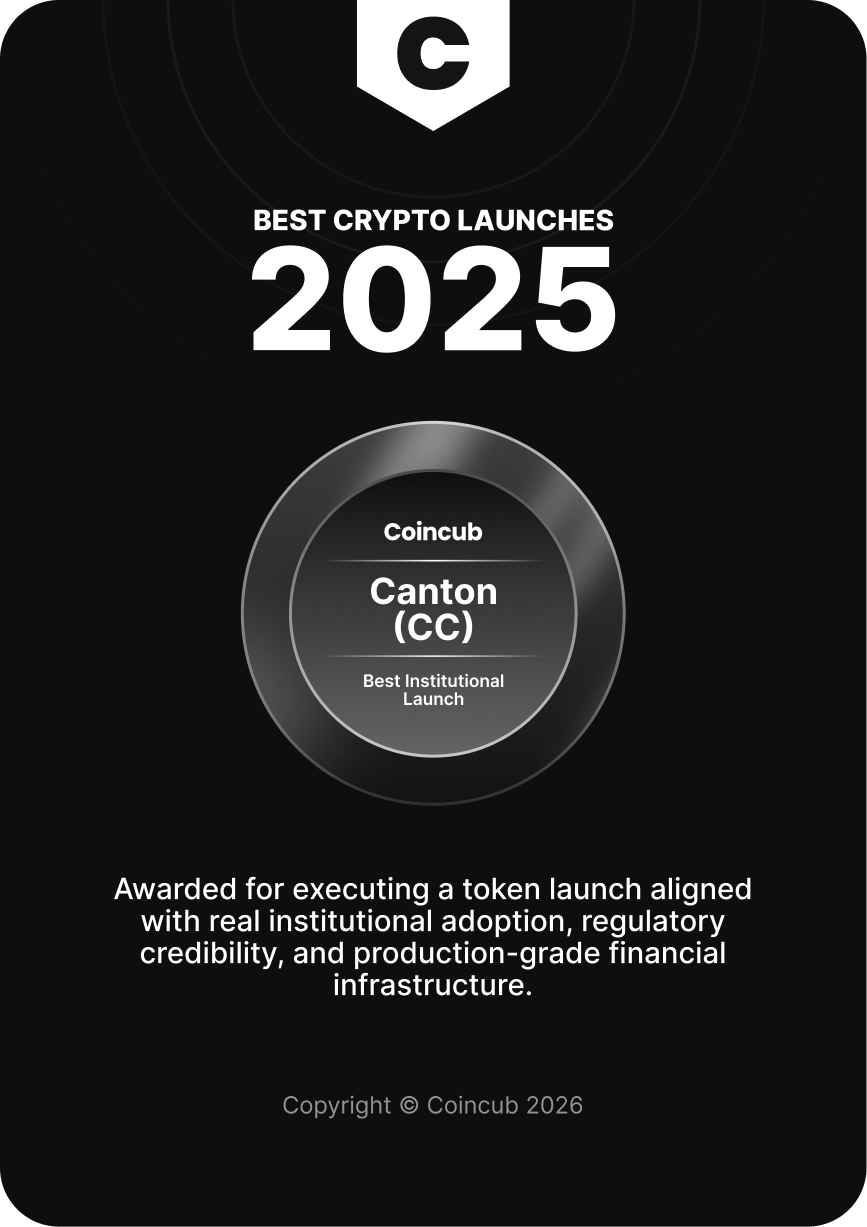
Canton (CC) – Best Institutional Launch
Canton sits in the lane of institutional-grade on-chain finance where privacy is not optional.
The easiest way to understand Canton is that it’s designed for regulated players who want the benefits of shared ledger infrastructure without exposing sensitive position and transaction data to the entire world. That alone filters the user base. You either build for this reality or you don’t.
Canton’s edge is that it doesn’t treat privacy as a cosmetic add-on. It treats it as a core requirement, then builds the network around that requirement. That shows up in who is willing to touch it.
The most important signal in 2025 was the move toward tokenized U.S. Treasuries on Canton through a DTCC-led initiative, with Digital Asset describing it as a step toward a viable production pathway and pilots targeted for 2026.
That’s the kind of thing that only happens when the plumbing people believe the plumbing works.
Broadridge’s Digital Liquidity Repository is another useful anchor point because it shows the type of workflow Canton is trying to capture, which is large-scale institutional repo and collateral movement. Broadridge, today, is a real-world tokenization and settlement layer used by major market participants
On utility, Canton scores high because it’s not pitching a vague future. The network’s core use case is institutions transacting on a shared system without handing their full internal state to competitors.
On transparency and regulatory execution, Canton scores high because its whole go-to-market depends on being taken seriously by serious counterparties. That creates constraints, but it also creates credibility.
Canton takes the top spot because it has credible partners, clear institutional utility, and execution that doesn’t rely on retail hype.
Kaito (KAITO) – Best AI-Native Crypto Platform
Kaito is not trying to be another “AI coin,” but rather be the interface layer for how crypto people find information.
If you look at what crypto actually is day-to-day, its full of fragmented research, social feeds pretending to be signal, a constant fight between real insight and engagement bait.
Kaito’s product direction makes sense because it targets that pain directly. Utility here is not theoretical. If the product works, it becomes sticky. You don’t need users to “believe,” you need them to stop using ten other tabs.
Kaito’s “InfoFi” framing is basically that attention and research have value, so build a system where that value can be surfaced, measured, and rewarded inside the platform, rather than leaking out to random social algorithms.
The token ties incentives to contribution and usage. That’s where Kaito is stronger than the usual “token for token’s sake” model. If the network actually aligns contributors and consumers of research, the token has a job.
Kaito scores well across social presence and listings because it came to market in a way that makes it visible, and it didn’t launch like a ghost project. It also scores well on sentiment because “AI + crypto research” is one of the few narratives that stayed strong even when parts of the market cooled.
Where it doesn’t get a free pass is adoption. Plenty of people talk about AI. The question is whether they make the tool part of their daily workflow. Kaito ranks this high because it looks like one of the few 2025 launches with a credible path to that kind of daily utility.
Zora (ZORA) – Best Social Launch
If social content creates value, people will trade it, and creators should get paid when it trades. That’s the whole bet. Tokenize posts and profiles, turn engagement into an on-chain market, and take the friction out of monetization.
What made Zora a top-3 launch was the distribution reality. Zora benefited from being built where users already were, and it leaned into behavior crypto users already understand: speculation and trading loops.
This is why Zora is a weird project to judge. The critics see casino energy. The supporters see a new creator economy primitive.
The fair view is that it’s both. The utility is not “posting.” The utility is that Zora turns social attention into liquid markets, and in crypto, that’s a real use case, even if it looks ugly to outsiders.
Zora scores high on adoption because social tokenization, when plugged into the right distribution channel, scales faster than almost anything else. It also scores high on social presence because the project lives inside the exact communities that amplify this kind of mechanic.
Launches that win are not always the ones that feel “ethical,” they’re the ones that correctly map crypto user behavior into a product loop.
Midnight (NIGHT) – Best Privacy Chain
Privacy chains often fail for predictable reasons, such as being too hard to build on, too isolated, too ideological, or too detached from compliance reality. Midnight frames privacy as a practical tool for selective disclosure, rather than a total invisibility cloak.
The biggest launch-specific element in 2025 was its distribution structure. Midnight used the Glacier Drop approach and a time-based claim design that signals the team is trying to avoid the worst launch dynamics, the ones where short-term extraction dominates everything else.
Privacy isn’t a use case by itself. It becomes a use case when developers can build applications where users prove something without revealing everything. Identity, compliance, credentials, private business logic, that’s the real market.
Midnight is packaging privacy as an application-layer concept with a developer-friendly framing. If that execution holds into mainnet reality, it becomes one of the more meaningful privacy attempts in years.
Sonic (S) – Best Rebrand
While many still see S as the FTM descendant, it still qualifies as a 2025 launch. But Sonic did something that many don’t, which is admit that tech alone doesn’t create an ecosystem. Incentives, on the other hand, can help.
Sonic pushed a model where applications can capture a large share of the fees they generate, making it easier to justify building and staying. Sonic’s Fee Monetization program is explicitly framed around returning up to 90% of fees to developers, which is a direct attempt to fix “builders leave because they can’t monetize.”
Sonic scores well on utility because it’s building on an existing lineage with existing infrastructure, then trying to reboot incentives to restart growth.
Rebrands carry baggage, and adoption is harder to attribute cleanly. But as a launch event, it worked because it gave the market a concrete reason to look again.
Rain (RAIN) – Best Prediction Markets Protocol
Rain is a decentralized prediction markets protocol built on Arbitrum with cross-chain support. It’s closer to an “Uniswap for prediction markets” than a betting app. Anyone can permissionlessly create markets, trade outcomes, and provide liquidity without relying on centralized operators or restricted jurisdictions.
Rain turns forecasting into a composable on-chain primitive. Markets can be public or private. Public markets can be resolved through an integrated AI oracle system, while private markets allow invite-only forecasting within specific communities, DAOs, or research groups. Disputes don’t rely on a single authority. Resolution flows through a hybrid arbitration model combining AI-based judgments with human oracle oversight.
Secondary trading is built in. Account abstraction reduces friction for non-technical users. Market creation doesn’t require permission or custom engineering.
The $RAIN token has a defined role. A portion of trading volume is used to buy and burn tokens, introducing a deflationary pressure directly tied to protocol usage. Governance is handled through a DAO, giving token holders control over protocol parameters rather than treating the token as a passive fee chip.
You can make the case that other prediction markets performed better, but most of them do not have their own tokens to govern the protocol.
DoubleZero (2Z) – Best Infrastructure Launch
DoubleZero is one of the more intellectually honest launches of 2025 because it targets a problem people complain about constantly, but rarely build against, which is network-level performance and data propagation constraints.
Instead of pretending blockchains live in a vacuum, DoubleZero treats blockchains like distributed systems that depend on real-world networking.
The project’s concept is a dedicated connectivity layer, aggregating underused fiber routes and offering a “fast lane” for blockchain traffic. Coverage describing it as a new physical infrastructure network built around fiber contribution captures the core premise.
This is why it scores well on utility despite being infrastructure-heavy. It’s not asking users to “believe,” but rather offering a service that validators, RPC providers, and latency-sensitive systems can rationally want.
Adoption is harder to measure early because infra usage doesn’t always show up like retail wallets. That’s why it doesn’t land in the top 5 in active wallets. But as a launch, it deserves the spot because it’s one of the few attempts to treat blockchain performance as a physical network problem.
Defi App (HOME) – Best DeFi Onboarding Product
Most people don’t use DeFi because DeFi feels like work. Wallet management, gas, bridging, signing, chain switching, half the experience is friction and fear. Defi App tries to compress that into something closer to a “do the thing” interface.
Its utility score is driven by product intention. Abstract complexity, standardize actions, and make DeFi tasks feel like app actions instead of protocol rituals.
HOME’s role makes sense if it’s genuinely used as the unit that powers transactions and incentives inside the app. That keeps the token from being a passenger.
Onboarding apps live and die by sustained usage. It’s not enough to launch well. The question is whether users stick when the rewards fade and the novelty drops.
Still, as a 2025 launch, HOME belongs in this list because it’s one of the few that treats user experience as the main product rather than a mere afterthought.
MemeCore (M) – Best Meme-Native Ecosystem
MemeCore is a real attempt to industrialize meme coin behavior into a structured ecosystem.
That can sound ridiculous. The market also keeps proving that memes are a major distribution engine for liquidity and attention.
MemeCore tries to capture that by building a chain and incentive system specifically around meme creation and meme economies, with a model that channels value back into ecosystem incentives rather than letting every meme token burn out immediately.
It scores well on social presence because meme projects either win mindshare or die. It also scores well on utility relative to other meme launches because it’s not only a token, it’s an attempt at an ecosystem design.
Where it stays lower-ranked is transparency and long-term trust risk. Meme ecosystems always live under the shadow of insider advantage, short-term extraction, and narrative fragility.
Kite (KITE) – Most Futuristic Launch
Kite represents a 2025 pattern, with projects trying to build for agent-based usage rather than human-based usage.
The core bet is that AI agents will transact, route payments, purchase compute, and interact with services autonomously. If that becomes true, “blockchain as an agent settlement layer” stops sounding sci-fi.
Kite’s utility is forward-looking, but it’s not empty. The project’s framing around agent identity and autonomous interaction is the reason it lands in the top 10 instead of being dismissed as narrative-only.
The proof of value is still emerging. The market can get excited about the idea, but sustained adoption will depend on whether developers actually build agent workflows that need an on-chain layer.
Kite is one of the few launches that tried to design for what the next usage mode could look like.
Honorable Mentions
These next tokens are still part of the 2025 story. In another year, any of them could have made the cut. They fell short here because the top 10 were stronger on the highest-impact signals, usually adoption, utility delivery, and overall execution coherence.
Plasma (XPL)
Plasma looks like an infrastructure-first launch, with less theater and more build. That tends to rank well on utility if the product is concrete, but it can lag on the visible “proof” metrics early on because infra adoption doesn’t always show up as big holder counts or loud communities. Plasma sits in that zone. Strong concept, credible direction, still fighting for the kind of public traction that pushes a project into the top tier.
Huma Finance (HUMA)
Huma is one of the more serious attempts at building DeFi that touches real economic activity instead of looping the same on-chain games. That’s a good starting point. The reason it lands in honorable mentions is that the launch didn’t overpower the cohort on enough dimensions at once. It shows utility intent, but it didn’t match the top group on the combination of adoption signal strength, market accessibility, and clean execution optics.
Official Trump (Trump)
TRUMP is pure distribution. It proves something important about 2025. Attention is still the strongest on-ramp in crypto, even when the fundamentals are thin. The model doesn’t reward that by default. It treats it as one signal among many, because attention is easy to get and easy to lose. TRUMP lands here because it dominated mindshare, but it doesn’t look like a “best launch” when you judge it on utility, transparency, and long-run execution shape.
Lombard (BARD)
Lombard has real strengths, but they’re not the kind that scream on day one. It shows up as a solid contender in parts of the scoring framework, but it didn’t outperform the top 10 across the categories that move the final ranking most. That usually means one of two things. Either the product is real but the launch wasn’t loud or accessible enough, or the market side worked but the execution story didn’t land cleanly. Lombard sits closer to that second bucket.
Aster (ASTER)
Aster looks like one of those launches that can age well. The reason it didn’t break into the top 10 is that the launch profile wasn’t dominant enough in the areas the model cares about most, especially adoption quality and the clarity of the product-token link. It’s not a weak project. It’s a project that didn’t beat the best cohort on the metrics that decide “top 10” versus “good launch.”
Closing Remarks: What 2025 Tells Us
Over the past two years, the crypto launch landscape has undergone a subtle but significant evolution. Our 2024 report highlighted a cohort of projects that managed to attract attention and liquidity in a market environment dominated by narrative and volatility. Back then, adoption signals were noisy, and utility often meant “market participants showing up.”
In contrast, the 2025 cohort, as captured in this report, reflects a maturing perspective on what it means to successfully launch a token. Adoption in 2025 did not always present itself as frenetic on-chain volume or viral social momentum. Instead, it showed in tangible use cases, real user engagement beyond the hype window, and thoughtful alignment between token design and product execution. This cohort reflects a crypto ecosystem that has learned, in part, from the limitations of earlier cycles.
For example, projects that prioritized regulatory clarity and transparency up front were not just tick-box compliant; they were easier for exchanges, partners, and serious users to engage with. Launches that tied the token to actual product usage found audiences that stuck around. Initiatives that built around existing behavior, whether it was creating social tokens on a user’s own content or embedding stablecoin rails into everyday payments, saw deeper engagement than projects that debuted with abstract future promises.
Social reach, attention, and sentiment remain important, but in 2025 they became amplifiers rather than substitutes for execution. In other words, narrative alone could no longer mask a lack of credible delivery.
Looking ahead, we expect this trend to sharpen further in 2026 and beyond. Successful launches will likely fall into a few patterns:
- They will integrate product and token utility more seamlessly, so the token’s economics are obvious from the first active user experience.
- They will demonstrate adoption through real user behavior, not just reward mining or air-drops.
- They will treat regulatory readiness as part of the launch strategy, not an afterthought.
In many ways, the Best Crypto Launches 2025 Report reads like a transition year, with part experimental frontier, part structural refinement. For stakeholders evaluating new launches, the key lesson is that the market rewards consistency of purpose as much as bursts of attention. Projects that balance adoption, utility, and credibility will dominate future narratives.

 Canada
  UAE
UAE 








