



 Buy a Licensed Company
  Explore VASP Data
  Talk to an Expert

 Atis Shala
Atis is a senior analyst and community lead with four years of experience in crypto. He has a bachelor from the Rochester Institute of Technology.
Atis Shala
Atis is a senior analyst and community lead with four years of experience in crypto. He has a bachelor from the Rochester Institute of Technology.
Hong Kong vs. Singapore: The Battle for Asian Crypto Dominance

The global cryptocurrency landscape is undergoing a decisive shift toward the East. While North American and European regulators struggle with fragmented frameworks or litigious enforcement, Asian financial centers have chosen a different path. They are building the infrastructure for the next decade of finance through clear, codified, and institutional-grade regulation.
Does Asia Matters for Crypto?
Asia no longer simply participates in the crypto market; it anchors it. According to the latest data from early 2026, the Asia-Pacific (APAC) region accounts for nearly 45% of global onchain transaction value. This dominance stems from a unique combination of high grassroots adoption in countries like India and Vietnam and sophisticated financial infrastructure in hubs like Hong Kong and Singapore.
In this region, policy drives technology. Unlike the “move fast and break things” ethos of Silicon Valley, Asian crypto adoption follows the lead of central banks and securities commissions. When a regulator in this region provides a clear rulebook, capital follows immediately. For global firms, Asia offers something that remains elusive in the West: predictability.

Hong Kong and Singapore now stand as the primary gatekeepers of this capital. They compete not just for trading volume, but for the right to define the standards for tokenized assets, stablecoins, and decentralized finance.
A Tale of Two Financial Hubs
To understand the current rivalry, one must look at the financial DNA of these two cities. Both are former British colonies with common law roots, yet their strategic priorities differ sharply.
Hong Kong: The China-Facing Powerhouse
Hong Kong functions as the primary offshore financial gateway for Mainland China. Despite China’s domestic ban on crypto trading, Hong Kong has successfully positioned itself as a “regulatory sandbox” for the mainland’s future crypto ambitions. The city’s identity shifted significantly post-2020. It transformed from a restrictive environment into a proactive “Virtual Asset Hub,” aiming to reclaim its status as Asia’s premier financial center through Web3 innovation.
Singapore: The Global Fintech Neutral Ground
Singapore markets itself as the “Swiss of Asia.” Its reputation rests on neutrality, a robust institutional framework, and a long-term focus on fintech and electronic payments. Singapore does not rely on a single large neighbor for its liquidity. Instead, it serves as a global node connecting Western capital with Southeast Asian growth.
Regulatory Philosophy: Control vs. Curation
The most visible difference between the two hubs lies in how they manage risk. This fundamental divergence in philosophy is a key driver of their respective ecosystems.
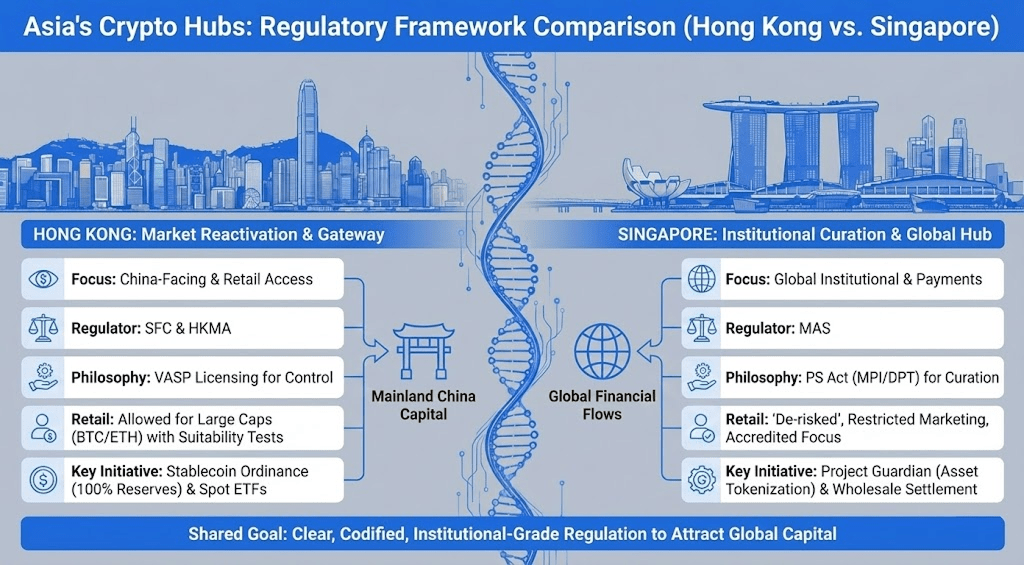
Hong Kong’s Approach: Market Reactivation
Hong Kong uses its licensing regime as a tool for market reactivation. The Securities and Futures Commission (SFC) mandates that every centralized exchange operating in the city must obtain a Virtual Asset Service Provider (VASP) license.
- Retail Signal: Hong Kong signaled its “all-in” stance by allowing retail investors to trade large-cap assets like Bitcoin and Ethereum.
- Separation of Duties: The framework strictly separates regulated exchanges from non-regulated OTC (Over-the-Counter) desks, forcing a clear distinction between institutional-grade platforms and high-risk operators.
Singapore’s Approach: Institutional Curation
The Monetary Authority of Singapore (MAS) adopts a “curation” mindset. Following the collapses of 2022, Singapore moved away from general retail hype.
Institutional First: MAS focuses on “responsible innovation.” It favors projects that solve real-world financial problems, such as cross-border settlements or tokenized government bills.
Consumer Protection: Singapore prohibits crypto firms from advertising in public spaces. This policy aims to protect retail users from speculative manias while keeping the door open for “Accredited Investors” and institutions.
Who Can Actually Use Crypto?
Accessibility determines the depth of a market. Here, the two cities offer contrasting experiences for the end-user.
Retail Access in Hong Kong and Singapore
In Hong Kong, retail users can access licensed platforms like HashKey and OSL. These platforms must perform rigorous “suitability assessments” on every user, but once approved, the retail participant enjoys a protected environment with mandatory insurance for custodial assets.
Singapore, however, increasingly “de-risks” the retail segment. While it is legal to hold crypto, MAS rules make it difficult for exchanges to offer high leverage or aggressive incentives to the general public.
Stablecoins and Custody in Hong Kong and Singapore
Hong Kong’s Monetary Authority (HKMA) implemented a strict stablecoin ordinance in August 2025. It requires issuers to maintain 100% reserve backing in highly liquid assets. As of January 2026, the first batch of licensed HKD-pegged stablecoins is entering the market, providing a bridge for mainland capital.
Singapore’s framework under the Payment Services Act is equally rigorous but focuses on “Single Currency Stablecoins” (SCS). MAS requires issuers to maintain a minimum base capital of S$1 million and ensures that users can redeem their tokens at par within five business days.
Institutional Adoption and Capital Flow
The “smart money” is no longer on the sidelines. Large-scale banks and asset managers are integrating blockchain technology into their core operations.
- Hong Kong: The city saw a peak in venture capital (VC) funding in December 2025, reaching $332 million in a single month. Firms like ZA Bank and HSBC have already launched pilots for tokenized real-world assets (RWA), including green bonds.
- Singapore: Institutional giants like DBS Bank and Standard Chartered dominate the landscape. The MAS “Project Guardian” has successfully transitioned from a lab experiment to a real-world settlement infrastructure involving JPMorgan and Fidelity.
| Metric | Hong Kong (Jan 2026) | Singapore (Jan 2026) |
| Licensed Exchanges | 11 (VASP) | 33+ (MPI/DPT) |
| Primary Focus | Retail/Institutional Bridge | B2B/Institutional/Payments |
| Stablecoin Rules | HKMA Ordinance (Aug 2025) | PS Act (SCS Framework) |
| Top Institutional Play | Tokenized Bonds/ETFs | CBDC Pilots/Wholesale Settlement |
Web3, Startups, and Builder Ecosystems in Asia
A crypto hub requires more than just traders; it requires developers.
Hong Kong leverages its government-backed Cyberport and Science Park to attract talent. By offering significant grants and residency programs, the city has seen a 30% increase in Web3-related startups over the last 18 months. These firms often focus on the “infrastructure layer”; the plumbing that connects traditional finance to the blockchain.
Singapore remains the regional leader in developer density. The city-state’s established tech ecosystem makes it the natural home for DeFi protocols and Web3 gaming studios. However, the high cost of living has caused some early-stage startups to move their back-office operations to Dubai or Ho Chi Minh City while keeping their headquarters in Singapore for the legal protection.
Political Risk and Long-Term Stability in Asia
Investors optimize for predictability. This is where the competition becomes most nuanced.
The China Factor: Hong Kong’s greatest strength is also its greatest perceived risk. Its proximity to Beijing provides an unparalleled pipeline to Chinese wealth. However, global firms still weigh the possibility of sudden regulatory reversals. If Beijing decides to tighten its grip on capital outflows, Hong Kong’s crypto policies could shift overnight.
The Neutrality Factor: Singapore offers a stable, sovereign environment. Its regulators have demonstrated a “slow but steady” approach for decades. While this makes Singapore safer, it also makes it slower to react to new trends. If you want to launch a high-speed retail product, Singapore’s bureaucracy might feel restrictive compared to the new, hungry Hong Kong.
Adoption Metrics That Actually Matter
Headlines often focus on “Total Value Locked” (TVL), but in the battle for dominance, three metrics matter most:
- Number of Licensed Entities: Singapore leads here with over 33 Major Payment Institution (MPI) licenses granted for digital payment tokens. Hong Kong is catching up with 11 VATPs and a growing list of applicants.
- Corporate Treasury Integration: Hong Kong is winning the race to convince traditional public companies to hold Bitcoin on their balance sheets.
- Real-World Usage: Singapore leads in using blockchain for “boring” but essential tasks, such as trade finance and interbank clearing.
Who Is Winning Right Now?
There is no single winner; rather, there is a functional split. Hong Kong is winning the “Gateway” race. It is the clear choice for firms that want to tap into the massive liquidity of the Greater China region and for those targeting the retail market. Singapore is winning the “Infrastructure” race. It remains the premier destination for institutional custody, wholesale banking, and global payment rails.
Both cities have successfully avoided the “Wild West” reputation of 2021. They have traded explosive, unregulated growth for sustainable, institutionalized expansion.
Choosing a jurisdiction is a strategic decision that depends on your specific goals.
- For Retail Users: Use Hong Kong-licensed exchanges if you want the highest level of statutory investor protection. Use Singapore platforms if you value integration with established global banks like DBS.
- For Founders: Build in Singapore if you are developing DeFi or B2B payment software. Move to Hong Kong if you are building retail-facing products or tokenizing real-world assets aimed at Asian capital markets.
- For Institutions: Establish a presence in both. Use Singapore for your treasury and settlement operations and Hong Kong as your trading and distribution hub for the North Asian market.
The Real Battle: Narrative vs. Execution
As we move through 2026, the battle for Asian crypto dominance will move from “policy announcements” to “real-world execution.” Hong Kong has created the most daring narrative in the industry, promising a total embrace of Web3. Singapore has chosen a more cautious, credible path.
The true test will come during the next market stress event. Every country can become a crypto hub during a bull market, but only a few make it through black swan events and dips. The jurisdiction that maintains its rules, protects its users, and keeps its liquidity flowing during a downturn will ultimately win the title of Asia’s Crypto Capital.
Frequently Asked Questions (FAQs)
Can a US citizen use a Hong Kong-licensed exchange?
Most licensed exchanges in Hong Kong and Singapore must comply with strict KYC and AML rules. Due to US tax and securities laws (like FATCA), many Asian platforms restrict access for US persons unless they are institutional or professional investors.
What is the “Professional Investor” threshold in Hong Kong?
A Professional Investor in Hong Kong generally requires a portfolio of at least HK$8 million (approx. $1 million USD). While retail can trade certain tokens, many advanced products are restricted to this PI group.
Does Singapore tax crypto capital gains?
Singapore generally does not tax capital gains. However, if you trade crypto as a primary business or as a source of regular income, the Inland Revenue Authority of Singapore (IRAS) may treat your profits as taxable income.









