


 Buy a Licensed Company
  Explore VASP Data
  Talk to an Expert

 Dren Hima
Rochester Institute of Technology (RIT) graduate.
Crypto Analyst, Market Researcher and Editor.
Dren Hima
Rochester Institute of Technology (RIT) graduate.
Crypto Analyst, Market Researcher and Editor.
Crypto Predictions 2025 Review: What We Got Right and Wrong

Early in 2025, we published our Crypto Market Predictions report. It covered adoption, market size, regulation, geopolitics, AI, DeFi, and how power in the crypto market was likely to shift over the year. Enough time has passed to line those predictions up against what actually happened.
Some calls landed, and some didn’t. Others pointed in the right direction but moved faster on paper than in reality. Each of these predictions had their own set of predictions within them. To illustrate, in our crypto market cap prediction, we predicted that BTC would go in the $180k range, which did not happen.
To see all of our predictions, check out our Crypto Predictions 2025.

Crypto Market Cap to Hit $6 Trillion – Verdict: False
We called for a $6T total market cap by the end of 2025. The market never got close. Today it sits around $3.06T, which is roughly half the target. Even at the high point this year, it only pushed into the mid-$3T range, then slid back with the year-end pullback.
Institutional flows helped, tokenization helped, ETFs helped. The tape still didn’t deliver a 2x move from the previous all-time high into $6T territory. This was an overshoot.
This call needed a perfect cycle with no air pockets. That cycle didn’t show up. Crypto ended the year closer to $3T, not $6T, and the gap is too big to argue around.
U.S. Will Dominate the Global Crypto Economy – Verdict: True
The U.S. did take the lead where money is largest and regulation matters most. Institutional crypto leaned heavily North American in 2025. Spot Bitcoin ETFs pulled capital in, and big transactions stacked up there.
Chainalysis data supports the shape of that. North America accounted for roughly 26% of global crypto transaction volume. It also led in the biggest transfers. Around 45% of $10M+ transfers happened in North America, compared with 34% in Europe.
That said, “dominate” implies the rest of the world fell quiet. That didn’t happen. Asia-Pacific stayed loud on adoption. India ranked #1 on the Chainalysis adoption index, with the U.S. at #2. Emerging markets kept growing faster than the U.S. in retail adoption. Europe also stayed large in absolute flow, with total received volume that was still comparable to North America.
The U.S. led the institutional side and set the tone again, which was the core idea behind the prediction. Total global dominance is a stretch. The U.S. looked like the top venue for big finance, while the rest of the world kept adding users.
Europe’s Crypto Footprint Plummets – Verdict: True
Europe absolutely tightened the screws in 2025, and the business side felt it. MiCA raised the cost of existing. A lot of smaller shops either exited or stopped bothering.
The headline statistic people quote is brutal. Europe had around 2,700 registered crypto companies in late 2024, then early MiCA implementation saw that collapse down to 11 licensed firms by February 2025. Later in 2025, MiCA licensing started to rebuild, with around 103 licensed CASPs by December, but that still leaves the ecosystem much smaller than the pre-MiCA sprawl.
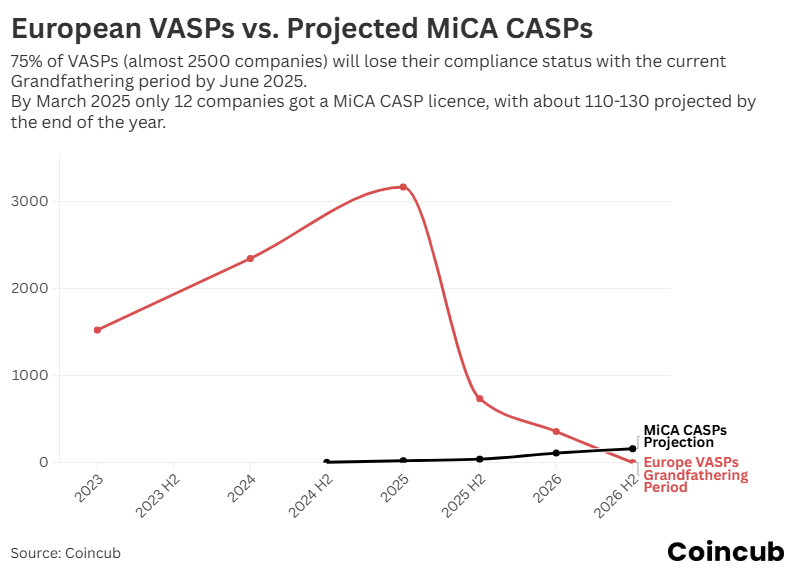
At the same time, Europe didn’t disappear as a usage region. On-chain activity still grew. Chainalysis shows Europe’s on-chain volume rising year over year. Europe and North America also still sit at the top in absolute activity by raw volume.
Europe made itself harder to build in, and that was the real call. It lost momentum on the business formation side. Users didn’t vanish overnight, and volume didn’t fall off a cliff. The footprint shrank where it matters for innovation, and it stayed alive where it matters for holders and flows. Chainalysis.com, compliancecorylated.com.
El Salvador, the UAE, and Hong Kong Will Overtake the EU – Verdict: True
On business friendliness and regulatory positioning, the EU got jumped. UAE and Hong Kong were the obvious winners.
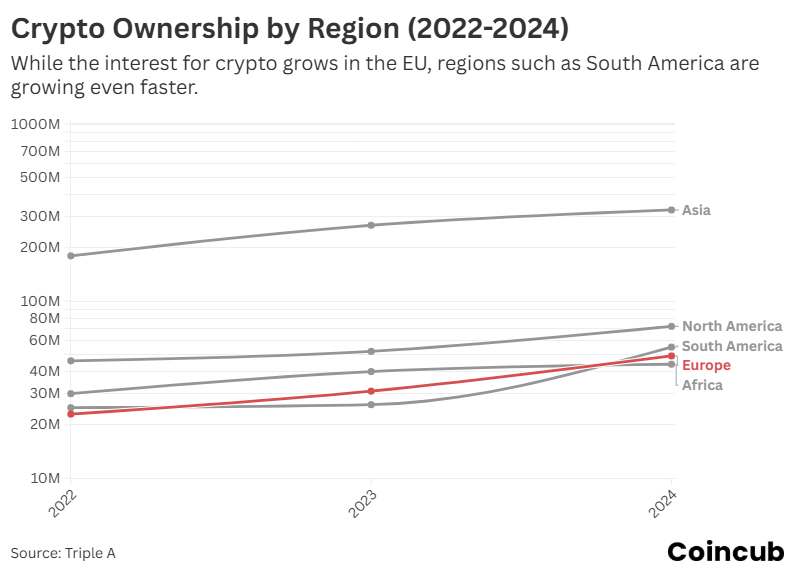
The UAE kept pulling talent, exchanges, and funds into Dubai and Abu Dhabi. Clear frameworks, fast licensing, and tax conditions did the job. Hong Kong also returned to the table with a proper licensing regime and retail access. It repositioned itself as an Asia-facing finance hub with a crypto lane.
El Salvador is the odd one out in this trio. It’s a policy symbol more than a volume leader. Bitcoin legal tender status and the pro-BTC stance still mattered in 2025. The scale is small, so it “wins” on narrative and policy posture, but not on raw capital or global liquidity.
Meanwhile, the EU’s crypto-friendly reputation took damage. Countries that were once magnets for licenses lost that edge. You also don’t see many EU countries showing up on “most crypto-friendly” lists in 2025. Switzerland often does, but that’s outside the EU.
So, the prediction lands if you interpret “overtake” as hub attractiveness and policy leadership, not as absolute volume.
Ethereum Will Be Dethroned as the Biggest Altcoin – Verdict: False
Ethereum stayed #2. End of story.
By year-end 2025, ETH sits around $356B market cap. The nearest “competitor” by size isn’t even a smart contract chain, it’s USDT at around $186B, and then BNB around $117B. Nobody flipped ETH. No stablecoin caught it. No L1 caught it.
People love the “Ethereum killer” story. 2025 didn’t reward it.
This prediction needed a structural break, and the market gave none. Ethereum kept its network effect, kept its capital base, and kept its spot in the rankings.
TradFi and DeFi Convergence Accelerates – Verdict: True
This one aged well because you could see it in product releases, settlement rails, and tokenization flows.
Visa and banks used stablecoins for settlement. JPMorgan pushed tokenized products. Société Générale issued a euro stablecoin and connected it to DeFi venues. This wasn’t theory anymore, it was institutions using public-chain infrastructure and DeFi primitives.
Tokenized real-world assets also grew hard in 2025. Estimates put tokenized RWAs near $19B by late 2025, up from about $5.6B at the start of the year. RWA also became one of the largest and fastest-growing DeFi categories, with reports showing it rising into the top tier by TVL.
Stablecoins were the quiet engine behind all of this. Some reports put stablecoin transaction volume in 2025 above $50T, which is the kind of number TradFi can’t ignore.
TradFi and DeFi moved closer because the incentives lined up. Settlement speed, lower friction, and better liquidity plumbing kept pulling institutions toward crypto rails. Regulation also got clearer in key markets, which reduced career risk for executives. This prediction delivered.
AI Will Manage 25% of DeFi Assets – Verdict: False (So Far)
This prediction needed scale, and the scale never showed up.
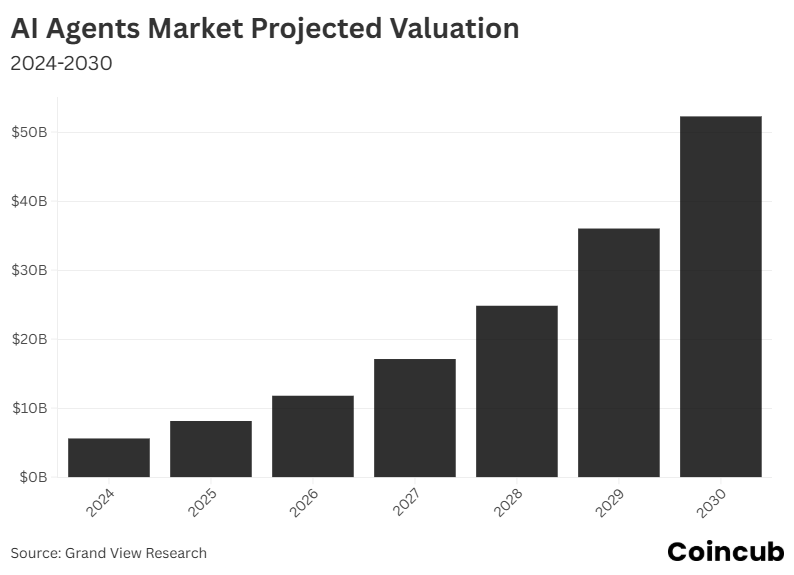
DeFi TVL is roughly in the low hundreds of billions by the end of 2025. For AI to manage 25%, you’d need something like $25B-$40B under AI-driven control. There’s no credible evidence of that. You can find “AI-powered” branding everywhere, and you can find bots and automated strategies everywhere. That still isn’t the same thing as AI managing a quarter of DeFi assets in a measurable way.
AI touched crypto in 2025, mostly on trading workflows, analytics, and marketing narratives. It didn’t become the dominant asset manager inside DeFi. Calling it false is fair, and the “so far” matters because the direction still has legs over a longer window.
10% of the Global Population Will Own Crypto – Verdict: True
This prediction landed because ownership grew faster than most people admit.
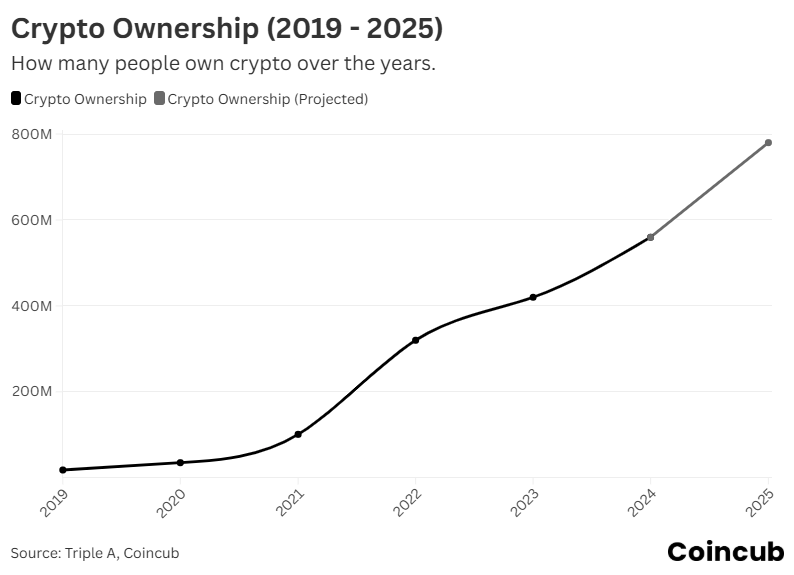
There are multiple estimates in 2025 pointing to the high hundreds of millions. One report cited over 824 million crypto owners worldwide. Crypto.com published figures around 708 million by mid-2025, with growth continuing. Bitcoin alone was estimated at 422-455 million holders by early 2025, so total crypto ownership being higher makes sense.
Ownership is the keyword here. It includes passive holders, small balances, and people who bought once and forgot about it. It still matters. It means crypto crossed into real global penetration.
The 10% milestone is a psychological line as much as a statistical one. It’s hard to call crypto a niche hobby when hundreds of millions hold it. The next obvious milestone is a billion owners, and the trend points that way.
What This Year Showed
TradFi and DeFi blending accelerated, crypto ownership pushed into the 10% range, and the “hub map” shifted toward UAE and Hong Kong while the EU made itself harder to build in.
The U.S. led where institutions and regulation drive outcomes, while emerging markets led on adoption growth. Europe hurt its startup surface area, while usage stayed surprisingly resilient.
If you take one thing from this review, it’s that crypto keeps moving forward, but it moves on its own schedule. Predictions that rely on a clean, fast, linear ramp usually get punished. The forecasts that track incentives and regulation tend to age better.
2026 will produce its own set of confident calls. Some will be right. Some will look ridiculous in twelve months. That’s the game.
Frequently Asked Questions (FAQ)
What were the main crypto predictions for 2025?
The predictions covered global crypto adoption, total market size, U.S. dominance, Europe’s regulatory impact, emerging crypto hubs, Ethereum’s position among altcoins, TradFi-DeFi integration, and the role of AI in DeFi.
Did global crypto adoption reach 10% of the population in 2025?
No. Adoption continued to grow, but estimates place global ownership closer to 7%, around 560-580 million people, rather than the 800 million implied by a 10% target.
Did the crypto market reach a $6 trillion market cap in 2025?
No. Total market capitalisation peaked around $3 trillion and ended the year near that level. Growth occurred, but the scale projected in the prediction was not reached.
Did the United States dominate the crypto market in 2025?
Yes. Institutional activity, ETF flows, stablecoin issuance, and mining concentration remained heavily centered in the U.S., making it the dominant crypto jurisdiction during the year.
Did Europe’s crypto footprint shrink under MiCA regulation?
Yes, but less dramatically than predicted. MiCA led to consolidation, higher compliance costs, and slower growth, though crypto activity in Europe did not disappear.
Did El Salvador, the UAE, and Hong Kong outperform the EU in crypto relevance?
Yes. These jurisdictions attracted more crypto businesses and capital relative to Europe, driven by clearer regulation, tax advantages, and strategic positioning.
Was Ethereum dethroned as the leading altcoin in 2025?
No. Ethereum faced increased competition and lost activity share in some areas, but it remained the largest altcoin by market capitalisation and institutional use.
Did TradFi and DeFi converge in 2025?
Yes. Traditional financial institutions increasingly used DeFi infrastructure for custody, settlement, lending, and tokenized products, accelerating integration between the two.
Did AI manage 25% of DeFi assets in 2025?
No. AI adoption in DeFi expanded across trading, compliance, and automation, but estimates suggest closer to 10-15% of DeFi activity involved AI-driven strategies.
What do the 2025 crypto predictions show overall?
Predictions tied to regulation, geography, and infrastructure held up better than those relying on precise numerical targets like prices or market caps.