Buy a Licensed Company
  Explore VASP Data
  Talk to an Expert

 Atis Shala
Atis is a senior analyst and community lead with four years of experience in crypto. He has a bachelor from the Rochester Institute of Technology.
Atis Shala
Atis is a senior analyst and community lead with four years of experience in crypto. He has a bachelor from the Rochester Institute of Technology.
Hyperliquid (HYPE) Price Prediction
Onchain derivatives have long promised transparency, self custody, and composability. In practice, they failed to meet the needs of serious traders. Slippage, shallow liquidity, and inconsistent execution pushed meaningful volume offchain. AMM-based perpetuals broke down during fast markets, where price moved quicker than pools could rebalance. Traders who needed precision, speed, and reliability found themselves choosing centralized venues, even when that choice came with counterparty risk. Onchain trading talked a good game, but it could not match centralized execution where it mattered most.
This gap shaped the derivatives market for years. Trading volume continued to consolidate on centralized exchanges, despite repeated failures that exposed custody and governance risks. DeFi perpetuals attracted users, but most activity stayed small and incentive-driven. Professional traders sized down or stayed away entirely. As a result, onchain derivatives adoption lagged far behind spot DeFi, even as demand for self custody and transparent infrastructure continued to grow across the industry.
Hyperliquid entered this environment with a different design choice. Instead of forcing derivatives into AMM constraints, it built a purpose-designed chain with a fully onchain order book optimized for speed, depth, and execution quality. That focus helped Hyperliquid capture real trading volume by solving a structural problem rather than chasing composability first. Any serious HYPE price prediction starts here, with an understanding of why this shift matters.

Hyperliquid (HYPE) Flash Prediction
| Timeframe | Bear | Base | Bull |
| 2026 | $10–18 | $25–45 | $60–90 |
| 2027–28 | $8–15 | $50–120 | $180–300 |
| 2030 | < $20 | $150–400 | $600+ |
What is Hyperliquid (HYPE)?
That structural shift sets the stage for understanding Hyperliquid itself. The protocol did not emerge as a marginal upgrade to existing DeFi perps. It launched as a purpose-built Layer 1 designed from the ground up for trading. Every design choice centers on execution, latency, and liquidity rather than generalized composability. In simple terms, Hyperliquid aims to deliver the trading experience of a centralized exchange while keeping the core mechanics onchain.
At the heart of that design sits a fully onchain order book. This matters because order books behave differently than automated market makers under stress. An order book allows buyers and sellers to meet directly at visible price levels, which leads to tighter spreads and more predictable fills when liquidity is deep. For active traders, this model feels familiar. It mirrors the workflows used on centralized venues and avoids many of the pricing distortions that AMMs introduce during sharp market moves. Better execution does not just improve user experience. It determines whether large traders can participate at all.
The main surface area for demand comes from perpetual futures trading, which remains the dominant source of volume on the platform. Hyperliquid also supports spot trading, which broadens asset coverage and gives traders a reason to keep capital inside the ecosystem. Beyond direct trading, the platform offers vaults that pool capital into structured strategies. These vaults lower the barrier for users who want exposure without running positions manually. For developers and professional traders, Hyperliquid provides APIs, documentation, and SDKs that support bots, dashboards, and integrations. That tooling matters because systematic traders often account for a large share of durable volume.
Why Does Hyperliquid Matter?
Hyperliquid matters to the market because usage often precedes valuation. Tokens tend to accrue value when activity generates fees, incentives align participants, and governance expectations grow alongside real economic throughput. In Hyperliquid’s case, the question for HYPE holders becomes straightforward. If trading volume, fees, and ecosystem participation continue to expand, the token gains a stronger fundamental footing.
HYPE Token Basics: What Purpose Does it Serve?
HYPE is the native token of the Hyperliquid network. It does not represent equity, revenue share, or a claim on assets. Its role is functional. HYPE exists to align incentives across traders, liquidity providers, developers, and long-term participants as the network grows. Any serious discussion about price starts with that distinction. The token reflects network activity and expectations around future usage, not ownership in a company.
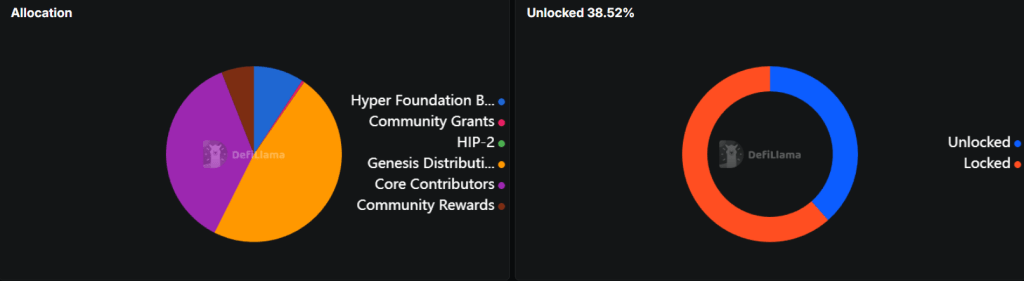
Two mechanics matter most when evaluating HYPE. The first is supply. Total supply and emissions act as gravity on price. Even strong demand can struggle against heavy token issuance, while controlled emissions can amplify the impact of growth. Understanding how much HYPE enters circulation, and when, helps frame both upside and downside scenarios over different time horizons.
The second mechanic is allocation and unlock structure. Tokens distributed to teams, early contributors, or ecosystem participants do not hit the market all at once. Some unlock through cliffs, where large amounts become liquid on specific dates. Others unlock linearly over time. Cliffs tend to introduce volatility, especially if market liquidity cannot absorb new supply. Linear unlocks usually soften that impact by spreading sell pressure across longer periods. Tracking these schedules matters as much as tracking trading volume.
For anyone who might’ve missed the launch period: HYPE entered the market alongside growing attention on onchain perpetuals, not during a quiet cycle. Early adoption coincided with rising volume and expanding user activity, which shaped initial price discovery. From here, future performance depends less on novelty and more on how supply dynamics interact with real usage across the ecosystem.
Hyperliquid Activity Metrics: Volume, Fees, and HYPE Unlocks
Activity metrics provide the clearest lens for evaluating HYPE beyond price action. Trading volume does not equal revenue, but it often predicts something more durable: whether users stick around. Consistent volume signals habit formation, liquidity gravity, and mindshare among active traders. In derivatives, that stickiness matters more than one-off spikes because liquidity attracts liquidity.
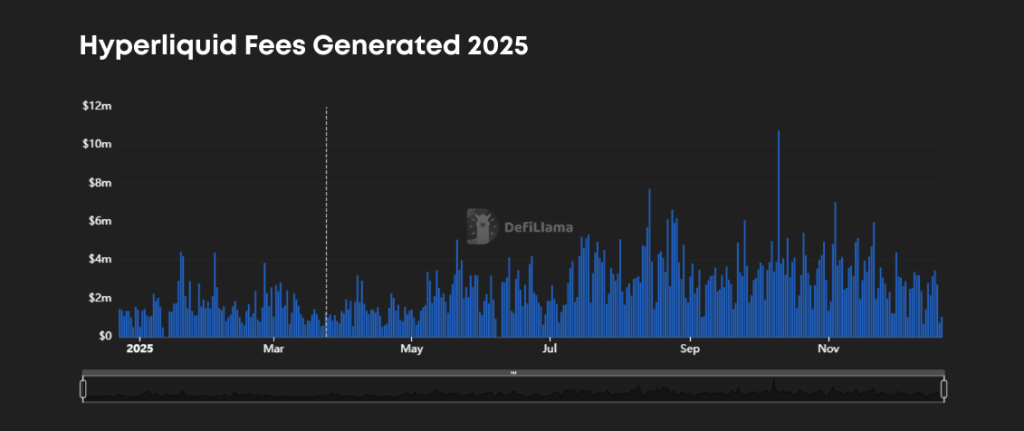
Fees and revenue convert usage into economic signal. Fees fund validator security, ongoing development, and incentive programs that keep markets competitive. On Hyperliquid, fee generation also feeds mechanisms designed to support the ecosystem over time. Even when value does not flow directly to token holders, sustained revenue strengthens the network’s ability to invest through cycles. For HYPE, this linkage between activity and economics frames every valuation discussion.
Recent onchain data shows Hyperliquid operating at a scale that few DeFi protocols reach. According to public dashboards, total value locked recently sat above $4 billion, reflecting the capital traders keep deployed on the platform. Annualized fees approached the $900 million range, while annualized revenue tracked slightly below that level. Thirty-day perpetual volume reached well into the hundreds of billions of dollars, dwarfing spot DEX volume but reinforcing where demand concentrates. Open interest climbed into the multi-billion-dollar range, signaling that traders do not just pass through positions but maintain exposure. Aggregators like DeFi Llama surface these metrics and allow direct comparison with competing venues.
That scale has started to register beyond crypto-native dashboards. Industry research highlighted Hyperliquid as one of the fastest-growing forces in onchain derivatives, pointing to record monthly volumes and rapid gains in market share. Analysis from 21Shares framed the protocol as a liquidity center rather than a niche experiment. Once a venue reaches this size, volume becomes self-reinforcing. Traders prefer deep books, and deep books attract more traders.
Hyperliquid therefore offers observers a concrete checklist. Instead of guessing narratives, weekly monitoring should focus on a small set of signals:
- Perpetual volume trends rather than isolated surges
- Open interest expansions or sharp contractions
- Fees and revenue direction relative to volume
- Active traders and new accounts, when publicly visible
The Main HYPE Catalysts
Activity and supply set the baseline, but catalysts determine whether demand accelerates or stalls. For Hyperliquid, potential upside does not hinge on abstract narratives. It depends on product execution and whether new features deepen usage among traders who already generate volume.
Perpetuals Expansion and Spot Market Growth
Perpetual futures remain the core engine of Hyperliquid’s activity. Adding new markets increases surface area, but depth and execution quality matter more than raw listings. Deeper liquidity, improved risk management, and a resilient liquidation engine attract larger position sizes. When professional traders can deploy size without moving the book, volume compounds. That dynamic directly strengthens the economic base that supports HYPE.
Spot trading plays a quieter but important role. It gives perps-only traders a reason to keep capital inside the ecosystem rather than bridging in and out. Spot markets also support broader asset listings and improve price discovery for derivatives. As spot activity grows, it reinforces liquidity loops between products and reduces reliance on external venues for basic trading needs.
Vaults also expand participation beyond active traders. By pooling capital into managed strategies, they allow users to gain exposure without running positions manually. This structure can convert passive observers into contributors of liquidity and fees. Higher vault participation also smooths volatility in platform activity, which helps stabilize usage through different market regimes.
HyperEVM and the Hyperliquid Ecosystem
HyperEVM extends the platform beyond trading. It offers an EVM-compatible environment where developers can deploy applications and tokens that interact with Hyperliquid’s liquidity. In simple terms, it turns a single-product venue into a broader ecosystem. If developers build tools, integrations, or new financial primitives on top of HyperEVM, demand for blockspace and user attention can expand alongside trading volume.
API-first trading culture
A large share of durable volume comes from systematic traders and market makers. These participants rely on reliable, low-latency APIs rather than front-end interfaces. Hyperliquid’s emphasis on public APIs, documentation, and developer tooling lowers friction for bots and professional trading systems. That focus matters because once automated strategies integrate deeply, they tend to stay, reinforcing liquidity and throughput over time.
Hypurr: Hyperliquid’s Flagship NFT Collection

As Hyperliquid expands beyond pure trading, cultural signals start to matter, even if they never replace fundamentals. NFTs sit firmly in that category. They do not drive volume, fees, or open interest. Instead, they reflect community engagement, experimentation, and whether users want to build identity inside an ecosystem rather than simply trade and leave.
Within HyperEVM, the emergence of Hypurr served as an early flagship moment. The collection drew attention not because of novel mechanics, but because it demonstrated demand for native assets built directly on Hyperliquid’s infrastructure. Trading activity around Hypurr signaled that users were willing to deploy capital and attention beyond derivatives, even in a market where trading remains the primary draw.
NFTs like Hypurr show whether HyperEVM can support cultural primitives alongside financial ones. That matters for ecosystem breadth, not for immediate token valuation. The risk is obvious and familiar. NFT activity can surge on narrative momentum and fade just as quickly once attention shifts. For HYPE, these moments function as signals of engagement, not pillars of the investment case. At the time of writing, the floor price for Hypurr sits around 434 HYPE, with a total trading volume of 5.5 million HYPE.
Hyperliquid (HYPE) Price Prediction for 2026 and Beyond
HYPE does not trade in a vacuum. Its price reflects a balance between execution-driven adoption and ongoing token dilution, filtered through broader crypto market conditions. Rather than targeting a single number, the only honest way to model HYPE is through scenario ranges tied to concrete operational outcomes.
Five inputs drive every scenario below: adoption trends, fee durability, supply unlocks, competitive pressure, and macro risk appetite. If two or more inputs flip, the range shifts with them.
Hyperliquid (HYPE) Price Prediction 2026
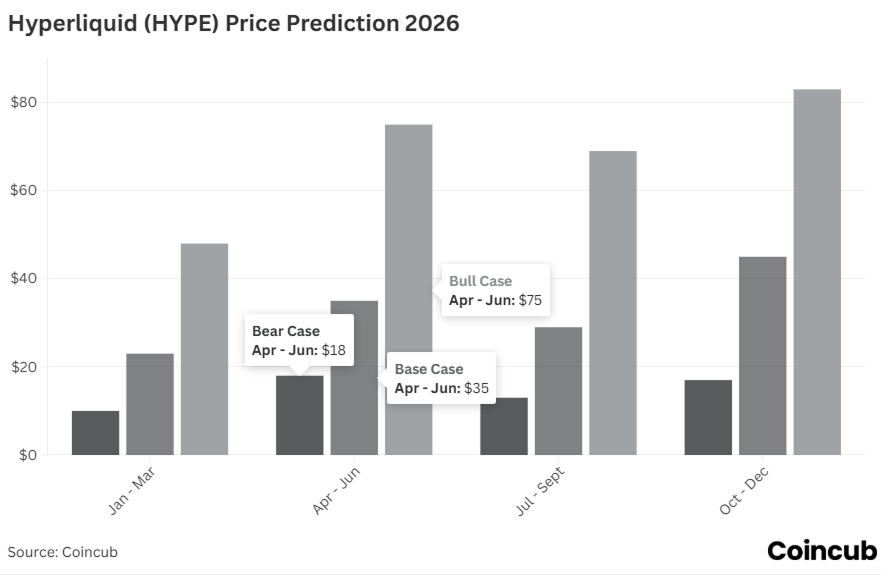
Bear Case: HYPE Trading Between $10 to $18
This scenario plays out if trading volume cools materially and unlock pressure hits during a neutral or risk-off market. Open interest declines, not catastrophically, but enough to signal reduced conviction from larger traders. Hyperliquid keeps functioning well, but competitors win incremental flow through incentives or new features.
Price weakness here reflects timing and liquidity, not protocol failure. Volatility remains high, with sharp squeezes inside a broader downtrend.
What drives it:
- Perp volume normalization
- Unlocks landing into weak bid depth
- Broader altcoin multiple compression
Base Case: HYPE Trading Between $25 to $45
The base case assumes Hyperliquid maintains a high plateau in perps volume and fee generation, even as growth slows from peak expansion rates. Unlocks continue, but organic demand absorbs much of the new supply. HyperEVM develops slowly, adding optionality without driving speculation.
Price trends upward over time, but the path includes deep pullbacks around unlock events and macro drawdowns. This looks like a maturing infrastructure asset, not a momentum trade.
What drives it:
- Stable or slightly growing market share
- Strong, consistent fee production
- Controlled response to unlock-related selling
Bull Case: HYPE Trading Between $60 to $90
The bullish one-year outcome requires Hyperliquid to extend its execution edge while competitors fail to close the gap. Volume stays elevated even without heavy incentives. Open interest grows alongside volume, signaling real risk transfer. Confidence builds that dilution will matter less relative to demand growth. On top of that, the Hype ecosystem might grow, with new wallets, dApps, and other platforms launching and attracting users.
Price appreciation accelerates, but corrections remain part of the structure. This is not a straight line.
What drives it:
- Sustained perps dominance
- Strong fee capture relative to emissions
- Favorable crypto market regime
Hyperliquid (HYPE) Price Prediction 2027-2028
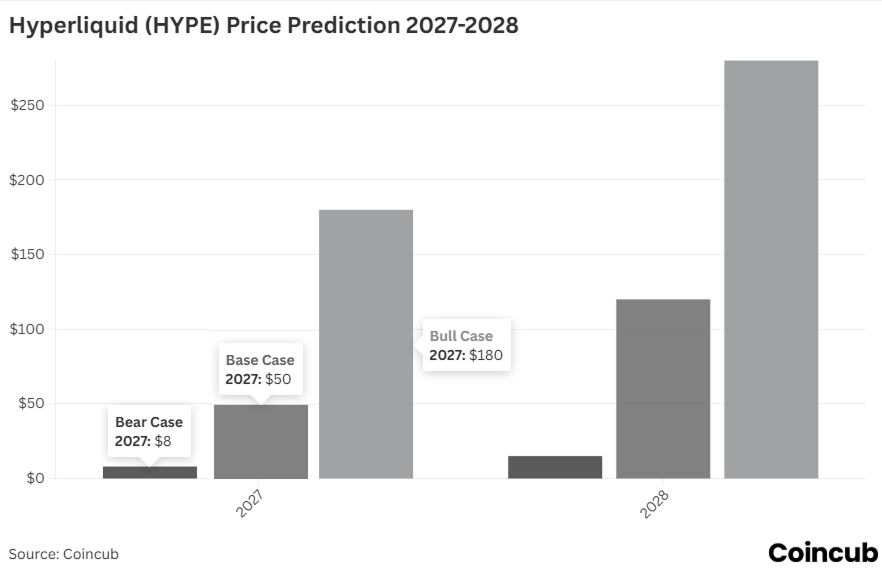
Bear Case: HYPE Trading Between $8 to $15
In a multi-year bearish outcome, Hyperliquid survives but loses relevance at the margin. Volume fragments across competing onchain venues. HyperEVM struggles to attract sticky applications. Unlocks continue to weigh on price as adoption growth stalls.
HYPE underperforms the broader market. Capital rotates to faster-growing ecosystems.
Base Case: HYPE Trading Between $50 to $120
The base case assumes adoption compounds gradually while dilution slows over time. Hyperliquid becomes established infrastructure for onchain derivatives. Fees fund development without aggressive incentives. HyperEVM supports a small but real ecosystem focused on trading-adjacent use cases.
HYPE appreciates alongside usage rather than narratives. Drawdowns occur, but long-term holders benefit from structural growth.
Bull Case: HYPE Trading Between $180 to $300
This scenario requires Hyperliquid to become the dominant venue for onchain perps. Institutional traders adopt its execution model. APIs drive systematic volume. HyperEVM deepens liquidity instead of fragmenting it.
Here, adoption clearly outruns emissions. The market reprices HYPE as core infrastructure rather than a high-beta DeFi token.
Hyperliquid (HYPE) Price Prediction 2030
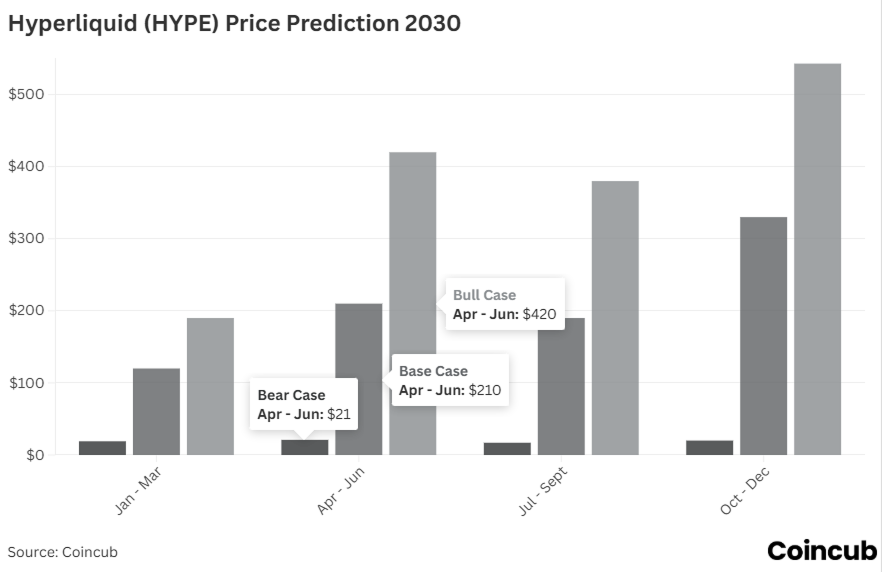
Bear Case: HYPE Trading Below $20
If regulation constrains onchain perps and centralized venues retain dominance, Hyperliquid operates but never scales meaningfully beyond crypto-native traders. HYPE retains utility but loses investment appeal.
Base Case: HYPE Trading Between $150 to $400
In a neutral-to-positive long-term regime, crypto adoption expands steadily. Onchain execution earns legitimacy. Hyperliquid sustains high volume and fees. HyperEVM grows slowly but purposefully.
HYPE behaves like an infrastructure asset tied to usage and market cycles rather than speculative hype.
Bull Case: HYPE Trading $600+
This outcome requires multiple conditions to align. Onchain perps rival centralized exchanges. Institutions participate directly. Global adoption expands. The 2028 Bitcoin halving reinforces a new macro expansion phase. Fee generation scales while emissions become marginal.
Hyperliquid Competitors: How Does It Stand Out?
Crypto markets often confuse good technology with durable advantage. Many protocols ship solid code, clean interfaces, and clever mechanics. Very few achieve liquidity gravity. That difference explains why Hyperliquid commands attention while dozens of capable competitors fight for marginal flow.
Good DeFi tech lowers barriers to entry. Liquidity gravity raises barriers to exit. Once traders deploy size, run bots, and anchor strategies to a venue, switching costs rise quickly. Order book depth, consistent execution during volatility, and predictable liquidation behavior matter more than feature checklists. This is where Hyperliquid currently separates itself. However, centralized exchanges still hold the advantage in regards to metrics and ease of use.
Volume and dominance provide the clearest evidence. Hyperliquid processes a disproportionate share of onchain perpetual volume and sustains multi-billion-dollar open interest. That activity is not purely incentive-driven. Research from 21Shares highlights how sustained volume reinforces itself as traders follow liquidity rather than marketing.
Still, crypto rotates fast. Liquidity dominance is not permanent. Competitors continue to push aggressively, often with subsidies. Newer venues like Aster focus on incentives, alternative risk models, or cross-chain access to attract flow. Others attempt to differentiate through leverage caps, risky products, or tighter integration with broader DeFi ecosystems. In strong markets, subsidies can mask weaker execution. In weaker markets, only venues with real liquidity survive.
Liquidity Fragmentation as a Risk for Hyperliquid
Several risks could weaken Hyperliquid’s position. Liquidity fragmentation remains a constant threat as capital chases yield across different blockchains. Any major security incident or prolonged downtime would damage trust quickly, regardless of past performance. Incentive dependence poses longer-term risk if organic volume fails to absorb reduced rewards. Finally, well-capitalized competitors willing to run losses for market share can compress margins and test loyalty.
Hyperliquid wins flow today because traders prioritize execution. Whether it keeps winning depends on maintaining that edge while competitors try to buy it away.
Final Thoughts on Hyperliquid (HYPE)
Hyperliquid sits at an inflection point that few layer 1 blockchains ever reach. It has moved past experimentation and into real market relevance. Traders use it because it works, not because incentives force them to. That distinction matters. Execution quality, deep liquidity, and a fully onchain order book have allowed Hyperliquid to solve a problem that held onchain derivatives back for years.
At the same time, HYPE remains a token shaped by reality, not narrative. Strong volume and fee generation create a solid foundation, but supply unlocks and emissions introduce constant pressure that the market cannot ignore. Price appreciation depends on demand consistently outrunning dilution. When that balance breaks, even the strongest products reprice quickly. This dynamic explains why HYPE trades with sharp volatility despite clear operational strength.
Looking forward, Hyperliquid’s trajectory hinges on a narrow set of outcomes. If the platform maintains its execution edge, defends market share, and gradually expands its ecosystem through HyperEVM, HYPE has room to mature into an infrastructure-grade asset. If volume fragments, competitors subsidize aggressively, or unlocks overwhelm organic demand, returns compress regardless of past success.
The most important takeaway is simple. Hyperliquid does not need to dominate all of DeFi to succeed. It needs to remain indispensable to a core group of serious traders. Liquidity follows reliability. Fees follow liquidity. Token value follows sustained usage, not attention cycles.
Frequently Asked Questions (FAQs)
What is hyperliquid?
Hyperliquid is an onchain derivatives trading platform built as a purpose-designed Layer 1 blockchain. It uses a fully onchain order book instead of AMMs, allowing traders to access perpetual futures with tighter spreads, faster execution, and transparent settlement while keeping custody onchain.
What is so special about hyperliquid?
Hyperliquid stands out because it prioritizes execution quality. Its fully onchain order book delivers centralized-exchange-style trading with deep liquidity, low latency, and predictable fills. This design allows professional traders and market makers to deploy size onchain without the slippage common in AMM-based perps.
Who is the owner of Hyperliquid?
While Hyperliquid does not have an owner, the founder is Jeff Yan. Nonetheless, it is developed and maintained by a core contributor team and governed through protocol-level mechanisms rather than corporate ownership.
How much does hype cost?
At the time of writing, HYPE costs around $25 per piece. The price of HYPE fluctuates continuously as it trades openly on crypto markets and should be checked in real time on major price-tracking platforms.
Is hype listed on Binance?
No, HYPE is not listed on Binance, despite being available on Binance.US. The coin is listed on multiple other exchanges, however, including OKX, Bitget, Bybit, Gate, KuCoin, and MEXC.