Buy a Licensed Company
  Explore VASP Data
  Talk to an Expert

 Atis Shala
Atis is a senior analyst and community lead with four years of experience in crypto. He has a bachelor from the Rochester Institute of Technology.
Atis Shala
Atis is a senior analyst and community lead with four years of experience in crypto. He has a bachelor from the Rochester Institute of Technology.
VeChain (VET) Price Prediction 2026
Cryptocurrency price predictions continue to attract attention, even as the market matures and speculation gives way to fundamentals. Investors no longer rely solely on hype cycles or social media momentum. They increasingly look for signals tied to real usage, economic design, and long-term relevance. In that context, price forecasts have shifted from bold guesses to structured assessments grounded in data, adoption trends, and market behavior.
Among the thousands of digital assets competing for attention, enterprise-focused blockchain projects occupy a distinct corner of the market. These networks aim to solve operational problems for businesses rather than chase retail enthusiasm. Their value propositions depend less on narrative velocity and more on measurable activity, contractual relationships, and sustained demand for blockchain services. That distinction shapes how analysts approach their price outlooks and the assumptions behind them.
VeChain sits firmly within this enterprise-first category. The project targets supply chain management, data verification, and product traceability, using blockchain infrastructure designed for corporate use rather than permissionless experimentation. Its native token, VET, reflects that positioning. Price movements often lag trend-driven sectors of the crypto market, yet they also resist some of the volatility that defines speculative tokens.

VeChain (VET) Flash Prediction
| Timeframe | Bear Case | Base Case | Bull Case | Key Drivers |
| 12 Months (2026) | $0.02 – $0.03 | $0.035 – $0.055 | $0.07 – $0.10 | Bitcoin trend, liquidity conditions, incremental enterprise usage |
| 2–3 Years (2027–2028) | $0.04 – $0.07 | $0.08 – $0.15 | $0.18 – $0.22 | Enterprise deployments, ecosystem maturity, market stability |
| 5+ Years (2030) | $0.07 – $0.12 | $0.15 – $0.25 | $0.20 – $0.35 | Sustained enterprise demand, higher VTHO burn, institutional inflows, post-2028 halving effects |
What Is VeChain (VET)?
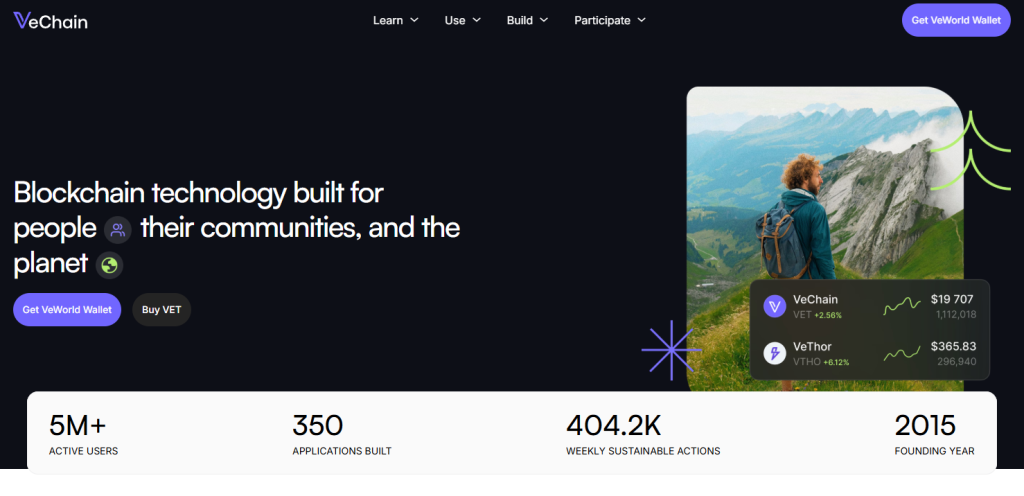
VeChain launched with a narrow and practical objective. The project set out to solve data trust problems in global supply chains. Traditional supply chains rely on fragmented databases, manual reporting, and intermediaries that introduce errors or manipulation. VeChain proposed blockchain as a shared source of truth that companies could use to verify product data across logistics, manufacturing, and distribution.
The project’s early focus reflected real-world constraints. Supply chains span multiple jurisdictions, involve many stakeholders, and generate large volumes of data. Public blockchains built for open finance often struggle with these requirements. VeChain chose to prioritize predictable costs, stable performance, and governance structures that enterprises could work with. That decision shaped both its technical design and its economic model.
At the core of the ecosystem sits the VeChainThor blockchain. Unlike permissionless networks that emphasize decentralization above all else, VeChainThor balances decentralization with enterprise usability. The network supports smart contracts, data anchoring, and transaction tracking while offering features such as fee delegation. This allows businesses to use the blockchain without forcing end users to hold or manage crypto assets directly.
VET and VTHO: The Drivers Behind VeChain
VeChain uses a dual-token system to separate network usage from value transfer. VET functions as the primary value token and represents ownership within the ecosystem. Holding VET generates VTHO, which pays for transactions and smart contract execution. This structure aims to keep transaction costs stable while allowing VET to reflect broader market expectations around adoption and growth.
This separation also explains the gap between token holders and actual network usage. Many VET holders act as long-term investors rather than active users of the blockchain. Enterprises, by contrast, consume VTHO to operate applications without speculating on VET’s price. As a result, VeChain’s token economics link price appreciation to sustained network demand rather than raw transaction volume alone.
VeChain’s Dual-Token Model: VET and VTHO
VeChain designed its dual-token model to address a core weakness in many early blockchains: volatile transaction costs. In networks where a single token serves both as a speculative asset and as gas, price swings directly affect usability. For enterprises that require predictable operating expenses, that volatility creates friction. VeChain separated value storage from transaction costs to make blockchain usage viable in commercial environments.
In this model, VET functions as the value and staking token, while VTHO acts as the gas token. Holding VET automatically generates VTHO over time at a fixed rate. The network consumes VTHO whenever a transaction or smart contract executes. This design allows VeChain to adjust transaction costs by modifying VTHO parameters without interfering with the market price of VET.
VTHO generation follows a straightforward mechanism. Each VET token produces a small amount of VTHO per block. This creates a continuous supply of gas tied to long-term VET ownership rather than short-term market activity. Enterprises that run applications on VeChain either generate VTHO through holding VET or acquire it directly from the market, depending on their operational setup.
In most enterprise use cases, the business pays for gas, not the end user. VeChain supports fee delegation, which allows companies to sponsor transactions on behalf of customers. This removes the need for users to interact with tokens at all. From an adoption standpoint, this matters more than decentralization purity. It lowers onboarding friction and mirrors traditional software billing models.
Does Enterprise Use Affect VET Price Performance?
For VET price appreciation, the implications remain mixed. Increased network usage drives VTHO demand, not direct VET buying pressure. VET accrues value indirectly through long-term holding incentives and expectations of future adoption. This contrasts with single-token Layer 1 networks, where higher usage often translates into immediate token demand. VeChain trades that direct feedback loop for stability and enterprise compatibility, a choice that shapes its long-term price dynamics.
VeChain’s Historical Performance
The structure of VeChain’s dual-token model shapes how the market values VET, but price behavior only becomes clear when placed in historical context. Market positioning, liquidity cycles, and investor expectations have all played roles in defining how VET trades relative to other Layer 1 tokens. Understanding that history helps separate structural limitations from short-term sentiment shifts.
VeChain currently occupies a mid-tier position by market capitalization, well below general-purpose smart contract platforms but still firmly within the upper ranks of enterprise-focused blockchain projects. Its valuation reflects steady survival across multiple market cycles rather than explosive growth. That consistency appeals to long-term observers, even if it frustrates momentum-driven traders.
VET’s price history follows the broader crypto market sentiment. The token experienced its most significant appreciation during periods of aggressive liquidity expansion, particularly in the 2017-2018 and 2020-2021 bull markets. In both cases, speculative capital lifted nearly all digital assets, including enterprise-oriented tokens that otherwise move slowly. VeChain benefited from renewed attention to real-world use cases, supply chain transparency, and corporate blockchain adoption narratives.
Subsequent drawdowns exposed structural weaknesses. VET struggled to maintain valuation once speculative demand faded, partly because network usage growth did not immediately translate into token demand. Long consolidation phases followed, highlighting the gap between enterprise development timelines and crypto market expectations.
Despite these limitations, historical price action still matters. It reveals where long-term holders accumulate, how the market reacts to adoption narratives, and which price zones attract sustained interest. For analysts, past behavior provides boundaries for realistic expectations rather than targets for repetition.
VET Historical Snapshot
| Year | Price range | Major catalyst |
| 2017–2018 | Low to sharp peak | Initial enterprise blockchain hype |
| 2020–2021 | Strong rally | Broad crypto bull market |
| 2022–2024 | Prolonged decline | Liquidity contraction and risk-off sentiment |
Key Factors Influencing VeChain (VET) Price
VeChain Enterprise Adoption and Real Usage
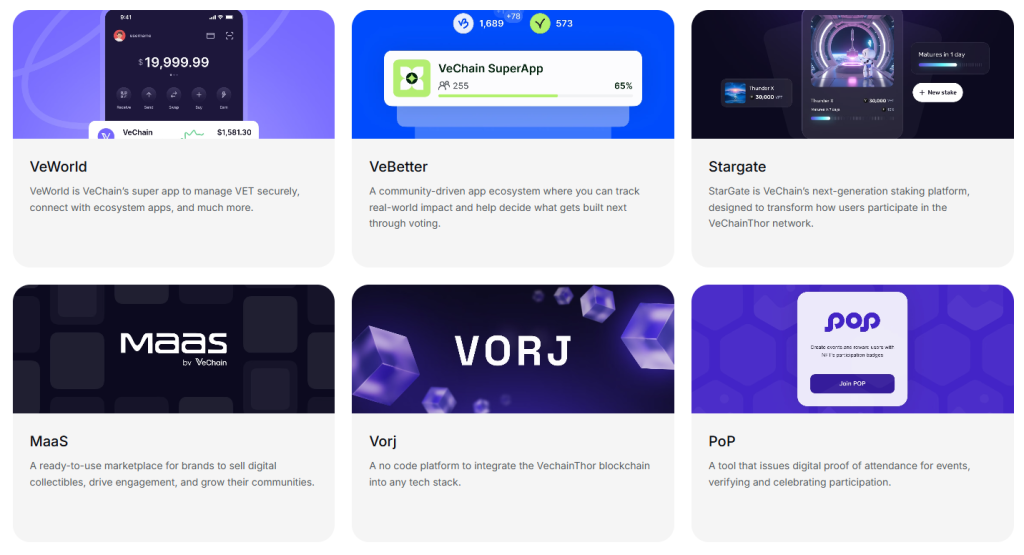
Historical price action sets the boundaries, but long-term valuation depends on what happens on the network today. For VeChain, enterprise adoption remains the most important variable influencing VET’s price trajectory. Unlike retail-driven protocols, VeChain does not rely on viral growth or rapid user onboarding. Its progress unfolds through corporate decision-making cycles that move at a very different pace.
A critical distinction exists between pilots, proofs of concept, and live deployments. Many companies experiment with blockchain through limited trials that never reach production. These initiatives generate headlines but little sustained network activity. Live deployments, by contrast, involve ongoing data recording, regular transactions, and operational dependency. Only this stage creates consistent demand for blockchain services.
Enterprise adoption also moves slower than crypto markets because it carries higher stakes. Companies must address compliance, data integration, legal risk, and long-term maintenance before committing to a public blockchain. These constraints limit sudden growth spurts, even when the underlying technology works as intended. As a result, VeChain’s adoption curve tends to look flat until it does not, which often tests investor patience.
Transaction volume provides a more reliable signal than partnership announcements. Rising transaction counts and consistent VTHO consumption indicate active applications rather than marketing narratives. While volume alone does not guarantee value capture for VET holders, it confirms that the network serves real operational needs.
At the time of writing, enterprises like Walmart (China), BMW, LVMH (luxury goods), PricewaterhouseCoopers (PwC), Bayer, BYD, and H&M all use VeChain one way or the other. The main use case remains traceability through the supply chain.
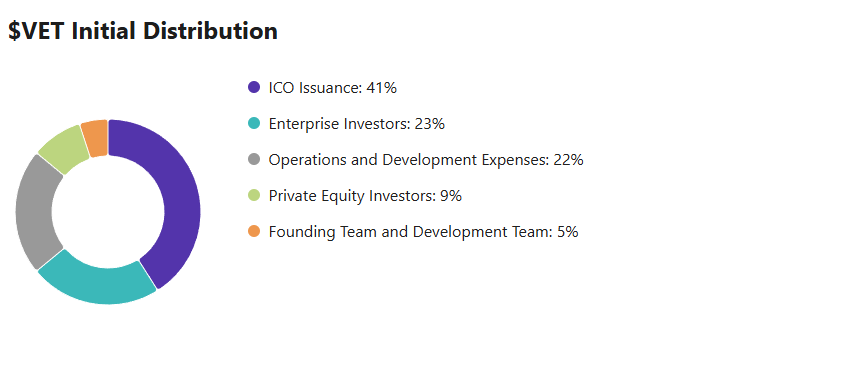
VeChain Tokenomics and Supply
Enterprise usage may justify VeChain’s existence, but tokenomics determine whether that usage benefits VET holders. The structure of supply, emissions, and gas mechanics shapes how value accrues over time. Without understanding these mechanics, any VeChain price prediction risks leaning on assumptions that do not align with how the network actually operates.
VET has a large fixed total supply, with the majority already in circulation. This limits sudden inflation shocks but also caps scarcity-driven upside. Unlike low-supply assets where marginal demand can move price quickly, VET requires sustained capital inflows to generate meaningful appreciation. Circulating supply dynamics therefore matter more than theoretical supply ceilings.
The emission structure ties directly into VTHO generation. VET holders continuously generate VTHO, which the network consumes as gas. This design introduces a predictable flow of new VTHO into the system. While burning VTHO reduces supply, issuance remains ongoing as long as VET exists. The balance between burn rates and generation reflects actual network demand rather than speculative interest.
VTHO burn has increased during periods of higher activity, but it has rarely outpaced issuance for extended stretches. This limits upward pressure on VTHO prices and weakens indirect value transfer to VET. As a result, increased usage does not automatically translate into tighter token economics for VET holders.
Long-term dilution risks remain moderate but persistent. Continuous VTHO generation rewards holding but also dampens scarcity narratives. This explains why traditional supply shock arguments do not fully apply to VET. The token’s value depends less on constrained supply and more on expectations around durable enterprise demand and long-term network relevance.
Partnerships Versus Revenue Reality
Tokenomics define the rules of value capture, but market perception often forms around partnerships. For VeChain, announced collaborations have played a major role in shaping sentiment, sometimes more than underlying usage data. This creates a recurring disconnect between headlines and economic impact.
VeChain has built a reputation for securing high-profile partnerships, particularly in logistics, manufacturing, and sustainability reporting. These announcements signal credibility and access to enterprise decision-makers. However, partnerships alone do not guarantee meaningful blockchain usage. Many agreements focus on exploration, integration testing, or limited deployments rather than full-scale operational reliance.
Markets have learned to discount partnership news when it lacks measurable follow-through. Investors now look for evidence that a partner actively uses the network, generates transactions, and consumes VTHO over time. Without those signals, partnerships function more as optional upside than as valuation anchors.
Revenue reality matters because it reflects commitment. Enterprises that pay for blockchain services, either directly or indirectly, demonstrate long-term intent. This type of engagement creates recurring activity rather than one-off publicity cycles. For VeChain, transparency around active usage remains more important than expanding the partnership list.
Broader Crypto Market Conditions
Enterprise fundamentals operate within a larger market structure that VeChain cannot escape. Regardless of adoption progress, VET trades inside the same liquidity and sentiment cycles that shape the broader crypto market. These external forces often overpower project-specific developments in the short to medium term.
Bitcoin correlation remains a dominant factor. When Bitcoin rallies, capital flows into large-cap altcoins, including VET. When Bitcoin enters prolonged drawdowns or consolidations, risk appetite contracts across the market. VeChain rarely decouples from this pattern, even when network metrics improve. Bitcoin dominance therefore sets the ceiling and floor for near-term price movement.
Risk appetite cycles further amplify this effect. During risk-on phases, investors favor growth narratives and speculative upside, which can temporarily lift enterprise tokens. In risk-off environments, capital retreats to Bitcoin, stablecoins, or exits crypto entirely. VeChain’s steady but slower-moving adoption profile often struggles to attract attention during these defensive periods.
Liquidity conditions also matter. Expansive monetary policy and rising leverage historically support higher crypto valuations. Tight liquidity, by contrast, compresses valuations across the board. VET’s price has shown sensitivity to these shifts, particularly during global deleveraging events.
Regulatory clarity adds another layer. Clear frameworks around data usage, token classification, and enterprise blockchain adoption reduce uncertainty for corporate users. While regulation rarely produces immediate price spikes, it shapes long-term demand conditions. For VeChain, favorable regulatory signals support adoption indirectly, even if markets take time to reflect that progress.
VeChain (VET) Price Prediction for 2026 and Beyond
VeChain (CET) 12-Month Forecast
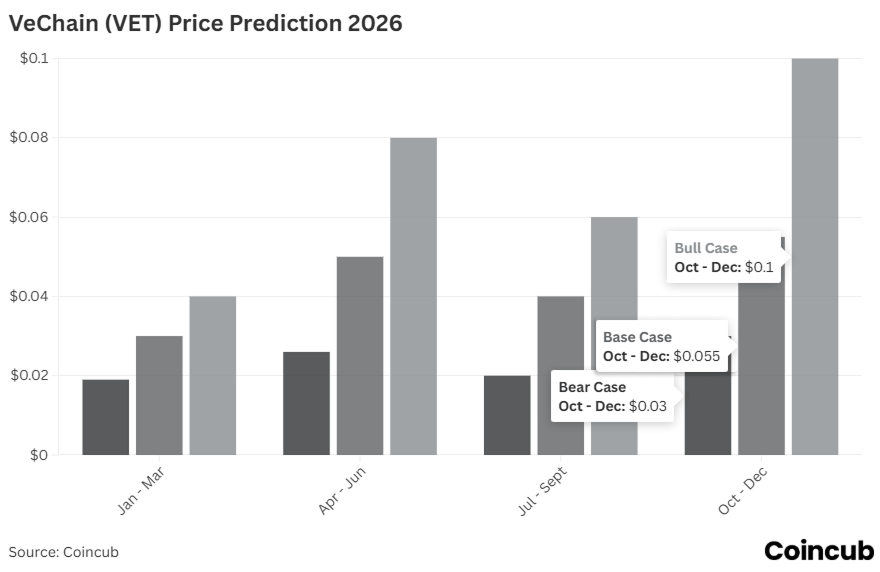
Over the next 12 months, VeChain’s price will likely remain constrained by broader market conditions rather than project-specific breakthroughs. Enterprise adoption tends to progress incrementally, which limits sudden repricing. As a result, VET’s short-term outlook depends primarily on Bitcoin’s direction, liquidity conditions, and general risk appetite.
Base Case: VET Trading Between $0.035 to $0.055
In a base case, VeChain sees moderate adoption growth while the crypto market remains stable. Bitcoin trades without extreme volatility, and liquidity conditions avoid sharp tightening. Network activity grows gradually, with small but consistent increases in transaction volume and VTHO consumption. Under these assumptions, VET likely trades within a $0.035 to $0.055 range. Price action would favor consolidation with mild upward bias, reflecting accumulation rather than speculative expansion.
Bull Case: VET Trading Between $0.07 to $0.10
The bull case assumes a supportive macro environment alongside clearer signals of enterprise usage. This includes sustained VTHO burn growth, improved transparency around active deployments, and a broader market rally led by Bitcoin. Capital rotation into established altcoins could lift VET beyond its base range. In this scenario, VET could test the $0.07 to $0.10 zone. Sustaining levels above this range would require continued follow-through rather than one-off market rallies.
Bear case: VET Trading Between $0.02 to $0.03
The bear case reflects unfavorable market conditions rather than failure at the protocol level. Rising Bitcoin dominance, contracting liquidity, or renewed macro stress would pressure altcoins broadly. Slow enterprise adoption would not offset these headwinds. Under this scenario, VET could revisit the $0.02 to $0.03 range, where long-term support has historically formed.
Across all outcomes, the 12-month outlook favors bounded movement rather than explosive upside. VeChain behaves more like an infrastructure asset than a momentum-driven token.
VeChain (VET) Price Prediction for 2027-2028
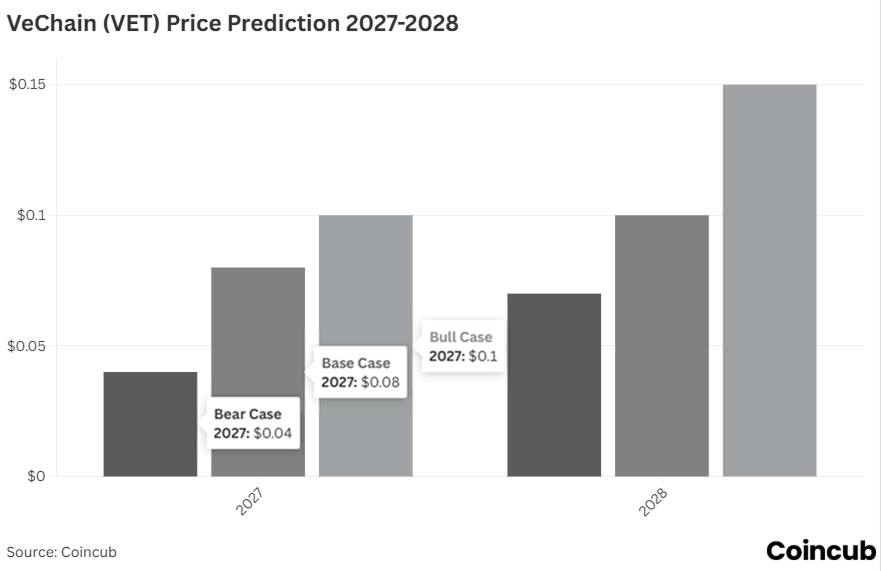
The two to three year horizon aligns more closely with enterprise adoption timelines. During this period, VeChain’s price performance will increasingly reflect execution quality, ecosystem maturity, and sustained network usage rather than short-term market sentiment alone.
A constructive scenario assumes steady enterprise onboarding. More applications move from pilots into production, transaction volumes stabilize at higher baselines, and tooling improves. Under these conditions, confidence builds gradually. If the broader crypto market avoids prolonged contraction, VET could trade within a $0.08 to $0.15 range over this period.
A more cautious scenario assumes slow enterprise adoption combined with weaker market tailwinds. Global liquidity could tighten, or regulatory uncertainty could suppress risk appetite. Even with continued development, VET would struggle to attract significant new capital. In this case, price action likely remains range-bound between $0.04 and $0.07, reflecting resilience but limited growth.
Importantly, this timeframe tests patience. VeChain’s value proposition does not lend itself to rapid repricing. Instead, the market gradually prices in execution, reliability, and relevance.
VeChain (VET) Price Prediction for 2030
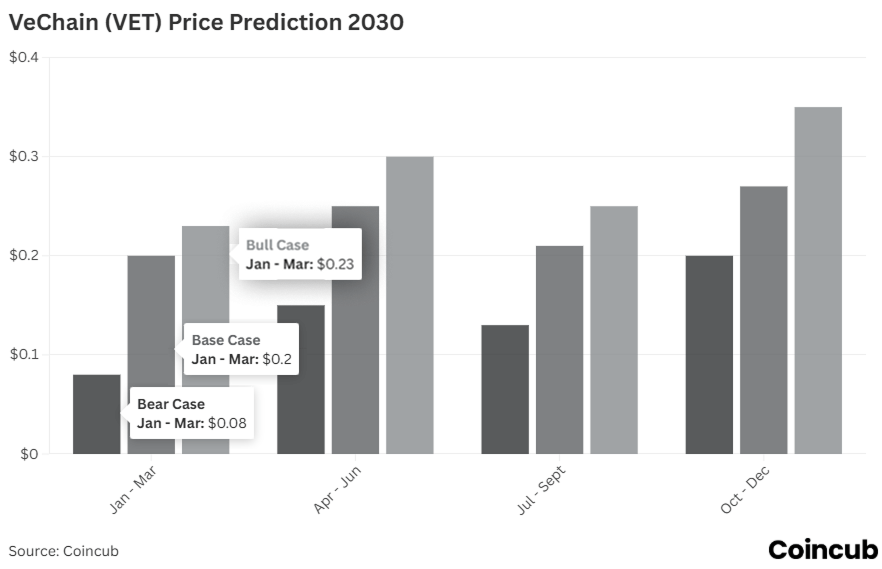
Beyond five years, VeChain’s price outlook becomes conditional rather than predictive. For meaningful upside to materialize, several structural factors must align simultaneously.
Strong enterprise usage would need to translate into consistently higher transaction volumes and sustained VTHO burn. Products must reach maturity, demand must become predictable, and emissions must feel economically balanced rather than dilutive. At that stage, VET’s role as a value token becomes clearer, supported by long-term holding incentives rather than speculation.
Macro conditions also matter. The Bitcoin halving expected in 2028 could influence liquidity cycles, as previous halvings have preceded periods of broader market expansion. Increased global adoption of blockchain infrastructure, combined with institutional inflows seeking operational exposure rather than short-term yield, would further support enterprise-focused networks like VeChain.
Under a favorable long-horizon scenario, VET could plausibly trade in the $0.20 to $0.35 range. This assumes sustained relevance rather than dominance. It does not require VeChain to lead the market, only to remain useful, credible, and integrated into real-world systems.
Main Challenges for VeChain
Several structural risks could limit adoption and suppress VET’s price potential, even if the network continues operating as designed. These risks stem from enterprise dynamics, competitive pressures, and market perception rather than from protocol instability.
One of the most persistent challenges involves long enterprise sales cycles. Large organizations move slowly, especially when adopting infrastructure that touches compliance, data governance, and operations. Blockchain integrations often require internal approvals, system audits, and legal review. These delays reduce the pace at which VeChain can scale real usage and make adoption progress difficult for markets to price in consistently.
Competition also poses a meaningful constraint. Many enterprises prefer private or permissioned systems that offer greater control over data access and governance. In some cases, traditional databases or hybrid solutions meet business needs without public blockchain exposure. These alternatives reduce the addressable market for VeChain’s public infrastructure, particularly when decentralization offers limited marginal benefit.
Token value capture remains another concern. VeChain’s dual-token model improves usability, but it weakens the direct link between network usage and VET demand. Enterprises consume VTHO, not VET, and increased activity does not automatically drive buying pressure for the primary token. This structural inefficiency can cap upside even during periods of higher adoption.
Market perception adds further risk. As an older Layer 1 project, VeChain competes for attention in an ecosystem that often prioritizes newer architectures and modular designs. Narrative fatigue can limit capital inflows, regardless of fundamentals.
Finally, regulatory uncertainty around utility tokens continues to loom. Shifting definitions of token classification, data compliance rules, and cross-border regulations could affect enterprise willingness to commit. While VeChain focuses on compliance-friendly use cases, regulatory clarity remains a prerequisite for broader institutional confidence.
Can VeChain Still Compete?
VeChain can definitely still compete. Its future depends on relevance, not reinvention. The blockchain landscape has shifted toward modular architectures, rollups, and execution-focused chains, many of which prioritize speed, composability, and developer experimentation. In that environment, VeChain does not compete head-to-head on throughput or ecosystem breadth. Instead, it occupies a narrower lane centered on enterprise utility and predictable infrastructure.
This positioning highlights the growing divide between utility-driven networks and narrative-driven growth. Over the past year, tokens tied to strong narratives have captured outsized attention, with Solana standing out as a clear example. Solana’s resurgence reflects ecosystem momentum, retail engagement, and capital rotation rather than enterprise usage. VeChain follows a different path, one that rarely benefits from rapid sentiment shifts.
Within Web3’s evolution, VeChain fits as necessary infra. Its role aligns more closely with backend systems that companies rely on quietly, without driving daily user engagement or developer hype. That limits upside during speculative cycles but supports durability across market downturns.
Realistic success for VET does not mean dominating the Layer 1 landscape or matching the growth trajectories of faster-moving ecosystems. It means maintaining relevance as a trusted enterprise blockchain, sustaining consistent usage, and surviving multiple market cycles without erosion of purpose. In that sense, VeChain competes on endurance. Its value proposition rests on staying useful when narratives fade and attention moves elsewhere.
Frequently Asked Questions (FAQs)
What is VeChain used for?
VeChain is used for supply chain tracking, data verification, and product traceability. Companies use it to record logistics data, sustainability metrics, and product information on a public blockchain.
Will VeChain reach $1?
VeChain reaching $1 would require a market capitalization far above historical levels. This would likely demand massive enterprise adoption, strong crypto market tailwinds, and sustained capital inflows.
Is VeChain a good investment?
Yes, if you prioritize product and distribution more than short term hype like with memecoins. VeChain’s value depends on enterprise adoption and network usage rather than hype-driven cycles.
Is there a future for VeChain?
VeChain has a future as long as enterprises continue to adopt blockchain for data verification and supply chain use cases. Its relevance depends on execution, regulatory clarity, and sustained usage.
Is VeChain a Chinese company?
VeChain is not a Chinese company, but it has strong ties to Asia. The project was founded by Sunny Lu and maintains partnerships in China and Europe.
Is Walmart using VeChain?
Walmart China has used VeChain-based solutions for supply chain traceability in specific programs. This involves tracking food products and logistics data.
Is VeChain part of Ethereum?
VeChain is not part of Ethereum. It operates its own independent blockchain called VeChainThor. While it supports smart contracts like Ethereum, it uses a different architecture, governance model, and dual-token system designed for enterprise use.