Buy a Licensed Company
  Explore VASP Data
  Talk to an Expert

 Dren Hima
Rochester Institute of Technology (RIT) graduate.
Crypto Analyst, Market Researcher and Editor.
Dren Hima
Rochester Institute of Technology (RIT) graduate.
Crypto Analyst, Market Researcher and Editor.
BNB Price Prediction 2026-2030: Will Deflationary Supply Outpace Regulatory Risk?

BNB is in that rare category where the fundamentals look better every quarter while the headline risk never fully goes away. It drives the BNB Chain ecosystem, plugs into almost every corner of Binance as a platform, and runs on a supply schedule that keeps shrinking the float in a way no other top-10 coin does. At the same time, it still carries the scar tissue from one of the biggest regulatory cases in the history of crypto.
If you are searching for a BNB price prediction today, you are really asking one question. Does the combination of real revenue, on-chain usage and a hard path toward 100 million supply outweigh the “Binance risk” over the next five years, or does that risk keep a lid on the multiple even as the numbers improve?
Where BNB Stands in December 2025
BNB spent 2025 reminding the market that it is more than an old exchange token.

On December 7, 2025, it trades in the high-$800s to low-$900s, depending on the feed you use, with a market cap around the low-hundreds of billions and a circulating supply in the 138-142 million band. That sits just below its October push, when BNB spiked into a new all-time high region above $1,300 and briefly challenged the top of the market cap table behind BTC, ETH, and the main stablecoins. The pullback after that move looks more like post-parabolic consolidation than a collapse.
Underneath the price chart, the on-chain story is strong. BNB Chain (BSC) holds about $6.8 billion in TVL, around $13.3 billion in stablecoins and roughly $1.8 billion in daily DEX volume on a typical day. Those numbers put it consistently in the top group of chains by actual usage. It also posts millions of daily transactions and addresses when memecoin seasons and AI-agent flows kick in, which is exactly what you want to see if you care about sustainable fee and burn.
On top of that you have the burn mechanics. The Auto-Burn and BEP-95 gas burn together removed millions of BNB in 2025 alone. Single quarterly-style burns have cleared more than 2.1 million BNB in one shot, and earlier events in the year retired about 1.9 million. Since 2023 the total supply has dropped by roughly a third. At current rates, the protocol is on track to hit its permanent 100 million BNB target sometime around 2027-2028. That supply path is the backbone of any BNB price prediction 2026-2030.
So you have a token that already made new highs in 2025, sits in a consolidation zone above previous ranges, and is backed by a chain and exchange that still rank at the top in real use. The question is whether the market will keep rewarding that, given where Binance stands on the regulatory side.
BNB Core Value Drivers
BNB is no longer “just a discount coin.” It now lives at the center of a three-layer stack: Binance exchange utility, BNB Chain and its L2s, and a deflationary schedule that keeps cutting supply every quarter and every block.
On the exchange, BNB still pulls its weight. Holders get trading fee discounts that scale with holdings and VIP level. They get access to Launchpad and Launchpool allocations. BNB acts as collateral across margin and derivatives products, plays a role in Binance Pay and card rewards, and sits in the background of various savings and staking offerings. That is classic CEX utility, but the scale of Binance’s user base and volume makes it matter.
On chain, BNB is the gas and staking token of BNB Chain, which covers BNB Smart Chain, opBNB and the broader ecosystem. Validators on BSC use a Proof of Staked Authority model, where BNB is bonded and delegated. Fees on BSC are paid in BNB. The same logic extends to opBNB, where transactions cost a fraction of a cent and settle quickly, which made it attractive for the 2025 memecoin and AI-agent meta.
Then you have Greenfield, the decentralized storage layer that targets content and AI data. BNB plugs into that layer for payments and incentives, adding another leg of utility that looks more like infrastructure than speculation.
All of this feeds into the tokenomics.
The Auto-Burn and BEP-95 Real-Time Burn
BNB started with a 200 million supply in 2017. The goal now is clear: bring that down to 100 million BNB and hold that line permanently.
There are three moving parts.
First, the Auto-Burn mechanism. Introduced in late 2021, it uses a transparent formula that takes the average BNB price for the quarter and the number of blocks produced. The outcome is a fixed amount of BNB removed from circulation at regular intervals. When price is lower, more BNB gets burned, and when price is higher, the units burned fall slightly even if notional value stays heavy. The system continues until total supply hits 100 million.
Second, BEP-95, which burns a slice of gas fees in real time. Every block carries a small ratio of fees that are deleted forever. This means that active usage on BNB Chain translates directly into supply contraction. Even once Auto-Burn stops at the 100 million supply mark, BEP-95 can keep nudging the float down as long as people transact on the network.
Third, the Pioneer Burn program, which reimburses users for provably lost BNB by burning an equivalent amount. That keeps the supply accounting honest when mistakes happen and removes an incentive to treat “lost” coins as a hidden treasury.
The result is simple to describe and hard to replicate. BNB’s supply is shrinking block by block. Burn events in 2025 alone removed several million BNB, sometimes over a billion dollars’ worth at prevailing prices. Combined burn since 2023 has taken out more than 30% of supply. With the target fixed at 100 million BNB, there is a reasonably tight window in which this contraction can play out.
Compared to Ethereum, which has no hard cap and only becomes deflationary when fees spike, and Solana or TON, which still issue new tokens through inflation, BNB sits in a unique position. It behaves like a revenue-linked, hard-supply asset that gets scarcer as the ecosystem grows. That is the core bull case.
Ecosystem Health
If the burn is the engine, the ecosystem is the fuel. A deflationary token with no actual usage would not deserve any premium.
BNB Chain has grown into a full stack. BSC handles most of the DeFi, memecoins and standard dApp activity. opBNB catches high-frequency flows that need cheap, fast blockspace, such as AI agents that act on-chain, games and small speculative tokens that churn volume. Greenfield sits next to that, handling storage use cases, especially in AI and content.
TVL on BSC around December 2025 sits just below $7 billion. That number looks modest next to Ethereum’s massive DeFi base but becomes more interesting when paired with the stablecoin base of around $13.3 billion and daily DEX volumes around $1.8 billion. You have a chain that handles serious stablecoin flow and spot leverage without needing eye-watering gas fees.
The 2025 roadmap execution matters too. The Pascal and Lorentz upgrades earlier in the year brought optimizations, lower costs and better MEV handling. Subsequent changes pushed block times down and kept finality tight. Together, they showed that BNB Chain can keep iterating on speed and stability instead of freezing in the “cheap Ethereum clone” box where critics put it in 2021.
Memecoin seasons, AI-agent frameworks and various Binance Labs-backed projects added activity throughout the year. opBNB in particular proved useful in catching that retail and bot traffic without congesting BSC itself. When people talk about total BNB ecosystem TVL in the $15-17 billion range for Q4 2025, they usually aggregate BSC, opBNB and related pieces, which is why the headline figures can differ from a single tracker’s BSC page.
Regulatory Headwinds
None of the above exists in a vacuum. BNB is tied to Binance, and Binance has lived under a spotlight for years.
In November 2023, Binance entered a $4.3 billion settlement with the US Department of Justice and related agencies over Bank Secrecy Act and sanctions violations. Changpeng Zhao pled guilty and resigned as CEO. He later served a short prison sentence. The deal imposed a compliance monitor and a strict reporting framework on the company. That event reset the risk profile for everyone holding BNB, because it took a huge part of the existential threat off the table. Binance was no longer facing immediate shutdown in the US, but it was under intense supervision.
Through 2024 and into 2025, the story shifted again. The SEC dropped a high-profile civil case against Binance. A new administration in Washington took a friendlier line toward crypto. Media coverage reported on efforts to end or soften the settlement monitoring as Binance ramped up internal compliance upgrades. Then, in late 2025, Trump pardoned CZ, which added a political twist and stirred debate around conflicts of interest.
From a holder’s point of view you end up with a messy picture. The largest, scariest criminal case is resolved and paid. Binance proved that it can keep operating under intense scrutiny. At the same time, the exchange remains an obvious target for future enforcement if it slips, and political noise around pardons and lobbying keeps BNB in the narrative whenever Congress or regulators talk about “systemic” crypto risks.
Add BNB Chain’s Proof of Staked Authority design on top of that. The validator set is small, twenty-one active nodes at a time, and large staking pools, some tied to Binance, hold a lot of voting power. Governance reforms in 2025 pushed more decisions on-chain and broadened participation, but the chain still looks more centralized than Ethereum, Cosmos or other multi-hundred-validator networks.
That structure cuts both ways. It keeps transactions cheap and fast. It also makes it easier for critics and regulators to argue that BNB Chain is effectively controlled or strongly influenced by a single corporate group. Anyone holding BNB needs to accept that this perception will not fully disappear, even if decentralization metrics improve.
BNB Price Prediction 2026
By 2026, the main moving pieces look like this. BNB’s supply keeps grinding down quarter by quarter. The Auto-Burn and BEP-95 mechanisms continue to retire coins as long as Binance revenues and on-chain activity stay healthy. BNB Chain and opBNB either cement their role as the go-to infrastructure for cheap on-chain activity, or they see share leak to Solana, TON and Ethereum L2s. The regulatory picture in the US and Europe either calms into routine oversight or throws up new surprises.
If the current Bitcoin bull market extends into 2026 and avoids a brutal blow-off, BNB holding above its previous breakout zone and slowly stretching higher is a realistic base case. The token already proved in 2025 that it can absorb negative headlines and still reach fresh all-time highs. If network revenue and burn keep trending up, the market will likely keep rewarding it with a premium to other exchange tokens.
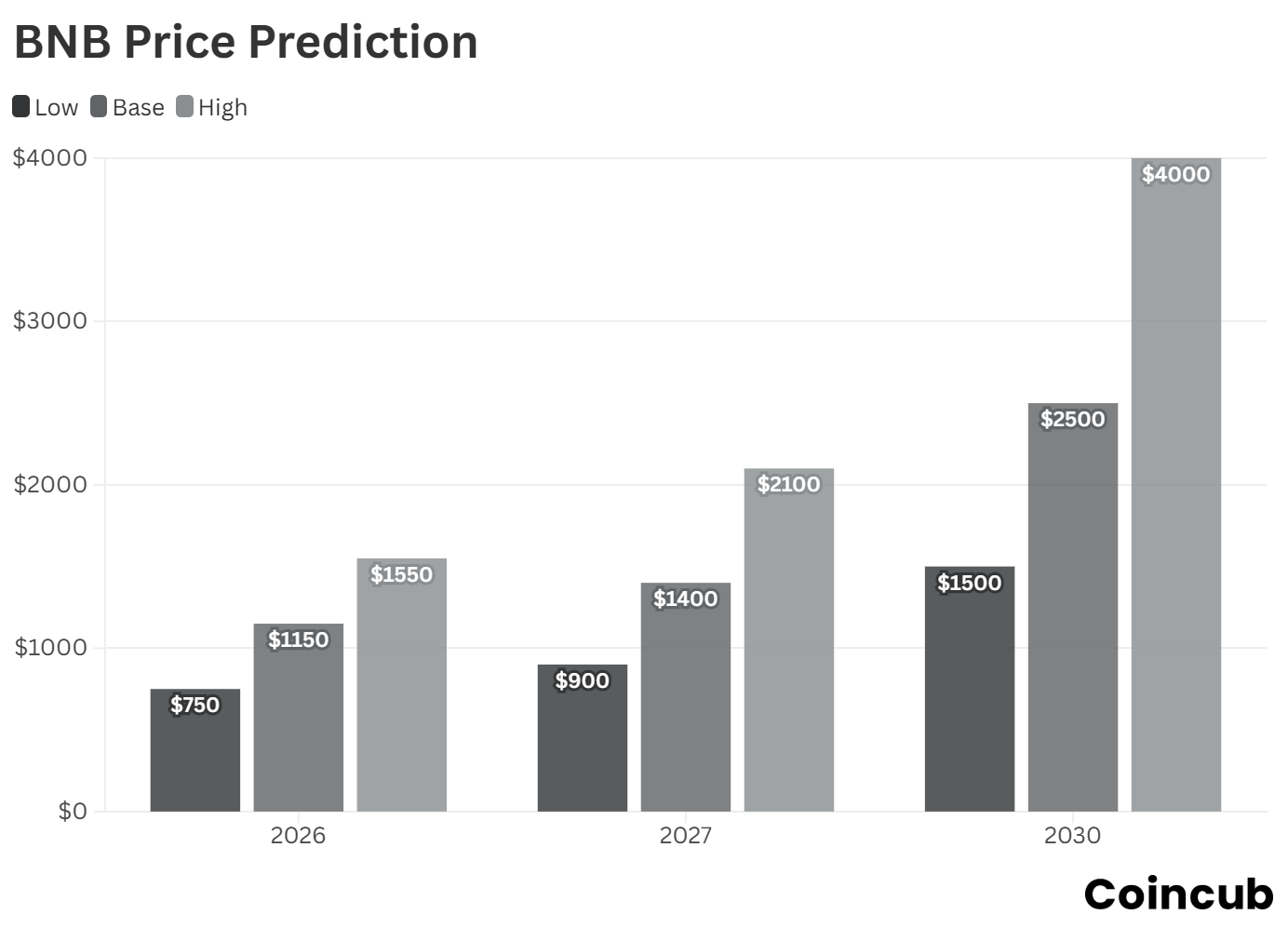
The low side reflects a scenario where the broader market rolls over, volumes and burns slow, and regulators reopen pressure in other regions. The base case assumes BNB defends strong support in the 800-900 range, pushes back into four-figure territory and treats new highs as a process, not a straight line. The upper band leans on a strong late-cycle extension, with Bitcoin moving toward the 150k region and BNB riding a renewed CeDeFi and AI-on-BNB narrative.
There is no magic in these numbers. They simply extend 2025 trends into one more year, with a discount for headline risk and competition.
BNB Price Prediction 2027-2028
If burn rates stay anywhere near current levels and BNB Chain maintains its activity, total supply could be sitting close to that 100 million mark by 2027 or 2028. At that point, the market is no longer speculating about future burn potential. The hard cap is essentially realized, and any new demand has to express itself through price rather than through expanding float.
In a soft environment, BNB can still hold value better than inflationary peers. The constant small burns from BEP-95 and whatever remains of Auto-Burn would be enough to offset passive selling from older holders if new inflows continue at a moderate pace.
In a healthy growth environment, with Binance still leading global spot and derivatives volume and BNB Chain remaining a top destination for memecoins, mid-cap DeFi, gaming and agents, the market has a reason to pay a premium for an asset that behaves like a leveraged bet on that combined revenue stream.
You can view this as an average across both years. A sluggish macro backdrop, tougher competition from Solana and Ethereum L2s, and renewed political noise around Binance would pull BNB toward the lower end, even with solid burns. A neutral to positive backdrop, where BNB Chain keeps at least its current share of stablecoin and DEX activity, justifies the middle of the band. A strong scenario, where opBNB and Greenfield actually gain share and Binance deepens its link to institutions and structured products, makes the 2,000-plus region reasonable.
The key point is that by then BNB’s main job is to maintain relevance. If it does, the burn mechanics do the rest.
BNB Price Prediction 2029-2030
For any BNB forecast 2030, you are effectively betting on whether three things are still true by the end of the decade:
Binance still matters as a trading venue. BNB Chain and its L2s still matter as places people actually use. Regulators have moved from headline-grabbing cases to dull supervision and licensing.
If those conditions hold, BNB becomes a scarce asset that captures a share of crypto’s overall growth, because its supply will be sitting near or at the terminal 100 million mark, and its role in the ecosystem will be well set. In that scenario it behaves like the “central bank” token of Binance’s world. Trading fees, listing fees, DeFi volume, stablecoin activity and storage fees all intersect with BNB at some point.
The low side fits a world where Binance remains relevant but loses some dominance to other exchanges, BNB Chain competes in a more crowded field, and the overall crypto market grows slower than current bulls hope. The mid-range fits a situation where crypto market cap is several times larger than today, BTC and ETH sit higher in absolute terms, and BNB slots in as a durable top-three or top-four asset by value. The upper range calls for a full risk-on outcome, with crypto in the tens of trillions, Binance entrenched as a core piece of market infrastructure, and BNB seen as a yield-adjacent, burn-driven asset warranting a significant valuation.
Again, the risk caveat matters. A new global crackdown explicitly targeting BNB, a structural failure on BNB Chain, a major hack that triggers lasting exchange-wide withdrawal freezes or a collapse in Binance’s volumes would all justify cutting these ranges sharply.
How BNB Stacks Up Against Other Majors
It helps to zoom out and see where BNB sits in the broader L1 and platform token field.
Ethereum has roughly 120 million ETH outstanding, a fee-burning mechanism that can turn the asset mildly deflationary when on-chain activity is high, and the largest DeFi and NFT base. Solana has a significantly larger circulating supply and a non-trivial inflation schedule, but has become the go-to chain for memecoins and high throughput apps. TON has a multi-billion token supply and inflation, anchored in Telegram’s distribution advantage.
BNB, with something like 140 million in circulation today and a clear run toward 100 million, is the only one in that group with a mechanically shrinking float tied both to CEX revenue and on-chain usage. It also consistently sits near the top in stablecoin volume and DEX activity. That combination of real revenue, low fees, heavy retail flow and hard supply is why many long-term holders see it as one of the cleanest risk-reward profiles in the top ten, even after accounting for regulatory baggage.
The main structural weakness is decentralization. BNB Chain still relies on a small validator set and has tighter links to a single corporate entity than Ethereum or Bitcoin, which is why purists give it a lower score. Whether the market keeps rewarding speed and user experience over that concern is an open question, but up to now users have clearly voted with their transactions.
Investment Conclusion
BNB is not a neutral asset. When you hold it, you are accepting both the upside of Binance and BNB Chain and the downside of their history and structure.
In practice, BNB suits investors who already use Binance or BNB Chain, understand how the ecosystem works and are comfortable with volatility that is driven as much by courtrooms and policy shifts as it is by charts. It can serve as a core position for people who want exposure to CeDeFi, stablecoin and retail flow, and are willing to take more headline risk than they would with Bitcoin or a more neutral L1.
It is less suited for anyone building a portfolio that needs maximum regulatory neutrality or wants to avoid any asset with a history of enforcement headlines. Those investors will usually feel more comfortable focusing on BTC, ETH and a broad set of more decentralized L1s and L2s.
As always, none of this is financial advice. It is a structured way to think about BNB price prediction 2026-2030, balancing the strength of the Auto-Burn and BNB Chain ecosystem against the reality that BNB will always trade with some degree of “Binance risk” baked in.