Buy a Licensed Company
  Explore VASP Data
  Talk to an Expert

 Atis Shala
Atis is a senior analyst and community lead with four years of experience in crypto. He has a bachelor from the Rochester Institute of Technology.
Atis Shala
Atis is a senior analyst and community lead with four years of experience in crypto. He has a bachelor from the Rochester Institute of Technology.
Crypto Inheritance Tax: Transferring Assets Abroad

The rise of crypto has reshaped how people build and preserve wealth. Crypto now sits alongside real estate, equities, and cash as a significant component of modern portfolios. As adoption grows, investors face a new responsibility. They must plan how their digital wealth will transfer to the next generation. Traditional estate planning tools do not always fit the structure of blockchain based assets, which depend on private keys, decentralized networks, and global exchanges.
This shift becomes even more complex when investors hold or move crypto across borders. Many seek countries with clearer regulations, lighter tax burdens, or stronger asset protection. Others relocate their holdings simply because major exchanges operate globally. These choices create tax consequences that differ sharply from one jurisdiction to another.
Crypto inheritance tax stands at the center of this conversation. Tax authorities want clear records while families want secure access. Investors want predictable rules that protect their assets without triggering unnecessary obligations. As crypto circulates across borders, the decisions investors make today will define how efficiently their heirs receive those assets in the future.

What Does Crypto Inheritance Tax Mean?
Crypto inheritance tax refers to the set of rules that govern how authorities treat cryptocurrencies when an investor dies. Most tax systems already impose levies on inherited wealth. As crypto becomes a mainstream store of value, governments have started applying those rules to tokens held in wallets, exchanges, or custody platforms. The core idea remains simple. When ownership passes from the original holder to an heir, the state may require a tax payment based on the value of the inherited crypto.
Tax agencies classify cryptocurrencies in different ways, and these classifications shape the final tax burden. Some countries treat crypto as personal property. Others categorize it as a financial asset or even a commodity. These labels matter because each category follows its own valuation method, reporting requirement, and tax threshold. For example, property classifications usually trigger estate or inheritance tax. Commodity classifications often fall under capital gains rules. Asset classifications may combine both.
A taxable event often arises at the moment of death, when authorities assess the fair market value of the crypto portfolio. They use price data from reputable exchanges to determine this value. Additional triggers can appear when the estate liquidates holdings, transfers tokens across borders, or redistributes wallets among multiple heirs. If the deceased lived in one country but stored crypto abroad, more than one jurisdiction may claim taxing rights. This creates a complex path that demands clear records, accurate valuations, and careful estate planning.
Key Components of Crypto Inheritance Tax
Asset valuation rules: authorities determine the fair market value of the crypto portfolio at the time of death. They rely on price data from reputable exchanges and expect consistent records that show how those values were measured.
Residency criteria: tax agencies use residency or domicile to decide which jurisdiction has the right to tax the inheritance. Some focus on the deceased’s physical residence. Others examine long-term economic ties or citizenship.
Reporting requirements: heirs must disclose inherited crypto through formal tax filings. Proper documentation and timely submissions reduce the risk of penalties or contested valuations.
Custody and ownership verification: clear proof of ownership supports a smooth transfer. Wallet histories, exchange statements, and key management instructions help authorities confirm that the crypto belonged to the deceased.
Growing Trend of Transferring Crypto Abroad
Investors increasingly move their crypto abroad as part of long-term wealth planning. Global custody options, international exchanges, and crypto-friendly jurisdictions make it easier to store tokens outside the investor’s home country. Many see this approach as a way to secure regulatory stability or reduce exposure to sudden policy shifts that affect taxation or access.
Tax efficiency drives a large share of this trend. Some countries impose high inheritance taxes, while others apply none. Investors who relocate their holdings often want to position their heirs in a more predictable environment. They look for jurisdictions with clearer rules, lower rates, or established legal frameworks for managing and distributing crypto. This search for stability encourages investors to compare regulatory climates before deciding where to store their assets.
Other motivations revolve around privacy and infrastructure. Some jurisdictions offer stronger data protection laws or more advanced custody services. Investors who manage large portfolios sometimes diversify geographically to reduce counterparty risk. They may spread assets across multiple exchanges or custody providers to limit exposure to a single point of failure.
These cross-border movements create an important reality. Shifting crypto abroad does not eliminate tax obligations. It simply changes where those obligations arise. Investors must understand reporting rules in both their home country and the foreign jurisdiction. Clear documentation and compliant transfers protect heirs from costly disputes and ensure that the inheritance process unfolds smoothly.
Jurisdictional Differences That Affect Crypto Inheritance Tax
Countries approach crypto inheritance in very different ways. Some apply traditional estate or inheritance tax rules to cryptocurrency without creating dedicated frameworks. Others classify crypto in categories that shape how the final tax burden is calculated. These variations create a patchwork of global policies. Investors who store or transfer their crypto abroad must understand how each jurisdiction defines ownership, location, and taxable value.
Some countries impose high inheritance taxes on worldwide assets. Others apply no inheritance tax at all. A few offer favorable conditions for foreign investors, yet still require clear reporting. These differences influence how heirs gain access to wallets, how authorities assess value, and whether more than one country can claim taxing rights. The lack of harmonized global standards means that a cross-border crypto portfolio can fall under multiple sets of rules at once.
Jurisdictions and Their Inheritance Tax Treatment
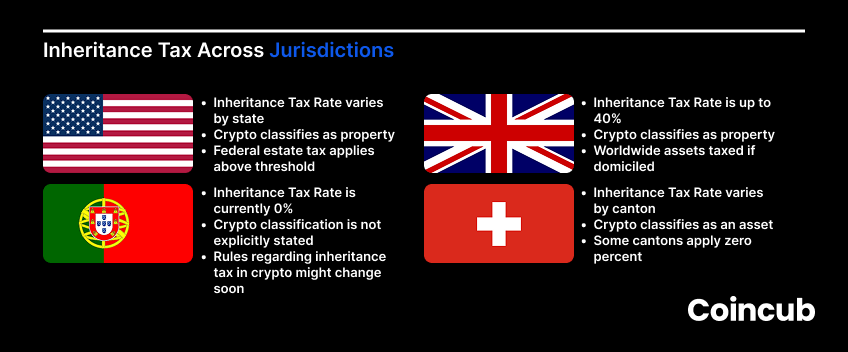
Domicile plays a central role in this process. Domicile reflects long-term ties rather than short-term residence. Many countries tax worldwide assets when the deceased is considered domiciled there. Residency, which refers to physical presence or tax status, can also trigger obligations, especially when the investor lived in a country that taxes foreign holdings.
Exchange location creates another layer of complexity. Some authorities view custodial holdings as assets located in the country where the exchange operates. Others focus on the investor’s residence at the time of death. When crypto is stored in a foreign exchange or trust structure, it may fall under both jurisdictions. Clear planning and documented ownership reduce the risk of double taxation and ensure that heirs receive their crypto without disputes.
How Crypto Is Treated in Cross-Border Estate Planning
Cross-border estate planning introduces a complex layer of rules that determine where crypto becomes taxable and which authorities hold jurisdiction. Tax agencies first examine the deceased’s residency and domicile. These factors often outweigh the physical location of the assets because many countries tax worldwide holdings. Some authorities also consider where the exchange or custodian operates. If a wallet or account sits under the legal structure of a foreign country, that country may claim taxing rights as well.
Valuation plays a key role in this process. Authorities assess the value of the crypto portfolio at the moment of death. They rely on market rate snapshots from reputable exchanges to create a consistent baseline. These snapshots help tax agencies calculate inheritance liabilities and prevent disputes between jurisdictions with different valuation methods. Because crypto trades globally and around the clock, timing and source selection matter. Estate planners often store historical prices and exchange logs to support accurate reporting.
Blockchain records help establish ownership, transaction history, and asset location. Courts and tax authorities increasingly accept on-chain data as part of the legal documentation. These records verify that the deceased held the assets, confirm wallet control, and show when transfers occurred. For cross-border cases, blockchain transparency simplifies the process because it provides a unified source of truth.
Documents Needed for Cross-Border Crypto Estates
Wallet address records: these confirm which wallets belonged to the deceased and allow authorities to verify balances and transaction history.
Exchange statements: these provide trading activity, custodial balances, and valuation data that support accurate tax assessments.
Key succession instructions: these explain how heirs can access the crypto without exposing private keys during the original owner’s lifetime.
Legal proof of ownership: these documents link the technical evidence to a recognized legal framework, such as wills, trusts, or custody agreements.
Methods for Transferring Crypto Assets Abroad Before Death
Investors use several strategies to position their crypto in jurisdictions that offer clearer rules or more favorable tax treatment. The most common approach involves shifting holdings to foreign exchanges. These platforms often provide stronger regulatory clarity and structured reporting, which simplifies future inheritance procedures. Others prefer foreign custodial services that specialize in long-term storage. These services may operate in jurisdictions with stable legal environments and predictable inheritance frameworks.
Some investors take a more formal path by creating offshore trusts or foundations. These structures allow them to define how their crypto will transfer to heirs while maintaining control during their lifetime. Trusts often provide a legal buffer that separates personal residency risks from asset location. Corporate structures serve a similar purpose. Investors can route their holdings through companies registered in crypto-friendly countries to achieve better administrative oversight.
Migrating tax residency represents a broader strategy. Investors who relocate to low-tax jurisdictions may reduce the burden their heirs face. This approach requires careful planning because authorities examine economic ties, physical presence, and long-term intent. Each method carries legal responsibilities, and none guarantee tax avoidance. Well-structured planning ensures that cross-border transfers stay compliant while preserving the investor’s long-term goals.
| Method | Description |
| Moving assets to foreign exchanges | Provides access to stable regulatory environments and clearer reporting. |
| Storing crypto in custodial services located abroad | Offers long-term storage under predictable legal frameworks. |
| Establishing offshore trusts or foundations | Defines inheritance rules and separates personal residency from asset location. |
| Using corporate structures in crypto-friendly jurisdictions | Transfers ownership through entities that benefit from favorable regulations. |
| Migrating tax residency | Reduces long-term tax exposure by relocating to low-tax jurisdictions. |
Estate Planning Tools for Crypto Investors
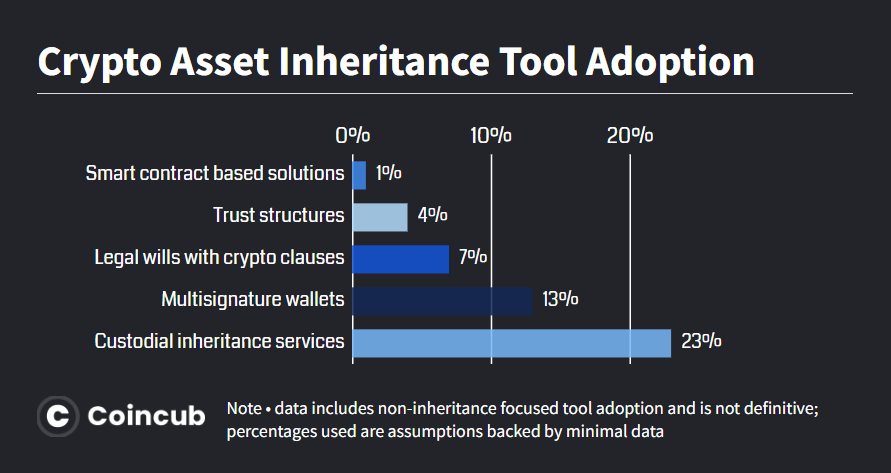
Estate planning for cryptocurrency requires a blend of legal structure and technical precision. Traditional wills alone rarely provide enough detail to manage private keys, multisig setups, or exchange accounts. Investors rely on a range of tools that create secure pathways for heirs without exposing sensitive information during their lifetime. Multisignature wallets stand at the center of many plans because they distribute control across several keys. This reduces the risk of loss while allowing designated heirs to participate in the recovery process.
Smart contract based inheritance systems offer another option. These protocols can release crypto to heirs once certain conditions are met. Some use time-locks. Others require off-chain verification from trusted parties. Investors who prefer a hands-off method often turn to custodial inheritance services. These providers manage asset storage, verification, and transfer under established legal agreements.
Legal documentation ties all these technical tools together. A properly structured estate plan includes clear instructions, recognized by local law, that describe how heirs can claim and manage the assets. This alignment between law and technology prevents disputes and ensures compliance across jurisdictions.
Risks of Crypto Inheritance Tax
Cross-border crypto inheritance planning carries several risks that can jeopardize the transfer of assets if investors fail to prepare. One of the most common issues involves double taxation. When the investor’s domicile differs from the location of the exchange or custodial service, both jurisdictions may claim taxing rights. This creates overlapping obligations that heirs must resolve quickly. Misinterpreting residency rules can also trigger penalties, especially when tax agencies argue that the deceased maintained stronger ties to a country than expected.
Reporting requirements add another challenge. Some jurisdictions require heirs to declare inherited crypto within strict timelines. Others expect detailed valuation breakdowns that must match exchange records. Incomplete submissions can delay probate or cause authorities to question the legitimacy of the holdings. Key management poses an even greater risk. If private keys remain inaccessible, heirs cannot recover the assets regardless of legal rights. Poor documentation, untested recovery plans, and unknown wallet locations often lead to permanent loss.
Scams and unregulated offshore services create additional vulnerabilities. Investors who move crypto abroad may face service providers that operate without oversight. These operators can mismanage assets or block heirs from accessing funds. Clear due diligence, strong legal documentation, and secure technical planning help prevent these outcomes. A well-structured strategy protects both the value of the estate and the long-term interests of beneficiaries.
Strategic Approaches for Legal and Efficient Crypto Inheritance
A strong inheritance plan requires coordination between legal, tax, and technical components. Investors benefit when they work with advisors who understand both crypto and international taxation. These professionals help select jurisdictions with consistent regulation and predictable tax frameworks. Jurisdictions that support clear crypto custody rules, enforce transparent tax policies, and maintain stable regulatory environments reduce risk for heirs and simplify probate.
Security remains essential. Investors must ensure that private key arrangements align with the legal structure of the estate. A multisig setup, for example, should match the estate documents so heirs can access the necessary keys without breaking compliance rules. Trusts or corporate structures must follow the laws of both the home country and the foreign jurisdiction. Clear instructions, well-documented ownership paths, and secure storage prevent disputes and reduce administrative burdens.
Long-term planning also matters. Investors should review jurisdictional changes regularly because crypto tax regulations often evolve quickly. A jurisdiction that offers low taxes today may change its policy in the future. A balanced approach combines tax efficiency with regulatory stability. This strategy ensures that heirs receive the intended value without facing unexpected obstacles or legal conflicts.
Frequently Asked Questions (FAQ)
How is crypto taxed when inherited?
Inherited crypto as property or an asset in most jurisdictions. The tax owed depends on the value at the time of death and the country’s inheritance or estate tax rules.
Can heirs access crypto stored in a private wallet?
Yes, but only if they have the necessary key information or multisig authorization. Without proper documentation, the assets may be lost permanently.
Does transferring crypto abroad reduce inheritance tax?
Not always. Some jurisdictions still tax global assets based on residency or domicile. Moving assets abroad may shift obligations but does not eliminate them.
Are offshore exchanges safe for long-term storage?
Some operate under strong regulations, but many do not. Investors must evaluate licensing, custody standards, and legal protections before choosing an offshore exchange.
Do smart contract based inheritance tools hold legal weight?
Smart contract based inheritance tools automate technical transfer conditions, but legal enforceability depends on the jurisdiction. Most investors pair them with traditional legal documents to ensure recognition.