


 Buy a Licensed Company
 Explore VASP Data
 Talk to an Expert

EU Regulator Finds USDT Leads Borrowing on Four DeFi Lenders
The European Banking Authority found Tether’s USDT led stablecoin borrowing on four of six DeFi lending protocols and repeated its call for the European Commission to weigh safeguards for crypto firms offering DeFi access.

The European Banking Authority (EBA) said on Nov. 25 that Tether’s USDT led stablecoin borrowing on four of the six decentralized lending protocols it reviewed. The EBA also repeated its call for the European Commission to assess extra rules for crypto firms that give customers access to such lending.
- USDT, counted with its bridged version USDT0, led stablecoin borrowing on Aave, Fluid, and Spark in a July 30 snapshot, and JustLend borrowers overwhelmingly chose USDT.
- USDC held a larger share of active loans than USDT on Compound and Morpho.
- USDT lacks authorization under MiCA, the EU’s crypto rulebook.
What the EBA found on six lending protocols
The EBA, the European Union’s banking regulator, compared stablecoin borrowing across six decentralized finance (DeFi) lending protocols using data from July 30. DeFi refers to financial services run by software on a blockchain, with no company in the middle.
On Aave, Fluid, and Spark, the regulator counted USDT together with USDT0, a bridged version that moves the token across blockchains. Borrowers on JustLend overwhelmingly chose USDT, which the EBA linked to Tron, the blockchain JustLend runs on. USDC held a bigger share of active loans than USDT on Compound and Morpho.
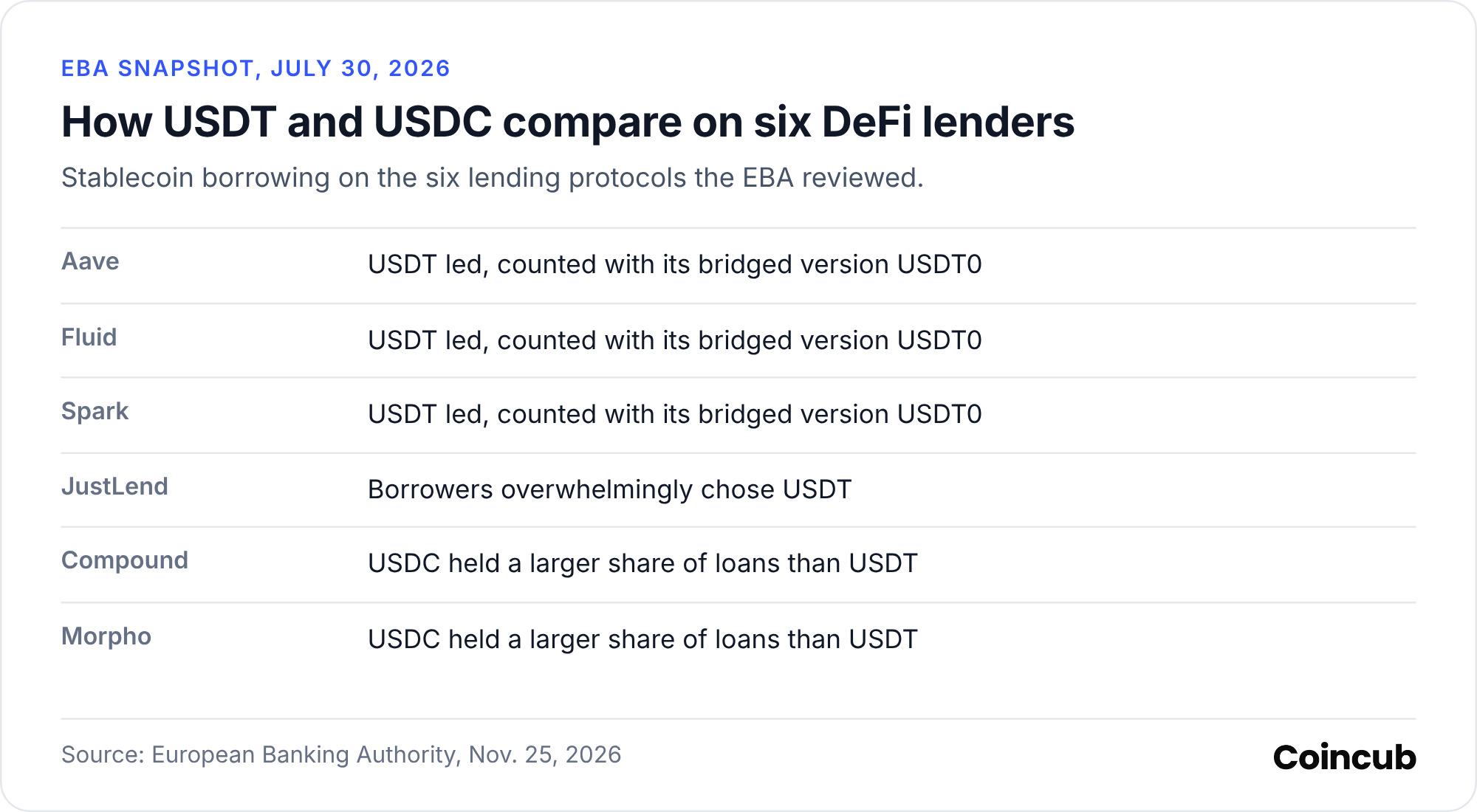
The data does not show where borrowers are based, since people typically reach DeFi through self-hosted wallets. The EBA said EU consumer use of DeFi remains limited.
Access is getting easier, according to the EBA. Crypto-asset service providers (CASPs), the firms licensed under MiCA, increasingly help customers reach DeFi and offer products tied to it. AI tools, including AI agents, are also lowering the barrier to entry.
Why USDT matters under MiCA
The Markets in Crypto-Assets Regulation (MiCA) is the EU’s crypto rulebook. It requires covered stablecoins to be authorized before they are offered to the public or admitted to trading in the EU. USDT lacks that authorization.
MiCA excludes services provided without an intermediary in a fully decentralized manner. The EBA flagged the use of DeFi to offer non-MiCA tokens to the public in the EU as a consumer protection and regulatory arbitrage concern.
What the EBA wants from the European Commission
The EBA recommended that the Commission assess whether extra requirements should apply to CASPs that facilitate access to DeFi, particularly lending protocols. The recommendation repeats the EBA’s September response to the Commission’s MiCA review.
In that response, the EBA listed options such as suitability checks, more disclosures, and leverage limits. It also raised restrictions on lending or borrowing tokens that need MiCA authorization but lack it. It asked the Commission to weigh the costs and benefits first. None of these options has been adopted.
The EBA said it will keep monitoring stablecoin use in DeFi and give the Commission further technical input as needed.