


 Buy a Licensed Company
 Explore VASP Data
 Talk to an Expert

 News Room
Admin Coincub
ECB to Accept Blockchain-Issued Assets as Collateral in 2027
The European Central Bank approved accepting assets issued on DLT Pilot Regime-licensed platforms as Eurosystem collateral, with detailed requirements due in spring 2027 and implementation planned for June 2027.

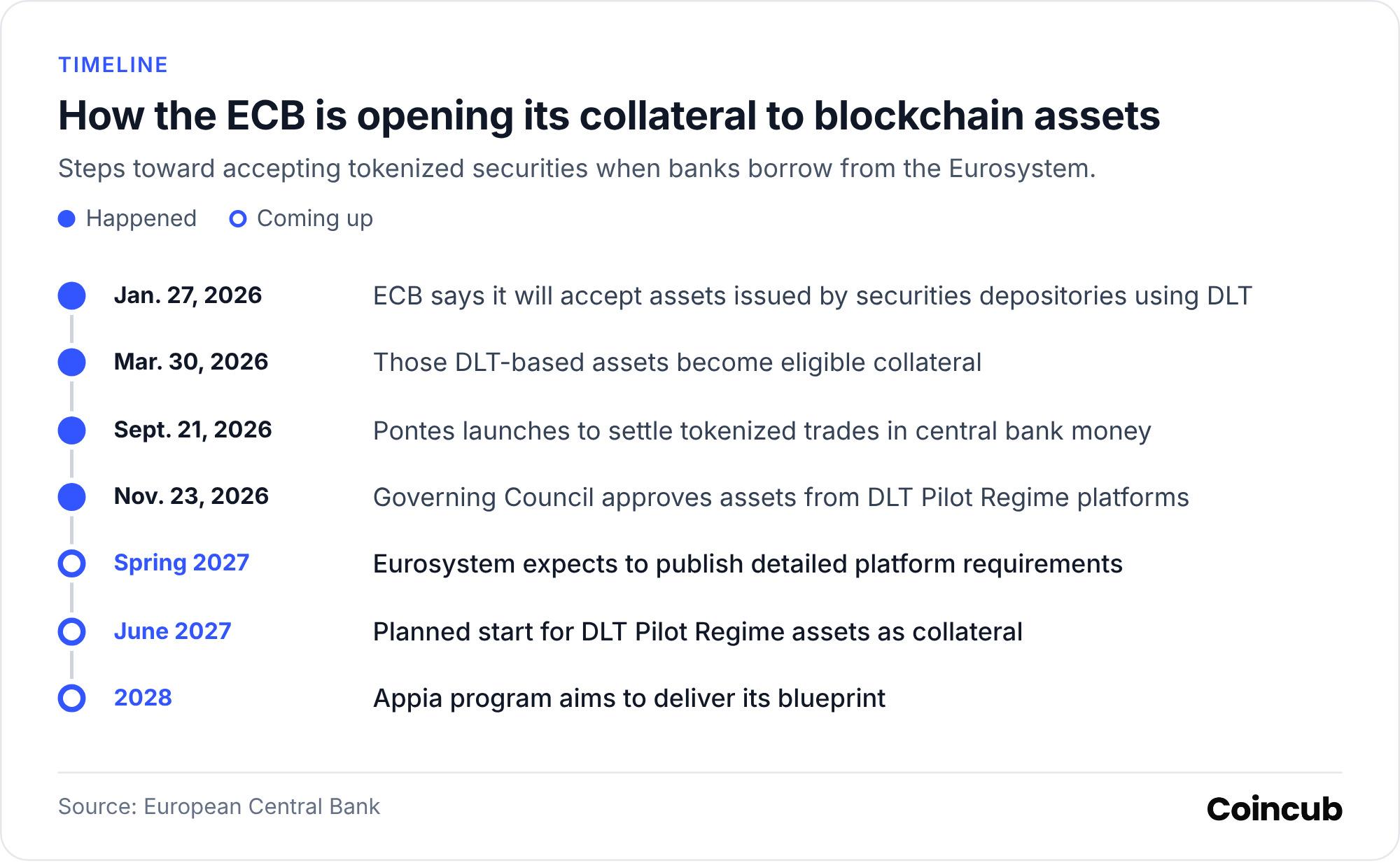
The European Central Bank (ECB) will accept securities issued on blockchain platforms licensed under the EU’s DLT Pilot Regime as collateral when banks borrow from the Eurosystem. The ECB’s Governing Council approved the step on Nov. 23, and the change is planned to take effect in June 2027.
- Eligible assets must come from a DLT Pilot Regime platform and settle through TARGET2-Securities, the Eurosystem’s system for settling securities trades.
- The Eurosystem expects to publish detailed requirements for the platforms in spring 2027.
- The decision builds on a Jan. 27 announcement that made assets issued by securities depositories using DLT eligible from March 30.
What the ECB decided
Distributed ledger technology (DLT) platforms are shared record-keeping systems such as blockchains. The EU’s DLT Pilot Regime lets licensed operators run trading and settlement systems for securities on them. Securities issued on these platforms can now back loans from the Eurosystem, as long as they meet its requirements.
The Eurosystem is the ECB plus the central banks of the countries that use the euro. The ECB called the decision one step in a plan to make its collateral rules fit tokenized markets.
Requirements for assets and DLT platforms
The assets must meet all the usual collateral rules. Banks must pledge them through an eligible link to a central securities depository (CSD), the institution that records and settles securities. That CSD’s settlement system must comply with the EU’s Central Securities Depositories Regulation and settle in TARGET2-Securities.
Platforms will also need more than their DLT Pilot Regime license. They must meet Eurosystem rules on legal certainty and operational safety. The ECB gave two examples, a formal designation that makes settlements final and rules on outsourcing critical functions. It expects to publish the details in spring 2027.
Why the ECB is moving now
The decision follows the Eurosystem’s launch of Pontes on Sept. 21. Pontes links market DLT platforms with the Eurosystem’s TARGET services, so tokenized wholesale trades can settle in central bank money. Appia, the Eurosystem’s longer-term program for tokenized wholesale markets, aims to deliver a blueprint by 2028.
“We support innovation without lowering our standards,” said Isabel Schnabel, a member of the ECB’s Executive Board. Fellow board member Piero Cipollone said, “Pontes and Appia are helping turn Europe’s vision for tokenised finance into reality.”
What comes next
The ECB also plans to look at accepting assets that are issued and settled entirely on blockchain networks. It gave no timeline for that step.