Buy a Licensed Company
 Explore VASP Data
 Talk to an Expert

 News Room
Admin Coincub
Russia Lets Exchanges Trade Crypto From Nov. 22 With Retail Cap
Russia’s central bank lets approved exchanges begin crypto trading from November 22, capping retail buyers at 300,000 rubles a year per intermediary. Sanctioned Moscow Exchange plans a December 1 pilot.
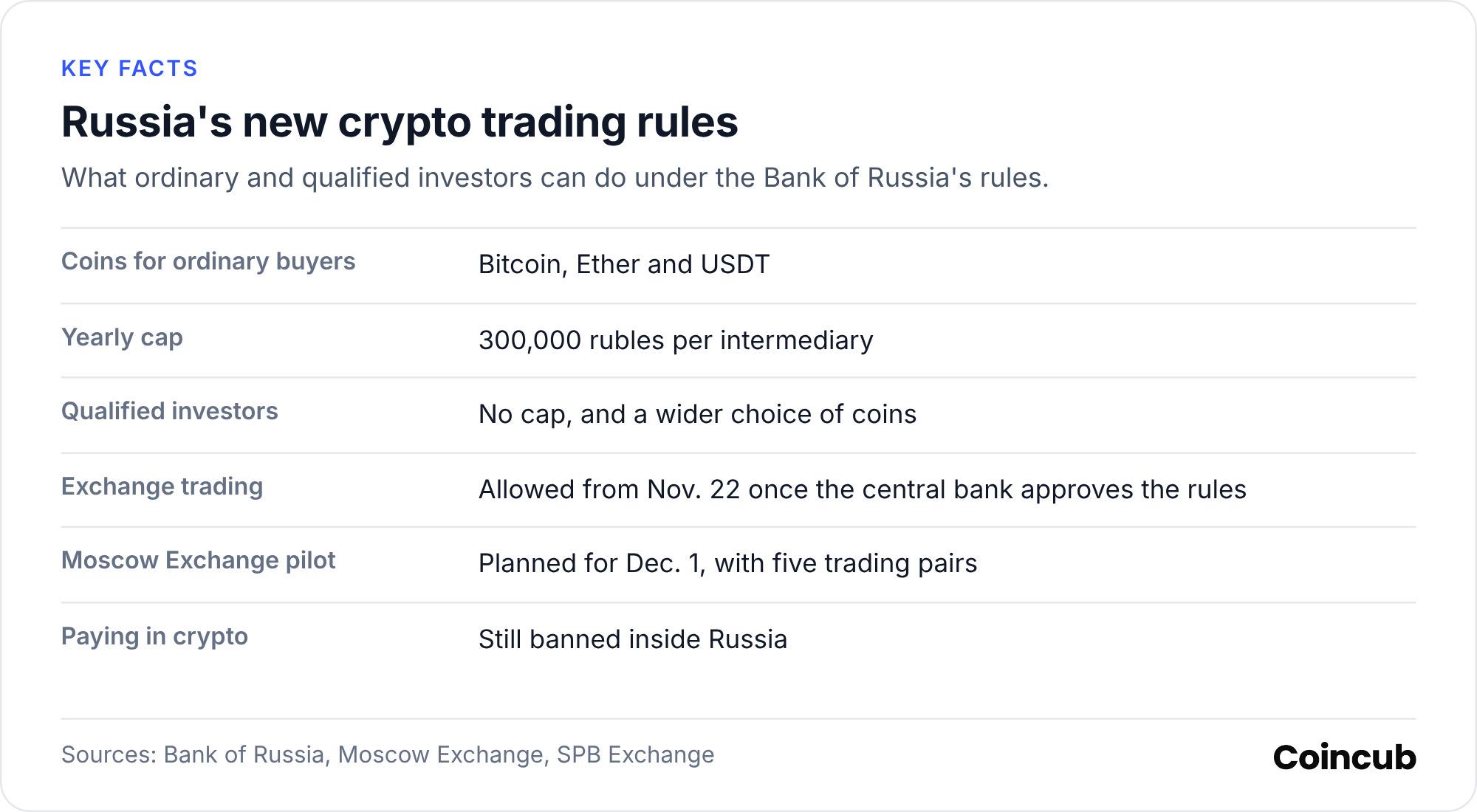
Russian exchanges can start trading crypto from Nov. 22 under a Bank of Russia ordinance, once the central bank approves their trading rules. Ordinary buyers can spend up to 300,000 rubles ($3,600) a year per intermediary, and the Moscow Exchange plans to start trading on Dec. 1.
- The Bank of Russia had not publicly named an approved exchange by Nov. 22. SPB Exchange has bitcoin, ether and USDT pairs in a test environment and has filed its rules.
- Retail rules took effect on Nov. 17 and limit ordinary buyers to bitcoin, ether and USDT.
- The Moscow Exchange will clear trades through its National Clearing Center, which the US Treasury sanctioned in June 2024.
What the Bank of Russia’s ordinance allows
The ordinance sets the requirements for organized trading in digital currencies and digital rights. The Justice Ministry registered it on Nov. 3, and the central bank published it on Nov. 11. Each exchange must agree its trading rules with the Bank of Russia before it can start. Exchanges must also register the brokers, trust managers and central counterparties that trade on them.
The rules sit under Federal Law No. 282-FZ on digital currencies and digital rights, dated Aug. 4. Its main provisions took effect on Sept. 1 and set up Russia’s crypto framework. Firms already registered have until Sept. 1, 2027, to bring their operations fully in line.
Crypto still cannot be used to pay for goods and services inside Russia. Exporters and importers may use it to settle cross-border trade.
How the 300,000-ruble cap works
Directive No. 7441-U took effect on Nov. 17. It lets ordinary investors buy bitcoin, ether and USDT through licensed intermediaries after they pass a knowledge test. Each intermediary can sell a client up to 300,000 rubles of crypto a year. The cap counts the rubles spent on purchases, so later price moves do not change it.
Qualified investors face no yearly cap and can buy a wider range of coins. They also have to pass a test and review the risks before trading.
The Moscow Exchange’s Dec. 1 pilot
The Moscow Exchange said on Nov. 2 that it will start crypto trading on Dec. 1, with pilot deals as participants connect. Trading will run from 6:50 a.m. to 11:50 p.m. Moscow time on the exchange’s existing systems. The launch list has five trading pairs, and bitcoin, ether and USDT each trade against the ruble.
The National Clearing Center will clear the trades, and partner digital depositories outside the exchange group will hold the coins. Brokers will give clients access, and short selling is banned at first. Moscow Exchange executive Boris Blokhin said brokers need no extra licenses to take part.
The exchange already runs crypto futures for qualified investors. It said on Sept. 16 that turnover had passed 600 billion rubles ($7.3 billion), with more than 72,000 qualified investors taking part.
Sanctions questions over USDT
The US Treasury’s Office of Foreign Assets Control designated the Moscow Exchange, the National Clearing Center and the National Settlement Depository on June 12, 2024. The UK sanctioned the exchange the same month, and the EU added it to its list in July 2026.
Tether, which issues USDT, freezes wallets linked to people and firms on US sanctions lists. Neither Tether nor the Moscow Exchange has said publicly how USDT held through the sanctioned clearing house will be treated.