Buy a Licensed Company
  Explore VASP Data
  Talk to an Expert

 Atis Shala
Atis is a senior analyst and community lead with four years of experience in crypto. He has a bachelor from the Rochester Institute of Technology.
Atis Shala
Atis is a senior analyst and community lead with four years of experience in crypto. He has a bachelor from the Rochester Institute of Technology.
Perpetual Futures Funding Rates: 78% of a Quarter at 0.01%

- A funding print carries five exchange choices, covering the interest component, the measurement depth, the clamp width, the cap and the settlement interval.
- With a 0.01% interest component and a 0.05% clamp, any average premium from minus 0.04% to plus 0.06% returns exactly 0.01%.
- Binance, Bybit and OKX shorten the settlement interval at the funding cap, turning an eight-hour series into an hourly one.
- Open interest sits nowhere in the funding formula, since the calculation reads executable bids and offers against a spot index.
- Price convergence supplied 63% of the Bitcoin arbitrage return and 65% of Ether’s.
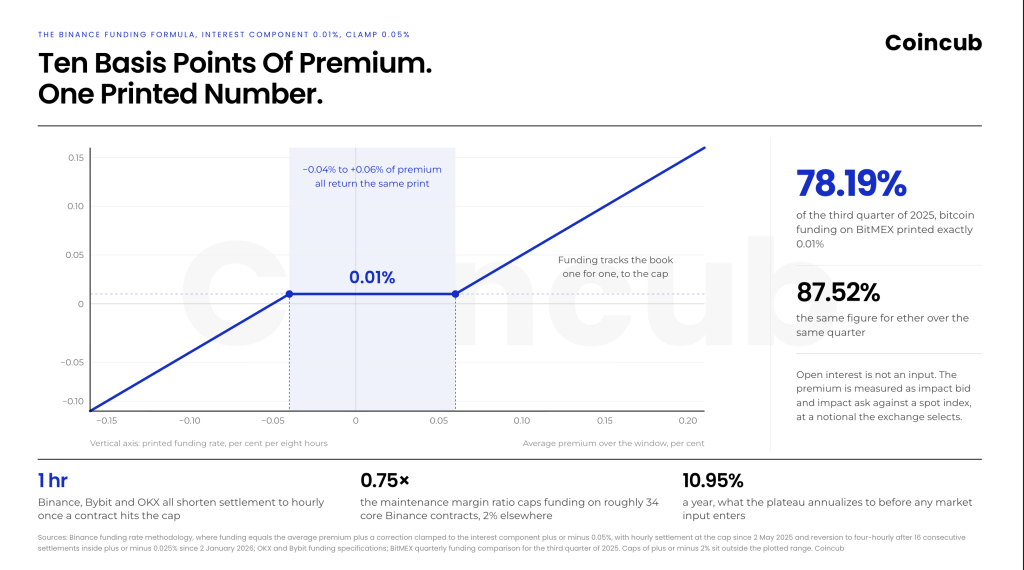
On BitMEX, the bitcoin perpetual funding rate printed exactly 0.01% for 78.19% of the third quarter of 2025. Ether printed the same figure 87.52% of the time. That repetition comes out of the formula every large venue runs. Each one combines a fixed interest component with a premium index, clamps the distance between the two, and returns the interest component untouched whenever the premium sits inside a narrow band.
The funding rate is a control output. An exchange picks the interest component, picks the order-book depth the premium is measured at, picks the clamp width, picks the cap, and picks how often the payment settles. It can change the settlement clock mid-week when a contract gets stressed. All five choices sit between the order book and the number on a trading screen.
A funding print read as a positioning signal therefore carries a smoothed and censored view of the book. Funding history pooled across venues mixes different clocks and different censoring thresholds. And a funding-capture book earns most of its money from the basis closing, with the funding leg as the smaller line.

How exchanges calculate the funding rate
A fixed interest component stands in for the cost of carry, and a premium index measures how far the perpetual trades from a spot index. Binance sets the interest component at 0.01% per eight hours. OKX uses the same 0.01% and holds it fixed across every settlement interval it offers, dividing by eight over the interval length to get the charge.
The design choices concentrate in premium construction. Binance does not read the last traded price. It computes an impact bid and an impact ask, the average fill prices for executing a set notional against the resting book, and measures both against the price index. That notional is 200 USDT divided by the initial margin rate at the contract’s maximum leverage. OKX writes the same idea from the other end, with an impact value of 200 times the maximum leverage allowed on the contract.
The premium is therefore a depth measurement, taken at a size the exchange selected and averaged on a schedule the exchange selected. Binance samples every five seconds and time-weights 5,760 observations across an eight-hour window. OKX builds a linearly weighted moving average from 480 one-minute observations over the same window, so the last minutes before settlement carry more weight than the first. Two books in identical shape can therefore settle at different rates depending on when during the window the imbalance appeared.
Open interest, long-short ratios and liquidation volume are absent from the calculation. Every open contract carries a long and a short, and a record open interest print is compatible with a market paying almost nothing to hold leveraged length. Funding moves when executable bids and offers move away from the index, and a crowded book shows up in funding only once it starts lifting offers.
The neutral band around 0.01%
Funding equals the average premium plus a clamped correction, where the clamp holds the interest component minus the average premium inside plus or minus 0.05%. Set the interest component at 0.01% and the result is a flat segment. Any average premium from minus 0.04% to plus 0.06% returns exactly 0.01%.
Outside the band the relationship turns linear. A premium above 0.06% returns that premium minus 0.05%, and a premium below minus 0.04% returns the premium plus 0.05%. Funding then tracks the book one for one until it reaches the cap. The transfer function has a flat middle, two linear wings, and a hard stop at each end.
Ten basis points of premium variation collapse into one printed number. That is the mechanical source of the BitMEX result above, and of the broader observation in the same report that funding was positive for over 92% of the quarter. The distribution is not Gaussian and should not be summarized as though it were. A mean and a standard deviation describe a shape with a spike at the interest component, a censored ceiling at the cap, and fat asymmetric tails during stress.
Useful summaries report the median, the share of observations sitting at the neutral value, the cap-hit frequency, and the 1st and 99th percentiles. The share of prints at the neutral value does the most work of the four, since it tells a modeler how much of the series carries market information at all, and on BitMEX in that quarter roughly four bitcoin observations in five carried none.
A 0.01% charge every eight hours is 10.95% a year on a simple basis. Hyperliquid publishes the identical component as 11.6% APR because its version compounds hourly. One parameter, two headline numbers, before any market input has entered.
Funding rate caps and settlement frequency
Binance sets the cap and floor for a named list of roughly 34 major contracts at 0.75 times the maintenance margin ratio, covering BTCUSDT, ETHUSDT, SOLUSDT and the rest of the core book. Every other USD-margined contract runs a flat cap of plus or minus 2%. Above that limit the printed rate stops tracking the book. A print sitting at the cap is a censored observation, and the funding pressure behind it is unobservable from the series.
Maintenance margin is the buffer a position keeps to survive, and tying the funding limit to a fraction of it bounds how fast a single settlement can eat that buffer. A venue that let funding run free would liquidate its own paying side through the funding mechanism during a squeeze.
Hourly Settlement
The clock then moves. Binance switches a contract to hourly settlement once the previous settlement hits the cap or floor, a rule live since 2 May 2025. Since 2 January 2026 it also publishes the way back, reverting from hourly to four-hourly on the seventeenth cycle after sixteen consecutive settlements inside plus or minus 0.025%. OKX escalates one step at a time through eight, four, two and one hour, and reverts only after funding has stayed within plus or minus 0.20% across 12 consecutive hours, judged at default schedule times.
| Venue | Interest component | Cap or floor | Behavior at the limit |
| Binance | 0.01% per eight hours | 0.75 times maintenance margin ratio on core contracts, 2% elsewhere | Hourly settlement, reverting to four-hourly after 16 cycles inside 0.025% |
| OKX | 0.01%, fixed across intervals | Set per contract | Escalates one step through 8h, 4h, 2h, 1h |
| Bybit | Published per contract | Preset upper and lower limit per contract | Switches to hourly settlement |
| Deribit | Mark against index with damping | Product specification | Accrues continuously |
| Hyperliquid | 0.01% per eight hours | 4% per hour | Pays hourly at one eighth of the rate |
Bybit runs the same escalation, switching a contract to hourly settlement once the funding rate reaches its preset upper or lower limit. Shortening the interval is a deliberate intervention. It raises the frequency of the corrective cash flow at the moment the crowded side is already under pressure, which is the point of the design and also the reason a naive series breaks. A contract pinned at its cap on the hourly schedule takes 24 capped charges in a day against three on the eight-hour schedule. A dataset with no interval field records an eight-hour charge where one hour was paid, and those rows cluster in the windows a researcher opened the dataset to look at.
Continuous accrual on Deribit and Hyperliquid
According to the CFTC’s description of the contract, Deribit calculates funding owed to or by position holders every millisecond. The rate runs off the mark price against the Deribit index, with product-level damping rates and caps applied. Each amount is scaled by the fraction of an eight-hour period that has elapsed, and margin obligations settle through the daily mark-to-market process.
It computes a rate on the familiar clamp architecture, pays one eighth of it every hour, and uses the oracle price for the notional conversion. Its outer limit is far looser than the centralized venues, capped at 4% per hour, which its own documentation describes as much less aggressive capping than exchange counterparts. The BitMEX quarterly comparison is consistent with that design, putting Hyperliquid at the highest mean funding rate and the widest dispersion of the venues measured, with bitcoin spikes above 0.067%.
The defensible method sums the realized period rates charged over the sample and scales by 365 divided by the number of days, which absorbs an interval that moved mid-sample. Multiplying every print by 1,095 assumes an eight-hour clock that several of these venues no longer keep.
Funding rates in 2020, 2021 and 2022
During March 2020, as liquidity evaporated in the first weeks of the pandemic, funding rates turned substantially negative on most exchanges. Shorts paid longs to hold the perpetual, because the perpetual was trading below spot while leveraged length unwound.
The early 2021 bull run inverted it. Funding turned highly positive as demand for leveraged long exposure ran ahead of the spot book, and the paying side stayed the paying side for months at a time. Persistence of that kind is what makes funding a poor timing signal on its own, since a rate can sit at an extreme for an entire quarter without a reversal arriving.
November 2022 is the more instructive episode. The FTX collapse drove significant negative funding across all solvent exchanges, with perpetual prices sitting below spot. Holders were selling perpetuals on venues they could still reach while spot inventory and collateral sat locked elsewhere. The sign held uniformly across the exchanges that stayed open, which is what a collateral event looks like in a funding series. Funding measured exit pressure and access to inventory that month.
Deviations from theoretical perpetual pricing have compressed since. He, Manela, Ross and von Wachter put the decline at about 11% a year across their sample, consistent with more arbitrage capital and more competition among the firms running the trade.
The rulebook governing those episodes was not the current one. Binance’s escalation to hourly settlement dates to May 2025 and its reversion criterion to January 2026, so the 2020 and 2022 series came out of caps and clocks that no longer apply. A 2022 funding extreme and a 2026 funding extreme are products of two different mechanisms.
Where funding capture returns come from
The standard trade is long spot and short perpetual, collecting funding while it stays positive. The delta is close to flat and the cash flow looks clean. A dated futures carry trade has a contractual date on which the basis closes. A perpetual has no such date, and the no-arbitrage treatment of these contracts handles convergence as a random-maturity event that may never arrive.
The same study splits the returns of its implied arbitrage strategy and finds price convergence contributing 8.64% against 5.06% from funding payments for Bitcoin, and 13.73% against 7.49% for Ether. Convergence supplied about 63% of the Bitcoin return and about 65% of the Ether return. The authors describe funding payments as playing the more minor role in total trading returns.
Costs decide the rest
The strategy produced an annualized Sharpe ratio of 3.53 for Bitcoin at zero fees and 1.80 under the high trading costs a retail participant pays. Ether ran 4.83 and 2.55 on the same two assumptions. Nearly half the risk-adjusted return sits in the fee schedule, which is why the trade concentrates among market makers on rebate tiers.
Operational requirements keep it narrow too. A funding-capture book needs spot inventory in custody, margin posted on the derivatives venue, a borrow line when the spot leg is financed, and free collateral on both sides to survive a basis move that carries no deadline. Each of those carries a cost that sits outside the funding series.
A 1 million dollar short perpetual position at 0.01% per eight hours receives 100 dollars a settlement, or 300 dollars a day. Posted against 100,000 dollars of margin that reads as a very high return on capital. A 1% adverse move in the perpetual against spot costs 10,000 dollars on the same position. That removes a month of funding receipts and a tenth of the margin in an afternoon, before spot financing, borrow, taker fees and slippage on the hedge.
Funding payments and liquidation risk
Bybit deducts the funding fee from available balance first, and when that balance is short it draws from the position’s initial margin, moving an isolated-margin liquidation price closer to the mark. A trader on the paying side of a capped rate is losing margin at an accelerated pace, on an hourly clock, while the market moves against the position.
The default waterfall sits behind that. On Deribit, members must hold maintenance margin and deficient accounts are liquidated. An insurance fund covers any remaining negative balance. Beyond the fund, the exchange can apply prorated haircuts to the variation margin gains of profitable members, so a correctly positioned account can still be paid less than it earned.
A trader short the perpetual on the venue paying high funding and long it on the venue paying low funding is flat on price and completely unnetted on margin. Liquidation on one leg leaves the other leg directional, and collateral transfers between venues run too slow to serve as an emergency margin process. Both legs need their own buffer, sized for the basis move each one can absorb alone. Bybit adds that opening or closing a position within five seconds of the funding timestamp gives no guarantee of inclusion in that cycle.
CFTC approval and the CME lawsuit
The mechanism now carries legal weight in the United States. On 29 May 2026 the CFTC approved the BTCPERP contract submitted by KalshiEX as a futures contract, while recording that the perpetual design may not be suitable for all asset classes. Kalshi runs as a CFTC-regulated designated contract market, and its event contract business gave it a live venue on which to list the product. The funding payment is the feature regulators point to as the substitute for terminal convergence in a contract that never expires.
Staff addressed the offshore side the same day. Perpetuals structured like Deribit’s may be categorized as foreign futures under Commission Regulation 30.1, on the basis of deep and continuous spot markets in the underlying digital commodities. Deribit has run its global headquarters from Dubai under VARA supervision since the start of 2025. Deribit FZE added a broker-dealer license from VARA on 13 August 2026.
CME took the classification question to court. On 18 June 2026 it sued the Commission in the District of Columbia. Its argument is that a perpetual exchanges funding payments based on a commodity’s value, transfers price risk and conveys no ownership interest, with “no set future delivery, the defining feature of futures”. CME asked the court to vacate the order and declare these contracts swaps. Reclassification would move them into a heavier regulatory regime and a less favorable tax treatment. The Commission moved to dismiss on 3 September 2026 on standing grounds, arguing that CME has shown no concrete injury and calling the suit much ado about nothing. The contract lists and trades while the classification question sits with the court.
Working with funding rate data
Five fields decide whether a funding dataset is usable. Store the realized settlement rate and keep it apart from the predicted rate an exchange displays beforehand. A model fed the prediction will score beautifully and forecast nothing, since the exchange has already done the work the model claims to do. Store the interval each observation covers. Flag observations that landed on the cap or floor, since those are censored and belong in a separate bucket from organic extremes.
Version the formula by effective date. Binance changed its stressed-contract behavior in May 2025 and added the reversion rule in January 2026, and a backtest running 2026 rules across a 2023 sample is measuring a policy that did not exist. Record whether the contract is linear or inverse, because notional and collateral behave differently in each.
Survivorship is the last trap. Dropping FTX and other delisted venues removes the most informative stress observations in the history of the product. A study of funding behavior during exchange failure that excludes the exchanges that failed is measuring something else.
That leaves the question of average historical funding without a single defensible answer. The number depends on the venue, the contract, the settlement interval, the sample window, and whether observations are weighted equally, by time or by notional. An equal-weighted average across six venues gives a thin contract the same say as the largest book in the market. An open-interest weighted index answers a different question, and the two readings separate furthest during the episodes that move the number. Binance’s 0.01% plateau annualizes to 10.95%, and that figure describes a formula parameter. A long-run funding average quoted without those five choices is a quotation from the rulebook.
Frequently Asked Questions (FAQ)
What does a positive funding rate mean? +
A positive funding rate means longs pay shorts at settlement. It indicates the perpetual is trading at a premium to the spot index measured through executable bids and offers, or simply that the premium is sitting inside the neutral band and the fixed interest component is carrying the print.
Why does the funding rate sit at 0.01% so often? +
The clamp produces it. With an interest component of 0.01% and a clamp of 0.05%, any average premium between minus 0.04% and plus 0.06% returns exactly 0.01%. On BitMEX during the third quarter of 2025, bitcoin funding printed that exact figure for 78.19% of the period.
Is the funding rate calculated from the last traded price? +
No. Binance and OKX both build the premium index from impact bid and impact ask prices. Both are average fill prices for a fixed notional executed against the resting order book. That notional is tied to the contract's maximum leverage. The premium therefore reflects book depth at a size the exchange chose.
Does high open interest predict positive funding? +
Open interest is not an input to any of these formulas. Every contract has a long and a short against it, and large open interest is compatible with a market paying very little to hold leveraged exposure. Funding responds to executable prices moving away from the index.
Can you annualize a funding rate by multiplying by 1,095? +
Only while the contract stays on an eight-hour clock. Binance, Bybit and OKX all shorten the interval when a contract reaches its cap or floor, and Deribit accrues continuously. The safer method sums the realized period rates charged across the sample and scales by 365 divided by the number of days.
Is long spot and short perpetual a risk-free trade? +
No. The position has little price delta and substantial basis, financing, margin and venue risk. A perpetual carries no contractual date on which the basis must close, so a widening spread can run against the position indefinitely while funding receipts accumulate slowly.
Can funding payments cause a liquidation? +
Yes. Bybit deducts funding from available balance and then from the position's initial margin, which moves an isolated-margin liquidation price toward the mark. Under a capped rate on an hourly clock, that drain accelerates at the point the market is already moving against the position.
Are perpetual futures regulated in the United States? +
Partly. The CFTC approved a bitcoin perpetual as a futures contract on a designated contract market in May 2026 and confirmed that similarly structured offshore perpetuals may be categorized as foreign futures. CME has sued to have the product class declared swaps, and that case is unresolved.