



 Buy a Licensed Company
  Explore VASP Data
  Talk to an Expert

 Atis Shala
Atis is a senior analyst and community lead with four years of experience in crypto. He has a bachelor from the Rochester Institute of Technology.
Atis Shala
Atis is a senior analyst and community lead with four years of experience in crypto. He has a bachelor from the Rochester Institute of Technology.
Quebec MSB License: Revenu Québec and AMF Requirements and Costs

- Revenu Québec has issued Quebec MSB licenses since 13 September 2021, when the AMF stopped administering the Money-Services Businesses Act; the AMF now matters mainly for crypto trading platforms under securities law.
- Six services need a license: currency exchange, funds transfer, traveller’s cheques, money orders and bank drafts, cheque cashing, ATM operation and, since 1 April 2025, cryptoasset ATM operation.
- From 1 April 2026 to 31 March 2027, fees are $826 per service class, $272 per ATM, $577 per cryptoasset ATM and $163 per person who needs a police security clearance, with indexation frozen until March 2029.
- Every applicant needs a respondent who lives in Quebec and security clearance reports from the Sûreté du Québec, and Revenu Québec aims to decide 90% of applications within 50 days.
- A Quebec license sits on top of federal FINTRAC registration, which is free but mandatory before operating, including for virtual currency dealers.
- Operating without a license can cost a company up to $200,000 on a first offence, and the federal Spring Economic Update 2026 proposed banning crypto ATMs altogether.
From the AMF to Revenu Québec: Why the Rules Changed Hands
A Quebec MSB license is a permit issued by Revenu Québec under the Money-Services Businesses Act (MSBA). Any business that exchanges currency, transfers funds, cashes cheques, issues money orders or operates regular or cryptoasset ATMs in the province needs one before it opens. The license is granted only after the Sûreté du Québec, the provincial police force, clears the business and the people behind it, and in 2026 it costs $826 per service class plus $163 for each person checked. The Autorité des marchés financiers (AMF) still supervises crypto trading platforms, but it no longer issues MSB licenses.
That split explains a lot of confusion. In February 2015, the AMF, which then administered the MSBA, announced that virtual currency ATMs and trading platforms needed its authorization. On 13 September 2021, administration of the Act passed to Revenu Québec, yet many guides written in between never caught up. By June 2023, a Quebec government impact analysis counted 327 cryptoasset ATMs run by 32 operators and 1,981 businesses holding active MSB licenses, which is why cryptoasset ATMs now form a license class of their own.
This guide sets out who regulates what, the six license classes, the documents and police checks Revenu Québec requires, the 2026 to 2027 fee schedule with worked examples, and the obligations that follow approval.

Revenu Québec, the AMF and FINTRAC: Who Regulates What
Three authorities can reach a money services or crypto business in Quebec, and each answers a different legal question. Revenu Québec decides whether a business may offer money services in the province, the AMF decides whether a crypto platform may deal with Quebec investors, and FINTRAC, the federal financial intelligence unit, supervises anti-money laundering duties across Canada.
Revenu Québec’s role comes straight from the Money-Services Businesses Act, which makes the Minister of Revenue responsible for the licensing regime and gives the Minister of Public Security the police checks. In practice, Revenu Québec issues licenses, receives the security clearance reports, inspects licensees and keeps the public register.
The AMF works under securities and derivatives law instead. Its list of authorized cryptoasset trading platforms names 10 dealers, including Coinbase Canada, Payward Canada (Kraken), Shakepay and Wealthsimple, each reviewed for competence, integrity and solvency after signing a pre-registration undertaking. The AMF enforces that perimeter hard: in November 2023, the Financial Markets Administrative Tribunal imposed a $2 million penalty on CoinEx for acting as an unregistered dealer toward Quebec residents.
FINTRAC adds a federal layer that applies whatever the province decides. Businesses that deal in foreign exchange, transfer money or deal in virtual currencies must register with FINTRAC before they begin to operate, at no cost. They must also file criminal record checks for the chief executive, president, directors and anyone owning or controlling 20% or more. The federal steps are covered in this guide on how to get an MSB license in Canada.
Which Registrations Each Business Model Needs
The table maps five common business models against the three authorities.
| Business model | Revenu Québec MSB license | FINTRAC registration | AMF registration
|
|---|---|---|---|
| Currency exchange bureau | Yes, currency exchange class | Yes, foreign exchange dealing | No |
| Remittance or funds transfer service | Yes, funds transfer class | Yes, money transferring | No |
| Cash ATM operator | Yes, per machine | No | No |
| Cryptoasset ATM operator | Yes, per machine, plus the ATM class if it dispenses cash | Yes, dealing in virtual currencies | No |
| Crypto trading platform holding client assets | Only if it also offers a listed money service, such as exchanging Canadian dollars for foreign currency | Yes, dealing in virtual currencies | Yes, as a registered dealer |
Read across the rows, crypto businesses carry the heaviest stack. A cryptoasset ATM operator answers to Revenu Québec and FINTRAC at the same time, while a trading platform answers to the AMF and FINTRAC and adds Revenu Québec only when it runs fiat money services in the province.
The Six License Classes Under the Money-Services Businesses Act
The MSBA licenses services rather than companies, so a business needs one license class for each money service it offers in Quebec. The Act lists six:
- Currency exchange.
- Funds transfer.
- Issuing or redeeming traveller’s cheques, money orders or bank drafts.
- Cheque cashing.
- Operating automated teller machines, licensed per machine.
- Operating cryptoasset automated teller machines, also licensed per machine.
Several groups sit outside the Act. Governments are excluded, and so are financial institutions already regulated under Quebec’s insurance, cooperative, securities and banking statutes.
The net can still reach further than many operators expect. Revenu Québec’s license application page states that the lessor of a commercial space hosting an ATM or cryptoasset ATM must be licensed if it is responsible for keeping the machine supplied with cash. A landlord who refills a machine therefore becomes an MSB in its own right.
Cryptoasset ATMs Became a Separate Class in 2025
Until recently, a crypto ATM in Quebec was licensed like any other cash machine, which left the government unable to say how many existed or where they stood. The 2023 impact analysis described that gap directly, and the amendments that followed created the cryptoasset ATM as a sixth money service, which took effect on 1 April 2025.
The new class comes with more paperwork per machine. Operators file a separate form for each cryptoasset ATM. The regulation under the MSBA also requires details on the machine, the cryptoassets it supports, the wallet it uses and the staff who handle its cash, as well as transaction data such as exchange rates and wallet addresses.
The scrutiny reflects where the risk sits. FINTRAC’s May 2024 advisory on virtual currency ATMs named the Greater Montréal Area as one of three national hotspots for suspicious activity, with fraud the predominant suspected offence and many deposits made just below reporting thresholds. What operators must check at the machine itself is covered in this breakdown of Bitcoin ATM KYC requirements in Canada.
What Revenu Québec Requires Before It Issues a License
Revenu Québec grants a license only when three things line up: a complete file, a respondent based in Quebec and clean security clearance reports for everyone connected to the business. Each requirement rests on the Act or its regulation, so none of them is optional.
A Respondent and Records in Quebec
Every MSB must name a respondent, the person who answers to Revenu Québec for the business. Section 5 of the Act requires the respondent to live in Quebec and, for a local business, to be a director, officer or partner, while a foreign business may appoint someone outside its management as long as that person can properly perform the role. Section 29 adds that transaction registers, accounting records and bank reconciliations must be kept in Quebec, which matters for foreign groups that centralise their records abroad.
Who Must Be Disclosed and Checked
The application reaches well beyond the owners. Revenu Québec’s license application details list the directors, officers, managers, respondent, ultimate beneficiaries, partners, employees in Quebec who provide money services, ATM cash suppliers, mandataries and lenders other than financial institutions. Each of them goes through a Sûreté du Québec security clearance, and Revenu Québec says it takes about 30 days to receive the reports. The logic mirrors the fit-and-proper tests for buyers and key persons that licensing authorities apply elsewhere.
Grounds for Refusal
The Act separates refusals that are mandatory from those left to Revenu Québec’s judgement. Revenu Québec must refuse a license when the applicant lacks good moral character, is bankrupt or insolvent, or had an operating right revoked by a Canadian or foreign regulator in the past 10 years. The same applies to convictions in that period for listed Criminal Code offences, such as fraud, currency offences, proceeds of crime, terrorism and criminal organisation offences, unless pardoned.
Revenu Québec may also refuse on tax and structural grounds. Convictions under fiscal laws, repeated failures to meet tax obligations, business activity out of proportion with legitimate sources of financing and structures that appear designed to evade the Act all count, which gives the tax authority’s own records real weight in the decision. Incomplete or inconsistent files remain a common reason crypto license applications get rejected, in Quebec as elsewhere.
The Application File
The core of the file is form SM-3-V, the Money-Services Business Licence Application, completed by the respondent, with form SM-3.A-V and a form SM-3.GA-V for each ATM or cryptoasset ATM. The package also needs proof of the legal structure, an organisational chart covering parent and subsidiary companies, a business plan, financial statements for the last fiscal year, the document appointing the respondent and payment of the fees. Businesses with cryptoasset activities must also provide the additional documents Revenu Québec lists for them.
How to Apply for a Quebec MSB License, Step by Step
With the requirements in place, the application itself follows a predictable sequence. Revenu Québec targets a decision within 50 calendar days for 90% of license applications, according to its published processing times, and the clock stops whenever it is waiting for missing information, so a complete file is the fastest route.
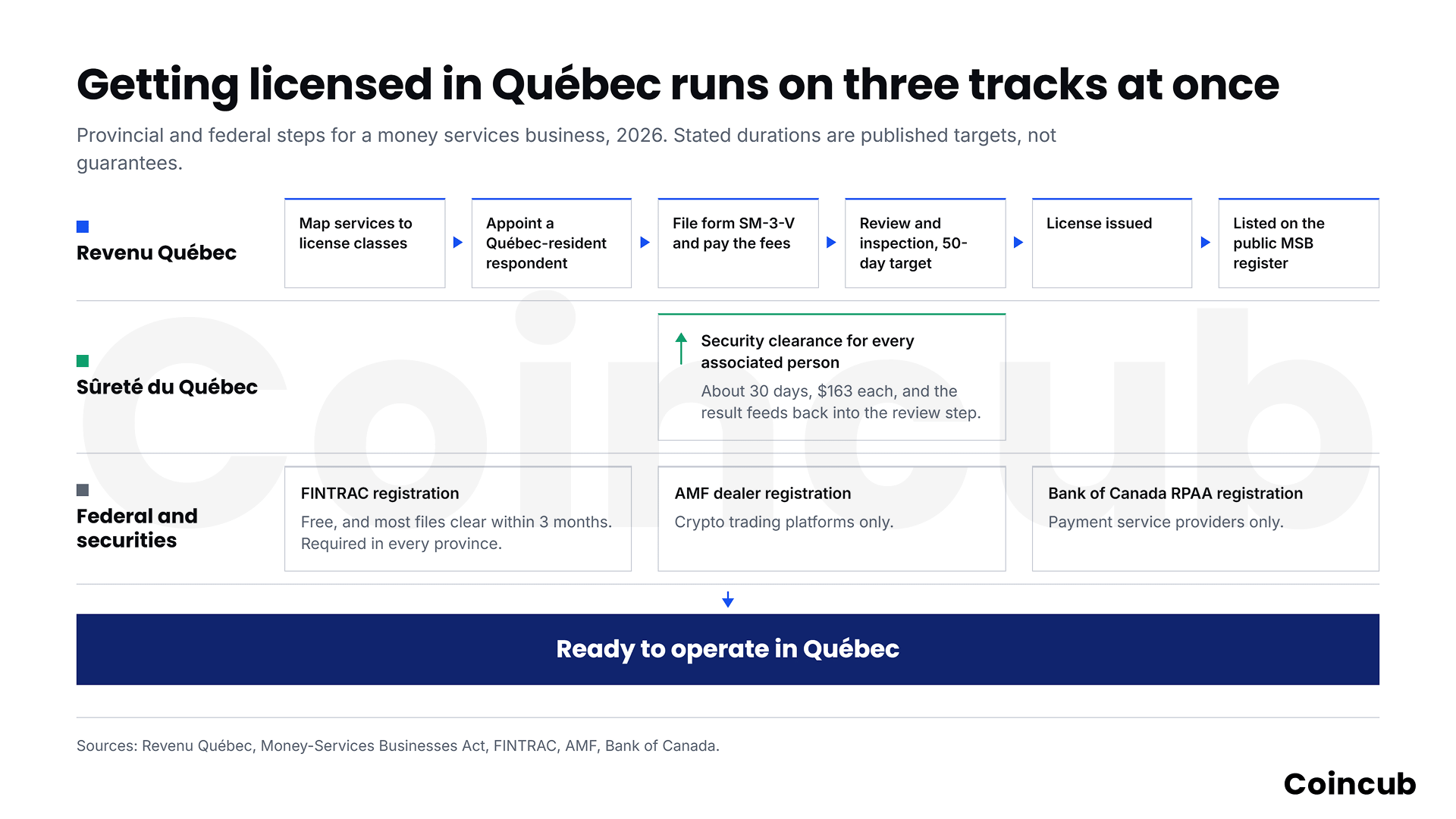
- Map each planned service to its license class, and confirm whether FINTRAC registration or AMF registration also applies.
- Appoint a respondent who lives in Quebec and collect identity and background information on every associated person.
- File form SM-3-V with the supporting forms, corporate documents, business plan, financial statements and fees.
- Wait for the Sûreté du Québec security clearance reports, which Revenu Québec expects within about 30 days.
- Answer Revenu Québec’s questions and allow any inspection of the premises or machines.
- Receive the license and appear on the public MSB register before offering any service.
Federal registration runs in parallel and has its own timetable. FINTRAC says most complete registration packages are processed within three months, so an operator that files in Quebec first can still be held back by Ottawa. The federal list also has its quirks, as this look at Canada’s MSB registry shows, which is one more reason to check a counterparty’s status on both registers before signing.
How Much a Quebec MSB License Costs in 2026
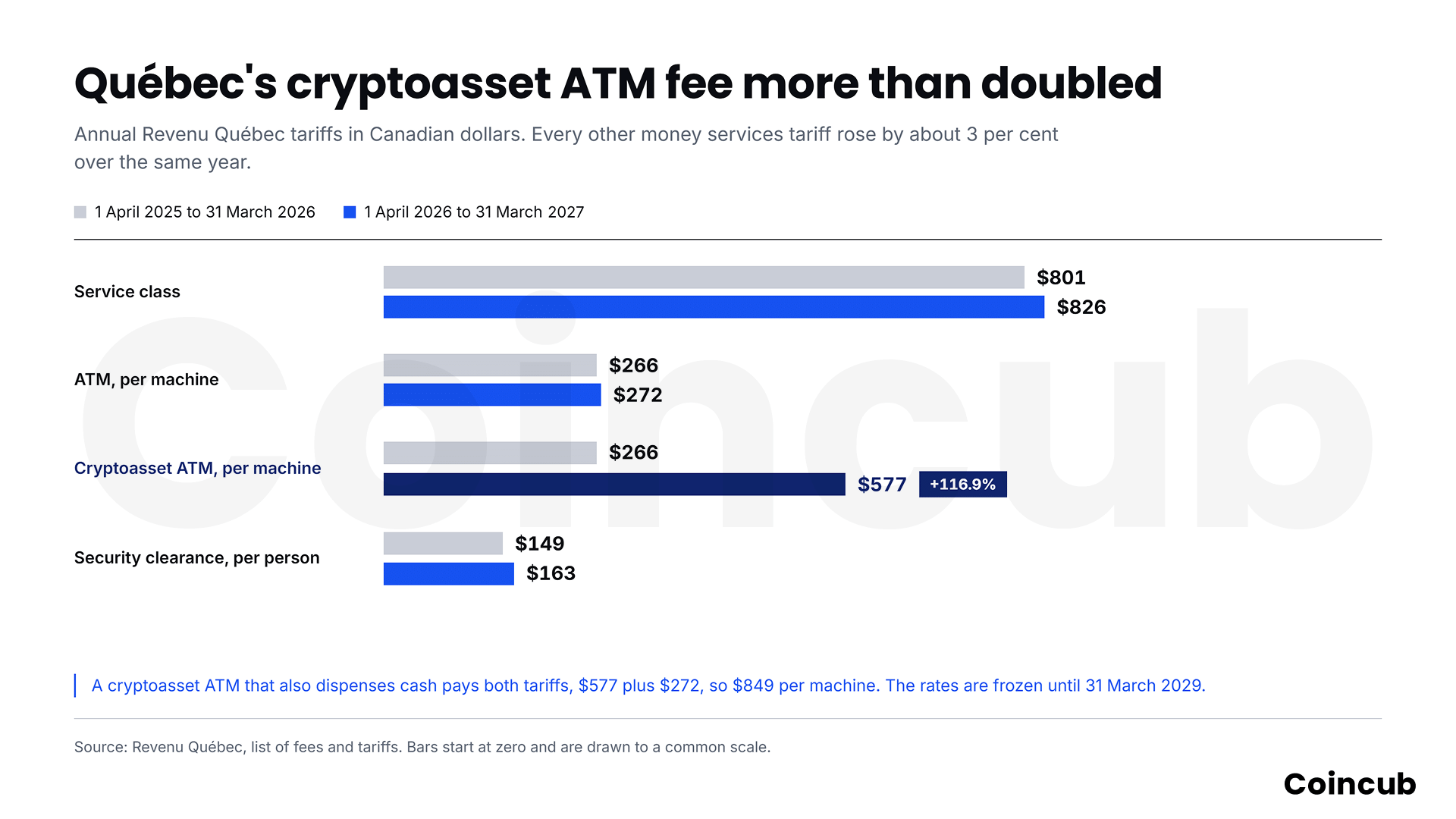
The government fees for a Quebec MSB license are modest, and they are annual rather than one-off. Under the fee regulation, last amended in April 2026, license fees fall due by 31 March each year, cannot be refunded and will not be indexed to inflation between 1 April 2026 and 31 March 2029. The table compares the two most recent fee years published on Revenu Québec’s list of fees and tariffs.
| Fee item | 1 April 2025 to 31 March 2026 | 1 April 2026 to 31 March 2027 | Change
|
|---|---|---|---|
| Each service class (currency exchange, funds transfer, cheques and money orders, cheque cashing) | $801 | $826 | +3.1% |
| ATM, per machine | $266 | $272 | +2.3% |
| Cryptoasset ATM, per machine | $266 | $577 | +116.9% |
| Security clearance report, per person | $149 | $163 | +9.4% |
| Each service point beyond the 25th | None | $514 | New |
One line in that table stands out. The per-machine fee for cryptoasset ATMs more than doubled on 1 April 2026, and Revenu Québec notes that a cryptoasset ATM which also dispenses cash owes both the cryptoasset and the standard ATM tariff, or $849 per machine.
Worked Cost Examples
Applying the 2026 to 2027 schedule to three common business models shows how quickly the numbers diverge:
- Currency exchange and remittance counter. One location offering currency exchange and funds transfer, with three people cleared, pays 2 × $826 plus 3 × $163, or $2,141 in the first year and $1,652 a year after that.
- Crypto ATM operator. Ten two-way machines that dispense cash, with four people cleared, pay 10 × $849 plus 4 × $163, or $9,142 in the first year and $8,490 a year after that.
- Online crypto trading platform. A platform with no Quebec money services pays no Revenu Québec fees, but it needs AMF registration as a dealer and FINTRAC registration.
Federal costs sit on top of those figures. FINTRAC charges nothing to register. A business that performs retail payment activities for electronic funds transfers may also need to register with the Bank of Canada under the Retail Payment Activities Act, whose registration application fee was set at $2,500 from 1 November 2024 and is indexed each year. Whether a crypto business falls under that regime is explained in this guide to when a crypto business falls under Canada’s RPAA. The largest costs usually sit outside government fees altogether, in compliance staff, anti-money laundering systems and record keeping.
Obligations After the License Is Granted
Approval starts a cycle of annual, event-driven and transaction-level duties, which Revenu Québec checks through inspections. The main ones are:
- Annual renewal. Fees must be paid by 31 March, and Revenu Québec’s renewal rules send an advance suspension notice in early April that leaves 10 days to pay before the license is suspended.
- Change notices. Any change to the information on file must be reported no later than 15 days after the end of the month in which it happened.
- Identity checks. Customers must be identified at set thresholds: $3,000 or more for currency exchange and for traveller’s cheques, money orders or bank drafts, $1,000 or more for funds transfers, and every time for cheque cashing.
- Records. Registers and supporting documents stay in Quebec for six years after they are gathered.
Federal duties run alongside the provincial ones. FINTRAC expects every MSB to maintain a compliance program. Crypto businesses must also file a Large Virtual Currency Transaction Report for amounts of $10,000 or more and apply the travel rule, whose data fields are set out in this guide to Canada’s crypto travel rule. Because those records hold personal information, PIPEDA privacy requirements apply to them as well.
Penalties for Operating Without a License
Running a money service without a license is a penal offence under section 67 of the MSBA. Individuals face fines of $5,000 to $50,000 and companies $15,000 to $200,000, with a further $10,000 to $100,000 when the business operates while suspended or revoked, and all minimums and maximums double for a repeat offence.
The federal side has also hardened. The Strengthening Canada’s Immigration System and Borders Act received Royal Assent on 26 March 2026, and FINTRAC can now apply maximum penalties up to 40 times higher, issue compliance orders and require mandatory compliance agreements for violations after that date.
What Changes Next for Crypto ATM Operators
The biggest open question for Quebec’s cryptoasset ATM class comes from Ottawa. The Spring Economic Update 2026 proposed to ban crypto ATMs. On 6 May 2026, Finance Canada said that studies link 85% to 98% of crypto ATM transactions to illicit activity and that the Canadian Anti-Fraud Centre estimates losses of $142 million to $284 million in 2024. Details were left to legislation, and until a ban takes effect, every cryptoasset ATM in Quebec still needs its per-machine license.
The same economic update chapter proposes wider MSB reforms, including powers for FINTRAC to refuse or revoke registrations, blocks on re-registering non-compliant businesses and more criminal record checks. Operators planning new machines in Quebec should weigh the doubled provincial fee and the federal proposal before they expand.
Final Thoughts
Quebec adds a full provincial license on top of federal registration, with a police clearance for every associated person, a respondent living in the province and records kept in Quebec. The government fees are the easy part, at $826 per service class a year, although crypto ATM operators now pay $577 or $849 per machine and face a proposed federal ban. The harder work lies in stacking Revenu Québec’s license with FINTRAC registration, AMF registration for trading platforms and, for payment firms, the Bank of Canada. The wider national picture is summarised on this Canada crypto regulation page, and a global VASP database tracking more than 30,000 registered crypto companies shows how Quebec licensees compare with peers elsewhere.
Frequently Asked Questions (FAQ)
Who issues MSB licenses in Quebec? +
Revenu Québec issues MSB licenses under the Money-Services Businesses Act and has done so since 13 September 2021, when it took over from the AMF. The AMF now regulates crypto trading platforms under securities law, while FINTRAC handles federal MSB registration.
How much does a Quebec MSB license cost? +
From 1 April 2026 to 31 March 2027, a Quebec MSB license costs $826 per service class, $272 per ATM, $577 per cryptoasset ATM and $163 per person for security clearance. The fees are annual, non-refundable and frozen until 31 March 2029.
Do crypto ATMs need a license in Quebec? +
Every cryptoasset ATM in Quebec needs a per-machine license from Revenu Québec, a separate class since 1 April 2025. Machines that also dispense cash pay both the cryptoasset and the standard ATM tariff, or $849 each in 2026 to 2027, and operators must also register with FINTRAC.
Does a crypto exchange need an MSB license in Quebec? +
A crypto trading platform serving Quebec residents must register with the AMF as a dealer and with FINTRAC as a virtual currency dealer. It needs a Revenu Québec MSB license only if it also offers a listed money service, such as exchanging Canadian dollars for foreign currency.
How long does it take to get a Quebec MSB license? +
Revenu Québec aims to decide 90% of license applications within 50 calendar days, and the Sûreté du Québec security clearance takes about 30 days. Time spent waiting for missing information is not counted, and FINTRAC processes most complete registrations within three months.
Is FINTRAC registration enough to operate in Quebec? +
FINTRAC registration alone does not allow a business to offer money services in Quebec. The province requires a Revenu Québec license for currency exchange, funds transfer, cheque services, cheque cashing and ATM operation, and operating without one exposes a company to fines of up to $200,000.
What happens if MSB license fees are not paid by 31 March? +
Revenu Québec sends an advance suspension notice in early April that gives the business 10 days to pay. If the fees are still unpaid, the license is suspended, and continuing to operate becomes an offence carrying an additional fine of $10,000 to $100,000.









