


 Buy a Licensed Company
  Explore VASP Data
  Talk to an Expert

 Atis Shala
Atis is a senior analyst and community lead with four years of experience in crypto. He has a bachelor from the Rochester Institute of Technology.
Atis Shala
Atis is a senior analyst and community lead with four years of experience in crypto. He has a bachelor from the Rochester Institute of Technology.
Regulatory Capital After a Licensed Company Share Sale

- A share sale leaves the licence inside the same legal entity, so its capital requirement carries straight through signing, completion and integration without any reset.
- Under MiCA, a crypto-asset service provider (CASP) must hold the higher of its Annex IV floor of €50,000, €125,000 or €150,000 and one quarter of the previous year’s fixed overheads, reviewed annually.
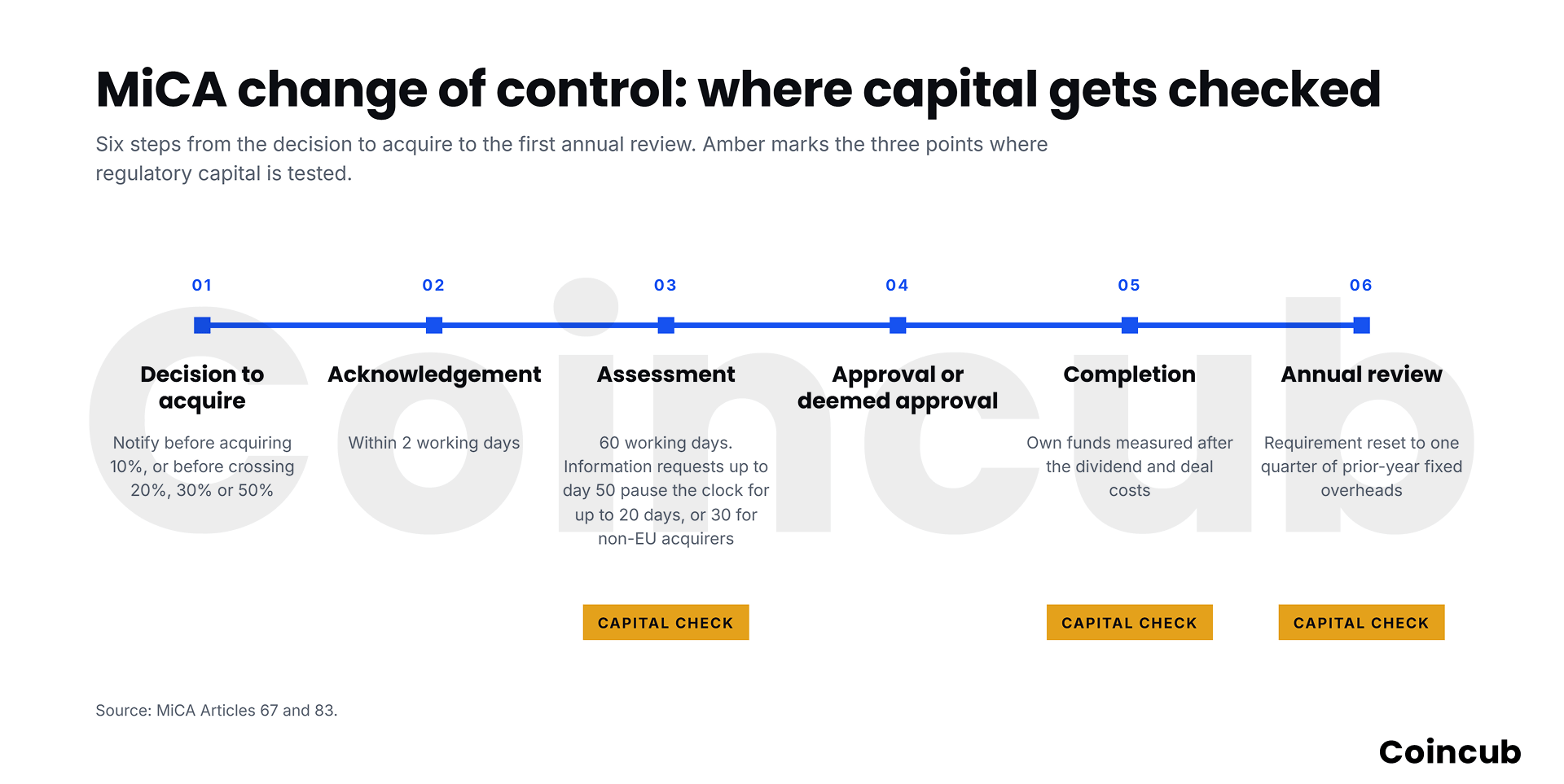
- Anyone planning to acquire 10% or more of a CASP, or to cross 20%, 30% or 50%, must notify the regulator first, and the assessment runs for 60 working days from acknowledgement.
- A buyer heading above 50% must file a three-year business plan that includes forecast prudential capital requirements under Delegated Regulation (EU) 2025/414.
- Pre-completion dividends, deal costs charged to the target and goodwill created by a post-closing merger all reduce own funds, because MiCA counts equity only after the full deductions in Article 36 of the Capital Requirements Regulation.
- Integration spending raises fixed overheads, which lifts the capital requirement at the next annual review even if own funds stay flat.
- Outside the EU, Dubai’s VARA requires prior written approval for any change of control, Hong Kong’s SFC approves substantial shareholders in advance, and the UK’s new crypto capital floors of £75,000 to £750,000 apply from 25 October 2027.
Why a New Owner Puts the Capital Question Back on the Table
Regulatory capital after a share sale has become a live issue since the MiCA transitional period ended on 1 July 2026. A week before that deadline, ESMA told unauthorised CASPs to stop onboarding new EU clients and wind down in an orderly way, and for firms still outside the perimeter, buying a MiCA-licensed company has become an obvious alternative to a fresh application. Most of those deals are structured as share sales, because the authorisation sits with the legal person and a share sale keeps that person intact. Our guide on how to get a crypto licence covers the alternative application route.
That structure solves the licensing problem and quietly creates a capital one. The capital rules after completion are the same ones that applied the day before signing, yet almost everything around the deal pulls money out of the target or pushes its requirement up. Sellers want surplus cash before they exit, buyers want to recover acquisition costs, and integration plans add expense.
What Regulatory Capital Means for a Licensed Crypto Firm
Regulatory capital is the loss-absorbing buffer a licensed firm must hold so that it can absorb losses or wind down without harming clients. For an EU CASP, the rule sits in Article 67 of the Markets in Crypto-Assets Regulation (MiCA), and it applies “at all times” for as long as the firm is authorised.

The Permanent Floor and the Overhead Test
Article 67(1) requires prudential safeguards equal to the higher of two figures. The first is the permanent minimum capital set in Annex IV for the firm’s class of services, and the second is one quarter of the firm’s fixed overheads for the preceding year, reviewed annually. A firm that has operated for less than a year uses the projected fixed overheads it submitted with its application instead.
The Annex IV floors depend on which services a firm is authorised to provide, as the table below shows.
| MiCA class | Permanent minimum capital | Services that place a firm in the class
|
|---|---|---|
| Class 1 | €50,000 | Reception and transmission of orders, execution of orders, placing, transfer services, advice, portfolio management |
| Class 2 | €125,000 | Any Class 1 service plus custody and administration, or exchange of crypto-assets for funds or for other crypto-assets |
| Class 3 | €150,000 | Any Class 2 service plus operating a trading platform for crypto-assets |
Two features of that table matter in a sale. The floors are modest, so for any CASP with a real payroll the overhead test is usually the binding figure: a firm with €2.4 million of fixed overheads needs €600,000 of safeguards, well above the Class 2 floor. The class is also tied to the authorised services, which means a buyer who plans to add custody or a trading venue is buying a higher floor along with the new permission. Our analysis of how CASPs scope their MiCA permissions looks at why custody features so prominently on the MiCA register.
What Counts Toward MiCA Own Funds
Having set the requirement, the next question is which resources can meet it. Article 67(4) allows three forms: own funds, an insurance policy covering the EU territories where services are provided (or a comparable guarantee), or a combination of both.
Own funds, in this context, means Common Equity Tier 1 (CET1) items and instruments under Articles 26 to 30 of the Capital Requirements Regulation (CRR), measured after full deductions under Article 36 of the CRR and without the threshold exemptions in Articles 46 and 48. CET1 is the highest-quality form of capital, essentially paid-up share capital, share premium and retained earnings that can absorb losses immediately. The deductions are where transactions bite. Article 36(1) removes losses for the current financial year, intangible assets (which include goodwill), and deferred tax assets that rely on future profitability.
Two further CRR conditions shape deal planning. Under Article 26(2), interim profits count only with the regulator’s prior permission, after independent auditors have verified them and any foreseeable charge or dividend has been deducted. Under Article 28(1)(b), CET1 instruments must be paid up and their purchase cannot be funded directly or indirectly by the firm itself.
The insurance route carries its own conditions. Article 67(5) requires the policy to be disclosed on the CASP’s website, to have an initial term of at least one year, to carry a cancellation notice period of at least 90 days, and to come from an authorised third-party insurer.
How the Share Sale Reaches the Regulator Before Closing
Because those requirements apply every day, supervisors want to see how a buyer will keep meeting them before the buyer gains control. MiCA builds that check into the change of control process in Articles 83 and 84.
Change of Control Thresholds and the 60 Working Day Clock
A qualifying holding under MiCA is any direct or indirect stake of at least 10% of the capital or voting rights, or one that allows significant influence over management. Anyone who decides to acquire such a holding, or to increase it so that it reaches or exceeds 20%, 30% or 50%, or so that the CASP becomes a subsidiary, must notify the CASP’s competent authority in writing beforehand. Sellers carry a mirror obligation, since a disposal that takes a holding below 10%, 20%, 30% or 50% must also be notified in advance.
The timeline that follows is fixed in Article 83. The authority acknowledges receipt within two working days and then has 60 working days from that acknowledgement to complete its assessment. It may request more information up to the 50th working day, which suspends the clock for up to 20 working days, or up to 30 working days where the acquirer is based or regulated outside the EU. If the authority does not oppose the acquisition within the period, the acquisition is deemed approved.
What the Buyer Must Prove About Money
The assessment itself follows five criteria in Article 84, and one of them is the financial soundness of the proposed acquirer in relation to the business the CASP pursues and plans to pursue. The regulator may oppose a deal only on those criteria or on incomplete or false information, which puts the buyer’s funding story at the centre of the file.
Delegated Regulation (EU) 2025/414, which sets out what the notification must contain, turns that criterion into specific disclosures. Article 8 requires a detailed explanation of the specific sources of funding for the acquisition, including borrowed funds with the names of lenders and details of the facilities, and any financial arrangements with other shareholders. Article 9 asks for the acquirer’s willingness to support the target with additional financing if it runs into difficulty.
The heaviest requirements apply to control transactions. Under Article 11, an acquirer heading above 50% or taking the CASP as a subsidiary must submit a three-year business plan, including forecast balance sheets and income statements, forecast prudential capital requirements and a forecast of intra-group transactions. In practice, the post-completion capital plan becomes part of the approval, so any change a buyer makes after closing is measured against numbers the regulator has already seen. The suitability side of the same file, covering the acquirer’s reputation and management, is examined in fit-and-proper tests for buyers and key persons.
Where Capital Leaks Around Completion
Approval confirms that the plan works on paper, while completion is where the numbers move. The risk points below cluster around the months either side of closing, and each one reduces own funds, raises the requirement, or does both.
Dividends and Deal Costs Before Closing
Sellers often extract surplus cash before completion, either through an agreed dividend or as permitted leakage under a locked-box price mechanism. A dividend reduces retained earnings, and therefore CET1, in the period it is declared. The safe amount is the surplus above the capital requirement after allowing for everything else that will hit the target before and after closing, which is usually far less than the cash on the balance sheet suggests.
Transaction costs create a second leak. Adviser fees, retention or transaction bonuses and similar deal expenses booked in the target flow into the current year’s result. Because current-year losses are deducted from CET1 immediately while interim profits count only once verified and permitted, a run of deal costs can erode own funds mid-year even when the business is profitable on an annual view.
The same costs are treated more gently on the requirement side. Article 67(3) excludes non-recurring expenses from non-ordinary activities, as well as profit-linked bonuses, from the fixed overheads calculation, so one-off deal costs reduce own funds without inflating the requirement.
Debt Pushdown, Goodwill and Circular Funding
Leveraged buyers sometimes merge their acquisition vehicle into the licensed target after closing so that the acquisition debt sits next to the operating cash flows. For a regulated entity, that step can move acquisition debt onto the CASP’s balance sheet and, depending on the accounting framework, bring goodwill or other intangible assets with it. Debt assumed without a matching asset reduces net equity, and intangibles are deducted in full under CRR Article 36(1)(b), so a merger of this kind can wipe out the capital headroom a buyer showed the regulator.
A related trap involves circular funding. Upstream loans to the new parent and cash sweeps into a group treasury move liquid assets out of the licensed entity, and if that money later returns as a capital injection, Article 28(1)(b) of the CRR comes into play, because CET1 instruments cannot be purchased with funds the firm provided directly or indirectly. Any intra-group flows should also match the forecast of intra-group transactions filed under Article 11 of Delegated Regulation 2025/414.
Integration Spending, Insurance and New Services
Even a clean completion can raise the requirement over time. New owners typically add group recharges, senior hires, compliance tooling and technology migrations, and those costs are largely fixed. Because the MiCA requirement is reviewed annually against one quarter of the preceding year’s fixed overheads, a budget that grows from €2.4 million to €3.2 million lifts the requirement from €600,000 to €800,000 at the next review.
Firms that rely partly on insurance face a separate check. Professional indemnity policies can contain change-of-control clauses, so the wording should be checked before completion, and any lapse or replacement has to preserve the Article 67(5) conditions, including the 90-day cancellation notice. Buyers who plan to add custody, exchange or a trading platform should likewise budget for the higher Annex IV floor and the additional overheads that come with it.
A Worked Example: One Class 2 CASP Through a Sale
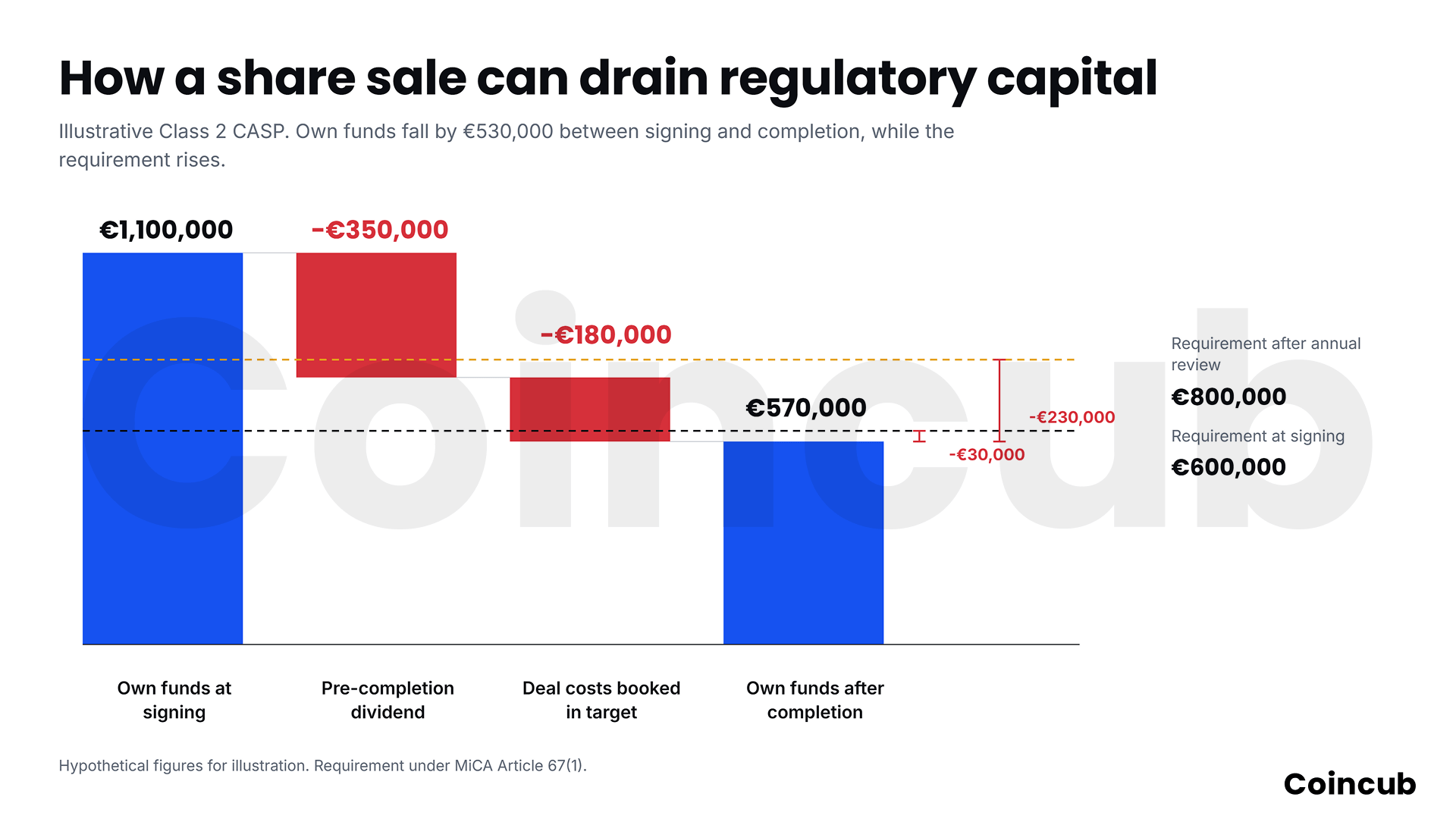
Putting those leaks together shows how quickly headroom disappears. The figures below describe a hypothetical Class 2 CASP and are illustrative only.
| Stage | Own funds (CET1 after deductions) | Capital requirement | Headroom
|
|---|---|---|---|
| At signing, fixed overheads €2.4m | €1,100,000 | €600,000 | €500,000 |
| After a €350,000 pre-completion dividend | €750,000 | €600,000 | €150,000 |
| After €180,000 of deal costs booked in the target | €570,000 | €600,000 | minus €30,000 |
| Next annual review, fixed overheads €3.2m | €570,000 | €800,000 | minus €230,000 |
Each step in that table is individually reasonable, which is exactly why the combined result surprises deal teams. The dividend alone left a comfortable margin, and the deal costs alone would have been absorbed easily. Together they tipped the firm below its requirement before the buyer had changed anything operational, and the integration budget then widened the gap to €230,000 plus whatever management buffer the firm aims to keep.
The consequences can be serious. Article 64(1)(e) of MiCA requires the competent authority to withdraw authorisation where a CASP no longer meets the conditions under which it was authorised and has not taken the remedial action requested within the time set. A shortfall discovered at completion therefore turns into a recapitalisation negotiation at the worst possible moment.
How Other Regimes Treat the Same Transaction
The EU is only one of the places where licensed crypto businesses change hands, and the pattern of a capital floor combined with prior approval repeats elsewhere with different numbers. The comparison below covers the frameworks Coincub readers most often operate under; country-level detail sits in country guides and the 2026 crypto licence map.
| Regime | Minimum capital | Ongoing measure | Change of control rule
|
|---|---|---|---|
| EU CASP (MiCA) | €50,000, €125,000 or €150,000 by class | Higher of floor and one quarter of prior-year fixed overheads | Notify before acquiring 10% or crossing 20%, 30%, 50%; 60 working day assessment |
| EU e-money institution (EMD2) | €350,000 initial capital | For e-money issuance, own funds of at least 2% of average outstanding e-money | Notify in advance before reaching or exceeding 20%, 30% or 50% |
| UK crypto firms (FSMA regime from 25 Oct 2027) | £75,000 to £750,000 by activity; £350,000 for stablecoin issuance | Higher of floor, fixed overheads requirement and K-factor requirement | Today, FCA approval before becoming a beneficial owner of an MLR-registered firm |
| Dubai (VARA) | AED 100,000 to AED 1,500,000 by activity | Paid-up capital (some activities use a share of fixed overheads if higher) plus net liquid assets of at least 1.2 times monthly operating expenses | Prior written approval for any action that may result in a change of control |
| Hong Kong (SFC platform operators) | HK$5,000,000 paid-up share capital | Liquid capital of at least the higher of HK$3,000,000 and the basic amount, plus 12 months of operating expenses in liquid assets | SFC approval before becoming a substantial shareholder (more than 10%) |
Three differences in that table change how a deal is run, and each is worth a closer look.
The UK: Two Regimes in Sequence
The UK currently regulates crypto firms for anti-money laundering purposes under the Money Laundering Regulations (MLRs). The FCA states that a person who decides to acquire or increase control so that they become a beneficial owner of a registered cryptoasset firm must notify the FCA and await approval before completing, and that acquiring control without approval is a criminal offence. Beneficial ownership under regulation 5 of the MLRs centres on owning or controlling more than 25% of a company’s shares or voting rights, or otherwise controlling the company.
That position is about to change. The FCA published its final crypto rules on 30 June 2026, including PS26/12 on prudential requirements, and the new regime applies from 25 October 2027. Its permanent minimum requirements range from £75,000 for dealing as agent and arranging deals, through £150,000 for operating a trading platform, safeguarding or staking, to £750,000 for dealing as principal, and a firm’s own funds requirement is the highest of that floor, its fixed overheads requirement and its K-factor requirement. Buyers signing deals that complete near that date should model both regimes.
Dubai: Capital Held in Approved Forms
VARA’s Company Rulebook requires VASPs to hold paid-up capital “at all times” in amounts set by activity, from AED 100,000 for advisory services to AED 1,500,000 (or 25% of annual fixed overheads, if higher) for some exchange licences. That capital must be held in trust accounts, surety bonds or another method VARA approves, and a separate net liquid assets test applies with daily reconciliation and monthly reporting. On ownership, no action that may result in a change of control can be taken without VARA’s prior written approval, and the rulebook sets a 30 working day decision period from a complete application, which VARA can extend. Coincub has covered VARA’s licensing structure in more detail.
Hong Kong: Approval With an Expiry Date
The SFC’s licensing handbook for virtual asset trading platforms requires operators to maintain HK$5,000,000 of paid-up share capital, liquid capital of at least the higher of HK$3,000,000 and the basic amount under the Financial Resources Rules, and liquid assets in Hong Kong equal to at least 12 months of actual operating expenses. A person cannot become or remain a substantial shareholder without SFC approval, and an approval is initially valid for six months, within which the share transfer should complete. A delayed closing can therefore mean refiling.
A Capital Plan That Survives the Handover
The regimes differ in detail, yet the practical defence is the same everywhere: treat regulatory capital as a deal workstream with its own owner and its own model. The checkpoints below follow the sequence of a typical transaction.
| When | What to check | Why it matters
|
|---|---|---|
| Before signing | Current own funds after all CRR deductions, and the latest fixed overheads figure | Establishes true headroom after deductions |
| Negotiating price mechanics | Size of any dividend or permitted leakage against headroom | Prevents the seller’s exit from creating a shortfall |
| Preparing the notification | Funding sources, lender details and a three-year capital forecast | Feeds Articles 8 to 11 of Delegated Regulation 2025/414 |
| Between signing and closing | Deal costs booked in the target and any interim losses | Current-year losses reduce CET1 immediately |
| At completion | Insurance policy continuity and any change-of-control clauses | Keeps the Article 67(5) conditions intact |
| First 12 months | Merger plans, intra-group flows and integration budget | Controls goodwill, circular funding and the next overhead review |
Allocating Capital Risk Between Buyer and Seller
Much of that list depends on agreeing responsibilities in the share purchase agreement. Buyers commonly seek a covenant that the target will meet its capital requirement at completion, while sellers look to cap leakage and any post-closing true-up. Whatever the allocation, the figures that matter are the ones calculated on the regulator’s basis, after deductions, and matched to the forecast already filed with the change of control notification.
The EU e-money side is also moving. The European Parliament and the Council reached a provisional agreement on the revised payment services framework on 27 November 2025, and the new directive folds e-money institutions into the payment institution framework and repeals the second Electronic Money Directive once it applies. Firms holding both a CASP authorisation and an e-money licence should track the final capital calibration before modelling a post-2027 group structure. For current register movements across these regimes, monthly licensing register tracks new authorisations as they appear, and the regulation hub collects rule changes by jurisdiction.
Frequently Asked Questions (FAQ)
Does a share sale change a CASP's MiCA capital requirement? +
A share sale does not reset the requirement, because the authorisation stays with the same legal entity. The CASP must still hold the higher of its Annex IV floor and one quarter of prior-year fixed overheads, although new services or higher overheads after the sale can raise it.
How long does MiCA change of control approval take? +
The competent authority has 60 working days from its written acknowledgement, which it must issue within two working days of a complete notification. Information requests can suspend the clock for up to 20 working days, or 30 where the acquirer is based or regulated outside the EU.
Can a seller take a dividend from a licensed crypto firm before completion? +
A seller can take a dividend if the CASP still meets its requirement afterwards. Dividends reduce CET1 immediately, so the safe amount is the surplus above the requirement after allowing for deal costs, interim losses and planned integration spending.
Does goodwill count as regulatory capital for a CASP? +
Goodwill does not count. MiCA measures own funds as CET1 after full deductions under Article 36 of the CRR, which removes intangible assets, including goodwill. A post-closing merger that brings goodwill onto the licensed entity's balance sheet reduces its own funds.
What happens if a CASP falls below its capital requirement after an acquisition? +
The competent authority will expect prompt remedial action, usually fresh capital from the new owner. Under Article 64(1)(e) of MiCA, authorisation must be withdrawn if the firm no longer meets its authorisation conditions and fails to take the remedial action requested within the set time.
Can a MiCA licence be transferred to a new owner? +
MiCA authorisation is granted to a specific legal person, so ownership usually changes through a share sale that leaves the authorised entity intact. The buyer must notify the competent authority before acquiring a qualifying holding, and the authority can oppose it within a 60 working day assessment period.
Can an insurance policy replace own funds under MiCA? +
An insurance policy or comparable guarantee can meet all or part of the requirement under Article 67(4). The policy must be disclosed on the CASP's website, run for at least one year initially, carry a 90-day cancellation notice period and come from an authorised third-party insurer.