Buy a Licensed Company
  Explore VASP Data
  Talk to an Expert

 Sergiu Hamza
Sergiu is a thought leader with a background in mathematics, authentification, identification, and a passion for Bitcoin.
Sergiu Hamza
Sergiu is a thought leader with a background in mathematics, authentification, identification, and a passion for Bitcoin.
Deutsche Bank secures MiCA authorization for crypto custody and transfers as digital-asset service nears launch
Deutsche Bank has secured authorization under the EU’s MiCA framework in Germany to provide crypto-asset custody and transfer services. The move comes as the bank prepares to launch digital-asset custody for institutional and corporate clients, initially supporting Bitcoin, Ether, USDC, EURC and EURAU. Deutsche Bank expects its first clients to go live in 2026, subject to completion of the applicable regulatory process.
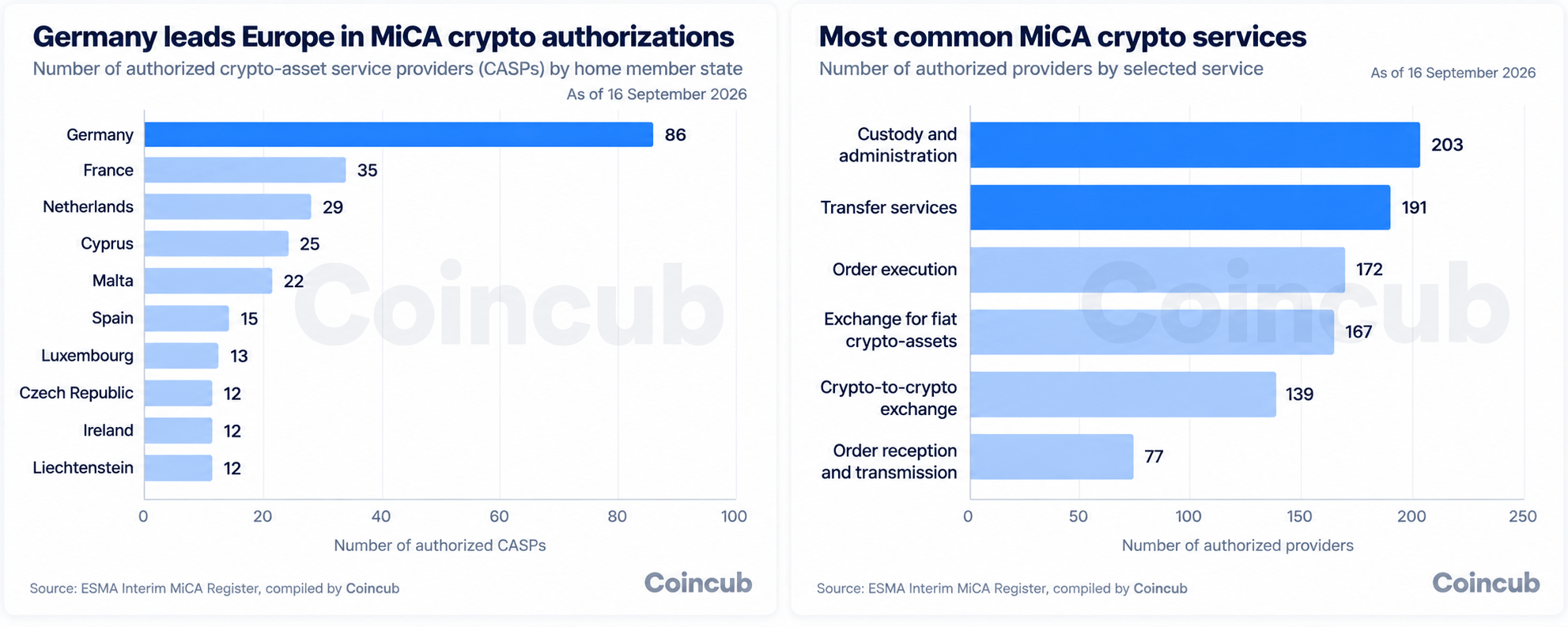
Deutsche Bank has secured authorization under the European Union’s Markets in Crypto-Assets framework to provide crypto-asset custody and transfer services in Germany, as the lender prepares to launch a digital-asset custody business for institutional clients.
The regulatory entry covers two activities: the custody and administration of crypto-assets on behalf of clients and transfer services for crypto-assets on behalf of clients.
The development comes a day after Deutsche Bank announced plans to launch a digital-asset custody service for institutional and corporate clients in Europe. The bank said on 16 September that it expects its first clients to go live this year, subject to completion of the applicable regulatory process.

Deutsche Bank’s authorization places the Frankfurt-based lender within the EU’s MiCA framework for crypto-asset service providers. The authorization is tied to Germany, where BaFin is the national competent authority, while ESMA maintains the EU’s central MiCA register.
The distinction matters because the registration should not be described as an “ESMA license”. Under MiCA, national competent authorities handle CASP authorization and provide the information used for ESMA’s register.
Deutsche Bank will custody Bitcoin, Ether and stablecoins
Deutsche Bank’s planned service will allow clients to hold digital assets with the bank and transfer them to third parties.
The bank will manage wallets and private keys on behalf of its clients, removing the need for institutions to build and operate their own crypto custody infrastructure. At launch, Deutsche Bank plans to support Bitcoin and Ether alongside the stablecoins and e-money tokens USDC, EURC and EURAU. It said the range could later expand depending on client demand as well as its product approval, risk-management and regulatory processes.
Tokenized financial instruments are also on the bank’s product roadmap, although they are not part of the initial list of supported assets.
The service is aimed initially at customers of Deutsche Bank’s Corporate Bank and Investment Bank. Potential clients include companies, asset managers, hedge funds, custodians, brokers and sovereign institutions.
Client onboarding will be subject to the bank’s due diligence requirements, eligibility criteria and risk appetite.
How Deutsche Bank plans to secure clients’ crypto
Digital-asset custody creates a different set of operational requirements from conventional securities custody because control of blockchain assets typically depends on the security of cryptographic private keys.
Deutsche Bank said its platform will use hardware-based key protection and secure key generation, alongside separate warm and cold storage environments.
The system will also use segregation of duties, multi-person approval processes, redundant technical infrastructure and controlled backup and recovery arrangements. Selected external technology and infrastructure providers will supply defined technical components of the service.
The bank has not said that its planned service eliminates the risks associated with digital assets. Its announcement warned of risks including cyber incidents, fraud, market-participant failures and price volatility. It also noted that crypto-assets do not receive deposit-guarantee protection comparable with eligible bank deposits.
What the MiCA authorization means for Deutsche Bank
The authorization gives Deutsche Bank a regulatory basis under MiCA for the crypto custody and transfer activities listed in its registration.
That brings a project the bank has been developing for years closer to becoming a client-facing service.
But authorization and commercial launch are not the same thing.
Deutsche Bank said on 16 September that its planned custody service remains subject to completion of the applicable regulatory process. Its launch date, geographical availability, supported assets and scope could also change because of regulatory requirements, internal approvals, market conditions or customer demand.
The bank currently expects to onboard its first customers before the end of 2026.
Gerald Podobnik, co-head of Deutsche Bank’s Corporate Bank, described digital assets as complementary to existing financial infrastructure rather than a replacement for it.
The bank’s stated strategy is to apply the controls associated with regulated financial institutions to digital-asset infrastructure while expanding the service according to demand, regulatory requirements and its risk appetite.
European banks are expanding regulated crypto custody
Deutsche Bank is entering a European crypto custody market that now includes traditional banks alongside exchanges and specialist digital-asset companies.
MiCA created an EU-wide regulatory framework for crypto-asset service providers, covering activities including custody, trading platforms, execution and transfer services.
Deutsche Bank said in research published on 9 September that ESMA’s interim MiCA register showed almost 200 European crypto-asset service providers authorized to provide custody and administration of crypto-assets on behalf of clients.
The bank argues that custody infrastructure is becoming increasingly important as financial institutions move beyond experimental blockchain projects and begin integrating digital assets into established financial systems.
Its research divides the institutional digital-asset market broadly into decentralized crypto-assets such as Bitcoin and Ether; tokenized money including stablecoins and tokenized deposits; and traditional financial or real-world assets represented using blockchain-based tokens.
For banks, custody can provide an entry point connecting those assets with existing settlement, governance, reporting and risk-management systems.
Deutsche Bank already operates conventional custody and clearing infrastructure across more than 30 markets. Its securities-services business provides custody, clearing, asset servicing, securities financing and liquidity services to institutional clients.
It has also been involved in other parts of the transition towards digital securities. In September, Deutsche Bank acted as issuing and paying agent for Clearstream’s pilot dematerialized Eurobond, a €50 million Euro-Commercial Paper issuance that replaced the traditional physical Global Note with a legally definitive electronic record.