



 Buy a Licensed Company
  Explore VASP Data
  Talk to an Expert

 Dren Hima
 is Head of Research at Coincub, leading research across digital asset regulation, licensing, market structure, tokenization and institutional adoption.
Dren Hima
Dren Hima is Head of Research at Coincub, leading research across digital asset regulation, licensing, market structure, tokenization and institutional adoption.
The Monthly Register – Crypto Licensing in July 2026

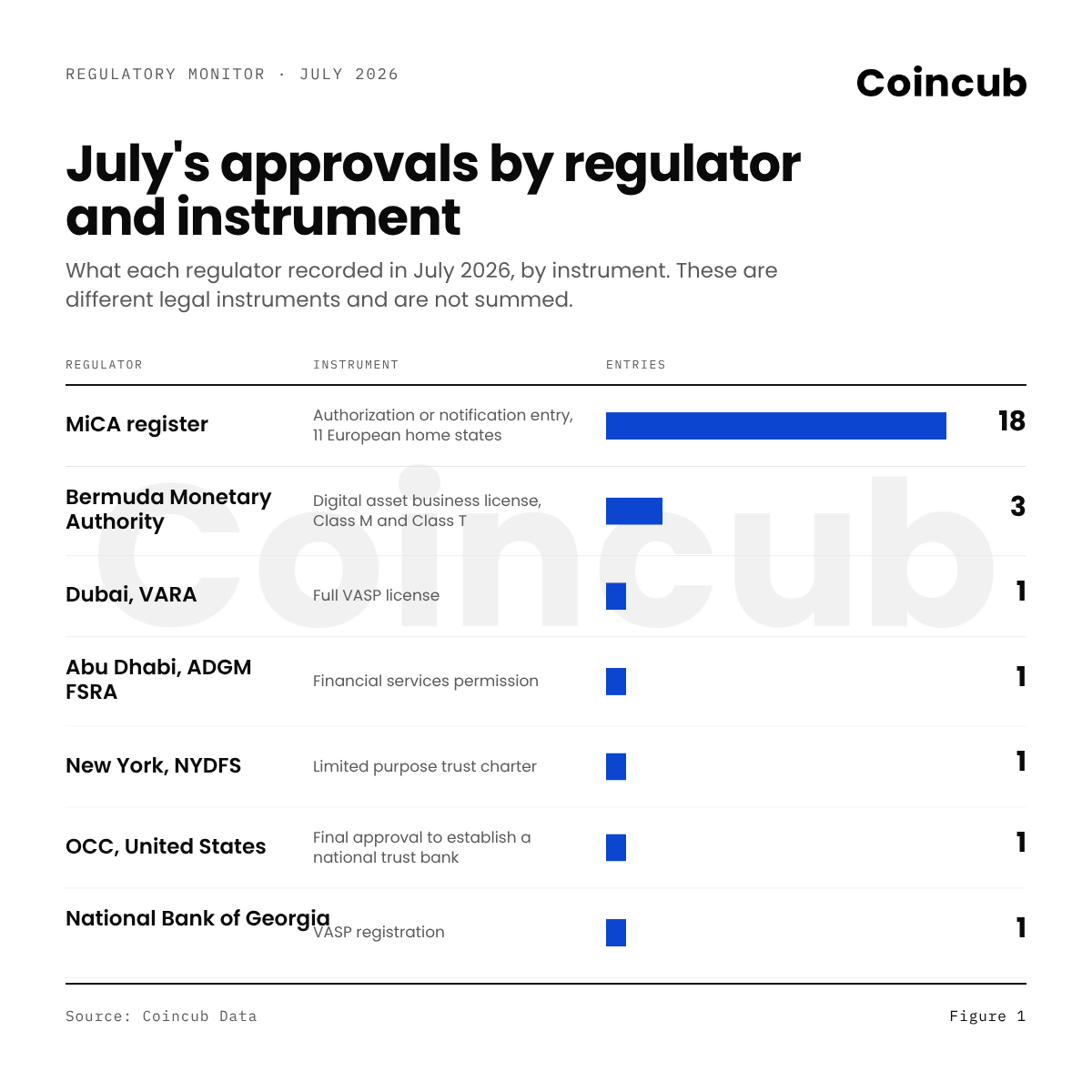
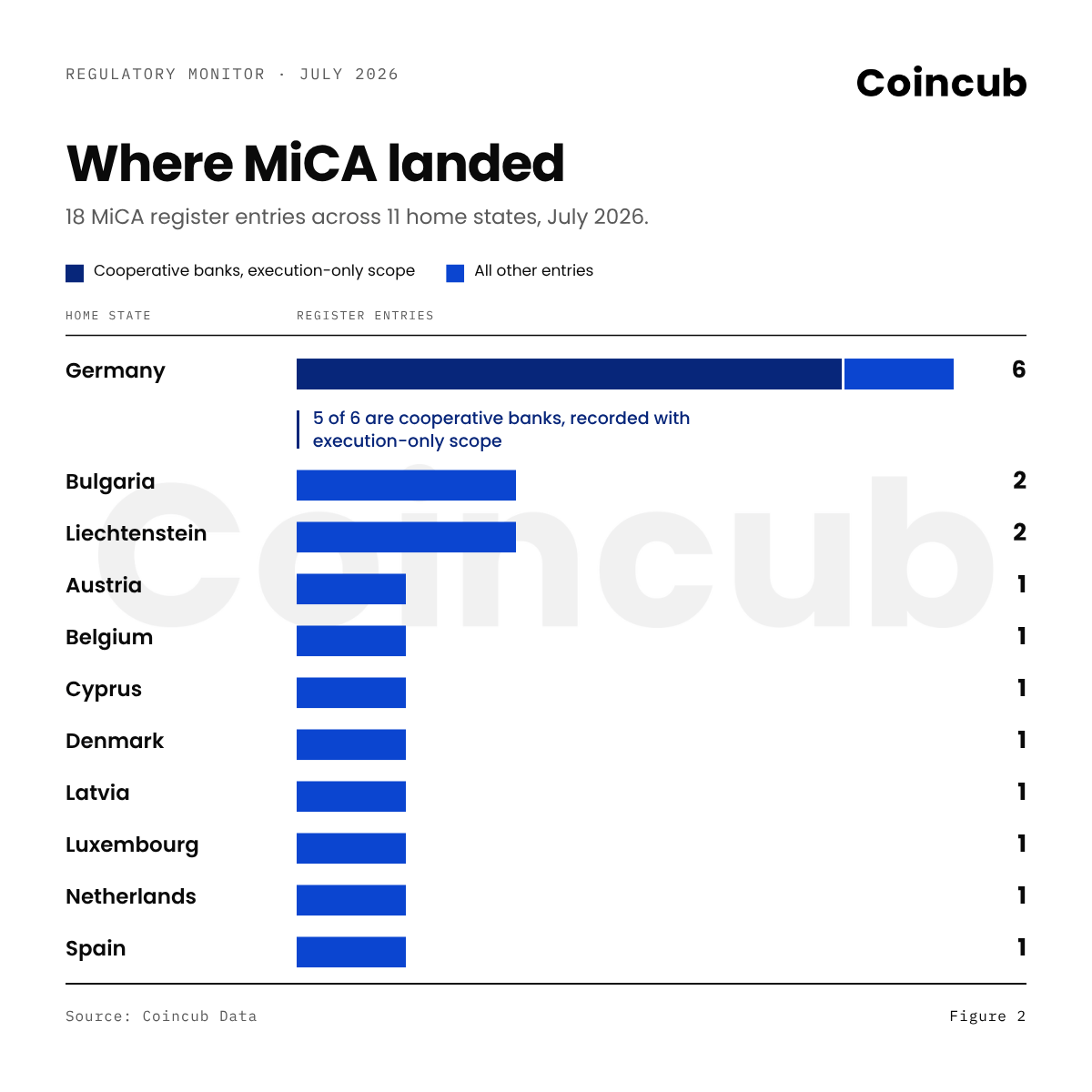
- 18 firms were added to the MiCA register in July across 11 European jurisdictions, with Germany taking six and Bulgaria and Liechtenstein two each. Entries reach the register through both of MiCA’s routes, authorization and notification.
- Five of Germany’s six are cooperative banks recorded with one permitted service, the execution of client orders, with no custody, trading venue or exchange permission attached to the entry.
- Circle announced during July that it had received final OCC approval to establish First National Digital Currency Bank, N.A., which will operate as Circle National Trust, and New York recorded a limited purpose trust charter for a separate Circle entity in the same month.
- Bermuda issued three digital asset licenses in nine days, Dubai issued Flipster a full VASP license, Abu Dhabi cleared BTCS (Middle East) for dealing and custody with retail clients excluded, and Georgia added Fintrust LLC to its VASP register.
- Canada added more firms to FINTRAC’s register in July than every approval in this report combined.
- The dates on these registers mark regulatory steps rather than launches, and an entry describes permitted scope rather than what a firm has built.
July’s approvals came through the MiCA register in 11 European jurisdictions, three digital asset licenses in Bermuda, a full VASP license in Dubai, a financial services permission in Abu Dhabi, a trust charter in New York and a federal approval for Circle.
Canada’s register took on more new virtual currency businesses in July than every approval in this report combined. A FINTRAC registration is not itself a license, product approval, certificate or endorsement, and the distance between those two categories is the most misread thing in this industry, so every item below comes with its instrument attached.

German Banks Entered at the Narrowest Scope
ESMA’s register picked up 18 crypto-asset service provider entries dated in July. The register covers both of MiCA’s routes in, since firms can be authorized by a national regulator and certain already-regulated institutions can enter by notifying instead, so an entry date is not always an authorization date. The home state names the regulator responsible rather than the only market a firm can serve, because MiCA scope passports across the bloc.
Five of the six German entries are cooperative banks, the Volksbanken and Raiffeisenbanken, and each is recorded with exactly one permitted service, the execution of orders for crypto-assets on behalf of clients, with no custody, no trading venue and no exchange for funds attached to the entry. The register stops at legal scope, so it does not say who will hold the assets, who sits on the other side of the execution, or what any of these banks will put in front of a customer, and those are the questions worth asking.
Broader scopes went to firms that already do this for a living, with SMART VALOR in Liechtenstein covering five services including operation of a trading platform, SG Digital Assets in Cyprus covering six, CPS Europe in Luxembourg covering custody, both forms of exchange, execution and transfers, and BNY SA/NV in Belgium, one of the world’s largest custodians, covering custody and transfers. BitPay’s Dutch entity was recorded on 15 July for exchange and transfers.
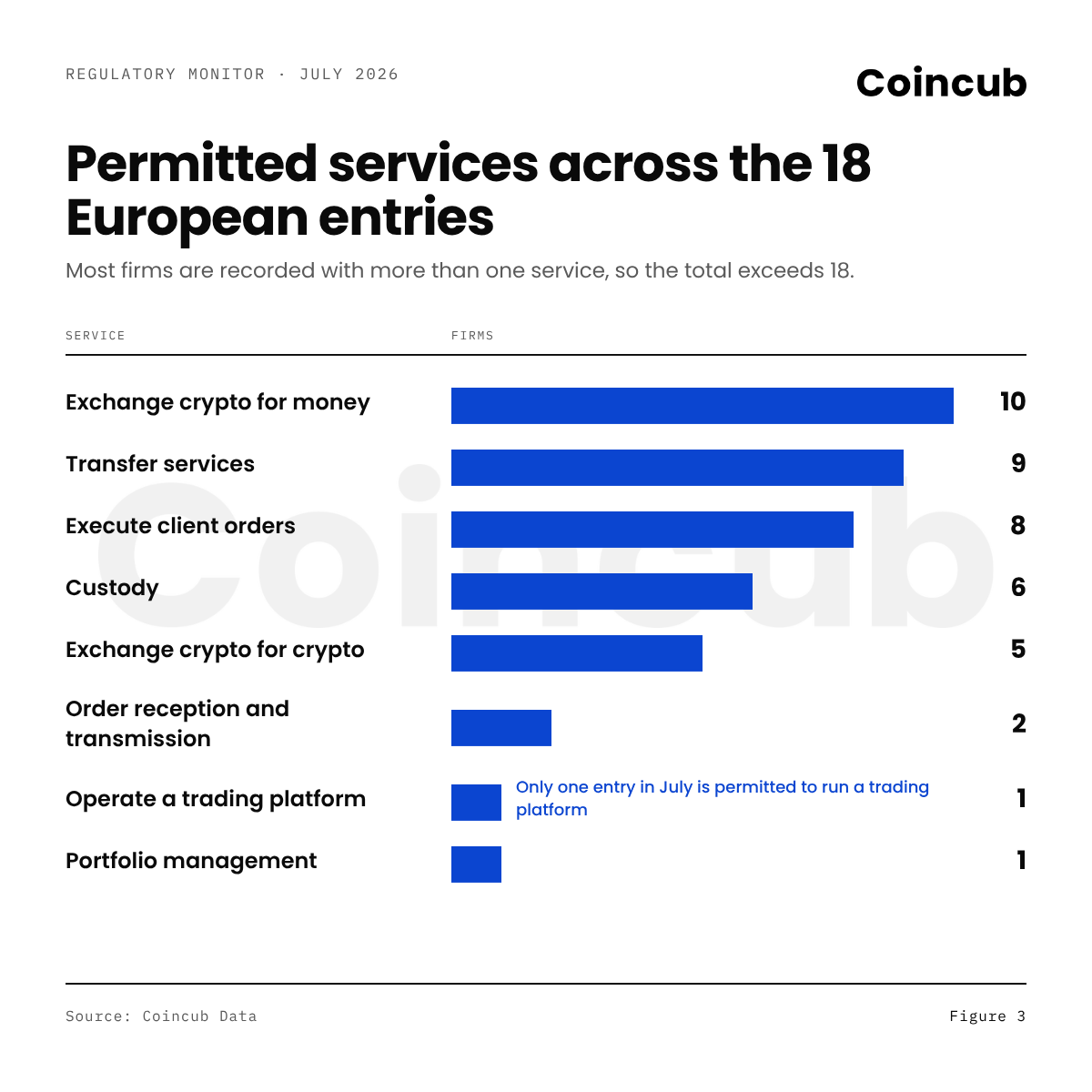
Across all 18, exchange of crypto-assets for funds appears 10 times, transfer services 9 times, execution of orders 8 times, custody 6 times and crypto-to-crypto exchange 5 times. One firm in the entire month is recorded as permitted to operate a trading platform, and one to manage portfolios.
MiCA’s transitional grandfathering could run no later than 1 July 2026, and firms operating on national legacy permissions had to be through the process or stop, which puts July on the far side of that deadline.
Circle Cleared the OCC
During July, Circle announced that it had received final OCC approval to establish First National Digital Currency Bank, N.A., which will operate as Circle National Trust under federal supervision. The bank has approval to be established rather than an open door, and Circle’s announcement describes what it will do once it opens, beginning with fiduciary custody of digital assets for Circle and its affiliates, with direct custody for a limited number of institutional clients possible later and management of the USDC reserves framed as a future capability. The approval is the substantive part regardless of the timeline, because it puts a stablecoin issuer on a path into the federal banking perimeter under the regulator that supervises national banks.
New York’s DFS separately recorded a limited purpose trust charter for Circle Internet Trust Company, LLC during July. A New York limited purpose trust company can exercise fiduciary powers and conduct money transmission in the state without holding a separate New York money transmitter license, which is worth considerably more to a stablecoin business than the phrase “trust charter” suggests.
The shared brand makes these easy to collapse into one story, and they are two legal entities answering to two different regulators. Circle Internet Trust Company holds the New York charter, First National Digital Currency Bank holds the federal approval, and anyone tracking who supervises what should keep them apart.
Bermuda Issued Three Licenses in Nine Days
CEX.IO Digital took a Class M license on 14 July covering operation of a digital asset exchange and digital asset services vendor activity. Excellar International took a Class T on 22 July covering the issuing, selling or redeeming of digital assets, custodial wallet services, and digital asset lending and repurchase services. Kimber Digital Assets Bermuda took a Class M on 23 July for issuing, selling or redeeming digital assets plus vendor activity.
Excellar’s scope is the widest of the three, since lending and repurchase against digital assets sits inside its class alongside issuance, redemption and custodial wallets.
Dubai’s VARA issued Flipster a full VASP license on 14 July for exchange services, and the entry shows active on the public register. Abu Dhabi’s FSRA opened the month by granting BTCS (Middle East) a financial services permission on 1 July to deal in virtual assets as agent and matched principal and to provide custody, with retail clients excluded. Georgia also added Fintrust LLC to the National Bank’s VASP register during July.
The Canada Case
Canada added more virtual currency businesses to FINTRAC’s register in July than every approval in this report combined, and the registration dates cluster heavily, although the register does not establish whether processing or publication cadence caused that pattern.
FINTRAC sets out the legal meaning on its own page, since registration confirms that a business has met the requirements to register under Canada’s anti-money-laundering framework, and it provides no license, certificate, endorsement or judgment that the business is legitimate. A registered firm may well hold permissions elsewhere, from a province, a securities regulator or another country, and the FINTRAC entry is not evidence of any of them. For anyone assessing an exchange or a payments provider, the entry establishes an AML reporting relationship and leaves custody arrangements, capital, product permissions and provincial requirements unanswered.
The American equivalent is harder to count, because FinCEN’s registry carries no crypto-specific activity code, so any national figure for crypto MSB filings is an estimate. What the register says about itself is clear enough, since FinCEN does not license money services businesses through it, does not verify what registrants submit, and publishes both the date the registrant signed the form and the date the agency received it, neither of which is an approval. FinCEN registration also does not replace any state license or other approval that may apply, which varies by state, activity and exemption
What to Watch in August
Check whether the MiCA register keeps filling at July’s pace now that the transitional window has closed is the first question. The German cooperative banks are the second, since the register will show whether any of them extend scope beyond order execution. Bermuda’s Class M and Class T issuance is worth following month to month, given how much of July’s non-European activity ran through it. And Circle National Trust holds approval to be established rather than an operating history, so the next few quarters will show what federal supervision of a stablecoin issuer looks like in practice.
Scope and Methodology
This edition covers developments dated July 1 through July 31, 2026, across selected regulatory sources rather than every regulator worldwide. It draws on FINTRAC, FinCEN, ESMA, the Bermuda Monetary Authority, ADGM’s FSRA, Dubai’s VARA, the National Bank of Georgia and NYDFS. Circle’s OCC approval is sourced to the company’s July announcement rather than an OCC register date. The figures describe what these sources published and should not be treated as global totals.
Register entries are not interchangeable. FINTRAC registration is mandatory before covered money services activities begin in Canada, but FINTRAC does not issue a license, certificate or endorsement through that process. The entry places a business within Canada’s anti-money-laundering reporting and compliance regime, but it does not establish its custody arrangements, capital requirements, product permissions or standing with provincial and foreign regulators. FinCEN registration is also an MSB filing rather than a license, and its register does not contain a crypto-specific activity code.
Dates must be read according to the source. FINTRAC publishes an initial registration date, FinCEN publishes signature and receipt dates, ESMA publishes an authorization or notification date, the BMA publishes a license effective date, and VARA publishes a license issue date. None should automatically be treated as a launch date. BNY provides a clean example, since its ESMA entry carries July 20 while noting that services could begin from July 27.
The figures reflect the records available at the cutoff date. Each register follows its own publication schedule and records can be added, amended or withdrawn after the relevant event. Monthly totals may therefore shift as the registers catch up, which should be kept in mind when a month-to-month comparison looks dramatic.
Frequently Asked Questions (FAQ)
How can I check whether a crypto company is licensed? +
Start with the exact legal entity rather than the brand name. One brand can operate through several subsidiaries, each with its own regulator, jurisdiction and permitted activities. Coincub Data brings those company and brand records together, while the regulator’s live register remains the final source for current legal status.
Is every entry in this report a crypto license? +
No. The report includes licenses, authorizations, notifications, financial services permissions, trust charters and registrations. Each instrument has a different legal effect, which is why they are identified separately rather than combined into one licensing total.
Does FINTRAC registration allow a company to operate in Canada? +
Registration is mandatory before a covered money services business begins operating in Canada. It places the business within FINTRAC’s anti-money-laundering reporting and compliance regime. FINTRAC does not classify the registration as a license, certificate or endorsement, and other provincial, securities or payment requirements may still apply.
Does a MiCA register entry cover every crypto service? +
No. Each entry lists the services the firm is permitted to provide, which can include custody, exchange, transfers, order execution, portfolio management or operation of a trading platform. Permission for one service does not imply permission for the others.
Why can one crypto brand appear under several regulated companies? +
Regulators approve legal entities rather than brands. A group may use different subsidiaries for different countries, products and customer types, and an approval held by one subsidiary does not automatically extend to the rest of the group. Coincub Data maps those entities back to their shared brands so the wider regulatory footprint can be followed without treating the group as one company.
Is the date shown on a register the date a company launched? +
Usually not. It records the regulatory event defined by that register, such as an authorization, notification, registration, effective date or filing date. A company may begin offering the covered service later, and some may have operated under an earlier national framework.









