Buy a Licensed Company
  Explore VASP Data
  Talk to an Expert

 Atis Shala
Atis is a senior analyst and community lead with four years of experience in crypto. He has a bachelor from the Rochester Institute of Technology.
Atis Shala
Atis is a senior analyst and community lead with four years of experience in crypto. He has a bachelor from the Rochester Institute of Technology.
What Are Tokenized Stocks and How Do They Work?

- “Tokenized stock” is an umbrella term covering at least three structures with materially different ownership rights. Buying one does not automatically make you a shareholder.
- On 28 January 2026, SEC staff issued a joint statement dividing tokenized securities into those tokenized by or on behalf of the issuer and those tokenized by unaffiliated third parties, noting that a third-party token’s rights may or may not differ materially from the underlying security.
- Robinhood’s Stock Tokens for European customers are structured as debt securities rather than equity. Holders receive no voting rights and no direct ownership claim on the underlying shares.
- The tokenized-stock sector’s aggregate market capitalisation crossed $1 billion in March 2026 with over 185,000 holders, which is meaningful growth and remains small relative to conventional equity markets.
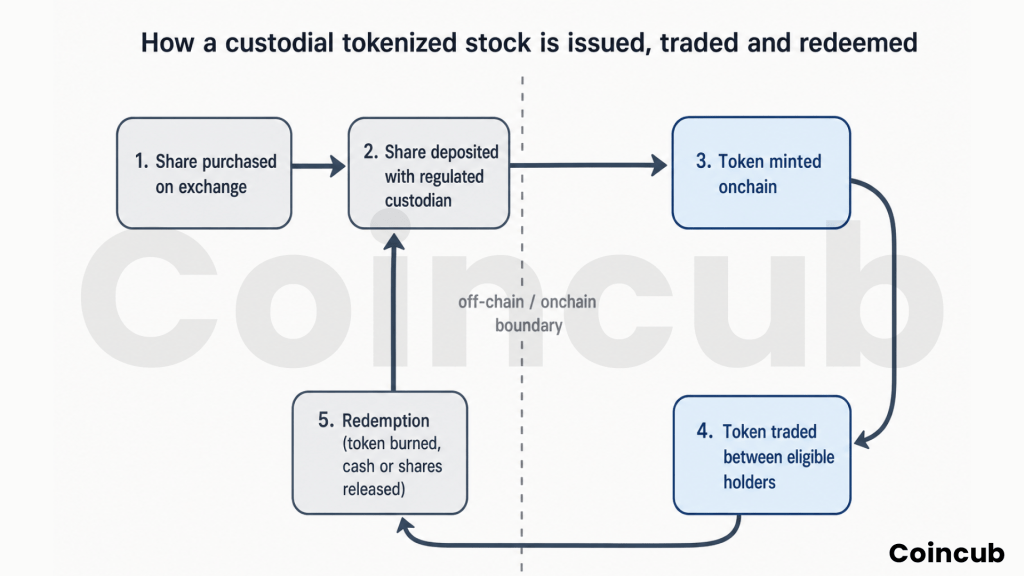
- Custodial products such as xStocks, issued by Backed Finance under a Liechtenstein prospectus, use a mint-and-custody loop: shares are bought, deposited with a regulated custodian, and matching tokens are minted.
- Continuous secondary trading and continuous issuance are different things. A token may trade around the clock on a decentralised venue while minting and redemption still track U.S. market hours.
- ESMA has warned that equity-linked token wrappers carry a risk of misunderstanding for retail investors who may not realise their tokens confer no shareholder rights.
Tokenized Stocks: What Role Does Technology Play?
Most explanations of tokenized stocks start with the technology. That is the wrong end. The blockchain part is comparatively simple and comparatively similar across products. What differs, enormously, is the legal instrument sitting underneath the token.
One product may give you a direct interest in a share held by a regulated custodian. Another may give you a claim against an issuer that promises to track the share’s price. A third may give you a contract with no relationship to the company at all. All three can display the same ticker, quote the same price, and sit in the same wallet. The rights attached to them are not remotely equivalent, and no amount of reading the marketing page will tell them apart reliably.
What Are Tokenized Stocks?
Tokenized stocks are blockchain-based tokens whose value or legal rights are connected to company shares. Depending on the structure, a token may represent an actual share, an indirect claim on shares held by a custodian, or a derivative designed only to track the share price.

The blockchain records the token and its transfers. Legal ownership of the underlying equity, where any exists, generally depends on off-chain records: a prospectus, a custody agreement, a transfer agent’s register, and the insolvency law of whichever jurisdiction the issuer sits in. The chain proves who holds the token. It does not, by itself, prove what the token entitles you to.
The Distinction Between Tokenized Stock and Company-Issued Crypto
A tokenized stock is not the same thing as a cryptocurrency issued by a company. If a business launches a token that grants access to its product, governance influence, or a share of protocol fees, that token may be valuable and it is not equity. Conversely, a tokenized stock references a company’s actual listed shares, whether or not it grants rights in them.
The reliable test is whether the product’s documentation references a specific listed security, identifies a custodian or issuer obligation connected to it, and specifies what the holder receives when the company pays a dividend. If none of that exists, you are not looking at a tokenized stock regardless of the name.
SEC’s Framing of Tokenized Stocks
The January 2026 staff statement’s split is the most practical taxonomy available. Securities tokenized by or on behalf of the issuer sit inside the company’s own ownership system, with the issuer’s cooperation and its transfer agent involved. Securities tokenized by third parties unaffiliated with the issuer are wrappers built around shares the wrapper’s creator acquired on the open market.
The staff noted that for third-party tokens, the rights and benefits may or may not be materially different from those of the underlying security, and may or may not confer any rights as a holder of that security. That “may or may not” is doing a great deal of work, and it is why the product documentation is the only reliable source.
What Does a Tokenized Stock Actually Represent?
Three structures dominate, and the differences are not cosmetic.
| Structure | What you hold | Shareholder rights | Main risk if things fail |
| Issuer-sponsored / native | An interest recorded in the company’s official ownership system | Typically full, as defined by the issuer | Ordinary equity risk plus infrastructure risk |
| Custodial / wrapped | A claim relating to shares held by a third-party custodian | Economic exposure; voting usually absent or limited | Issuer or custodian insolvency; segregation quality |
| Synthetic | A contract tracking price performance | None against the referenced company | Counterparty and collateral failure |
Issuer-sponsored or native equity means the company or its agent has incorporated blockchain into the official system for recording share ownership. This is the structure closest to owning a share, because there is no wrapper between you and the register. It is also the rarest, because it requires the issuer’s active participation and regulatory accommodation.
Custodial or wrapped equity is the dominant model in practice. A regulated entity buys the real shares, deposits them with a custodian, and issues tokens representing a direct or indirect interest in that pool. Backed Finance issues xStocks under a Liechtenstein prospectus supervised by the FMA, with each token collateralised by the underlying share held at a regulated custodian and redeemable at net asset value. The quality of this structure depends entirely on how well the shares are segregated from the issuer’s own assets and what happens in insolvency.
Synthetic stock tokens track a share’s performance through a contractual or collateralised mechanism without conferring rights against the referenced company. This category also captures products structured as debt securities of the platform, which is how Robinhood’s Stock Tokens for European customers are built: holders are creditors of the issuing entity rather than shareholders of the referenced company.
Reading the Structure From the Documents
Marketing language will not distinguish these. Four document checks will.
- The prospectus or key information document states the legal instrument. If it says “debt security,” you hold debt.
- The custody arrangement identifies who holds the shares and under what segregation terms.
- The corporate-actions section explains what happens on dividends, splits, and mergers, which is the single most revealing part of any product’s documentation.
- The insolvency and redemption terms describe your position when the issuer fails, which is the scenario the rest of the document is quietly designed around.
How Do Tokenized Stocks Work Step by Step?
For the custodial model, which covers most of what retail investors can access, the mechanism is a mint-and-custody loop.
- Share acquisition: The issuer or its broker buys the underlying share on a conventional exchange during market hours.
- Custody: The share is deposited with a regulated custodian, held for the benefit of token holders under the terms of the prospectus.
- Minting: A smart contract mints a corresponding quantity of tokens onchain. Backing is intended to be one-to-one, subject to the product’s own terms.
- Distribution and eligibility: Investors complete KYC and eligibility checks before buying, either through a platform or an approved onchain venue. Eligibility restrictions are typically jurisdiction-based and are the reason many products are unavailable to U.S. persons.
- Secondary trading: Tokens transfer onchain between eligible holders, and may trade on decentralised venues or centralised platforms depending on the product’s transfer restrictions.
- Redemption: Tokens are burned and the holder receives cash or, in some in-kind structures, the underlying shares. Backed’s xChange, introduced in March 2026, provides a request-for-quote engine for atomic minting and redemption across EVM networks and Solana.
What Happens on Corporate Actions?
This is where products diverge most and where documentation is most often skimmed.
Dividends may be paid in cash to token holders, paid in stablecoins, or reinvested. Some products handle reinvestment through token rebasing, meaning your token balance or the value each token represents adjusts rather than a cash payment arriving. That difference has real tax consequences in most jurisdictions and is easy to miss.
Stock splits are usually reflected by adjusting the token supply or the ratio each token represents. Mergers and acquisitions require the issuer to decide whether to deliver the acquiring company’s tokens, cash out holders, or suspend the product. Delistings typically trigger a wind-down with forced redemption at a determined value.
Read the corporate-actions clause before buying. It tells you more about the product’s operational maturity than any audit report.
Do Token Holders Receive Dividends and Voting Rights?
Rights depend on the prospectus or contract, and never on the token’s name or ticker.
| Right | Native / issuer-sponsored | Custodial / wrapped | Synthetic or debt-structured |
| Price exposure | Yes | Yes | Yes |
| Dividends | Yes, as a shareholder | Often passed through or reinvested | Sometimes mirrored economically |
| Voting | Typically yes | Usually not, or via issuer discretion | No |
| Information rights | Yes | No direct right | No |
| Redemption for shares | Not applicable | Sometimes, subject to minimums | No |
| Claim in issuer bankruptcy | Against the company | Against the token issuer or custody pool | Unsecured claim against the issuer |
The Robinhood example is instructive precisely because it is explicit. The Stock Tokens offered to European customers are debt securities, and holders do not own the underlying stock and receive no voting rights. That is a clearly disclosed product design rather than a defect, and an investor who assumes ticker parity implies rights parity has misread it.
ESMA has warned publicly that equity-linked token wrappers carry a risk of misunderstanding for retail investors who may not realise their tokens confer no shareholder rights. That warning is aimed at exactly this gap between what a product displays and what it grants.
The Practical Consequence
If your reason for buying a stock is price exposure, most tokenized structures deliver it. If your reason involves voting in a proxy contest, receiving shareholder communications, or holding a direct claim on company assets in a wind-up, you need the native structure or a conventional brokerage account, and most tokenized products will not serve you.
Why Use Tokenized Stocks Instead of a Brokerage?
- Fractional access: tokens divide finely, so exposure to a high-priced share is available in small amounts. Many conventional brokers now offer fractional shares too, so this advantage is narrower than it was.
- Wallet portability and DeFi compatibility: where transfer restrictions permit, a token can be held in a self-custody wallet and used as collateral or in liquidity pools. This is the genuinely novel capability, and it is also where the additional risk lives.
- Blockchain settlement: onchain transfers settle in minutes rather than on a T+1 cycle, which matters more for institutional workflows than for a retail buy-and-hold investor.
- Extended trading availability, with an important caveat: do not assume every product trades continuously. xStocks tokens may trade continuously on secondary venues, while issuer minting and redemption are generally aligned with U.S. market hours because the underlying shares can only be bought and sold when the exchange is open. The practical result is that off-hours prices are set by secondary-market supply and demand rather than by an arbitrage mechanism running against the real share, and they can diverge from the last exchange print.
- Global distribution: products can reach investors in markets where access to U.S. equities is difficult, subject to eligibility restrictions that are often extensive.
The Tracking-Error Question
A point that rarely appears in product marketing: a tokenized stock’s price and the underlying share’s price are related by a mechanism, and mechanisms can slip.
For custodial products with functioning arbitrage, an authorised participant who sees the token trading above the share can mint new tokens and sell them, and the gap closes. That mechanism only operates when minting is available, when the underlying market is open, and when the arbitrageur has capital and access. Remove any of those conditions, which happens overnight, at weekends, and during stress, and the token’s price is set purely by whoever is willing to trade it on a thin venue.
The practical implication is that the price you see on a decentralised exchange at 3am is not a quote for the share. It is a quote for the token, from a market with a fraction of the depth. Sizeable orders in those conditions can move the price several percent against you, which is a cost that never appears in a fee schedule. Check historical spread and premium data for the specific product across off-hours periods before assuming continuous trading is a benefit rather than a hazard.
Where a Conventional Brokerage Still Wins
For an investor in a market with good brokerage access, wanting dividends and votes on a long-term holding, a conventional account is simpler, cheaper, better protected by investor-compensation schemes, and has clearer tax treatment. The case for tokenized equities strengthens where brokerage access is poor, where onchain composability is the actual objective, or where fractional exposure to otherwise inaccessible securities matters.
What Are the Main Risks of Tokenized Stocks?
Issuer and custodian insolvency. A custodial token is a claim. Whether that claim survives the issuer’s failure depends on segregation of the underlying shares, the security-agent arrangements, and the insolvency law of the issuer’s jurisdiction. Read this section of the prospectus first.
Smart-contract exploits. The token contract, any bridge it crosses, and any DeFi protocol it enters are all attack surfaces that conventional shares do not have.
Lost keys. Self-custody means irreversible loss is possible in a way it is not with a broker-held position.
Restricted redemption. Many products impose minimum redemption sizes, eligibility restrictions, or processing windows. A token you can buy in $50 increments may only be redeemable in blocks worth far more.
Thin liquidity and off-hours divergence. Secondary-market depth for a tokenized equity is a small fraction of the underlying share’s. Spreads widen, and off-hours prices can drift from fair value with no arbitrage mechanism available to correct them.
Loss of shareholder protections. Investor-compensation schemes, shareholder-communication rights, and the protections attaching to a brokerage relationship generally do not follow the token.
Regulatory change. The SEC’s January 2026 statement tightened scrutiny of synthetic equity structures in particular. Products can be restricted, restructured, or withdrawn from a market with limited notice.
Tax and FX complexity. Treatment of dividends passed through a wrapper, rebasing events, and disposals in a currency different from your own adds work that a domestic brokerage would not.
The Concentration Point Most People Miss
These risks compound rather than sitting side by side. A tokenized share used as DeFi collateral carries equity-market risk, issuer risk, custodian risk, token-contract risk, protocol risk, oracle risk, and liquidation risk simultaneously. Each layer might be individually modest. Stacked, they can produce a total loss on a position whose underlying company performed perfectly well.
Community discussion of these products, which is worth reading and should be treated as anecdotal rather than verified, returns persistently to the same worries: liquidity in stress, redemption friction, platform restrictions, exchange hacks, tax uncertainty, and a recurring suspicion that a normal brokerage would be simpler. Those concerns are directionally reasonable and none of them substitute for checking a specific product’s documents.
How Can You Evaluate a Tokenized Stock?
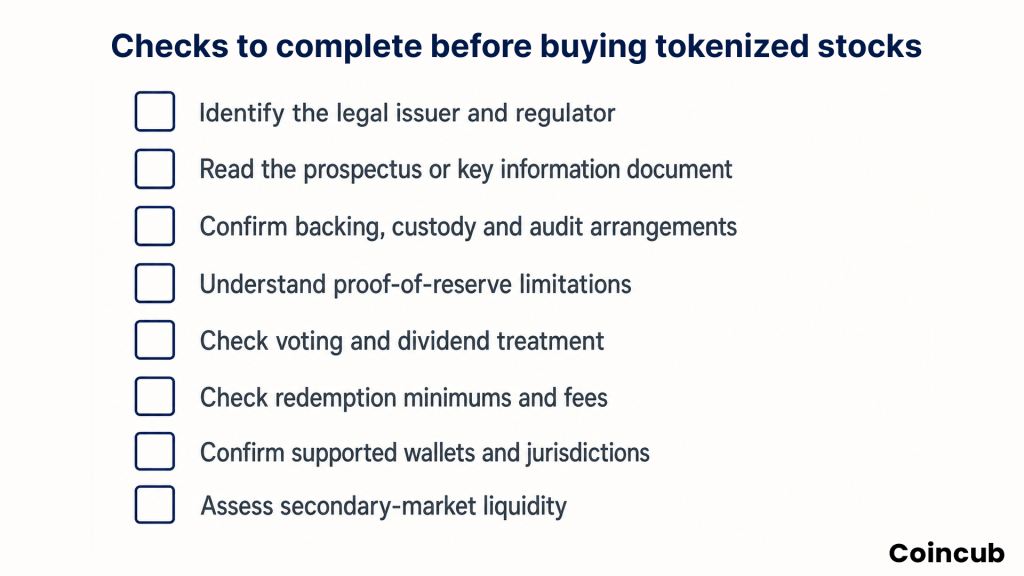
Work through this in order. Each step can end the evaluation.
Identify the legal issuer and its regulator. Not the platform selling it to you. The entity whose balance sheet you are exposed to, and the supervisor it answers to. If this cannot be established quickly from primary documents, stop.
Read the prospectus or key information document. Establish the legal instrument: equity interest, debt security, or derivative contract. This single fact determines most of your rights.
Confirm backing, custody, and what is actually verified. Who holds the shares, under what segregation terms, and who checks. Proof-of-reserve attestations vary widely in scope. Many confirm that assets existed at a point in time without confirming they are unencumbered, which is a meaningfully weaker statement than it appears.
Check corporate-action treatment. Dividends, splits, mergers, delistings. Whether dividends arrive as cash, stablecoins, or rebasing, and how each is taxed where you live.
Check redemption mechanics. Minimum size, eligibility, fees, processing time, and whether redemption is suspended in stressed conditions.
Check jurisdictional availability and wallet support. Confirmed for your residence, on a dated basis, and compatible with a wallet you can actually use.
Assess secondary-market liquidity. Look at real depth and spreads on the venues available to you, at the times you would realistically trade, rather than at headline volume figures.
Sizing the Market Honestly
Context helps calibrate expectations. The tokenized-stock sector’s aggregate market capitalisation crossed $1 billion in March 2026 with more than 185,000 holders, with xStocks accounting for roughly a quarter of total value and around 17% of users at that point, offering over 140 tokenized stocks and ETFs. Those are point-in-time figures and should be re-checked against a live dashboard before relying on them.
That is real adoption, and it is a rounding error next to conventional equity markets. Treat these products as an emerging category with corresponding liquidity and operational risk, not as an equivalent venue that happens to settle onchain.
Read This Before You Buy a Tokenized Stock
The useful discipline with tokenized stocks is to classify before you compare. Establish whether the product is native, custodial, or synthetic, and everything else, including rights, risks, tax treatment, and what happens in a failure, follows from that answer.
If you want price exposure and onchain composability, custodial products from regulated issuers are the mainstream option and are worth evaluating on their documentation rather than their interface. If you want the full bundle of shareholder rights, a conventional brokerage still delivers it more cheaply and with better protection.
Frequently Asked Questions (FAQ)
Are tokenized stocks real stocks? +
Some represent genuine equity interests, others are custodial claims on shares held by a third party, and some are derivatives or debt securities with no ownership rights. The structure is set by the prospectus, not by the token’s name or ticker.
Do tokenized stocks pay dividends? +
Some do, by distributing cash or stablecoins, and others reinvest the equivalent value through token rebasing. Terms and tax treatment differ by product and jurisdiction, so check the corporate-actions section of the product documentation before assuming.
Can tokenized stocks be traded 24/7? +
Some secondary markets operate continuously, but issuer minting and redemption generally align with the underlying exchange’s hours. Off-hours liquidity is usually thin, and prices can diverge from the last exchange print without an arbitrage mechanism to correct them.
Do stock-token holders receive voting rights? +
Only where the legal structure explicitly provides them, which is uncommon. Custodial wrappers usually do not pass through votes, and debt-structured products such as Robinhood’s Stock Tokens confer no voting rights or direct ownership of the underlying shares.
Can I hold stock tokens in my own wallet? +
Some products are transferable to self-custody wallets, subject to eligibility and transfer restrictions coded into the token. Others remain inside the issuing platform entirely. Check supported wallets and networks before buying, since this varies by product.
Are tokenized stocks available in the United States? +
Availability depends on the product, investor status, trading venue, and securities-law compliance. SEC staff addressed tokenized securities in a January 2026 statement, and many third-party wrapped products currently restrict U.S. persons from purchasing.
What happens if the token issuer fails? +
Recovery depends on how the underlying shares were segregated, the custody and security-agent arrangements, any collateral held, and the insolvency law of the issuer’s jurisdiction. Holders may rank as unsecured creditors rather than owners of the shares.