



 Buy a Licensed Company
  Explore VASP Data
  Talk to an Expert


Coincub’s 2026 report ranks global crypto exchanges using user demand, licensing coverage, and regulatory risk to assess market access and compliance. It highlights how MiCA, fintech convergence, and evolving regulations are reshaping competition worldwide.
Executive Summary
The global cryptocurrency exchange market entered 2026 as a structurally different industry from the one that existed two years ago. We have put behind us the era of opt-in compliance. Instead, we now have a rigid, increasingly surveilled framework that determines who can operate in major markets, and who gets to keep operating there.
This report is Coincub’s most detailed exchange analysis to date. It uses Q1 2026 licensing data, overlaid with regulatory sanctions and actual user data. Of the users flowing through the world’s most visited exchanges, how many are being served by a platform that is officially authorized to serve them by the local regulator?
Searching for this answer leads to two ends. Platforms that dominated user growth by building offshore and prioritizing reach over regulatory footprint now face structural pressure from every direction. On the other hand, platforms built within the licensed perimeter (or entered crypto via existing regulated financial infrastructure) are well established as the default winners of the convergence already underway.
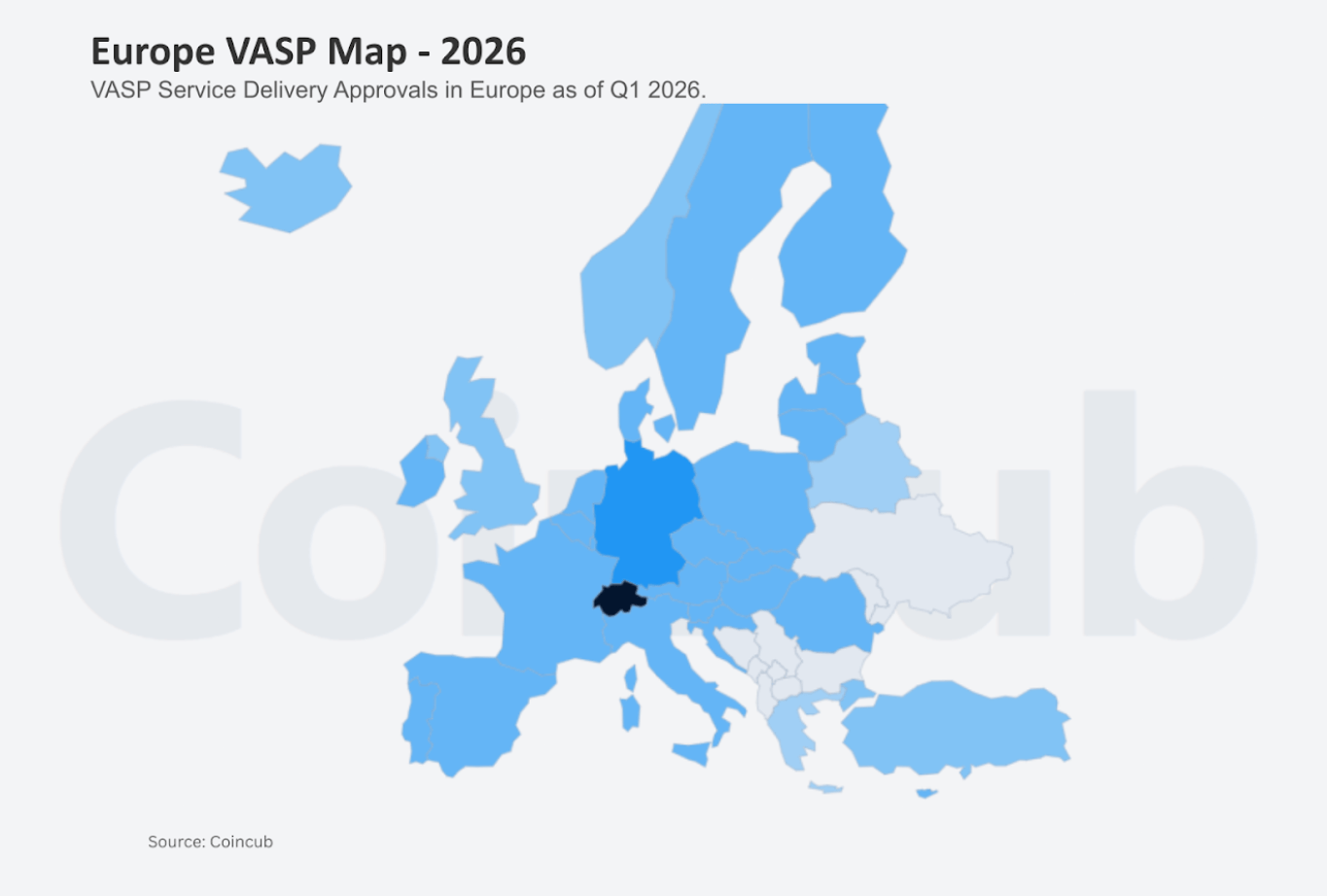
Europe remains the center of this story. It is now the largest single regional source of crypto exchange user base globally and the most aggressively regulated market on the planet. MiCA is in full force, with the final grandfathering deadline set for July 1, 2026. DAC8 entered its first reporting year on January 1, 2026. The EU now has a compliance stack, with a market access gate and a reporting backplane, that has no parallel anywhere in the world.
The United States needs to be framed more carefully. Coverage exists through MSB registration, state-level structures, and other regulatory permissions that matter in practice. But the US still lacks a unified federal crypto-specific spot-exchange regime comparable to MiCA. So the better description is partial and fragmented coverage.
Therefore, today, we have a market in transition. Exchanges with the highest raw user scale are not always the exchanges with the strongest licensed user bases. Fintech platforms such as Revolut now compete directly with crypto-native players by embedding crypto inside products users already trust. At the same time, offshore exchanges are being pushed to rebuild market access, country by country, license by license, while carrying user bases accumulated under a looser regime.
Key Findings
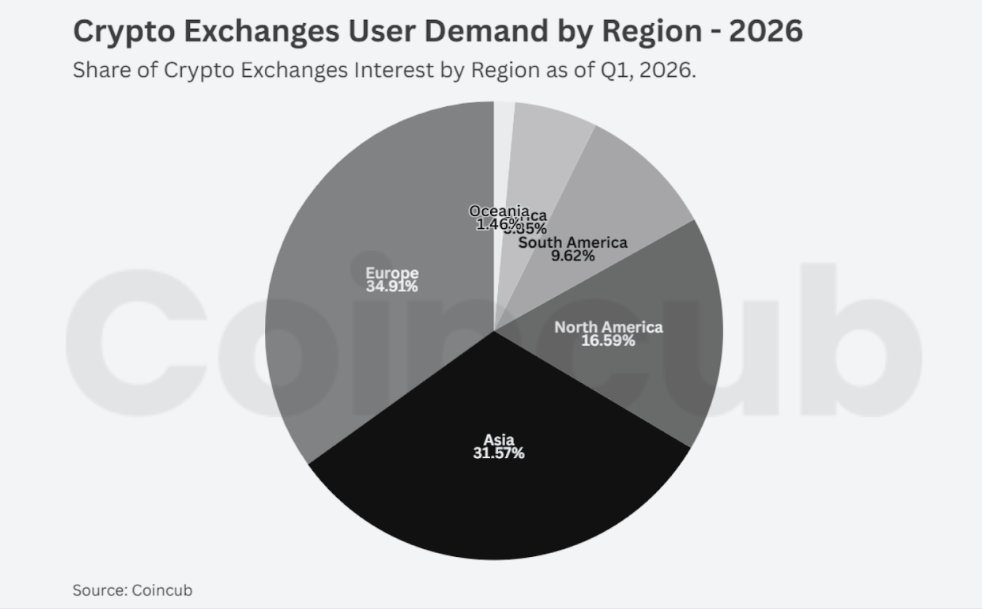
- Europe is now the largest user region in the dataset at around 35% of total demand, ahead of Asia at 32%, and North America at 17%. So, the largest user region is also the most regulated.
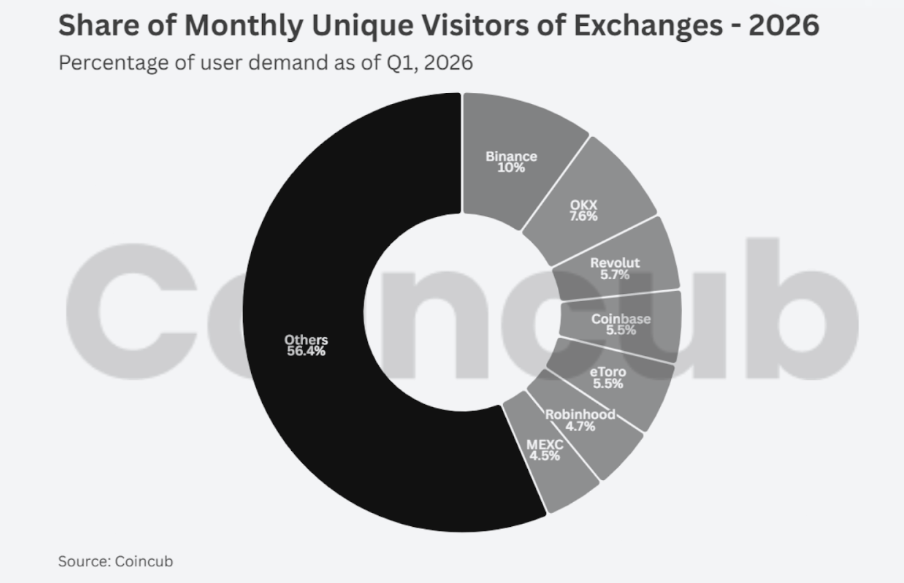
- Binance remains the biggest branded platform, having 10% of the user demand share, followed by OKX at 7.6%, Revolut at 5.7%, and both Coinbase and eToro at 5.5%.
- The market is less concentrated than the biggest brands make it look. The “others” bucket still accounts for the majority of user demand, meaning most of it sits outside the top branded names.
- There is a wide user base split between regulated and offshore-heavy platforms. Robinhood, Coinbase, Revolut, and eToro get the majority of their users from licensed markets. By contrast, Binance and OKX get the majority of their users from jurisdictions where they don’t have a license to operate.
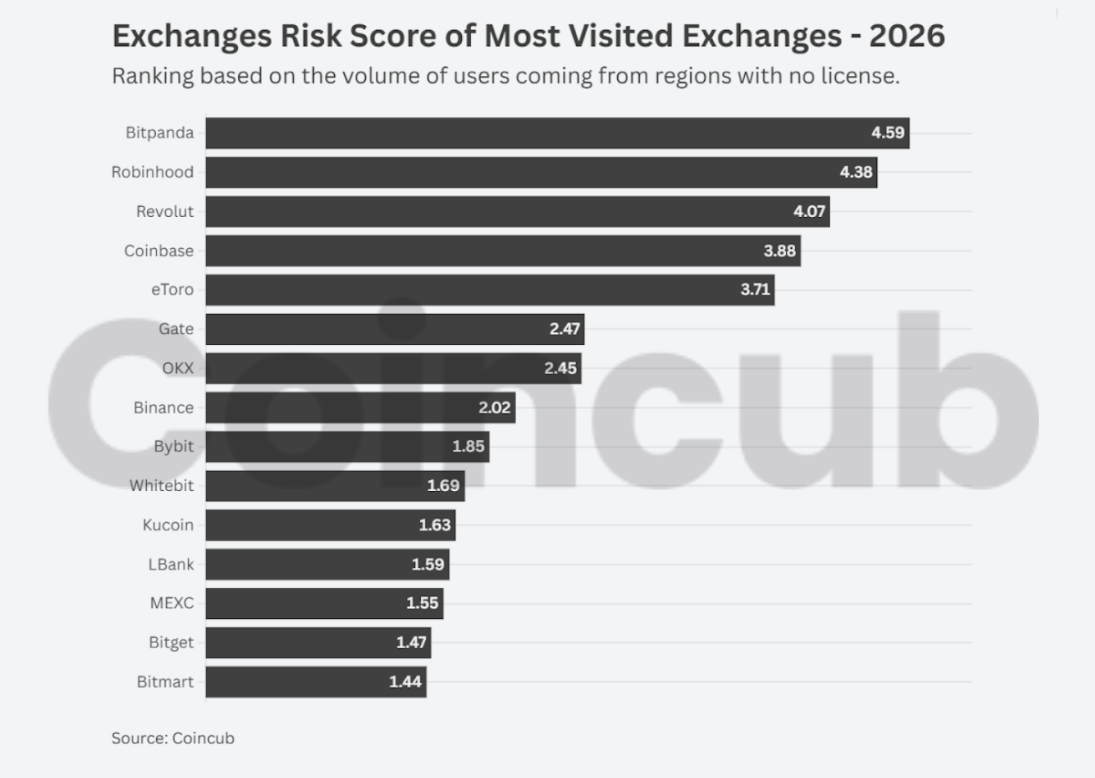
- Bitpanda has the highest risk score among all exchanges, at 4.59, followed by Robinhood at 4.38, Revolut at 4.07, Coinbase at 3.88, and eToro at 3.71. OKX scores 2.45, Binance 2.02, and Bybit 1.85.
- While still one of the largest markets, the US is fragmented. Supervision exists through MSB registration and related structures, but there isn’t a unified federal crypto-specific exchange regime yet.
Methodology
This analysis starts with user access. It tracks where people are going for crypto services, then maps that demand against licensing coverage and regulatory conduct. Web visits are used as a directional proxy for user attention and access. They do not measure revenue, solvency, or executed trading volume.
The exchange dataset was screened from more than 1,100 exchange and broker domains and matched against more than 40,000 licensed companies in Coincub’s regulatory database. From that broader universe, 129 exchanges were retained for the core ranking and 162 entities for the country analysis.
User data is based on Q1 2026 monthly web visits and unique visitors compiled in Coincub Data. These figures show where users are trying to access crypto services and which platforms attract the strongest country-level demand.
Visits also do not map one-to-one to active trading users or funded accounts. A share of user demand reflects research behavior, price checking, educational use, support access, login activity, comparison shopping, and other non-transactional interactions. For that reason, user demand should be read as an indicator of market attention, access intent, and platform reach, rather than as a direct measure of executed trading activity or customer value.
The Scoring Framework
What share of an exchange’s unique visitors come from countries where it holds a current, relevant authorization to offer crypto-asset services? That is what the risk score measures.
For each exchange, country-level unique visitor data was mapped against the Coincub licensing lookup. Visitors from countries where the exchange holds a verifiable relevant authorization are classified as licensed. Visitors from countries where it is not classified as unlicensed. The result is scaled from 0 to 5.
The risk score also reflects regulatory conduct over time. It captures licensing failures, AML/CFT failures, consumer protection violations, market integrity issues, and unlicensed operations. Limited remediation credit can be added back where the record shows meaningful corrective action or dismissal.
A higher score means broader licensed coverage and lower licensing risk. A score of 5 means all tracked visitors come from markets where the exchange is authorized to serve them. A score of 0 means none do. Most exchanges sit somewhere between those poles.
Transitional MiCA registrations that had not yet converted into full CASP authorization were treated as unlicensed. Where the license status was unclear, the more conservative classification was used.
This is not intended to be a moral ranking. It is a practical measure of how exposed an exchange is across licensing coverage and regulatory conduct.
Part I: The User Landscape
Europe at the Center
The clearest result in Q1 2026 is at the regional level. Europe is the largest source of crypto exchange users in the dataset, ahead of Asia and North America. That is purely the product of user demand, regulated distribution, and trust moving in the same direction there.
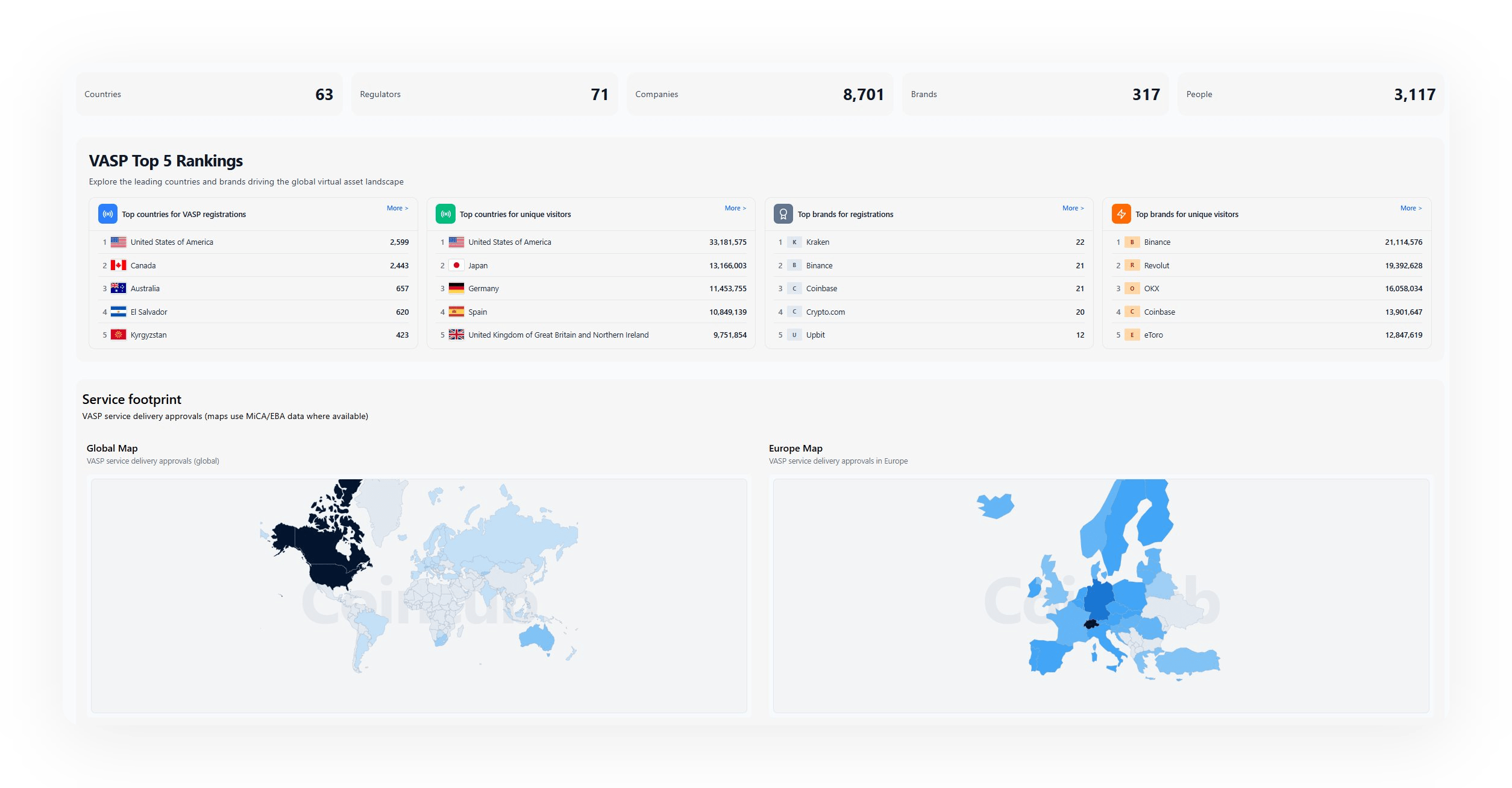
Europe accounts for 34.91% of monthly users accessing regulated platforms, ahead of Asia at 31.57% and North America at 16.59%. South America is much smaller at 9.62%, while Africa is 5.85% and Oceania 1.46%. So the most regulated region is also the largest one, which is exactly why MiCA is important at the market level rather than just at the policy level.
MiCA gave Europe something crypto markets rarely get at scale: a single framework, a single route to authorization, and a single passport across 27 member states. For years, Europe was populous but fragmented in its market structure. Every country looked slightly different. MiCA did not remove every difference, but it removed enough to turn Europe into a coherent market for exchanges that qualify.
While the initial thought would be that a large part of Europe’s crypto growth came from native exchanges acquiring users through aggressive campaign funnels, it actually came through financial apps that users already trusted. Revolut added crypto to a banking product. Trade Republic added crypto to a mainstream investing product. N26 embedded it into digital finance. Bitvavo and Bitpanda were built around a regulated European user base rather than a global grey zone. That changed how crypto entered the retail market. It became another financial feature rather than a separate frontier product.
That has consequences for competition. In a market where the product is already inside the banking or investing app, user acquisition is cheaper, compliance is cleaner, and retention can be stronger. Europe now produces the largest user base and also the cleanest conditions for that model.
In Asia, user demand remains large, but the regulatory environment has broken into stricter national silos. Asia is still close behind Europe at 31.57% of total users, but the regulatory environment has broken into stricter national silos. Japan has kept one of the most demanding exchange regimes in the world. Singapore has maintained a narrow licensing funnel. South Korea has tightened reporting and AML obligations. Those are mature markets, but they are not easy markets. User demand still exists, though the cost of serving it lawfully is much higher than it was.
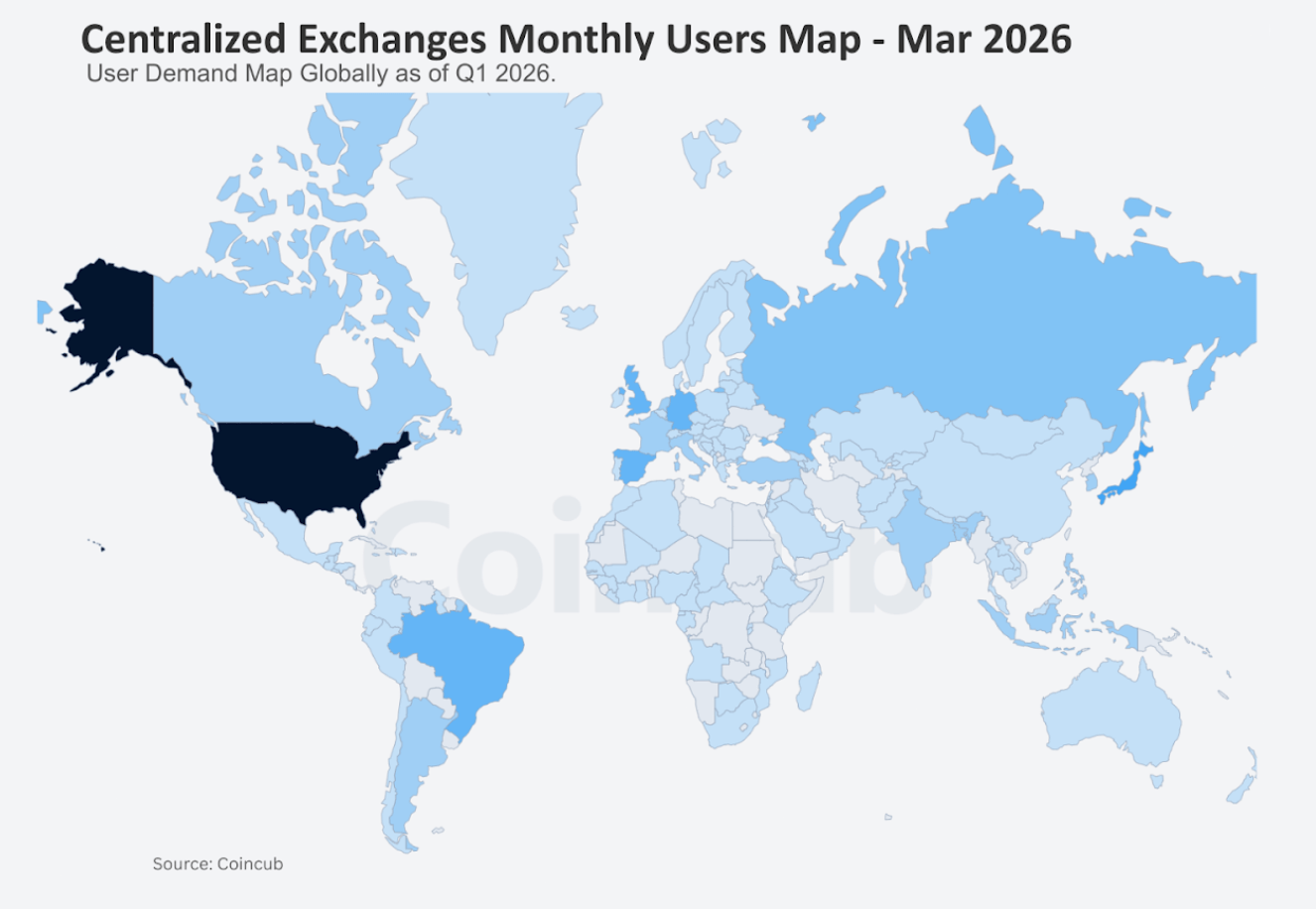
The US appears dominant because it registers as a single country. Europe looks lighter because its demand is split across individual nations. In practice, Spain (27M), Germany (27.3M), and the UK (28M) alone already outpace total US traffic (77M) before the rest of Europe is counted. Use the regional percentages, not the map shading, to compare scale.
The Fintech Convergence
The most important structural change in the user data is that crypto-native exchanges are no longer competing only with one another.
Binance still leads with 10.0% of monthly unique visitors, followed by OKX at 7.6%, Revolut at 5.7%, and both Coinbase and eToro at 5.5%. Robinhood adds another 4.7%, and MEXC sits at 4.5%. Regulated finance entrants are now close enough in user share to shape the same market.
Revolut, Robinhood, eToro, and Coinbase all sit inside or near the same user-reach conversation as the largest offshore exchanges. They got there through different routes, but the common pattern is that each built on an already-regulated user relationship. They did not need to teach users how to trust a crypto platform from scratch. They extended existing trust into crypto.
Revolut is the cleanest example. Much of its user demand comes from utility and finance searches, rather than from pure crypto acquisition. The user arrives through a product they already use for banking, FX, or budgeting. Crypto is embedded in that experience.
Robinhood’s European expansion is relevant for similar reasons. It now operates not as a US-only brokerage with a crypto feature, but as a cross-market platform blending brokerage, tokenization, perpetuals, and exchange infrastructure. Coinbase has done the same from the other direction, starting with crypto and building outward into broader financial rails and institutional products.
The “others” bucket still holds 56.4% of total monthly unique visitors. The market is less concentrated than the headline brands suggest. Binance may be the single biggest name, but most user demand still lies outside the top-branded cluster, much of it on regional platforms with cleaner regulatory footprints than those at the very top of the market.
Part II: The Compliance Divide
Licensed vs. Unlicensed User Bases
But exchanges with the most users are often not the strongest in terms of license coverage. That does not mean every high-user exchange is operating unlawfully everywhere it is used. It means the geographic build-out of crypto happened faster than licensing regimes did. Demand accumulated in markets before those markets had clear authorization frameworks, before regulators coordinated across borders, and before public warnings carried serious commercial consequences. And that legacy is quite visible in the data.
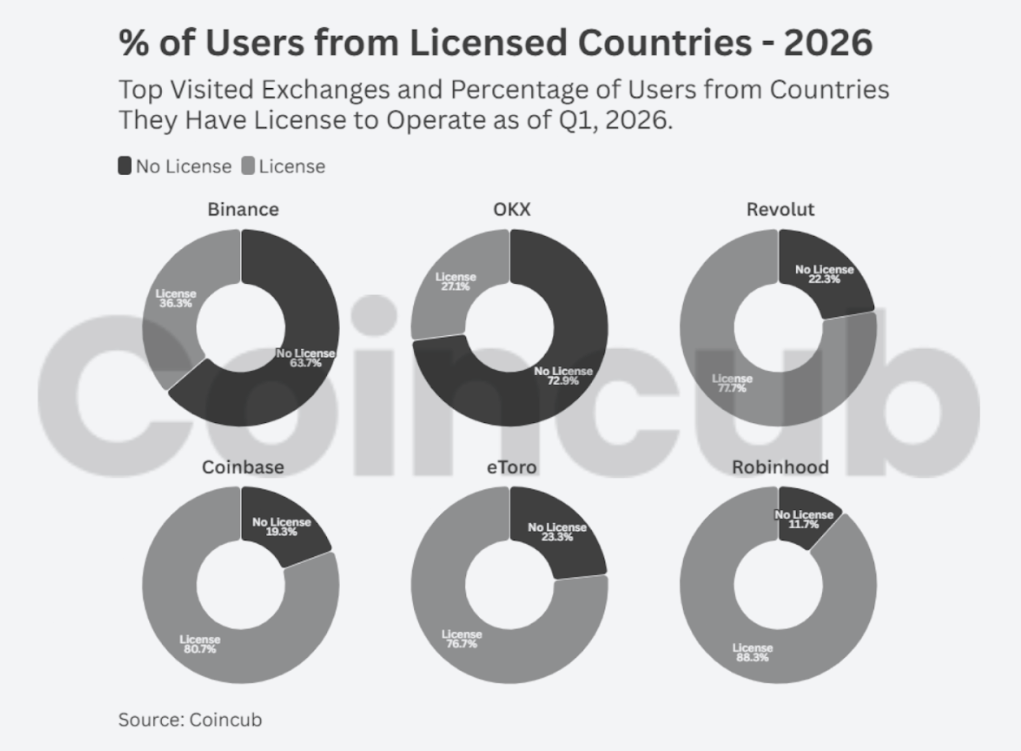
The donut charts show the split directly. Platforms with the strongest registration-user shares usually built their user bases in markets they were authorized to serve from the start, or they expanded in step with licensing. Platforms with the weakest licensed share often built global reach first and formal coverage later.
Robinhood has 88.3% of its users coming from licensed markets, Coinbase 80.7%, Revolut 77.7%, and eToro 76.7%. At the other end, Binance is at 36.3% and OKX at 27.1%. That is not a small difference around the margin. It is a split between platforms whose user bases were built largely within the regulated perimeter and platforms that still carry much heavier exposure outside it.
This is where the risk score becomes relevant. The ranking tracks that exposure directly. Bitpanda leads at 4.59, followed by Robinhood at 4.38, Revolut at 4.07, Coinbase at 3.88, and eToro at 3.71. Further down, OKX scores 2.45, Binance 2.02, and Bybit 1.85. The score shows how much of that scale sits on firmer licensing ground.
This kind of vulnerability is becoming very easy to act on. In earlier cycles, “unlicensed” often remained abstract. In 2026, it increasingly arrives via public warnings, app-store coordination, payment friction, consumer alerts, or named enforcement notices. Once that happens, the issue becomes a reputational event that affects conversion, retention, banking relationships, and local partnerships.
Stablecoins made this visible to users in a way licensing language never could. MiCA’s stablecoin rules forced several exchanges to remove or restrict USDT for EEA users, prompting them to shift toward compliant alternatives. That was not a back-office compliance change. It changed what users could actually deposit, trade, or hold on regulated European platforms.
The enforcement shift is similar. FCA warnings about unlicensed activity, VARA consumer alerts, CSA restrictions, and FSA warnings in Japan are no longer side notes. They are part of the market-access apparatus itself. If an exchange wants long-term access to Europe, the UK, Singapore, Japan, or, eventually, Brazil under a more comprehensive regime, licensing is becoming part of the distribution.
Part III: Exchange Profiles
The profiles below explain why major exchanges sit where they do in the user base and licensing framework. The charts show the numbers. These profiles explain the structure behind them.
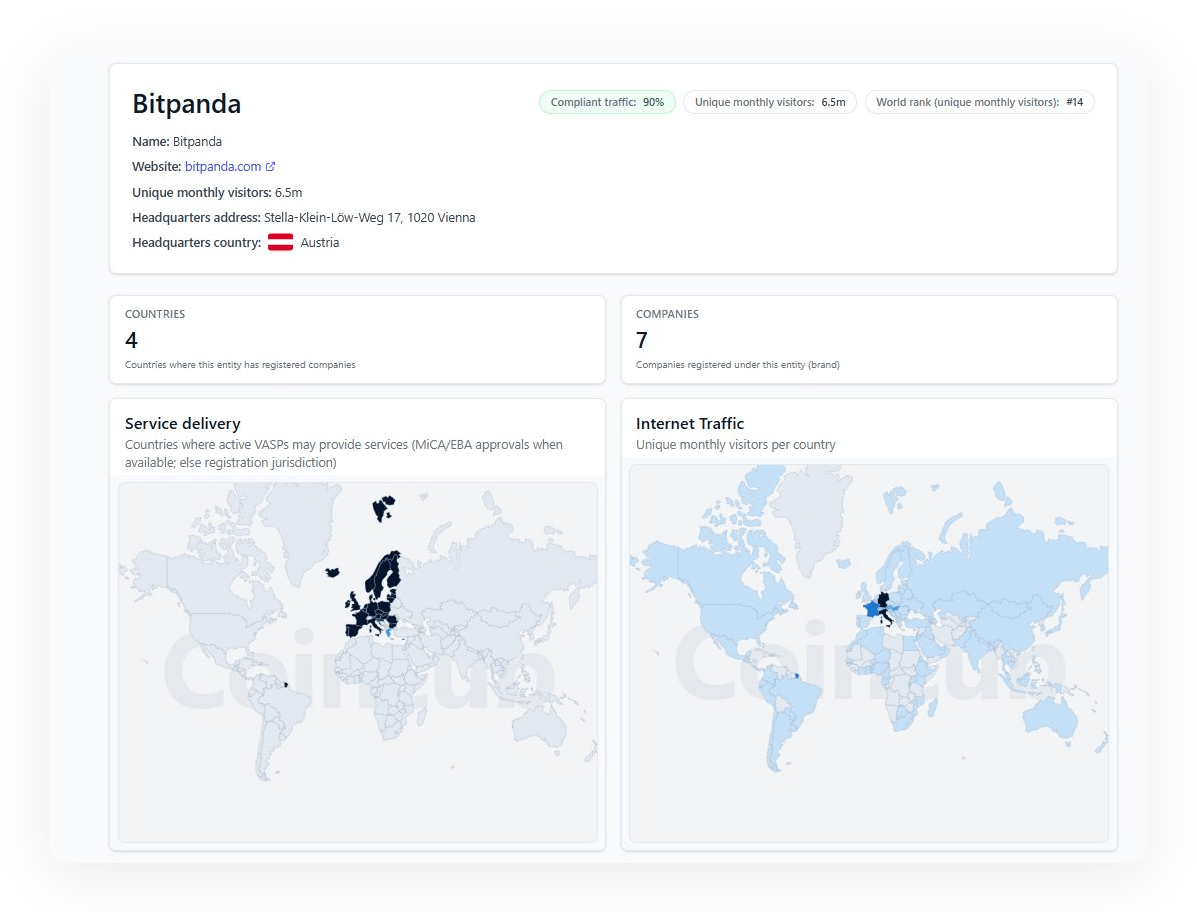
Bitpanda
Bitpanda is one of the clearest examples of the opposite strategy to Binance. It was built around licensed European retail demand from the start, accepted a narrower addressable market, and now benefits from that discipline as Europe becomes the most important regulated region.
Bitpanda has the highest risk score in the ranking at 4.59. It is smaller in raw scale than the biggest offshore names, with roughly 6 to 7 million monthly unique visitors in the current chart, but that is the point. It built less scale on cleaner ground, and that now ranks better than bigger user bases with thinner licensing coverage.
Its strongest user base comes from countries where it holds, or can clear, passport authorization. That is what a high score looks like in practice. Bitpanda did not need to retrofit compliance into its global footprint because the footprint itself was built within a regulatory framework.
MiCA increases the value of that strategy. A company that already knows how to operate in a regulated European environment can now scale across the EEA with much less friction than before.
Robinhood
Robinhood is the clearest example of why the US needs to be explained carefully in this report. It operates inside a dense US regulatory environment.
It scores 4.38, with 88.3% of users coming from licensed markets, the highest licensed share in the donut set. It also sits at 4.7% of total monthly unique visitors in the market-share chart. Robinhood has a meaningful user scale and one of the cleanest licensing profiles in the ranking.
Robinhood’s expansion across the EEA, product rollout in tokenized assets and perpetuals, and Bitstamp acquisition give it a stronger international footing than it had even a year ago. If the US eventually adopts a federal market structure and licensing framework, Robinhood is one of the exchanges that could re-rate quickly under this model.
Coinbase
Coinbase scaled inside a public-market and institutional framework. Every regulatory action is a disclosure event. And every license is strategic infrastructure.
Its advantage is that it has pursued a compliance-first expansion, turning compliance into a distribution layer for custody, prime services, tokenization, and broader financial products. That makes Coinbase harder to analyze as a simple exchange. It increasingly operates as financial infrastructure.
Coinbase still combines scale with relatively strong coverage. It accounts for 5.5% of total monthly unique visitors globally, with 80.7% of users from licensed markets and a risk score of 3.88. That keeps it below Robinhood and Revolut on the ranking, but still well ahead of the larger offshore exchanges on licensing quality.
Revolut
Revolut shows what happens when crypto is added to an already regulated financial relationship. Its users did not need to be onboarded into a separate trust perimeter.
That sequencing explains why Revolut’s profile looks cleaner than many crypto-native exchanges. Its European model is built on banking and e-money infrastructure first, crypto second. That is a major competitive advantage in a market like Europe, where regulation, payments, and product design are now tightly linked.
Revolut is one of the clearest examples of regulated distribution converting into crypto scale. It accounts for 5.7% of total monthly unique visitors, ahead of both Coinbase and eToro in the share chart, while 77.7% of its users come from licensed markets. Its risk score of 4.07 puts it ahead of Coinbase despite Coinbase’s stronger crypto-native brand recognition.
eToro
eToro sits in the same convergence trend but through a different route. It entered crypto as part of a broader trading platform, using its regulated EU structure as the basis. MiCA made that base more meaningful because the old differences between a lighter and stricter EU licensing jurisdiction matter less once the core rules are harmonized.
Besides being part of the convergence story in theory, eToro holds 5.5% of total monthly unique visitors, roughly in line with Coinbase, while 76.7% of its users come from licensed markets. Its risk score is 3.71, which puts it below Coinbase and Revolut but still well ahead of the large offshore exchanges. So the market is already treating it as a scaled platform.
Its risk now is less about whether it belongs inside the regulated perimeter and more about how its social and copy-trading model fits tougher conduct oversight. MiCA’s market abuse provisions and broader supervisory attention to retail investor protection could play a bigger role for eToro than for a plain-vanilla spot exchange.
Binance
Binance remains the clearest example of scale built ahead of regulation. That was a conscious strategy. The exchange grew faster than most national frameworks could react, and the subsequent DOJ, CFTC, OFAC, and FinCEN settlement brought that period to a close.
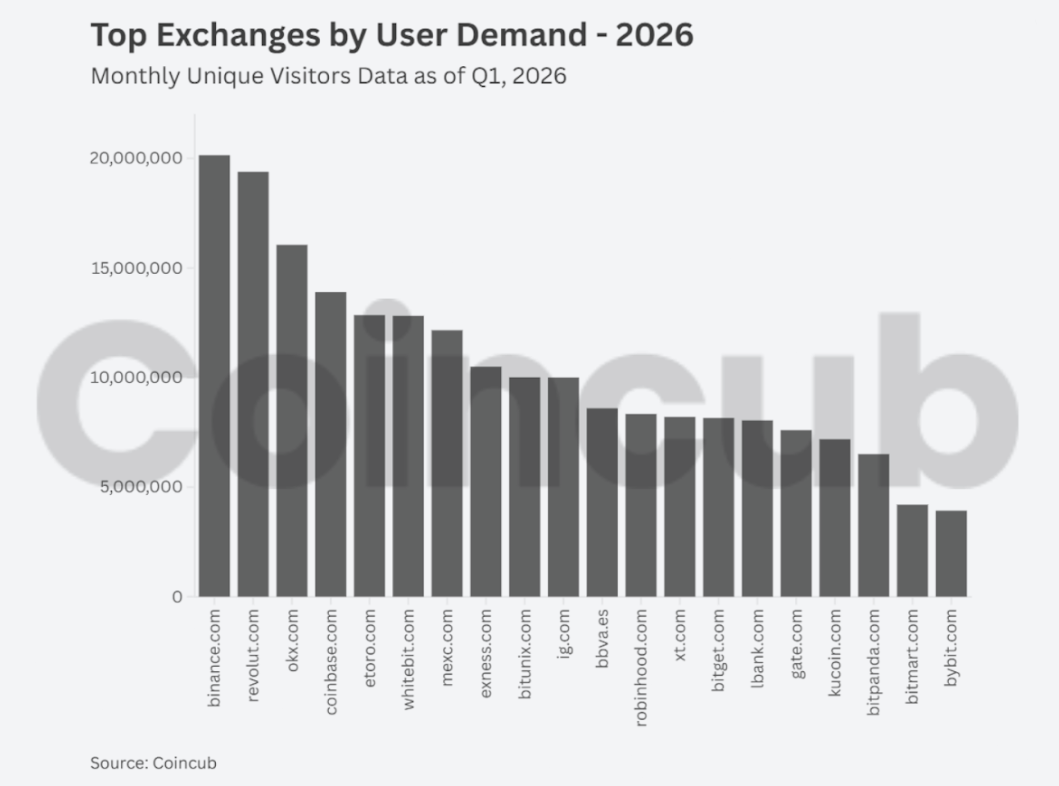
Binance remains the largest platform in the user-share chart, at 10.0% of global monthly unique visitors, with just over 20 million monthly users. But only 36.3% of those users come from licensed markets, and its risk score is 2.02. So, the largest user base in the report still has one of the weakest licensing profiles among the major names.
The post-settlement company is different in real ways. Compliance staffing expanded, KYC standards tightened, and licensing became a strategic priority. But user geography does not change as quickly as a compliance program. Binance still draws large interest from markets in South Asia, Latin America, the Middle East, and Africa, where adoption is driven by inflation, capital controls, or dollar access rather than clean authorization.
That is why Binance remains such a focal point in this report. It is trying to retrofit one of the world’s largest crypto user bases into a world where major markets increasingly require formal standing. Its MiCA strategy is crucial because Europe is now too important to treat as peripheral. But their MiCA application in Greece recently raised some serious questions.
OKX
OKX is following the Binance playbook. It has run one of the most deliberate licensing campaigns among offshore-origin exchanges. Its MiCA authorization through Malta, combined with payments infrastructure under PSD2 and licenses in Dubai, Singapore, and Australia, shows a serious attempt to build a multi-jurisdiction footprint before enforcement closes in further.
OKX is now the second biggest global exchange, just behind Binance. Since 2023, it has overtaken Coinbase, and it holds 7.6% of total monthly unique visitors and around 16 million monthly users. The problem is coverage. Only 27.1% of users come from licensed markets, and the risk score is 2.45. So the licensing campaign is real, but the user base still reflects the older offshore footprint.
But much of OKX’s user base was built before those licenses arrived. Brazil, the US, and Japan remain important source markets where regulatory positions are weaker. So OKX’s legal build-out is real, but the score still reflects the older geography of its user base.
Its Malta-first strategy also places it inside the wider EU debate over supervisory consistency. If MiCA becomes a regime where exchanges choose the softest entry point and passport from there, regulators in France, Germany, Austria, and Italy will push back hard.
Bybit
Bybit sits at the other end of the score distribution because its user base is concentrated in markets where licensing is weak, absent, or geopolitically difficult. Russia matters heavily. So do other markets shaped more by derivatives demand and access than by regulatory alignment.
Bybit sits near the bottom of the ranking for the same reason. Its risk score is 1.85, and the monthly user bar puts it at just under 4 million in the current cut. That is much smaller than Binance or OKX in raw demand, but the licensing exposure is still heavy relative to that base.
That already produced a fragile score before the security side is considered. The February 2025 hack then added a second layer of structural pressure by turning third-party custody and operational controls into a major part of the Bybit story.
The split between the global platform and the European entity does play an important role. It shows that licensing can clean up one part of the business while leaving the broader user base exposed.
Part IV: Country Intelligence
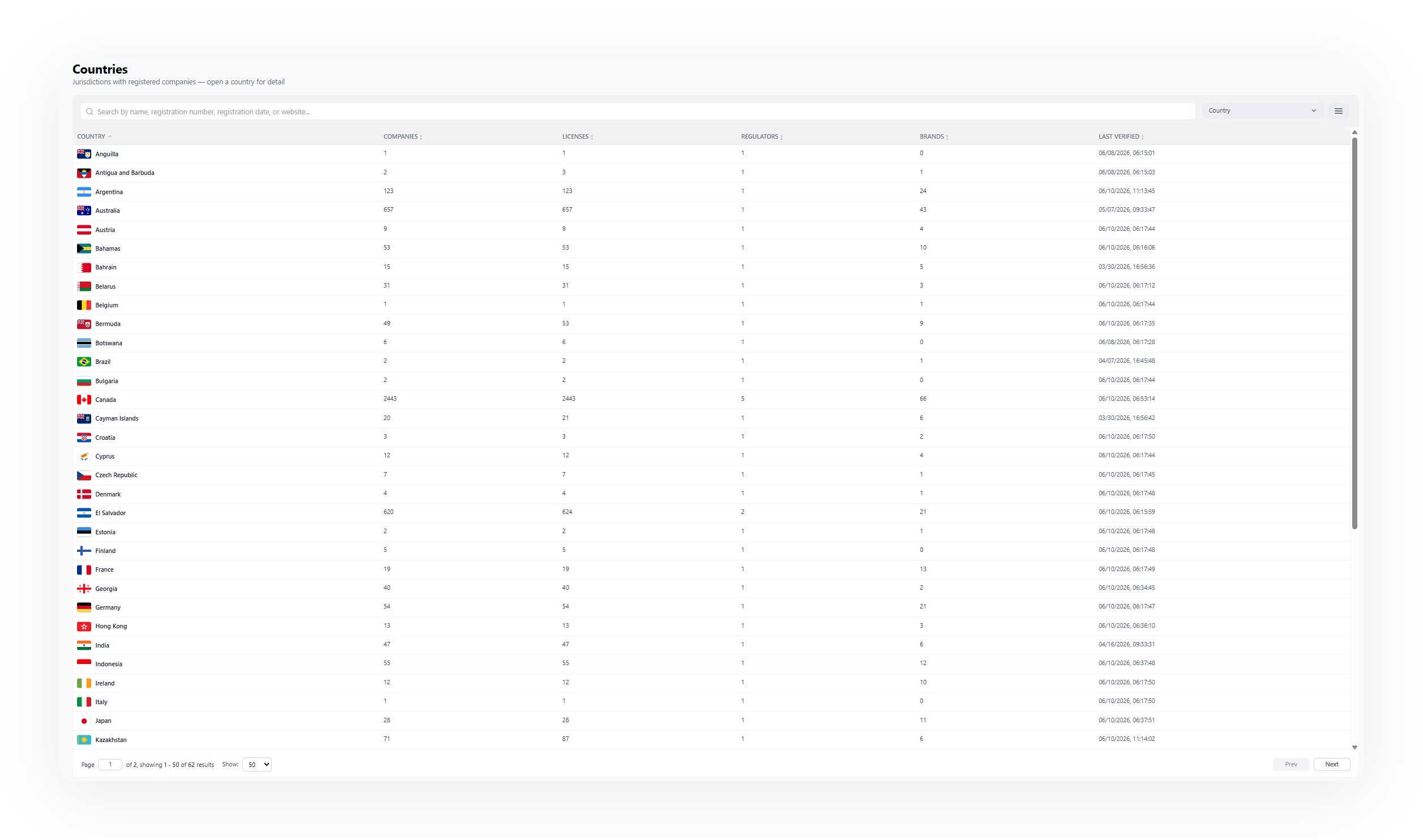
Country-level analysis shows something that exchange profiles alone cannot. In many cases, the problem is that entire national user populations sit outside any meaningful licensed perimeter.
That’s because the exchange story changes once you stop looking at platforms in isolation and start looking at the markets underneath them. Some countries combine strong retail interest with relatively strong licensing coverage. Others generate huge unique visits and demand volumes while still sitting in a regulatory gap. As a result, you get a market where user demand and the legal market structure often move at different speeds.
Selected Market Notes
| Market | What is happening | Forward pressure |
| United States | Large user market with meaningful but fragmented coverage through MSB and related structures rather than one unified federal crypto-exchange regime | Federal harmonization would change how US-heavy exchanges are scored and compared |
| Germany | BaFin is one of the clearest tone-setting MiCA supervisors in Europe | Germany will influence how strict MiCA enforcement feels in practice |
| UAE | The UAE stands out because regulatory architecture itself is part of the competitive story, with separate centers of gravity across the market | It remains a licensing bridge for exchanges moving from offshore scale toward formal legitimacy |
| El Salvador | El Salvador stands out for its dual-regulator setup and large number of digital-asset companies, which makes it an outlier in the dataset | The key question is whether licensing density turns into durable international relevance |
| Japan | Mature legal framework, high demand, and limited room for foreign platforms without proper qualification | Enforcement against unregistered platforms remains structural |
| Singapore | High user interest, narrow licensing funnel, and high supervisory standards | Lawful supply remains tighter than demand |
| Brazil | Large demand and growing regulatory momentum, but local licensing depth still trails market size | A fuller rollout could reshape Latin American user distribution |
| Canada | Enforcement-led perimeter has narrowed room for foreign platforms that do not localize properly | Access will continue shifting toward firms willing to meet local registration standards |
| Australia | Credible financial supervision with crypto policy still evolving in practical terms | Greater clarity could shift regional positioning |
| South Africa | One of the more relevant African markets where formal oversight is becoming more central to the story | It could become a regional compliance base if licensing depth grows |
The EU Compliance Stack
MiCA and the wider EU compliance stack are a net positive for the market because they turn Europe from a patchwork of national workarounds into one scalable, regulated market. That changes the economics for exchanges. Expansion across Europe used to be stitching together local registrations one by one. Now it depends on whether a platform can meet a common standard and scale within it.
Europe is now the only major market in this report where market access, tax reporting, transfer transparency, and operational resilience work as one connected system. DAC8 makes EU-facing crypto activity visible to tax authorities. The Travel Rule adds friction and traceability to transfers. DORA raises the standard for systems, governance, and operational resilience. Together, they make Europe harder to enter casually, but easier to trust and easier to scale once inside. That is a net positive for serious operators and for users.
The short-term cost was real. Europe’s earlier MiCA transition phase came with weaker hiring, lower funding, and higher compliance costs. But that was the reset. The longer-term effect is a stronger market structure. A firm that clears the bar now gains access to a deeper, more coherent market than Europe offered before. That favors exchanges with durable operating models, stronger controls, and the ability to keep serving users without rebuilding their legal footing in every jurisdiction.
That is the actual value of the EU stack in this report. It is a distribution filter. It rewards exchanges that can combine licensing, reporting, and operational discipline, and it pushes weaker operators toward the edge of the market.
The US Legislative Pivot
The US has moved away from pure case-by-case enforcement as its only organizing principle. Stablecoin legislation and broader market structure efforts have improved clarity for large institutions that were waiting for definitional progress before committing more fully.
US market legitimacy now comes less from surviving lawsuits and more from fitting into a broader institutional stack. Custody, ETFs, tokenization, treasury products, and extended-hours trading are all part of that shift.
The Survival Track
Outside the regulated perimeter, crypto is still being used for reasons that have little to do with formal market structure. Sanctions pressure, inflation, blocked payment corridors, and geopolitical fragmentation continue to drive demand.
Russia is one example. Iran is another. North Korea represents the security dimension. The Bybit hack showed again that the threat surface extends to custody providers, operational vendors, and the laundering layer behind the breach.
The point is that the regulated market is not the whole market. MiCA and DAC8 can close many gaps inside Europe. They cannot by themselves stop necessity-driven or state-linked crypto infrastructure from growing elsewhere.
So this could have huge strategic significance for exchanges. Some firms are clearly moving toward the regulated world and the capital, banking, and retail distribution that come with it. Others may end up more concentrated in the necessity-driven track, whether by choice or by exclusion.
Closing Remarks
It is not easy to understand the exchange market in 2026. Post-MiCA Europe is the clearest test case. It is now the region with the highest user demand in this dataset and the most complete regulatory stack.
Once the grandfathering period ends, exchanges that carry authorization, reporting capability, and operational resilience will be in the best position to absorb displaced European users. The exchanges still trying to bridge that gap will face a harder transition.
Next, we have the US, where policy clarity has improved, and so has institutional confidence. The scoring framework still treats the US as fragmented because the legal architecture remains incomplete from a crypto-specific exchange licensing standpoint.
Lastly, fintech convergence is never a “side” trend. Platforms that own the user relationship in banking, brokerage, and digital finance now have a serious advantage in crypto. But there will also still be a large market outside the clean, regulated perimeter. Some of it will come from necessity, some from geopolitical pressure, and some from users and firms willing to accept greater legal uncertainty. Regulators used to do everything to play down crypto and diminish its utility, but now, in 2026, it is actually crypto companies that can thrive in a regulated world.
Appendix
Data and Methodology Notes
User data: Monthly visits and unique visitor counts compiled in Coincub Data for Q1 2026. User estimates reflect unique visits to exchange domains and should be read as relative indicators of user attention and access patterns rather than precise active account counts. Visit counts change daily; figures cited in this report reflect a Q1 2026 snapshot and are used for relative comparisons.
License data: Active licenses are sourced from Coincub Data and direct review of national regulatory authority records, verified for Q1 2026. Transitional MiCA registrations not yet constituting full CASP authorization were treated as unlicensed. Where status was ambiguous, the more conservative classification was applied.
Risk score: A 0 to 5 score based on licensed user coverage and regulatory conduct. Exchanges with broader licensed coverage and cleaner enforcement histories score higher, while licensing gaps, AML/CFT failures, consumer-protection actions, market-integrity issues, unlicensed-operation cases, and similar regulatory events weigh on the score. Transitional MiCA registrations that had not yet converted into full CASP authorization were treated as unlicensed. Where status was ambiguous, the more conservative classification was used. Limited credit was given where corrective action or dismissal materially changed the picture.
Country intelligence: The estimated KYC’d crypto user percentage is derived by dividing the total unique visitors from a country by its population. All exchanges in this dataset require KYC. The metric approximates the share of a country’s population with a KYC’d exchange account across tracked platforms. Multiple accounts per user would overstate penetration; VPN usage would understate it.
Regulatory coverage rate: The share of active exchanges serving a country that hold at least one relevant active license for that market. MiCA-authorized exchanges are considered licensed in all 30 EEA member states under the passporting mechanism. Exchanges in national transitional periods are unlicensed unless full authorization has been granted.
Limitations and Further Research
This report uses web visits as a directional indicator of user attention, platform reach, and access intent. That is useful, but it is not the full picture of exchange usage. A visit to an exchange domain does not always equal active trading, funded account activity, or even a logged-in user session. Some user demand will reflect research, price checking, customer support, compliance, and KYC workflows, comparison shopping, news-driven curiosity, or other non-transactional behavior. In other words, user demand is a meaningful signal, but not a complete behavioral map.
That limitation is most visible at the top end of the market, where very large brands attract a wide mix of user intent. Millions of visits to a platform like Binance or Coinbase are unlikely to be explained by educational pages or support visits alone. Still, the exact mix between trading intent, account access, product discovery, and non-execution behavior cannot be fully resolved from web visit data by itself. This report therefore, treats user demand as a proxy for market attention and access patterns rather than a direct measure of transaction activity or economic value.
Further work should focus on separating why users visit exchanges. The next step would be a structured user-intent survey across major markets, asking whether exchange visits are driven primarily by active trading, account access, onboarding, research, price discovery, customer support, compliance requirements, or general monitoring of the market. That would help distinguish high-user exchanges with genuinely active retail usage from high-user exchanges that function partly as price, brand, or information hubs.
The point is that user visits and licensing is strongest when treated as one layer in a broader market-structure framework. This report uses it that way, not as a perfect count of who traded, but as a practical indicator of where demand, access, and regulatory exposure are concentrated.
Sources
| Source | Type | Relevance | Link |
| Coincub Data | Proprietary database | Licensing coverage data, licensed unique visitor calculations, risk score computation | Coincub |
| Crystal Analytics | Blockchain compliance | Enforcement records database, 777 entries covering 2011 through 2025 | Crystal Expert |
| US Department of Justice | Federal enforcement | Binance AML and sanctions settlement (2023); enforcement records | Binance plea and resolution |
| OFAC (US Treasury) | Sanctions authority | Binance sanctions violations settlement; secondary sanctions data for sanctioned jurisdictions | Binance settlement agreement |
| FinCEN (US Treasury) | Financial intelligence | Binance AML resolution; money transmitter violation records | Binance FinCEN settlement |
| CFTC | Commodities regulator | Binance settlement; crypto derivatives enforcement records | Binance enforcement action |
| Financial Conduct Authority (UK) | UK financial regulator | MEXC warning; crypto register; Robinhood Crypto penalty (2022); consultation paper Dec 2025 | MEXC warning / Crypto AML/CTF regime / CP25/41 |
| European Banking Authority (EBA) | EU banking authority | PSD2/MiCA interaction guidance; EMT transfer opinion (Feb 2026) | MiCA ART/EMT hub / 12 Feb 2026 opinion |
| European Commission | EU executive | DAC8 directive text and transposition guidance; MiCA legislative text | DAC8 / MiCA text |
| Canadian Securities Administrators (CSA) | Canadian multi-regulator | Named platform bans; XT.COM prohibition; Ontario Securities Commission LBank warning | CSA crypto risk notice / OSC LBank warning |
| Financial Services Agency (Japan) | Japanese financial regulator | LBank warning; VASP registration requirements; Bybit market exit context | Registered crypto-asset exchanges list |
| TRM Labs | Blockchain intelligence | Global Crypto Policy Review Outlook 2025/26; sanctions compliance data | Global Crypto Policy Review & Outlook 2025/26 |
| Chainalysis | Blockchain analytics | 2025 crypto regulatory round-up; illicit transaction volume estimates ($154B) | 2025 regulatory round-up / 2026 Crypto Crime Report |
| European Systemic Risk Board (ESRB) | EU systemic risk body | USDT delisting documentation; MiCA stablecoin market impact data | 20 Oct 2025 stablecoin report / NBFI Monitor 2025 |

 Canada
  UAE
UAE 








