Buy a Licensed Company
  Explore VASP Data
  Talk to an Expert

 Atis Shala
Atis is a senior analyst and community lead with four years of experience in crypto. He has a bachelor from the Rochester Institute of Technology.
Atis Shala
Atis is a senior analyst and community lead with four years of experience in crypto. He has a bachelor from the Rochester Institute of Technology.
Crypto Burnout: How to Stay Sane in a 24/7 Market
- The market never sleeps, but you have to: Crypto lacks the built-in guardrails and closing bells of traditional finance. Without actively building your own boundaries, chronic burnout becomes the default state.
- Emotional compression is the real tax. The accelerated pace of the market turns FOMO, euphoria, and revenge trading into systemic risks. The market doesn’t just trade assets; it monetizes your emotional reactions.
- The industry is highly adversarial and designed to pull your focus. Protecting your sanity means ruthlessly filtering out the endless noise from the timeline and Telegram groups.
- Staring at 1-minute charts drains your edge. Shift from reactive doomscrolling to systematic execution by relying on predefined alerts and sizing positions so you can actually rest.
- Logging off, setting hard limits, and touching grass aren’t signs of weakness. In a space that demands 24/7 engagement, protecting your mental bandwidth is the only way to survive long enough to win.
The Market Never Sleeps
It is 2:17 a.m. You open your phone “just to check.” Bitcoin first. Then a few altcoins. Then Telegram, then X, then a chart you have already looked at twice today. An hour passes. Nothing actually happened during that hour, but your nervous system reacted as though something did. Your heart rate climbed. Your sleep is gone. Tomorrow will be harder.
This scene repeats every night, in every time zone, for millions of people. Crypto runs without a closing bell. There is no weekend pause, no holiday break, no built-in psychological off-switch. Anthony Pompliano once described crypto as a market that trades 24/7/365, with weekdays, weekends, midnight, and holidays all open for business. Traditional traders inherit boundaries from the exchange. Crypto traders inherit nothing.
That structural freedom comes with a hidden cost. Crypto offers access, opportunity, and a kind of financial agency that legacy markets never delivered to ordinary people. At the same time, it removes the guardrails that used to protect those people from themselves. You can buy at any hour, liquidate at any hour, and panic at any hour. Someone, somewhere, is always trading against you.

Crypto does not ask whether you slept, ate, exercised, answered your friends, or touched grass. The chart keeps printing. This article is about what that does to the people watching, and what they can do about it.
Why Crypto Creates Burnout Differently
Crypto burnout is structurally distinct from the stress that comes with traditional investing. Volatility plays a role, but volatility alone does not explain why so many traders end up exhausted, anxious, and unable to step away. The real engine combines several pressures at once: nonstop trading hours, leverage, social media saturation, community pressure, and financial insecurity. Each one amplifies the others.
Always-on trading changes how “checking” feels. When the market never closes, looking at your portfolio at 3 a.m. seems rational rather than compulsive. A stock investor can blame the closing bell for stopping the action. A crypto trader has to invent that bell from scratch, and very few people do.
Volatility also lacks recovery time. Equities give you weekends to process a rough Friday. In crypto, the Sunday night dump or the 4 a.m. liquidation cascade is part of the deal. Your portfolio can shift meaningfully while you sleep, and your brain learns to expect it.
Global participation makes it worse. Someone is always awake somewhere. The Asia session bleeds into Europe, which bleeds into the U.S., which bleeds into weekend traders, bots, perpetuals desks, Telegram groups, whales, and market makers. The action genuinely never stops.
Finally, the phone collapses the distance between your life and the market. Your exchange, wallet, portfolio tracker, X feed, and group chats all live in your pocket. Bankrate notes that crypto trades 24/7 and that investor sentiment, other traders, and social media can move prices at any moment. The market reaches you wherever you go.
| Traditional Market Stress | Crypto Market Stress |
| Market closes daily | Market never really closes |
| News cycle has pauses | News and narratives run nonstop |
| Fewer assets to track | Thousands of tokens compete for attention |
| Portfolio shifts slowly | Portfolio can swing violently in minutes |
| Centralized media flow | X, Discord, Telegram, YouTube, on-chain alerts |
Market Psychology: FOMO, Fear, Euphoria, Revenge Trading
Crypto compresses the emotional cycle of investing into shorter and shorter windows. What used to take years in equity markets now happens in weeks, or sometimes in a single afternoon. That compression is where most burnout begins.
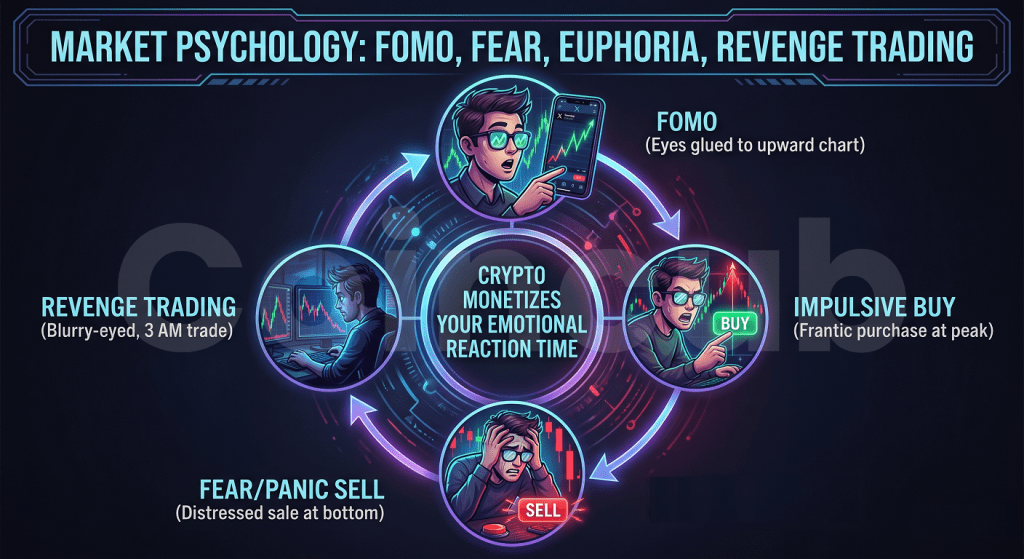
FOMO leads the cycle. Someone else always seems to be catching the next coin, airdrop, NFT mint, L2 rotation, AI token, restaking play, or points campaign. The feed makes every missed move look both obvious and profitable in retrospect. In crypto, missing a move can feel like losing money, even when you never held a position.
Loss aversion follows close behind. A 20% drawdown stings far more than a 20% gain delights. Traders respond by over-monitoring, by panic selling at local bottoms, or by doubling down to “average in.” Each response feels rational in the moment and looks foolish a week later.
Euphoria does its own damage. After a big win, traders often increase size, drop their standards, and start treating luck as skill. This usually ends with the same trader giving back gains during the next correction, often with extra leverage on board.
Then comes revenge trading. After a loss, people trade to get back to even rather than because they spotted a clean setup. The urgency itself becomes the problem. You stop watching the market and start fighting it.
Narrative whiplash ties everything together. The same asset can be “the future of finance” on Monday and “obviously dead” by Friday. Your conviction has to survive a constant rewriting of the story, which slowly grinds down your ability to make clear decisions.
A 2025 scoping review found that crypto trading can mirror high-risk, high-reward gambling and links to genuine psychological strain. Another review identified likely connections between crypto trading, problem gambling, and high-risk stock behavior. The pattern is not anecdotal. It shows up in the data.
The problem is not that crypto is emotional. The problem is that it monetizes emotional reaction time.
The Industry Is Ruthless by Design
Crypto presents itself as a frontier of opportunity, and in many ways it is. It also functions as an adversarial environment where attention, liquidity, and trust are constantly contested. Reading the industry honestly means accepting both halves at once.
When you market-buy a green candle, someone is often selling into your enthusiasm. When you panic-sell a wick, someone is buying your fear. This is not a conspiracy. It is the basic mechanic of any market with willing counterparties, and crypto runs it at maximum speed.
The industry also professionalizes extraction. Scams, phishing kits, fake airdrops, wallet drainers, paid influencers, bot engagement, manipulated charts, insider allocations, and “strategic” token launches form a real ecosystem. TRM Labs reported that illicit crypto activity rebounded in 2025, with roughly $158 billion in incoming value to illicit entities, around $2.87 billion stolen across nearly 150 hacks, and approximately $35 billion sent to fraud schemes. Those numbers represent real people, often retail traders, getting drained.
Community can also become exit liquidity. Many projects use emotional belonging to keep holders from thinking clearly about whether the underlying thesis still holds. Loyalty becomes a feature for the team and a liability for the holder. Not every community works this way, but enough do that skepticism pays.
Information asymmetry compounds the problem. Founders, insiders, market makers, exchanges, whales, and influencers usually know more than retail traders about supply schedules, treasury moves, and upcoming announcements. By the time you see the chart move, several people already understood why.
| Ruthless Industry Feature | Psychological Impact |
| Influencer hype | FOMO and comparison |
| Anonymous teams | Trust fatigue |
| Token unlocks | Sudden betrayal or confusion |
| Leverage | Panic and sleep disruption |
| Scams and phishing | Hypervigilance |
| Discord and Telegram noise | Constant social pressure |
| “Diamond hands” culture | Shame around risk management |
Crypto talks constantly about decentralization. Attention, though, remains highly centralized around whoever can move the crowd fastest.
Social Media, Identity, and Comparison Pressure
Crypto burnout intensifies because traders watch charts and other traders at the same time. The feed shows people performing success, and that performance shapes how everyone else feels about their own portfolio.
Screenshots of huge gains circulate without the matching screenshots of losses. Influencers post “easy” wins after the move already happened. Anonymous accounts substitute confidence for credibility, and many followers cannot tell the difference. Public shame builds around selling early, missing a pump, or staying bearish during a rally. Tribal identities form around Bitcoin, Ethereum, Solana, memecoins, or airdrop farming, and each maxi group pressures its members to always have a take.
A few voices in the community push back. Zeneca, a well-known community figure, reminds readers that mental health matters more than any portfolio. Both messages cut against the dominant tone of the feed.
Vitalik Buterin offered a deeper version of the same critique. Business Insider reported that Buterin once threatened to leave crypto if communities only posted memes about how much money they had made, later clarifying that he would stay if the ecosystem worked toward real social value. The point still applies. A culture organized around wealth performance produces burned out traders, regardless of the underlying technology.
Crypto social media makes everyone look early, rich, calm, and correct. Usually, people are only showing the screenshot that survived.
What Burnout Looks Like in Crypto
Burnout often shows up before anyone names it. In crypto, it can look like a failure of discipline, but underneath, it usually reflects nervous system overload. Recognizing the signs matters more than diagnosing yourself.
Common patterns include checking prices the moment you wake up, feeling anxious when you cannot reach your phone, losing sleep over open positions, and feeling guilty after missing a pump. Some traders take positions out of boredom rather than conviction. Others confuse being informed with being overstimulated. Many notice they have become irritable with friends or family, or that wins no longer feel rewarding. A subtle sign is increasing risk simply to feel something again. The most stubborn sign is the belief that you cannot step away because “this cycle is different.”
| Symptom | What It Sounds Like | Healthier Reframe |
| Constant checking | “I just need to stay updated.” | “I am training my brain to expect danger.” |
| FOMO | “Everyone is winning except me.” | “There will always be another setup.” |
| Revenge trading | “I need to make it back today.” | “My urgency is the signal to stop.” |
| Doomscrolling | “I am doing research.” | “I am consuming anxiety.” |
| Overexposure | “I have conviction.” | “Conviction still needs sizing.” |
None of these signs proves anything on its own. Several of them, showing up together over weeks, may suggest that your relationship with the market needs adjustment.
How to Stay Sane: A Practical Operating System
You cannot control the market’s hours, its volatility, or its cruelty. You can control your own operating system. The following principles work together. Adopting one or two helps. Adopting most of them changes the experience entirely.
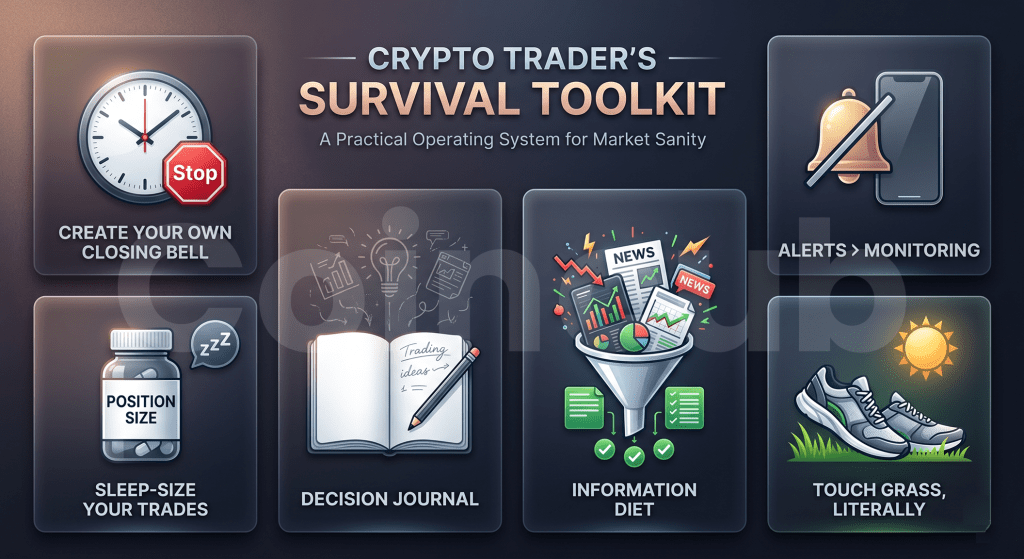
Create Your Own Closing Bell
Crypto has no closing bell, so you have to build one. Pick clear rules and stick to them.
- No chart checking before breakfast.
- No trading after a fixed evening hour.
- No leverage when tired.
- No new positions from bed.
- No trades during family meals or social events.
- One full market-free block every week, ideally a full day.
The market being open is not the same as an opportunity being present. Most hours produce no edge for retail traders. Treating every hour as actionable is what wears people down.
Use Alerts, Not Constant Monitoring
Set price alerts at levels that actually matter to your plan. Then close the app. Watching every candle teaches your brain that every candle deserves a reaction, which is the opposite of what you want.
| Reactive Trader | Systematic Trader |
| Watches every candle | Sets price alerts |
| Trades emotion | Trades predefined levels |
| Lives in group chats | Checks curated sources |
| Measures self-worth in PnL | Measures process quality |
Size Positions So You Can Sleep
If a position ruins your sleep, the size is probably wrong. Smaller positions produce less emotional noise and better decisions. Cash counts as a position. Missing upside beats blowing up. Survival itself is a strategy, and one of the few that compounds.
Your position size should be small enough that your personality does not change when the chart moves.
Separate Investing, Trading, and Gambling
Most traders mix these three activities without realizing it. Naming them honestly reduces a surprising amount of stress.
| Activity | Time Horizon | Rules Needed | Burnout Risk |
| Long-term investing | Months to years | Thesis, allocation, rebalancing | Lower if sized well |
| Trading | Minutes to weeks | Entry, invalidation, exit, risk | Medium to high |
| Gambling and speculation | Seconds to days | Hard loss limits | Very high |
Keep each activity in a separate mental bucket, and ideally a separate account. Money that belongs to your long-term thesis should not fund a 3 a.m. perp trade.
Build an Information Diet
Crypto information is infinite. Your attention is not. Pick three to five trusted sources and ignore the rest. Mute accounts that consistently push you into impulsive decisions. Avoid Telegram during high volatility. Separate research time from trading time, so reading does not automatically lead to clicking buy.
Your edge does not come from consuming more information. It comes from filtering harder.
Keep a Decision Journal
Write down each meaningful trade before placing it. Note why you entered, what would invalidate the thesis, how much you can afford to lose, whether you slept well, and whether the trade came from a plan or a feeling. Reviewing this journal weekly reveals patterns that no chart can show you. Most traders discover that their worst trades share the same emotional fingerprint.
Touch Grass, Literally
The human basics matter more than any indicator. Sleep, exercise, real meals, offline relationships, sunlight, and time away from screens all directly affect trading performance. Therapy or support helps when trading starts to feel compulsive. The research linking crypto activity to gambling-like behavior and psychological distress is clear enough that treating this as a health issue, not a discipline issue, makes sense.
Consider building a personal circuit breaker. Stop trading for 24 hours if you slept poorly, if you are chasing a loss, if you are angry, if you are hiding trades from someone close to you, if you increased size without a written plan, or if you cannot explain the trade in one sentence.
You Do Not Have to Match the Market’s Hours
Crypto’s greatest trick is making constant availability feel like responsibility. The feed implies that paying attention is the same as being prepared, and that stepping away means falling behind. Neither is true. Staying sane requires accepting that you will miss moves, narratives, entries, exits, airdrops, tops, bottoms, and screenshots. That is the cost of remaining human inside a market that does not care about humans.
Crypto markets run 24/7, but you do not have to.
The goal is not to become emotionless. The goal is to build a life and a system where the market does not get unlimited access to your attention. Crypto will still be open tomorrow. The real question is whether you will be rested enough, clear enough, and detached enough to meet it on your own terms. The traders who last in this industry are rarely the ones who watched the most charts. They are the ones who learned, early, that their nervous system was not a renewable resource, and that protecting it was the actual edge.
Frequently Asked Questions (FAQs)
What is the 1% rule in crypto?
Is crypto trading linked to mental health issues like depression and anxiety?
Yes, crypto trading is linked to mental health issues. The extreme volatility and sudden financial losses can trigger severe stress, anxiety, and depression. Frequent traders often report higher levels of loneliness and mood disorders compared to non-traders.
Can the 24/7 nature of the crypto market lead to behavioral addiction?
Yes. Because the crypto market never closes, traders often spend excessive waking hours monitoring charts. This constant mobile access and hypervigilance frequently lead to compulsive checking, mirroring symptoms of behavioral addiction and pathological gambling disorders.
Why is FOMO (Fear Of Missing Out) so dangerous in crypto?
FOMO drives irrational, high-risk decision-making in crypto. Heavily influenced by social media hype, the fear of missing out overrides strategic planning. This prompts traders to make impulsive investments, abandon risk management, and ultimately accelerate psychological burnout.
How can I prevent crypto burnout and protect my mental health?
To prevent crypto burnout, establish strict trading boundaries. Limit your chart-checking hours, remove exchange apps from your phone’s home screen, and set predefined price alerts. Separating your identity from market volatility is crucial for long-term mental health.
How do I stop revenge trading after a crypto loss?
Stop revenge trading by implementing a mandatory 24-hour cooling-off period after any major loss. Step away from your screens, review your decision journal, and refuse to re-enter the market until your emotional urgency has completely subsided.