


 Buy a Licensed Company
  Explore VASP Data
  Talk to an Expert

 Atis Shala
Atis is a senior analyst and community lead with four years of experience in crypto. He has a bachelor from the Rochester Institute of Technology.
Atis Shala
Atis is a senior analyst and community lead with four years of experience in crypto. He has a bachelor from the Rochester Institute of Technology.
Anjouan Licensing: A Fast and Cost-Effective Path for Crypto Brokers

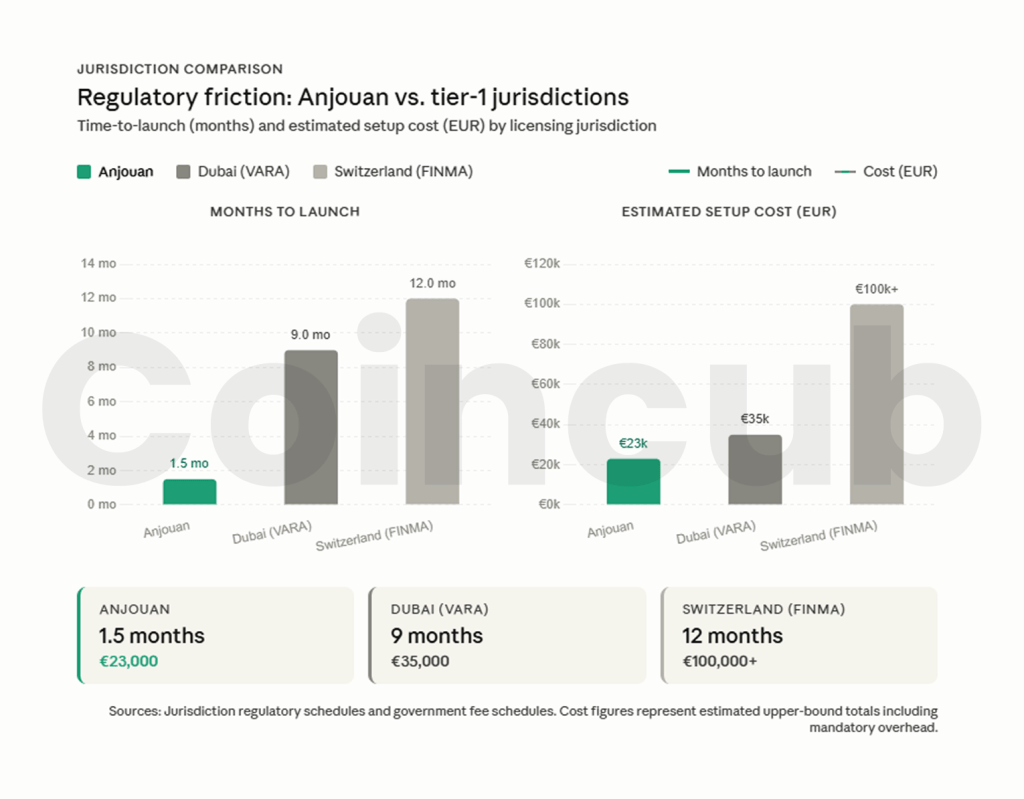
- Obtain full licensing in just 4 to 6 weeks, vastly outpacing the 9-12+ month timelines typical of tier-1 jurisdictions like Dubai (VARA) or Switzerland (FINMA).
- Features dramatically lower setup fees than major hubs, coupled with a 0% corporate tax rate for qualifying International Business Companies (IBCs).
- Requires no physical office, no minimum capital, and no resident directors on the island, making it ideal for globally distributed digital-native teams.
- A single license covers a wide spectrum of Web3 activities simultaneously, including fiat/crypto exchanges, OTC trading, custodial solutions, and token issuance.
- Provides the necessary regulatory credential for early-stage startups to successfully onboard with corporate banks and payment processors.
- The license is issued by Anjouan’s autonomous regulator (not the central Comoros government) and restricts servicing users in certain jurisdictions, including the US, UK, and FATF-blocklisted nations.
What is Anjouan Licensing?
Anjouan offers one of the fastest crypto licensing timelines available, allowing businesses to become fully licensed and operational in four to six weeks. By comparison, tier-1 jurisdictions like Switzerland’s FINMA can take well over a year, and Dubai’s VARA process typically requires a minimum of nine months from start to finish.
With setup costs being a fraction of those in places like Dubai or Switzerland, and a 0% corporate tax rate for qualifying International Business Companies, founders can redirect significant capital back into product development and marketing.
The Anjouan International Business Company (IBC) model requires no local physical office, resident directors, or minimum capital. A single Anjouan license can cover a wide range of Web3 activities, including fiat/crypto exchanges, OTC brokerages, custody solutions, and token issuance. For many early-stage crypto startups, holding this regulatory credential opens doors to corporate banking and payment processors that would otherwise remain closed.

One important caveat before proceeding: the Anjouan license is issued by the island’s autonomous regulator and is not formally recognised by the central government of the Union of the Comoros. In practice, a number of banks and payment providers accept it, but operators should be aware of this distinction and factor it into their due diligence before committing.
Speed to Market Is Everything
In the Web3 and crypto sector, regulatory delay has a direct cost. Every week your platform is waiting on a license is a week your competitors are onboarding users and capturing market share.
The Anjouan International Crypto License is among the fastest and most cost-effective offshore regulatory credentials available to crypto exchanges, CFD brokers, and digital asset managers today. It comes with a 0% corporate tax rate and requires no local physical presence to maintain. For lean startups, decentralised infrastructure projects, and fast-moving brokerages, it removes one of the biggest obstacles to launch: the regulatory waiting game.
Going live in the crypto space without proper licensing carries serious risk. Banking partners refuse to work with unlicensed entities, payment processors decline onboarding requests, and institutional clients walk away before a deal is done. The Anjouan license addresses all of these pain points in one affordable package.
The Anjouan Offshore Finance Authority (AOFA) operates under a legislative framework established in 2005. Companies licensed through the AOFA hold a regulatory credential that is accepted by a meaningful number of banking and payment partners. For any team that has its technology stack ready and needs to reach the market quickly, Anjouan is worth serious consideration.
The Advantages: Speed, Cost, and Flexibility
The Four to Six Week Timeline
For any project timing a token generation event or preparing a platform launch, regulatory timelines are a critical variable. The Anjouan process, from incorporation to license issuance, takes between four and six weeks. That is considerably faster than any comparable tier-1 jurisdiction.
The process is streamlined without cutting corners on compliance. Applicants go through a structured review, submit a full AML/KYC framework, and present a credible business plan. The speed comes from a focused and efficient regulatory authority rather than from relaxed standards.
The 0% Tax Environment
As an International Business Company registered in Anjouan, your entity is exempt from corporate tax, income tax, dividend tax, and capital gains tax. The only condition is that the company does not conduct business with residents of Anjouan itself. For a crypto brokerage or exchange operating globally, this condition is straightforward to meet.
The financial impact is substantial. A company generating ten million dollars in annual revenue in a standard European jurisdiction might pay two million or more in corporate taxes. The same company structured as an Anjouan IBC retains that capital in full, a direct competitive advantage that can be redeployed into product development and user acquisition.
The Borderless Model
There are no minimum capital requirements to obtain the Anjouan license. There is no need to rent a physical office on the island, and there is no requirement to hire local resident directors or staff. The entire entity can be managed remotely by your existing team from anywhere in the world. This structure is purpose-built for digital-native businesses that operate across borders.
What You Can Actually Do: The Scope of the License
A Broad Regulatory Umbrella
The Anjouan Offshore Finance Authority issues a license designed to cover a wide spectrum of Web3 business activities under a single credential. Rather than forcing operators into narrow product categories, the AOFA structures its licensing to reflect the real-world complexity of modern crypto businesses. A single license can cover exchange operations, OTC trading, custody, and token issuance simultaneously.
| Permitted Business Model | Practical Application |
| Crypto Exchange (Fiat/Crypto) | Operate a spot or derivatives trading platform that accepts fiat deposits and withdrawals alongside crypto pairs. |
| OTC Brokerage | Facilitate large-block, off-exchange trades for institutional clients and high-net-worth individuals. |
| Custodial Wallet Solutions | Offer regulated digital asset custody services to retail or institutional clients. |
| Token Issuance / ICOs | Issue, distribute, and manage digital tokens or conduct an Initial Coin Offering under a recognised regulatory umbrella. |
| DeFi / Liquidity Management | Operate liquidity pools, yield strategies, or decentralised exchange infrastructure with a compliant legal wrapper. |
Banking and Payment Processing Access
One of the most significant practical benefits of holding an Anjouan license is improved access to corporate banking and payment processing partners. Unlicensed crypto entities face near-universal rejection from banking institutions. Holding a recognised regulatory license changes that dynamic in many cases.
Payment processors, acquiring banks, and crypto-native banking providers typically require some form of regulatory status before onboarding a new client. The Anjouan license satisfies this requirement with a number of providers, giving your platform the credibility it needs to open accounts and process fiat deposits and withdrawals.
For many startups, this is the most immediate and tangible return on the cost of licensing. Access to banking is the single most common bottleneck for early-stage crypto businesses. Solving it on day one, with a license that costs a fraction of what European or Gulf alternatives demand, is a clear business decision. That said, some larger institutional partners and regulated counterparties will require a tier-1 license, so operators targeting those relationships should plan accordingly.
The Financial Breakdown: Setup and Maintenance Costs
Upfront Costs
The government license fee for an Anjouan crypto license typically ranges between 5,000 and 23,000 euros, depending on the scope of the license and the structure of the applicant company. Full turnkey legal packages, which include registered agent services, compliance documentation, and the application itself, are priced separately and vary by provider.
This is a meaningful contrast to tier-1 alternatives. A VARA license in Dubai carries an application fee starting at AED 40,000 (approximately 10,000 eur) for advisory services, rising to AED 100,000 or more for exchange and broker-dealer licenses, on top of mandatory local office costs, resident director fees, and operational infrastructure. A Swiss FINMA license routinely reaches six figures before the business has processed a single trade.
Ongoing Operational Costs
Because there is no physical office requirement in Anjouan, ongoing operational overhead is minimal. The primary recurring expenses are the annual license renewal fee and the registered agent retainer. Both are modest relative to the cost of maintaining regulatory compliance in a major tier-1 jurisdiction.
The ROI for Builders
The capital saved on initial compliance has a direct effect on the health of the business. Founders who save six figures on regulatory setup can redirect that budget into user acquisition, liquidity provision, marketing campaigns, and platform development. In the early stages of a crypto startup, capital efficiency is one of the most important determinants of long-term survival.
The Playbook: A Four-Step Guide to Getting Licensed
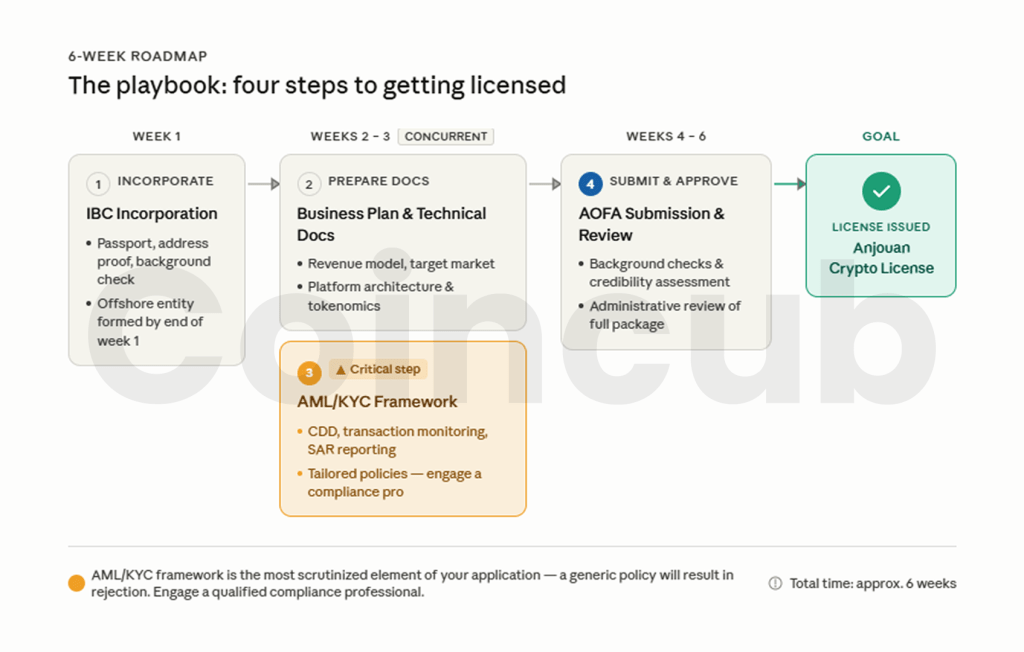
Step 1: IBC Incorporation (Week 1)
The first step is incorporating an International Business Company in Anjouan. The documentation required at this stage is minimal and standard across most offshore jurisdictions. Applicants need to provide certified copies of passports, proof of residential address, and a clean background check for all directors and beneficial owners. The company can be fully incorporated within the first week of the process.
Step 2: Documentation and Business Plan (Weeks 2 to 3)
Once the IBC is established, the focus shifts to preparing the application package for the AOFA. The regulator requires a clear and detailed business plan that covers the company’s revenue model, target markets, and operational structure. Technical documentation is also required, including the platform’s system architecture and, where applicable, a description of the tokenomics underpinning any digital asset issuance.
This stage requires genuine effort and attention to quality. The AOFA is a functioning regulatory authority that takes its review process seriously. The documentation package needs to demonstrate that the business is real, credible, and operationally capable. Applicants who submit vague or incomplete documentation should expect delays and revision requests before their application advances.
Step 3: The AML/KYC Framework (The Most Critical Step)
This is the most critical stage of the entire licensing process. The streamlined nature of Anjouan’s framework is offset by a strict and non-negotiable requirement for a robust Anti-Money Laundering (AML) and Combating the Financing of Terrorism (CFT) policy structure. Cutting corners here will stall any application.
The AOFA requires applicants to submit comprehensive internal policies covering customer due diligence, transaction monitoring, suspicious activity reporting, and record-keeping. These policies must be tailored to the specific nature of the applicant’s business. A generic, copy-pasted AML policy will not pass the regulator’s review.
Applicants are strongly advised to engage a qualified compliance professional to prepare this documentation. The quality of the AML framework is the single greatest factor in determining whether an application is approved efficiently or returned for revisions.
Step 4: AOFA Submission and Approval (Weeks 4 to 6)
With the full documentation package in order, the application is submitted to the Anjouan Offshore Finance Authority for final administrative review. The AOFA verifies all submitted materials, conducts background checks on the principals, and assesses the overall credibility of the application. If the application is thorough and well-prepared, approval and license issuance typically follow within weeks four to six. The license is then issued as an official regulatory credential, valid for all permitted business activities listed in the application.
Background and Context: Understanding Anjouan
Where Is Anjouan?
Anjouan is one of three main islands that make up the Union of the Comoros, an archipelago nation located in the Indian Ocean at the northern end of the Mozambique Channel, off the East African coastline. It is a semi-autonomous island with its own legislative powers in specific areas, including offshore financial services. The island has a limited domestic economy, which is precisely why its offshore framework is structured to attract international business rather than serve local residents.
The Regulator and the Legal Framework
The Anjouan Offshore Finance Authority was established under the Offshore Finance Authority Act of 2005. It is the licensing body for offshore financial services entities registered in Anjouan, including crypto and digital asset businesses. The AOFA operates with a mandate to attract foreign investment through a streamlined, low-cost, and rules-based regulatory environment.
It is worth noting that the AOFA operates as the autonomous island’s own regulatory body, independently from the Central Bank of the Comoros. The licenses it issues are not formally recognised by the Union government. This is a legitimate legal consideration that any operator should discuss with a qualified adviser before proceeding.
A Balanced View
Anjouan is an offshore jurisdiction, and that distinction carries practical implications. Banking relationships in certain markets may involve additional scrutiny when presenting an Anjouan credential. Some institutional partners and larger regulated counterparties will prefer a tier-1 license for certain partnerships.
The businesses that perform best under this framework are those that pair the license with a genuinely strong internal compliance culture. Maintaining rigorous AML standards, conducting thorough KYC on all clients, and operating with full transparency are essential practices. The license provides the regulatory foundation; the operator’s ongoing conduct builds the reputation that sustains long-term growth.
Is An Anjouan License the Right Move for Your Platform?
For any crypto startup that has its technology ready and needs to reach the market quickly, Anjouan offers one of the fastest and most cost-efficient paths to regulatory status available. The combination of a sub-six-week timeline, a zero-tax IBC structure, a broad licensing scope, and minimal operational overhead makes it a compelling option for lean, fast-moving teams operating on a tight runway.
The trade-off is real: this is an offshore credential issued by an autonomous island regulator, not a tier-1 license. Operators who understand that distinction, pair the license with a serious compliance programme, and target markets where the credential is accepted will find Anjouan a genuinely useful launchpad. Those who need institutional banking relationships or tier-1 regulatory standing from day one should plan for a longer licensing journey elsewhere.
If your platform is built, your team is ready, and your AML framework is solid, Anjouan is a strong first conversation to have.
Frequently Asked Questions (FAQs)
What is an Anjouan license?
An Anjouan license is an offshore regulatory credential issued by the Anjouan Offshore Finance Authority (AOFA). It allows Web3 businesses, crypto exchanges, CFD brokers, and digital asset managers to operate globally under a cost-effective legal umbrella. It is important to note that this credential is issued by the autonomous island’s own regulator and is not formally recognised by the central government of the Union of the Comoros.
How much does an Anjouan license cost?
The government fee typically ranges between 5,000 and 23,000 euros, depending on the specific licensing scope and company structure. Full turnkey legal packages, which include registered agents and compliance documentation, are priced separately by providers.
How do you get an Anjouan license?
The process involves four steps: incorporating an International Business Company (IBC), preparing a detailed business plan, developing a comprehensive AML and KYC framework, and submitting the full documentation package to the Anjouan Offshore Finance Authority for final approval. The full process typically takes four to six weeks.
What countries are restricted by Anjouan?
Anjouan license holders are prohibited from conducting business with residents of the Comoros. The license also broadly restricts offering services to users in the USA, UK, France, Germany, Spain, Netherlands, Australia, Austria, and any FATF-blocklisted jurisdictions.
Where is the Anjouan Offshore Finance Authority?
The Anjouan Offshore Finance Authority is located on Anjouan, a semi-autonomous island at the northern end of the Mozambique Channel in the Indian Ocean. It is one of three main islands forming the Union of the Comoros, situated off the East African coastline.