Buy a Licensed Company
  Explore VASP Data
  Talk to an Expert

 Dren Hima
Rochester Institute of Technology (RIT) graduate.
Crypto Analyst, Market Researcher and Editor.
Dren Hima
Rochester Institute of Technology (RIT) graduate.
Crypto Analyst, Market Researcher and Editor.
Tokenizing Green Bitcoin: How AI Audits and Onchain ESG Claims Are Emerging
- Green Bitcoin is still an early market. AI tools, tokenized certificates, and pilot auctions exist, but there is no deep, standardized global market for ESG-linked Bitcoin yet.
- MiCA is important, but it does not track individual Bitcoin lots. The EU’s sustainability rules focus on disclosure of the consensus mechanism and network-level indicators.
- AI is more proven in demand response than in audit-grade energy tracing. Mining firms already use AI to manage power loads and participate in the grid. NILM-based energy disaggregation is promising, but still not a plug-and-play institutional audit standard.
- Tokenization is creating a way to separate environmental claims from Bitcoin itself. Protocols like SBP do not change Bitcoin’s base layer. They create a parallel tokenized environmental attribute that institutions may use for reporting or sustainability positioning.
- The “green premium” exists in pilots. There have been OTC transactions and regulated sandbox auctions, but that is still very different from having a broad, continuously traded premium for ESG-certified Bitcoin.
The digital asset industry is currently attempting to reconcile the energy-intensive reality of Proof-of-Work (PoW) consensus mechanisms with the increasingly stringent compliance requirements of institutional capital. As European regulatory frameworks like the Markets in Crypto-Assets (MiCA) regulation and the Sustainable Finance Disclosure Regulation (SFDR) mature, the pressure to accurately quantify and verify the environmental impact of Bitcoin mining has intensified. In response, a nascent ecosystem of tokenized environmental commodities and AI-driven energy monitoring tools is emerging.
This report examines the current state of “Green Hashing” and the mechanisms being developed to audit and tokenize sustainable mining practices. Artificial intelligence is increasingly deployed to manage demand response programs and explore non-intrusive energy disaggregation at the facility level. Simultaneously, frameworks like the Sustainable Bitcoin Protocol (SBP) are demonstrating how environmental attributes can be unbundled from raw compute and tokenized on-chain, as evidenced by recent pilots in regulated sandboxes such as the Abu Dhabi Global Market (ADGM).
However, while the foundational technologies and pilot programs are real, the narrative that a fully mature, standardized institutional market for “ESG-Certified” Bitcoin already exists is premature. The market remains fragmented. AI-driven verification tools are largely experimental at the edge-computing level, regulatory regimes are actively undergoing overhauls to combat greenwashing, and the “green premium” for sustainable Bitcoin remains confined to bespoke over-the-counter (OTC) transactions rather than broad market liquidity. Ultimately, AI and tokenization are laying the groundwork for verifiable energy attribution, but the transition into a standardized institutional product is still ongoing.

Institutional Demand and the Search for Verifiable Provenance
The intersection of digital assets and traditional finance is driving a clear demand for verifiable environmental data. However, understanding the true scale of this demand requires a precise examination of current market sentiment data, avoiding the conflation of existing crypto-native investors with traditional asset managers.
Quantifying Institutional Exposure
Recent surveys indicate a strong, yet nuanced, appetite for digital assets among specific investor classes. According to a July 2025 report by CoinShares, 89% of current digital asset holders (a demographic that includes high-net-worth (HNW) investors) plan to increase their exposure to the asset class over the course of the year. This metric highlights deepening conviction among those already participating in the market, rather than a universal mandate across all global asset managers. Furthermore, 88% of these existing crypto investors already work with a financial advisor, indicating a strong desire to integrate digital assets into broader, managed wealth strategies.
Within the institutional hedge fund sector, exposure is steadily climbing. The 7th Annual Global Crypto Hedge Fund Report, published in 2025 by the Alternative Investment Management Association (AIMA) and PwC, revealed that 55% of traditional hedge funds now maintain some form of exposure to digital assets, an increase from 47% in 2024. Among the funds already invested, 71% reported plans to increase their allocations over the subsequent twelve months.
The Role of Tokenization in Alternative Investments
Beyond direct exposure to cryptocurrencies, the tokenization infrastructure itself is gaining significant traction among institutional allocators. The AIMA and PwC report noted that 52% of surveyed hedge funds expressed interest in tokenized fund structures, citing the potential for broader investor access and operational efficiencies. One-third (33%) of these funds are actively pursuing or exploring specific tokenization initiatives.
This growing comfort with blockchain-based asset representation provides the necessary foundation for tokenized environmental commodities. If traditional funds are increasingly willing to engage with tokenized traditional assets, the leap to holding tokenized energy attributes (to offset the carbon footprint of their Bitcoin allocations) becomes operationally viable. However, this capital deployment is heavily gated by the evolving regulatory environments in the European Union and the United States.
The Regulatory Reality: MiCA, SFDR, and the GENIUS Act
The push to tokenize the green hashing audit is largely a reaction to concrete legislative developments. However, navigating this landscape requires accurately distinguishing between finalized laws, phased rollouts, and proposed regulatory overhauls.
MiCA and the Standardization of Sustainability Indicators
The European Union’s Markets in Crypto-Assets (MiCA) regulation represents the most comprehensive digital asset framework globally. MiCA’s primary application dates have already passed: rules governing Asset-Referenced Tokens (ARTs) and E-Money Tokens (EMTs) took effect on June 30, 2024, followed by the broader regime for Crypto-Asset Service Providers (CASPs) on December 30, 2024. The widely discussed “Phase II,” often referenced for 2026, primarily pertains to the European Securities and Markets Authority (ESMA) rolling out monitoring and enforcement mechanisms, rather than to the introduction of novel ESG legislation.
The critical development for green mining occurred on March 31, 2025, when Commission Delegated Regulation (EU) 2025/422 was published in the Official Journal of the European Union. This delegated act specifically mandates the content, methodologies, and presentation of sustainability indicators regarding the adverse environmental impacts of consensus mechanisms.
Under this framework, the primary mandatory indicator is the network’s total annual energy consumption. Additional metrics, such as Scope 1 and Scope 2 greenhouse gas (GHG) emissions, are categorized as supplementary indicators designed for higher-energy consensus mechanisms. Meanwhile, indicators related to the generation of waste electrical and electronic equipment (WEEE) and impacts on natural resources were shifted to the optional category. Crucially, MiCA’s disclosure requirements apply broadly to the consensus mechanism used to issue the crypto-asset, meaning these metrics are published in white papers and on CASP websites, rather than acting as a tracking mechanism to prove the specific energy provenance of an individual investor’s discrete Bitcoin lot.
The SFDR 2.0 Overhaul
The Sustainable Finance Disclosure Regulation (SFDR) governs how European financial market participants disclose sustainability information. Historically, the regime categorized products under Article 6 (no sustainability scope), Article 8 (promoting environmental/social characteristics), and Article 9 (having sustainable investment as an objective). It is crucial to note that the European Commission explicitly designed SFDR as a transparency and disclosure regime, rather than a prescriptive rulebook that legally forces investors to choose green assets or restricts capital flows.
However, the market quickly adopted SFDR as a de facto labeling system, leading to widespread confusion, compliance burdens, and risks of greenwashing. To rectify this, the European Commission proposed a massive overhaul of the framework (colloquially termed SFDR 2.0) on November 20, 2025.
The November 2025 proposal shifts SFDR from a disclosure regime to a strict product categorization regime, introducing three new voluntary categories:
- Article 7 (Transition): Products investing in assets aiming to improve their sustainability trajectory.
- Article 8 (ESG Basics): Products integrating basic environmental, social, and governance factors.
- Article 9 (Sustainable): Products with a dedicated sustainability objective.
Crucially, the proposal mandates a strict 70% minimum investment threshold for a fund to qualify under any of these new categories. Consequently, a likely compliance interpretation is that, for an asset manager seeking to maintain a “Sustainable” or “Transition” fund, holding raw, unmitigated Bitcoin could dilute the 70% threshold. To prevent this, managers might increasingly seek out tokenized green energy certificates to back their Bitcoin positions and substantiate their portfolio’s alignment with the fund’s stated sustainability strategy.
Market Clarity in the United States: The GENIUS Act
In the United States, regulatory clarity took a different path with the enactment of the Guiding and Establishing National Innovation for US Stablecoins Act (GENIUS Act) on July 18, 2025. As the first federal legislation addressing digital assets, the GENIUS Act provides a vital regulatory foundation, though its scope is highly specific.
The Act creates a comprehensive framework exclusively for payment stablecoins, placing nonbank issuers under the regulatory oversight of the Office of the Comptroller of the Currency (OCC). It legally classifies payment stablecoins as neither securities nor commodities, requires 1-to-1 backing by low-risk, liquid assets (such as U.S. Treasuries), and strictly prohibits issuers from paying interest or yield to stablecoin holders.
While the GENIUS Act significantly de-risks the stablecoin sector, which serves as the primary settlement layer for institutional crypto trading, it does not directly govern Bitcoin mining, nor does it explicitly clear the path for new institutional ETF investments. Its primary contribution to the green hashing sector is the establishment of secure, federally regulated, fiat-pegged settlement rails (such as USDC) that can be used to reliably trade tokenized environmental commodities on secondary markets.
AI and Energy Disaggregation: Demand Response vs. Experimental NILM
To meet the rigorous reporting standards emerging in global markets, the mining industry is turning to artificial intelligence. AI is highly effective at managing macro-level grid interactions, but its application in micro-level energy auditing remains an emerging science.
Monetizing Grid Flexibility via Demand Response
The most mature application of AI in Bitcoin mining relates to demand response and Virtual Power Plant (VPP) orchestration. Because mining hardware is uniquely flexible and interruptible, operations can serve as dynamic energy sinks, absorbing excess renewable generation and curtailing load during grid stress.
Energy management platforms, such as Voltus, use AI to optimize these industrial loads in real time. The architecture relies on high-frequency, 30-second interval metering to provide granular data streams. Through an API-first design, these systems integrate programmatically with wholesale energy markets, automatically powering down mining fleets when electricity prices spike or grid operators issue emergency curtailment requests. Miners monetize this flexibility through demand-response payments, peak-avoidance savings, and energy-price-response programs. In this capacity, AI is not necessarily “auditing” the greenness of the hash, but rather optimizing the economic efficiency of the facility’s interaction with the broader electrical grid.
The Reality of Non-Intrusive Load Monitoring (NILM)
Proving the exact provenance of energy consumption for regulatory reporting requires stripping away facility-level noise. A highly touted theoretical solution for automated energy auditing is Non-Intrusive Load Monitoring (NILM). NILM uses machine learning to disaggregate total facility energy consumption from a single smart meter into individual appliance-level usage patterns.
Recent research in 2025 has focused heavily on deploying hybrid deep learning networks, specifically Convolutional Neural Networks combined with Long Short-Term Memory networks (CNN-LSTM), to enhance NILM efficiency. These models are designed to analyze complex electrical power signals, identifying the unique transient responses and duty cycles of specific hardware to classify energy usage accurately.
However, deploying NILM as a trustless, institutional auditing standard for Bitcoin mining pools is not yet a reality. A 2025 study evaluating the deployment of NILM algorithms on constrained edge computing platforms (the type of hardware often required for on-site, trustless data ingestion) revealed significant limitations. While the models achieved consistent detection and disaggregation under controlled conditions, edge platforms struggled severely with real-time inference due to processing latency and memory constraints.
Currently, NILM represents a promising research vector for reducing reliance on manual sub-metering, but portraying AI-driven energy disaggregation (combined with Zero-Knowledge Proofs and decentralized oracles) as a mature, plug-and-play institutional auditing product overstates the technology’s present readiness.
Eradicating Scope 1 Emissions: The Maturity of Digital Flare Mitigation
While AI-driven energy disaggregation remains largely in the research and development phase, the mitigation of Scope 1 emissions (direct greenhouse gas emissions) via methane capture has evolved into a mature, verifiable, and highly impactful sector of the mining industry.
The Mechanics of Stranded Methane
The extraction of oil frequently results in the release of associated natural gas, predominantly methane. In remote locations lacking adequate pipeline infrastructure, operators typically dispose of this byproduct by venting it directly into the atmosphere or flaring it (burning it at the wellhead). Flaring is an inherently inefficient process; factors such as high winds can significantly reduce combustion efficiency, allowing unburned methane (a greenhouse gas with over 80 times the warming potential of CO2 over a 20-year timeframe) to escape.
Verifiable Digital Flare Mitigation (DFM)
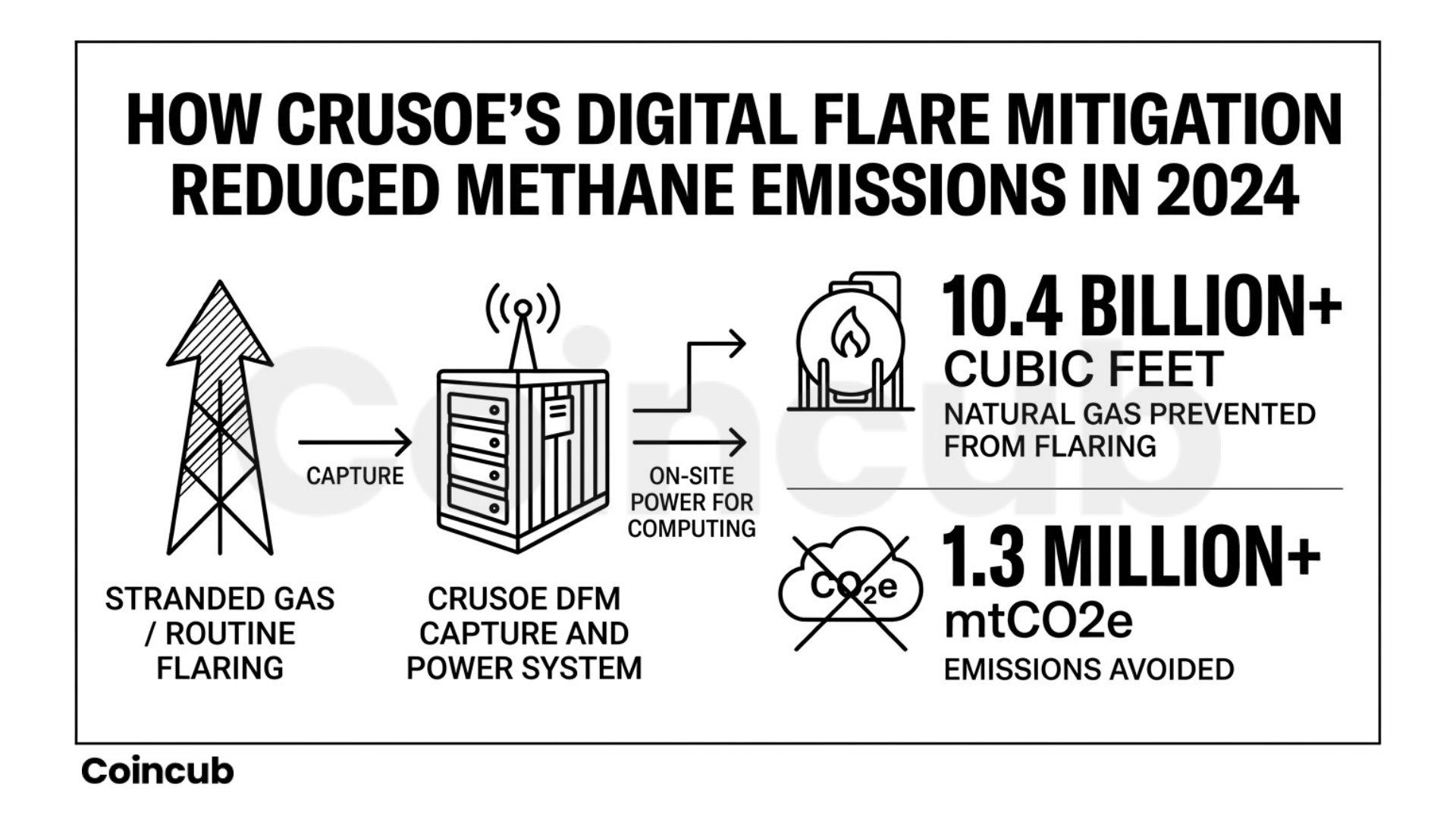
Bitcoin mining companies have successfully commercialized technologies to capture and utilize this stranded energy. Crusoe Energy’s Digital Flare Mitigation (DFM) captures methane directly at the well pad and redirects it into high-efficiency enclosed generators to produce localized electricity. This power is then consumed on-site by modular data centers executing intensive computing workloads, including cryptocurrency mining and AI model training.
The operational and environmental data supporting DFM are substantial. Unlike open-air flaring, the enclosed engines utilized in these deployments achieve superior combustion efficiency, drastically reducing atmospheric methane leakage. In 2024 alone, Crusoe’s DFM solution was deployed across 43 oilfield locations, preventing the flaring of over 10.4 billion cubic feet of natural gas and avoiding more than 1.3 million metric tons of CO2-equivalent (mtCO2e) emissions.
Crucially, the environmental benefits of these operations are beginning to be evaluated against established, traditional auditing frameworks rather than experimental AI oracles. For example, secondary legal commentary indicates that specific multisite DFM projects in Montana have been recognized with Upstream Emission Reductions (UER) certifications approved by the German Federal Environmental Agency. If widely adopted, these certifications, which use methodologies developed under the United Nations’ Clean Development Mechanism (UN CDM) program, could provide early proof of concept for how oilfield mitigation might satisfy institutional ESG requirements.
Tokenizing the Environmental Attribute: SBP and Project Diamond
Once environmental mitigation (whether through renewable energy use or DFM) is verified, the resulting attribute must be structured so that institutions can acquire and report it. One emerging model for this process involves unbundling the environmental attribute from the physical compute and tokenizing it on a blockchain.
The Sustainable Bitcoin Protocol (SBP) Architecture
The Sustainable Bitcoin Protocol (SBP) provides a prominent framework for this unbundling process. It is vital to understand that SBP does not alter the underlying cryptographic code of the Bitcoin network, nor does it attempt to create “colored coins” that compromise Bitcoin’s base layer fungibility.
Instead, SBP tokenizes the verified clean energy utilized during the mining process, creating a distinct, parallel environmental commodity known as the SBP token (or “Kyoto”). SBP issues these tokens only when specific environmental impacts are measured:
- Direct Mining: For every Bitcoin successfully mined using verified clean energy (substantiated by traditional Energy Attribute Certificates or RECs to prevent double-counting), one SBP token is minted.
- Capital Mobilization: Tokens are also issued when capital is mobilized into renewable energy markets to offset the network’s historical energy consumption.
By unbundling the attribute, an institutional investor can purchase standard Bitcoin and separately acquire SBP tokens as a means to support sustainability claims in internal reporting and evolving regulatory frameworks.
Regulatory Sandboxes: The ADGM Project Diamond Auction
The transition of these tokenized environmental commodities from theoretical frameworks into regulated financial markets is actively underway, facilitated by institutional blockchain infrastructure.
A significant milestone occurred on December 16, 2025, when SBP completed the inaugural auction of its tokenized energy transition asset on Coinbase’s institutional platform, Project Diamond. This transaction took place within the Abu Dhabi Global Market (ADGM) RegLab, a tailored regulatory sandbox that provides a controlled environment for fintech innovation.
Project Diamond leverages the Base Layer-2 blockchain and the USDC stablecoin to ensure near-instant settlement speeds within a compliant framework. Operating under a Financial Services Permission from the ADGM’s Financial Services Regulatory Authority (FSRA), the platform facilitated the auction between major institutional participants, successfully converting a verified environmental attribute into a tradeable, regulated financial instrument. This event demonstrated the technical feasibility of bridging sustainable crypto mining with institutional capital markets.
The “Green Premium” Reality Check
The creation of tokenized environmental commodities theoretically introduces a bifurcated pricing structure: raw Bitcoin and ESG-compliant Bitcoin (achieved by holding BTC alongside an environmental token). Proponents argue that the latter should command a distinct market premium. However, an objective analysis reveals that a standardized, liquid market premium does not currently exist.
Early OTC Pilots vs. Market Liquidity
Discussions regarding a “green premium” frequently cite early, bespoke pilot transactions. Notably, during a pilot transaction in 2023, an SBP token was sold over-the-counter (OTC) between CleanSpark (a miner that heavily utilizes low-carbon energy) and Melanion Digital at a clearing price of $980.
While this transaction successfully proved that a buyer was willing to assign nearly $1,000 of distinct value to the environmental attributes of a single mined Bitcoin, it represented a localized, bilateral agreement rather than the establishment of a continuous, liquid market spread. The December 2025 auction on Coinbase’s Project Diamond further validated the technological and regulatory infrastructure required to trade these assets, but it occurred within a controlled regulatory sandbox.
Currently, the market for tokenized mining audits is highly fragmented. Because unified global standards for cryptographic energy verification do not yet exist, the value of a tokenized environmental claim largely depends on the issuer’s specific methodology and the buyer’s subjective interpretation of compliance. Until platforms like Project Diamond exit regulatory sandboxes and achieve deep, continuous order-book liquidity, the “green premium” remains an emerging concept rather than a reliable, daily revenue stream for the broader mining industry.
| Component | Current status | What it means for the market |
| AI demand response in mining | Already in use | Miners can adjust power consumption based on grid conditions and monetize flexibility through curtailment and energy response programs |
| NILM-based energy disaggregation | Still experimental | Promising for audit automation, but not yet reliable enough to serve as a standard institutional verification layer |
| MiCA sustainability disclosures | Active framework | Europe now has a clearer disclosure structure for consensus-related sustainability metrics, but it does not trace individual Bitcoin lots |
| SFDR 2.0 proposal | Still evolving | Asset managers may face stronger pressure to justify the sustainability profile of digital asset exposure |
| Sustainable Bitcoin Protocol (SBP) | Live but early | Shows that environmental attributes can be tokenized separately from Bitcoin without changing Bitcoin itself |
| Project Diamond / ADGM auction | Pilot-stage proof of concept | Confirms that regulated infrastructure exists for these instruments, but not yet broad secondary market liquidity |
| “Green premium” for Bitcoin | Limited to pilots and OTC deals | There is evidence of buyer interest, but no stable, liquid market premium across the industry |
| Standardized ESG-certified Bitcoin market | Not established | The market narrative is ahead of the infrastructure, standards, and liquidity. |
Current Limitations and the Path to Standardization
The narrative surrounding the greening of Bitcoin is frequently overly deterministic. While the tools to align Proof-of-Work mining with institutional ESG mandates are rapidly developing, significant friction remains.
- Technological Immaturity: While AI excels at macro-level energy demand response, micro-level verification tools like NILM require significant refinement. Deploying advanced deep learning models (CNN-LSTMs) at the edge of mining networks is hindered by persistent latency and hardware constraints, which currently prevent their use as unassailable, automated auditors.
- Regulatory Fragmentation: The European Union has provided a clear roadmap with the finalized MiCA sustainability indicators and the proposed SFDR 2.0 product categories. However, jurisdictions outside of Europe lack comparable, unified frameworks. The U.S. GENIUS Act provided vital clarity for stablecoins, but it did not establish federal ESG reporting standards for digital assets. This jurisdictional mismatch forces multinational asset managers to navigate a patchwork of compliance requirements.
- The Threat of Greenwashing: The fundamental purpose of tokenizing the green audit is to establish cryptographic trust. If the underlying data ingested by the blockchain oracle relies on flawed sub-metering, unverified analog certificates, or incomplete methodologies that ignore the embodied carbon of hardware manufacturing, the resulting token will be viewed by regulators as highly technical greenwashing.
Conclusion
The digital asset industry is slowly piecing together the tools necessary to address its energy footprint and align with institutional capital. AI is proving highly useful for managing demand response and optimizing a mining facility’s interaction with fluctuating power grids. At the same time, protocols like SBP have successfully demonstrated that environmental attributes can be tokenized separately from the underlying Bitcoin. At the same time, the regulatory landscape is maturing, shifting away from broad disclosure regimes toward specific metrics, as seen in the recent MiCA delegated acts and the proposed SFDR 2.0 categories.
However, the market is still very much in its early stages. Fully automated, AI-driven energy disaggregation via NILM is not yet a reliable auditing standard, and the financial “green premium” for sustainable Bitcoin remains confined to bespoke OTC pilots and regulatory sandboxes. The groundwork for verifiable energy attribution is being laid, but realizing a seamless, liquid, and globally standardized institutional market for ESG-certified digital assets remains a complex process still unfolding.
Frequently Asked Questions (FAQ)
What is green hashing?
Green hashing refers to Bitcoin mining powered by verified renewable or mitigated energy sources, such as hydro, wind, solar, or captured methane, with a focus on proving the energy’s source.
Is there really such a thing as ESG-certified Bitcoin?
Not as a universally accepted market standard. What exists today is a set of tokenized environmental claims and pilot structures that try to attach sustainability attributes to Bitcoin exposure.
How is AI being used in Bitcoin mining today?
Mostly for energy management, load balancing, and demand response. AI helps miners shut down or scale operations based on power prices and grid stress.
What is NILM, and why does it matter here?
NILM, or Non-Intrusive Load Monitoring, is a machine-learning method that tries to break down total facility energy use into device-level consumption. In theory, it could help prove how much electricity was actually used for mining.
Is NILM ready for institutional-grade Bitcoin audits?
Not yet. Research is progressing, but real-time deployment on edge hardware still faces latency, memory, and reliability challenges.
What does MiCA require on sustainability?
MiCA’s delegated sustainability rules require disclosure of indicators tied to the consensus mechanism, especially annual energy consumption, with some emissions metrics as supplementary data.
Does SFDR force investors to hold green Bitcoin?
No. SFDR is not a direct Bitcoin rulebook. But stricter product categorization and sustainability thresholds may push some managers to seek stronger environmental substantiation for digital asset exposure.
What is the Sustainable Bitcoin Protocol (SBP)?
SBP is a framework that tokenizes verified environmental attributes associated with sustainable mining without changing Bitcoin itself. It creates a separate token that can sit alongside BTC exposure.
Does green Bitcoin trade at a premium today?
In isolated cases, yes. There have been OTC pilot transactions and sandbox-based auctions. But there is no broad, liquid market that yet supports a stable daily premium.
What is the main risk in this whole model?
Greenwashing. If the underlying data, certificates, or methodologies are weak, tokenized environmental claims can look credible on paper while failing real scrutiny.