


 Buy a Licensed Company
  Explore VASP Data
  Talk to an Expert

 Atis Shala
Atis is a senior analyst and community lead with four years of experience in crypto. He has a bachelor from the Rochester Institute of Technology.
Atis Shala
Atis is a senior analyst and community lead with four years of experience in crypto. He has a bachelor from the Rochester Institute of Technology.
Diamond Hands vs. Paper Hands: The Psychology of HODLing
The market just opened, and the charts are bleeding red. Prices are down twenty percent in a single hour. Panic is all over twitter.
Consider the story of two distinct investors facing this exact scenario.
First, there is Cramer. Cramer checks the portfolio app every ten minutes. As the red numbers grow larger, a knot tightens in Cramer’s stomach. The fear becomes overwhelming. To stop the pain of watching the money vanish, Cramer hits the “Sell” button. The loss is locked in, but the anxiety is gone.

Then there is Saylor. Saylor sees the same twenty percent drop but does not react with fear. Instead, Saylor closes the app and goes for a walk. Saylor remembers the research done months ago and understands that volatility is the price of entry for high returns. A week later, the market recovers. Cramer is left with a realized loss, while Saylor’s portfolio is back in the green.
This scenario raises a fundamental question about investing. Why do some people fold under pressure while others hold firm?
In the world of modern finance and cryptocurrency, this distinction is often summarized by two terms: Diamond Hands and Paper Hands. These are not just internet slang or memes. They represent deep psychological frameworks that dictate financial success or failure.
By understanding the psychology behind these behaviors, you can learn to master your emotions and avoid costly mistakes.
Diamond Hands vs. Paper Hands
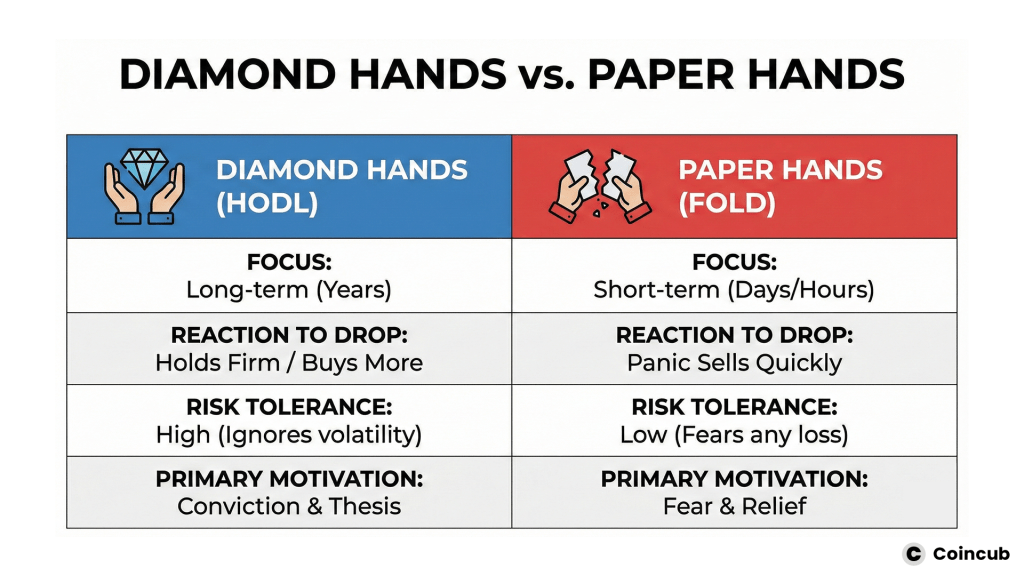
Before diving into the psychology, we must clearly define these terms. They originated in online trading communities, such as Reddit’s WallStreetBets, and exploded into the mainstream during the GameStop stock surge of 2021. Despite their humorous origins, they describe serious investment behaviors.
What Do Diamond Hands Mean?
This term refers to an investor who holds onto an asset regardless of market volatility. Someone with Diamond Hands does not sell when the price crashes. They also do not sell as soon as the price rises slightly. They hold because they have high conviction in the asset’s long-term potential.
Key characteristics include:
- High Risk Tolerance: They are not easily shaken by double-digit price swings.
- Long-Term Vision: They focus on years, not days.
- Conviction: They believe in the fundamental value of what they own.
What Do Paper Hands Mean?
In contrast, Paper Hands refers to an investor who sells their position at the first sign of trouble. The term implies fragility. Like paper, their resolve folds easily under pressure. These investors are often motivated by fear or a desire to cut losses quickly, even if the drop is temporary.
Key characteristics include:
- Low Risk Tolerance: Market dips cause immediate anxiety.
- Short-Term Focus: They react to daily news cycles.
- Reactionary Behavior: They often sell near the bottom and buy near the top.
These terms serve as a shorthand for behavioral finance concepts. They categorize how different personalities react to the stress of financial risk.
The Core Psychology Behind HODLing
The decision to hold or sell is rarely purely logical. It is biological. Our brains are wired to react to threats, and losing money feels like a physical threat to our survival. Several psychological forces are at play during market volatility.
Loss Aversion
This is the most powerful force driving Paper Hands behavior. Psychologists Daniel Kahneman and Amos Tversky discovered that humans feel the pain of a loss about twice as strongly as they feel the pleasure of an equivalent gain. Losing $1,000 feels much worse than gaining $1,000 feels good.
When the market drops, your brain screams at you to stop the pain. Selling the asset removes the immediate source of pain. This makes “folding” feel like a relief, even though it solidifies a financial loss.
Fear vs. Greed Cycles
Markets move through emotional phases. Understanding where you are in the cycle can help you maintain Diamond Hands.
- Optimism: Prices are rising, and investors feel confident.
- Euphoria: Prices are at all-time highs. Everyone believes they are a genius. This is usually where Paper Hands buy in due to FOMO (Fear Of Missing Out).
- Anxiety: The price dips. Investors wonder if the run is over.
- Panic: The price drops sharply. Fear takes over.
- Capitulation: This is the breaking point. Investors sell everything just to exit the market. This is where Paper Hands usually exit.
Diamond Hands investors understand this cycle. They know that capitulation is often the best time to buy, not sell.
Herd Mentality in Investing
Humans are social creatures. We look to others to determine how to behave. In investing, this is dangerous. When you see everyone on social media panic-selling, your instinct is to join the herd to stay safe.
Paper Hands behavior is often a result of following the crowd. Diamond Hands requires the psychological strength to stand apart from the herd and trust your own analysis.
Confirmation Bias
We naturally seek out information that supports what we already believe.
If you are scared and want to sell, you will look for news articles that say the market is crashing. This confirms your fear and leads to Paper Hands. Conversely, if you are determined to hold, you might ignore valid warning signs. This is the shadow side of Diamond Hands, where conviction can turn into delusion.
Why Are Paper Hands So Common?
If HODLing (Holding On for Dear Life) has historically been a successful strategy for quality assets, why do so many people fail to do it? Panic selling is rarely a conscious strategic choice. It is usually a reaction to specific triggers.
Watching Prices Too Frequently
The most common trigger is checking the portfolio too often. If you check your investments ten times a day, you expose yourself to micro-volatility. You see every small dip and spike. This constant stimulation exhausts your willpower. Eventually, a dip occurs that breaks your resolve.
Over-Investing
It is easy to have Diamond Hands with money you do not need. It is nearly impossible to hold when you need that money for rent or groceries. Paper Hands often occur because the investor has put in more money than they can afford to lose. When the stakes are survival, emotion inevitably takes over.
Lack of a Plan
Most panic selling happens because the investor never defined a plan. They bought an asset because it was going up. When it starts going down, they have no rules to guide them. Without a plan, emotion becomes the driver.
Typical Paper Hands Thought Patterns
You can identify this mindset by specific internal dialogue.
- “I will sell now and buy back when it is lower.” (Market timing is notoriously difficult).
- “Everyone else is selling, so there must be something wrong.”
- “I just want to get my initial money back.”
- “What if this goes to zero?”
Recognizing these thoughts is the first step to stopping them.
Diamond Hands: Strength, Strategy, or Stubbornness?
While “Diamond Hands” is often praised in investment communities, it is important to add nuance. Holding is not always the right decision. There is a fine line between conviction and stubbornness.
The Healthy Version
Healthy Diamond Hands are backed by research. You hold the asset because the fundamental reason you bought it hasn’t changed. The price has dropped, but the company or protocol is still growing, generating revenue, and meeting its goals. In this context, holding is a rational strategy to ride out market noise.
The Dangerous Version
There is a toxic side to this mindset. Sometimes, “Diamond Hands” is used to justify holding a bad investment. If a company is going bankrupt or a cryptocurrency project has been abandoned by its developers, holding is not bravery. It is denial.
Investors must distinguish between “informed conviction” and “blind faith.”
- Informed Conviction: “I am holding because the user base grew 20% this quarter despite the stock price dropping.”
- Blind Faith: “I am holding because people on the internet said it will go to the moon.”
True Diamond Hands requires constant reassessment. You must be willing to hold through fear, but you must also be willing to sell if the fundamentals actually break.
The HODL Mindset: What Long-Term Holders Do Differently
Successful long-term investors share a specific set of habits. They do not just have “stronger wills.” They have better systems.
They Define Exit Criteria
A professional investor knows when they will sell before they even buy. They might plan to sell 10% of their holdings when the price doubles. Having a pre-set exit strategy prevents greed from keeping them in the trade too long, and it prevents fear from forcing them out too early.
They Zoom Out
Paper Hands look at the 1-hour or 1-day chart. Diamond Hands look at the 1-year or 5-year chart. When you zoom out, a terrifying crash often looks like a small blip in a larger upward trend. Changing your time horizon changes your emotional response.
They Diversify
It is easier to hold a volatile asset if it only makes up 5% of your portfolio. If it drops 50%, your total wealth only drops 2.5%. This makes the loss manageable. If that same asset is 100% of your portfolio, a 50% drop is catastrophic. Diversification buys you the emotional stability needed to hold.
The 3-Question HODL Check
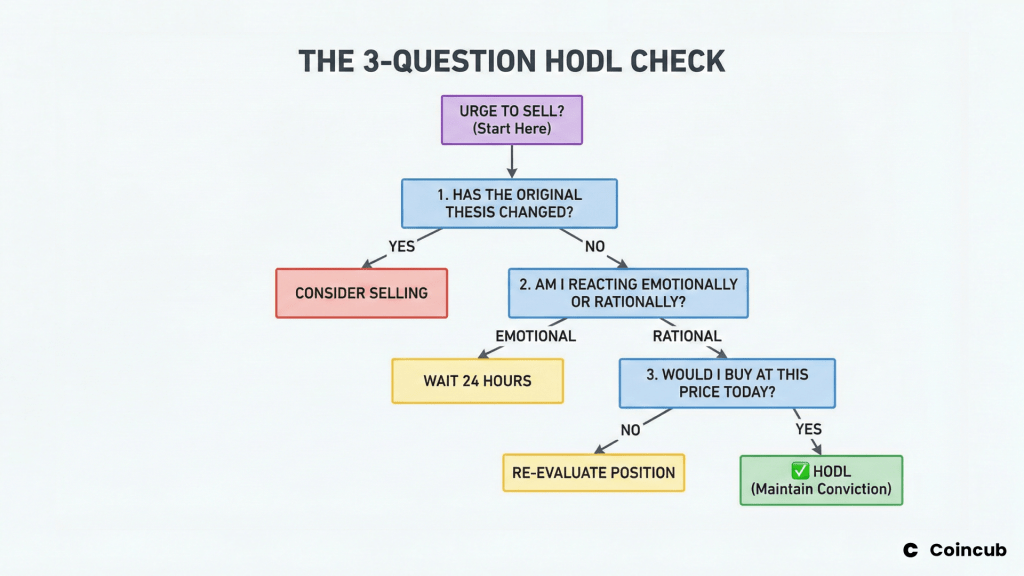
When you feel the urge to sell, ask yourself these three questions:
- Has the original thesis changed? Is the reason I bought this still true?
- Am I reacting emotionally or rationally? Am I selling because of a fact, or because I am scared?
- Would I buy at this price today? If you had cash right now, would you buy this asset at this lower price? If the answer is yes, you should certainly not sell.
How to Avoid Paper Hands Without Becoming Reckless
Developing a resilient mindset takes practice. However, you can implement concrete rules to protect yourself from your own emotions.
Only Invest What You Can Lock Up
The golden rule of investing is to never invest money you might need in the next 3 to 5 years. If you know you do not need the capital for a long time, short-term drops become irrelevant. You can simply wait for the recovery.
Create Written Rules
Write down your investment plan.
Entry: I am buying X because of Y.
Exit: I will sell if the price hits Z, or if the news changes in a specific way.
Risk: I am willing to lose this specific amount.
When the market crashes, read your rules. Trust the “calm you” who wrote the plan, not the “panicked you” staring at the red charts.
Use Position Sizing
There is a concept called the “Sleep Test.” If you cannot sleep at night because you are worried about your portfolio, your position is too large. Reduce the size of your investment until you no longer worry about it. It is better to make a smaller profit with peace of mind than to panic-sell a large position for a loss.
Keep a Decision Journal
Document why you buy and sell. Over time, you will see patterns. You might realize that every time you sold on a Tuesday morning after reading bad news, the market recovered a week later. Data helps you correct bad behavior.
Beginner Rule of Thumb
If a 30% to 50% drop in the market would cause you to panic and sell, your position is too large for your risk tolerance. Scale back until that number feels uncomfortable but manageable.
Final Thoughts: Master Yourself Before You Master Markets
The battle between Diamond Hands and Paper Hands is not really about the market. It is about the investor. The market is simply a mirror that reflects your own psychology back at you.
Diamond Hands is not about ego. It is about the discipline to trust your research over your adrenaline. Paper Hands is not about weakness. It is about an untrained emotional response to stress.
Investing is one of the few areas in life where doing nothing is often the hardest thing to do. The natural instinct is to act, to fix, to flee. But wealth is rarely made by frenetic activity. It is made by patience.
The real investment edge isn’t finding secret coins or timing the exact bottom. It is learning to sit calmly while everyone else loses their nerve.
Frequently Asked Questions (FAQs)
Is Diamond Hands always the best strategy?
No. Diamond Hands is effective for high-quality assets with long-term potential. Holding a failing asset with poor fundamentals despite clear warning signs is not a strategy; it is a way to maximize losses.
What causes Paper Hands?
Paper Hands are primarily caused by loss aversion (the intense fear of losing money) and a lack of a clear investment plan. Investing money that you cannot afford to lose also triggers this behavior.
Can you learn to have Diamond Hands?
Yes. While some people have a naturally higher risk tolerance, anyone can improve their ability to hold. Techniques like proper position sizing, diversification, and reduced chart-watching can help build the necessary discipline.
Is HODLing a legitimate financial strategy?
Yes. In traditional finance, it is called “Buy and Hold.” Historical data for the stock market and major cryptocurrencies suggests that time in the market generally beats timing the market.