Buy a Licensed Company
 Explore VASP Data
 Talk to an Expert



What Crypto Casino Activity Figures Actually Count

A crypto casino activity figure can describe addresses, transfers, or money moved without revealing how many people played. These measurements answer different questions. A player count concerns individuals; a deposit count concerns account funding; a game-round count concerns play. Reading any of them as evidence of casino use starts with identifying the event recorded, the unit being counted, and the population the figure covers.
Broad cryptocurrency payment figures require that distinction. In January 2026, Visa’s crypto chief Cuy Sheffield told Reuters that the company’s adjusted stablecoin transaction volume excluded high-frequency trading across exchanges and other activity unrelated to payments. The adjustment changed which transfers contributed to the figure. It did not turn the result into a count of consumers.
For casino activity, the equivalent question is what a dataset recognizes: a payment arriving, an address interacting with a service, or an account recording play. These figures describe different activities, even when presented together on a dashboard.

Which addresses are being counted?
A receiving address tells a sender where to direct cryptocurrency. The address alone does not identify an individual player. Bitcoin wallets can generate multiple addresses, so even the word “wallet” needs care when a report actually counts addresses.
When people play casino games online with crypto, successive deposits can fund the same account through different addresses. Casino deposit instructions can explicitly call for a fresh receiving address before each new cryptocurrency deposit. Counting those destinations would count receiving addresses used for funding, with no automatic way to tell how many individual players were involved.
The direction of the transfer is essential here. A receiving-address total counts destinations. A metric based on sending addresses or addresses initiating a particular interaction measures something else. Fresh deposit addresses do not explain every figure labeled “active wallets.”
Read the methodology for both “active” and “unique.” What action qualifies an address for inclusion? Is it counted once across the full reporting period? Removing repeated appearances of the same address produces a distinct-address count. Identifying distinct people requires additional evidence connecting activity to individuals.
Deposits and game rounds record different events
A deposit records funds entering a casino account. It does not specify how those funds are subsequently used, which games are played, or how many rounds take place. A transfer record alone cannot supply those missing observations.
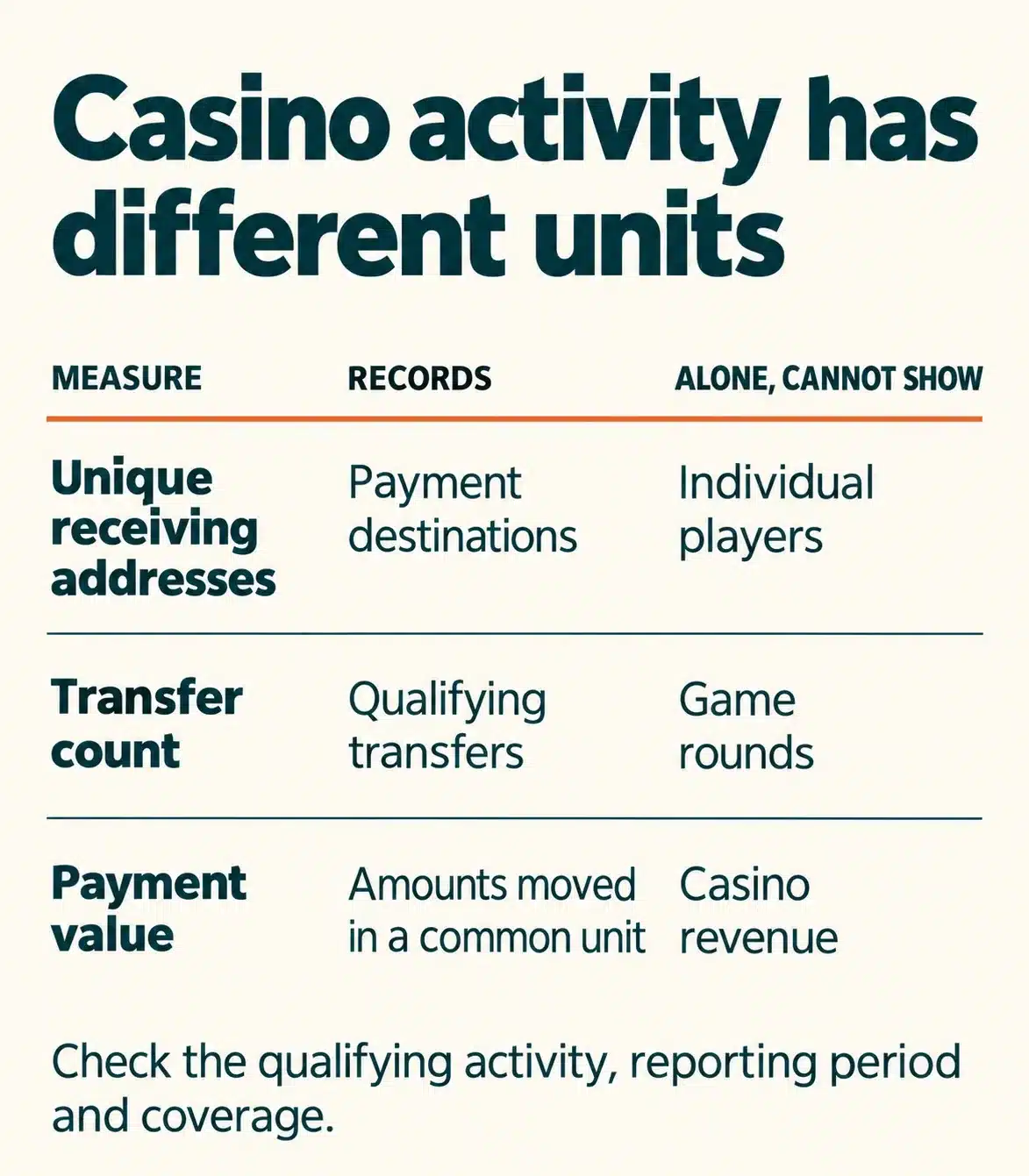
Where games use an account balance, measuring play requires the relevant account or game records. A blockchain deposit total does not automatically include that information. Conversely, a dataset expressly counting game interactions needs a definition of the interaction before it can be compared with a deposit dataset. “Transactions” is too broad a label to settle the question.
Payment value introduces another unit. Adding transferred amounts in a common unit measures money moved; counting qualifying transfers measures how many occurred. Neither calculation establishes how that activity is distributed among people. A larger total value alone cannot show that a casino has more players.
Deposits also cannot be relabeled as casino revenue. Funding an account and measuring the operator’s revenue concern different events and require different records. The same discipline applies to claims about time spent playing: payment timestamps record transfer times, not the duration of a casino session.
Account figures need equally precise definitions. Registered accounts, accounts that deposited during a period, and accounts that recorded play describe different groups. A report should identify that group and the action needed to qualify. Even an account total should not become a person total unless the method explains how it avoids counting the same individual more than once.
Put the period beside the number
A daily count and a monthly count are not interchangeable. Adding daily unique-address totals can count returning addresses repeatedly, whereas a monthly unique-address measure should count each qualifying address once within that month.
Comparisons also need consistent coverage. Check which casinos, cryptocurrencies, and networks are included, and whether those boundaries changed between reporting periods. An expanded dataset can record more activity without establishing growth among the services it previously covered.
For payment values expressed in dollars, the conversion method belongs with the result. Cryptocurrency quantities and their dollar equivalents are different measurements. A comparison needs to explain when amounts were valued and whether the same method was applied throughout. Otherwise, the reader cannot separate changes in transferred quantities from changes in their dollar valuation.
Where the sample ends
In an update published in November 2025, Artemis describes a stablecoin payments survey produced with at least 30 partners. The partner group is part of the study’s scope. Interpreting the reported totals still requires knowing which payments were included and what period the observations cover.
The update’s headline totals do not identify casino spending or establish a casino player count. They describe payments across the survey’s stated scope. Extending the findings to casinos would require separately identified casino payments, together with an explanation of which operators and networks were represented and how the sample was assembled.
For the next casino usage claim, look for the counted unit, qualifying event, reporting period, and coverage. An address total can describe address activity, and a payment total can describe transfers within its stated scope. A claim about how many people actually played needs evidence of distinct individuals and qualifying play. Without those connections, the narrower measurement is the one the data supports.