Buy a Licensed Company
 Explore VASP Data
 Talk to an Expert

 News Room
Admin Coincub
US Treasury Sanctions 41 More Companies Tied to Cambodia’s Prince Group
OFAC sanctioned four people and 41 entities on November 5, 2026, targeting a network Treasury says sustained Prince Group after earlier sanctions. Entities 50% or more owned by blocked persons are also blocked.
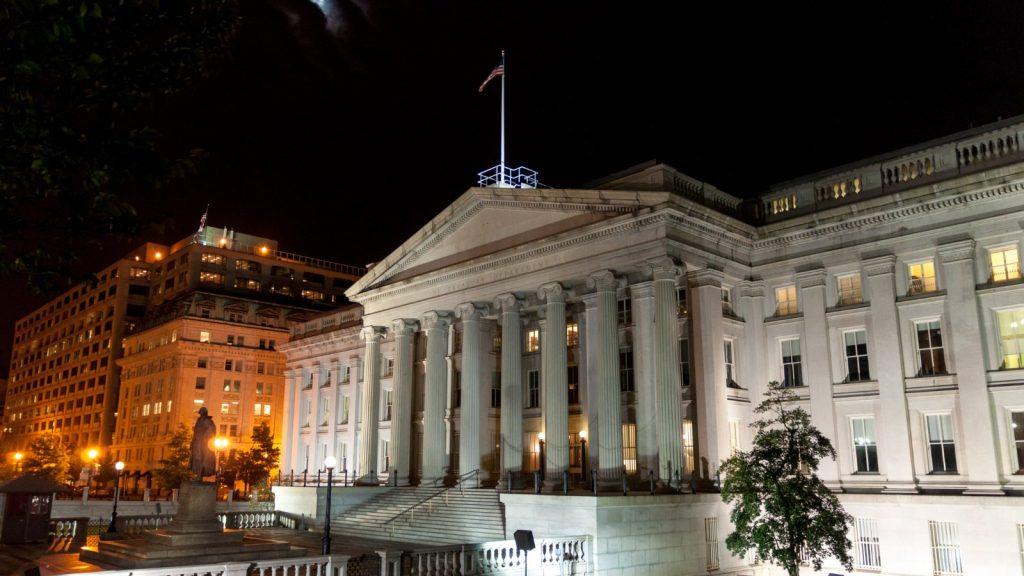
The US Treasury’s Office of Foreign Assets Control (OFAC) sanctioned four people and 41 entities on November 5, 2026, targeting a corporate network that Treasury says kept Prince Group running after earlier sanctions. Treasury Secretary Scott Bessent said cyber scam syndicates “continue to steal billions of dollars from American victims.”
- OFAC designated four people and 41 entities on November 5, 2026, for supporting Prince Group’s business network.
- Treasury says offshore ownership structures and business services helped Prince Group sustain operations after earlier sanctions.
- Entities owned 50% or more by blocked persons, including in aggregate, are also blocked under OFAC’s ownership rule.
What OFAC did and who it named
OFAC, the US Treasury office that enforces sanctions, said the network helped Prince Group manage offshore structures, conceal beneficial ownership and maintain commercial activities. Treasury has designated Prince Group a transnational criminal organization. It links the group’s affiliates to digital asset investment scams, romance scams and other online fraud. Many of those operations rely on trafficked and coerced workers in compounds in Southeast Asia.
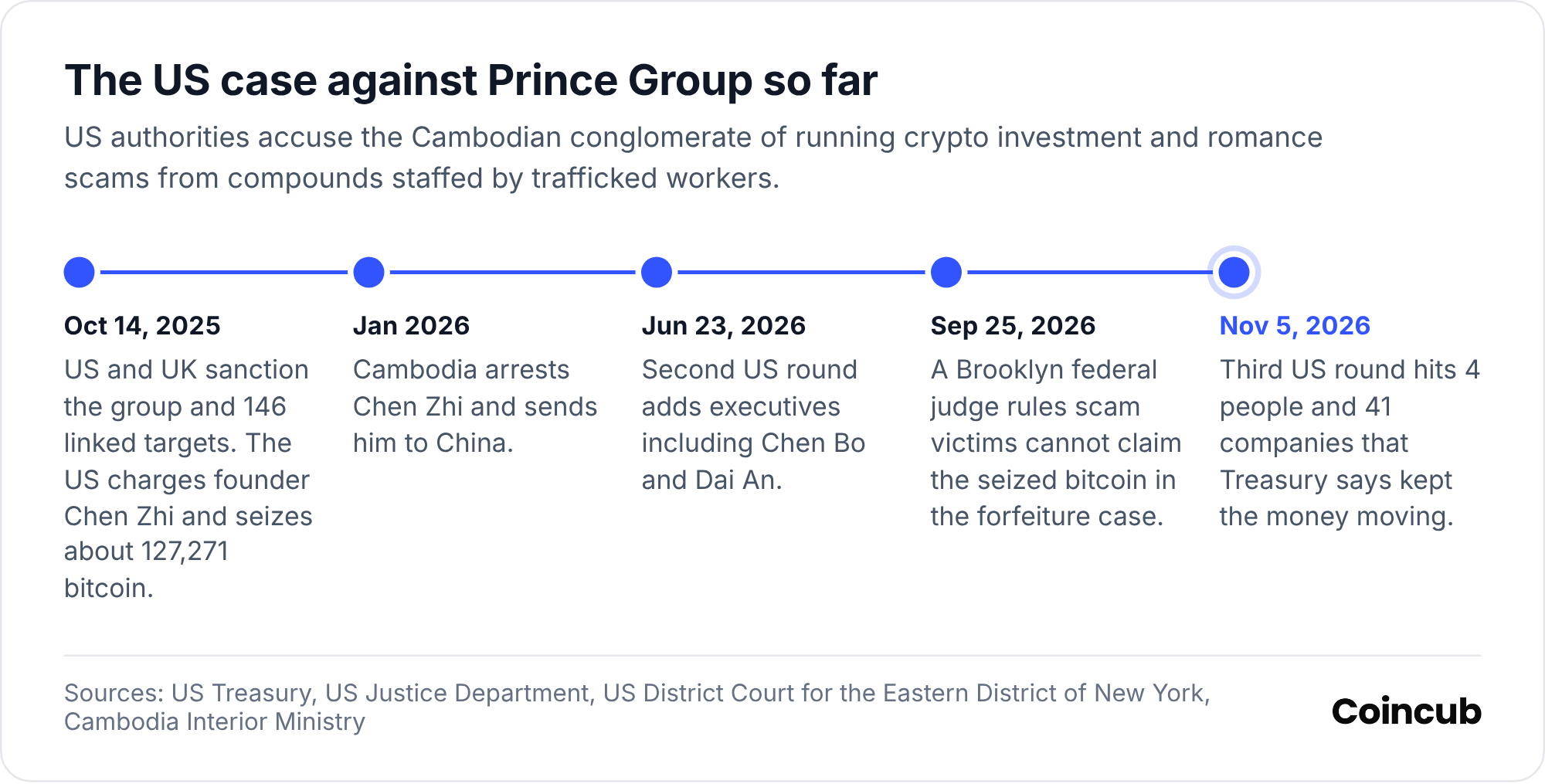
The newly sanctioned individuals are Qiu Yong, Zhao Mengyao, He Yujing and Visal Pang, according to OFAC’s designation record. The action is the third round of US sanctions against the network.

How Treasury describes the ownership chains
Treasury says Qiu ultimately owns Premium Financial Limited, a Hong Kong money lender, through Sun Speed Holdings Limited, registered in the British Virgin Islands. It says he also controls other British Virgin Islands and Hong Kong companies on behalf of Prince Group. Zhao is Qiu’s personal assistant and serves as secretary and co-director of several Hong Kong companies he ultimately controls, Treasury said.
Treasury also targeted He Yujing, the wife of Prince Group executive Chen Bo. It says Chen transferred ownership of a Tokyo mansion to He after the October 2025 sanctions action. Treasury says Pang controls 11 Cambodian companies, several co-directed with Chen, who received his own US designation on June 23, 2026.
The action also names companies linked to previously sanctioned Prince Group executives Dai An and Thet Li. Treasury says Singapore-based Greenbay Multi Media is wholly owned by Thet Li.
The crypto side of the case
Prince Group is a Cambodian conglomerate that US authorities accuse of running crypto investment and romance scams from compounds where trafficked workers were forced to target people online. US government estimates put American losses to scam operations based in Southeast Asia at $10 billion or more in 2024.
In October 2025, federal prosecutors in Brooklyn charged Prince Group founder Chen Zhi with wire fraud conspiracy and money laundering conspiracy. They also moved to seize about 127,271 bitcoin, worth roughly $15 billion at the time, which the Justice Department called the largest forfeiture action in its history. Prosecutors say the coins sat in wallets Chen controlled. The charges are allegations, and Chen has not stood trial in the US.
Several parties are fighting over that bitcoin in court. Chen has filed a claim, and so have representatives of LuBian, a bitcoin mining platform hacked in 2020, and victims of terror attacks and their families who hold US court judgments against Iran. On September 25, Judge Rachel Kovner ruled that individual scam victims cannot claim the coins in the forfeiture case. She found that people who sent money to scammers are unsecured creditors with no ownership stake in the seized wallets. If the government wins, victims can ask the Attorney General for a share through a process called remission.
What came before
The first round of US sanctions, on October 14, 2025, was a joint action with the UK that named Prince Group a transnational criminal organization and sanctioned 146 linked people and companies. Cambodia revoked Chen Zhi’s citizenship in December 2025, then arrested him in January 2026 and sent him to China. His status there has not been made public. The second US round, on June 23, 2026, added senior executives including Chen Bo and Dai An.
The Madagascar case
Treasury also sanctioned Chui Kok Wa, a Malaysian national. US prosecutors indicted him in late October, accusing him of restarting a scam operation in Madagascar after leaving Cambodia. Prosecutors say the scheme took more than $516,000 from 74 crypto wallets belonging to victims in states including Maryland, Oregon, Nevada and Minnesota. They say the money moved through wallets he controlled on Binance before reaching accounts held by people in China. The Justice Department has not said whether he is in custody.
What the blocking rules require
Property of designated persons that is in the United States, or in the possession or control of US persons, is blocked and must be reported to OFAC. The standing 50 Percent Rule also blocks entities owned 50% or more, directly or indirectly, individually or in aggregate, by one or more blocked persons. The ownership chain therefore matters alongside the names on the list.
Unless a general or specific OFAC license authorizes a transaction, or an exemption applies, US persons and transactions within or transiting the United States generally may not deal in blocked property. Treasury says violations can bring civil or criminal penalties, and civil penalties can apply on a strict liability basis. OFAC’s guidance calls for ownership due diligence on entities involved in transactions and account relationships.
Treasury warns that people and companies outside the US that deal with the newly sanctioned targets may face sanctions themselves. The bitcoin forfeiture case remains open in federal court in Brooklyn.