


 Buy a Licensed Company
 Explore VASP Data
 Talk to an Expert

 News Room
Admin Coincub
Global Financial Watchdog Urges Türkiye to Tighten Foreign Stablecoin Checks
The Financial Stability Board urged Turkey to require stronger reserve, audit and redemption safeguards for foreign stablecoins sold on local crypto exchanges. The peer review’s recommendations are nonbinding.

The Financial Stability Board (FSB), a global body that monitors financial system risks, urged Türkiye to tighten oversight of foreign-issued stablecoins sold through local crypto exchanges. The recommendations appear in a peer review the FSB published on November 11, 2026, and are nonbinding.
- The FSB called for targeted requirements on peg stability, reserve composition and transparency for foreign-currency stablecoins sold in Türkiye.
- The review found Türkiye has no dedicated stablecoin issuance regime and no tailored listing rules on reserves or peg history.
- The FSB said its recommendations create no new legal obligations or redemption rights, and the review reflects reform information through August 2026.
What the FSB review recommends for Türkiye
A stablecoin is a crypto token designed to hold a steady value, usually by tracking a currency such as the US dollar. The FSB said Türkiye should use domestic crypto platforms as a channel to oversee tokens issued abroad.
For foreign-currency tokens circulating through Turkish platforms, the FSB wants specific rules on how tokens keep their peg, what reserves back them and what issuers disclose. It also recommended issuer rules for fiat-referenced stablecoins covering effective stabilization mechanisms, prudential requirements and clear redemption rights.
The FSB called for closer cooperation with the home authorities of foreign issuers. It also asked Türkiye to consider the regulatory and prudential rules that apply to those issuers overseas.
Gaps in Türkiye’s current crypto rules
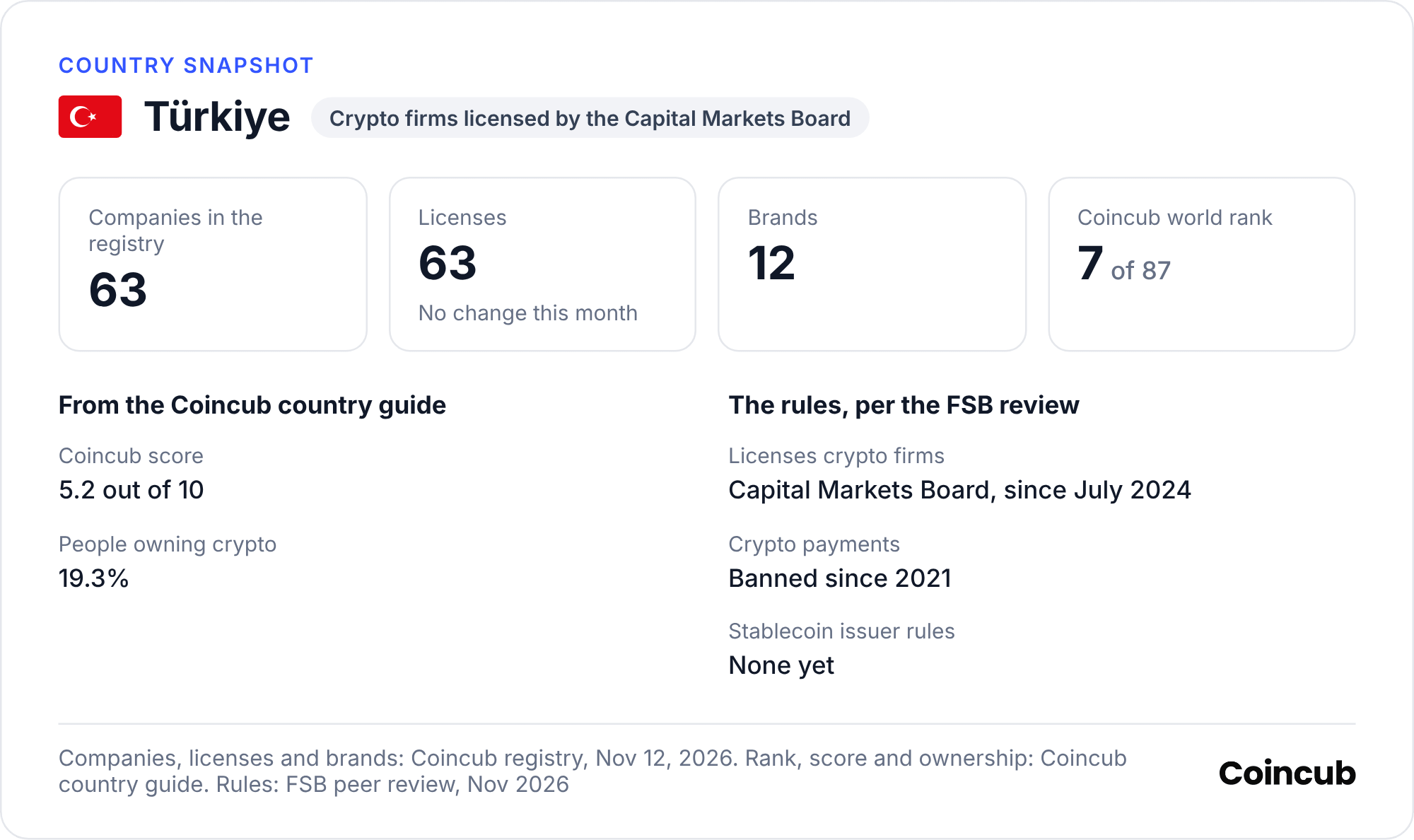
The FSB credited Türkiye with progress on crypto-platform registration and licensing, strict separation of customer custody and centralized data monitoring. These are existing measures.
Current Turkish rules cover stablecoin distribution, trading and custody through crypto service providers. They also include anti-money-laundering controls, limits on certain transfers and an existing ban on domestic crypto payments. The FSB said these controls do not fully address reserve and redemption arrangements specific to stablecoins.
The review said reserve transparency, redemption practices and incident management can be hard for Turkish authorities to assess when foreign issuers or their supervisors do not share information.
Why stablecoins matter for Turkish holders
According to the review, stablecoins in Türkiye serve as a store of value, a hedge against lira depreciation and a way to move funds between domestic and offshore platforms. Turkish authorities described domestic stablecoin exposures as modest.
The FSB warned that wider adoption could increase currency substitution and capital-flow volatility and put pressure on bank funding. Stronger oversight of local distributors could improve scrutiny of backing abroad, but the recommendations do not give customers a new way to cash out.
How big Türkiye’s crypto market is
Türkiye reported 7.1 million crypto accounts held by 5.3 million people, and about $200 billion in crypto transactions in 2025, according to the review. Crypto held on licensed Turkish platforms came to about $3 billion, roughly 0.3% of banking sector assets. Much of the trading happens on offshore platforms that Turkish rules do not cover.
Almost all the dollar stablecoins Turkish users hold are issued abroad. BiLira, the only lira stablecoin issued in Türkiye, is worth about $5.9 million. Türkiye’s financial crimes unit, MASAK, has a direct channel with Tether, the largest stablecoin issuer, to share information and freeze assets.
What remains undecided
The FSB asked Türkiye to clarify how payments and e-money law would apply to fully backed fiat-pegged stablecoins. It said policy direction and timing had not been set. An amendment to the central bank’s payments regulation would let certain currency-pegged stablecoins count as e-money, but the rules to put it in place have not been issued. The FSB also called for safeguards separating foreign-currency stablecoins from domestic payments, within a coordinated framework linking issuer rules, local distribution and cross-border supervision.
The FSB also asked Turkish authorities to publish a dated schedule for moving crypto firms from interim registration to full licenses, and to deal with the limited number of auditors able to check them.