



 Buy a Licensed Company
  Explore VASP Data
  Talk to an Expert


Crypto Exchange Guide 2025: Instant Swaps, Fees, Safety
In 2025, a crypto exchange serves as a vital tool for portfolio rebalancing, enabling quick entries or exits from positions amid market shifts. With cross-chain transfers becoming standard, users rely on these platforms to move assets seamlessly between blockchains without intermediaries. This efficiency is crucial in a landscape where regulatory changes and economic events demand agile responses.
Instant swaps stand out by offering non-custodial conversions that bypass traditional delays, appealing to those prioritizing speed and privacy. Unlike centralized setups, they minimize custody risks and often require no KYC, streamlining the process for everyday trades. However, users must navigate potential slippage from volatility, network congestion impacting confirmation times, and varying fees that could erode gains if not monitored.
This guide breaks down models, compares options, and provides practical steps to help you select the right approach, weighing trade-offs like liquidity against anonymity.

What Is a Crypto Exchange Today — Models and Trade-Offs
A crypto exchange today facilitates the buying, selling, or swapping of digital assets, evolving to include diverse models tailored to user needs. From high-volume trading floors to peer-driven networks, these platforms handle everything from fiat-to-crypto onboarding to complex cross-chain operations. In 2025, emphasis on transparency and user control defines the space, with real-time tools like live exchange rates becoming essential for informed decisions.
Key models include centralized exchanges (CEXs) that act as custodians, peer-to-peer (P2P) setups for direct deals, and instant non-custodial swaps for quick, trustless transactions. Each addresses specific scenarios, but understanding their differences is key to avoiding pitfalls like high fees or delayed settlements.
CEXs hold user funds, requiring KYC for compliance, which enhances security but sacrifices privacy; they excel in liquidity and speed for large trades, often completing in minutes. P2P platforms eliminate middlemen, allowing negotiated terms without custody, though they can be slower due to manual matching and carry trust risks from counterparties.
Instant non-custodial swaps shine in speed and anonymity, processing without holding assets long-term and skipping mandatory KYC. They suit quick conversions, with confirmation times tied to blockchain activity, making them ideal for volatile environments where users want control over wallet addresses.
Top Crypto Exchanges vs an Instant Crypto Exchange
When evaluating top crypto exchanges, factors like scale and features come into play, but instant alternatives offer compelling edges in certain areas. Largest crypto exchanges dominate in volume, supporting hundreds of pairs with deep liquidity, yet they often mandate accounts and verifications that slow onboarding. In contrast, an instant crypto exchange prioritizes seamless, no-frills access.
Biggest crypto exchanges provide robust tools for advanced trading, but instant options counter with simplicity, appealing to users avoiding complexity. For a deeper look at list of crypto exchanges and their types, check our overview here.
Fees, liquidity, pairs and more
Fees on top crypto exchanges vary from 0.1% to higher tiers based on volume, with liquidity ensuring minimal slippage for major pairs. Instant swaps often embed competitive, transparent fees into rates, avoiding surprises. Pair availability is vast on large platforms, covering fiat-to-crypto and exotics, while instants focus on popular ones with over 50 assets.
UX favors intuitive designs on instants, with mobile access enabling trades from any device. Transparency shines through no hidden fees and live calculators, though largest exchanges offer detailed audits. Mobile optimization is standard, but instants excel in quick, on-the-go swaps without apps.
How to Use an Instant Crypto Exchange
Using an instant crypto exchange begins with selecting your pair from supported assets, leveraging a live calculator to preview outcomes based on current market data. This approach ensures transparency from the start, with options for fixed or floating rates to suit your risk tolerance amid volatility. Non-custodial flow means you retain control, providing only a wallet address without account creation.
For example, on such a platform, you can opt for floating rates that adjust to live exchange rates or fixed ones to lock in value during the rate lock window, minimizing slippage. With no KYC required at the outset and competitive fees displayed upfront, the process emphasizes efficiency. To start an instant swap on a reliable crypto exchange, simply input your details and proceed, enjoying mobile access for convenience anywhere. Once confirmed, send funds and await quick receipt after network verifications.
- Select the crypto pair and check the live quote in the calculator. Choose from options like BTC to ETH or fiat-to-crypto, viewing real-time estimates.
- Enter the amount and destination wallet address. Ensure accuracy to prevent errors, as transactions are irreversible.
- Choose fixed or floating, review fees and details. Fixed protects against shifts, while floating may benefit from favorable moves, with no hidden fees included.
- Send funds and receive coins after confirmations. Monitor progress, typically completing in minutes depending on network congestion.
This method supports over 50 assets, making it versatile for diverse needs without custody risks.
The decision between fixed and floating rates on a crypto exchange hinges on market conditions and your strategy. Fixed rates secure the quoted price at initiation, shielding from adverse shifts during processing. This is particularly useful in turbulent times, where volatility could otherwise lead to unexpected outcomes.
Floating rates, tied to live market fluctuations, offer potential upside if conditions improve but expose you to downside risks. Best bitcoin exchanges often provide both, allowing flexibility based on trade size and timing.
A typical rate lock window for fixed options spans 10-20 minutes, giving ample time to send funds without rate changes. Slippage occurs more in floating setups during high volatility, where network congestion delays confirmations and alters final values. Timing your deal during low-activity periods reduces these issues, as explored in our guide on best bitcoin exchanges criteria here.
Fees, Live Rates, and Question
Fees play a pivotal role in assessing any crypto exchange, with transparent structures ensuring users know exact costs upfront. Live rates, pulled from market feeds, enable real-time calculations via integrated tools, helping compare effective prices across platforms. In 2025, no hidden fees have become a benchmark, with breakdowns covering network and service charges.
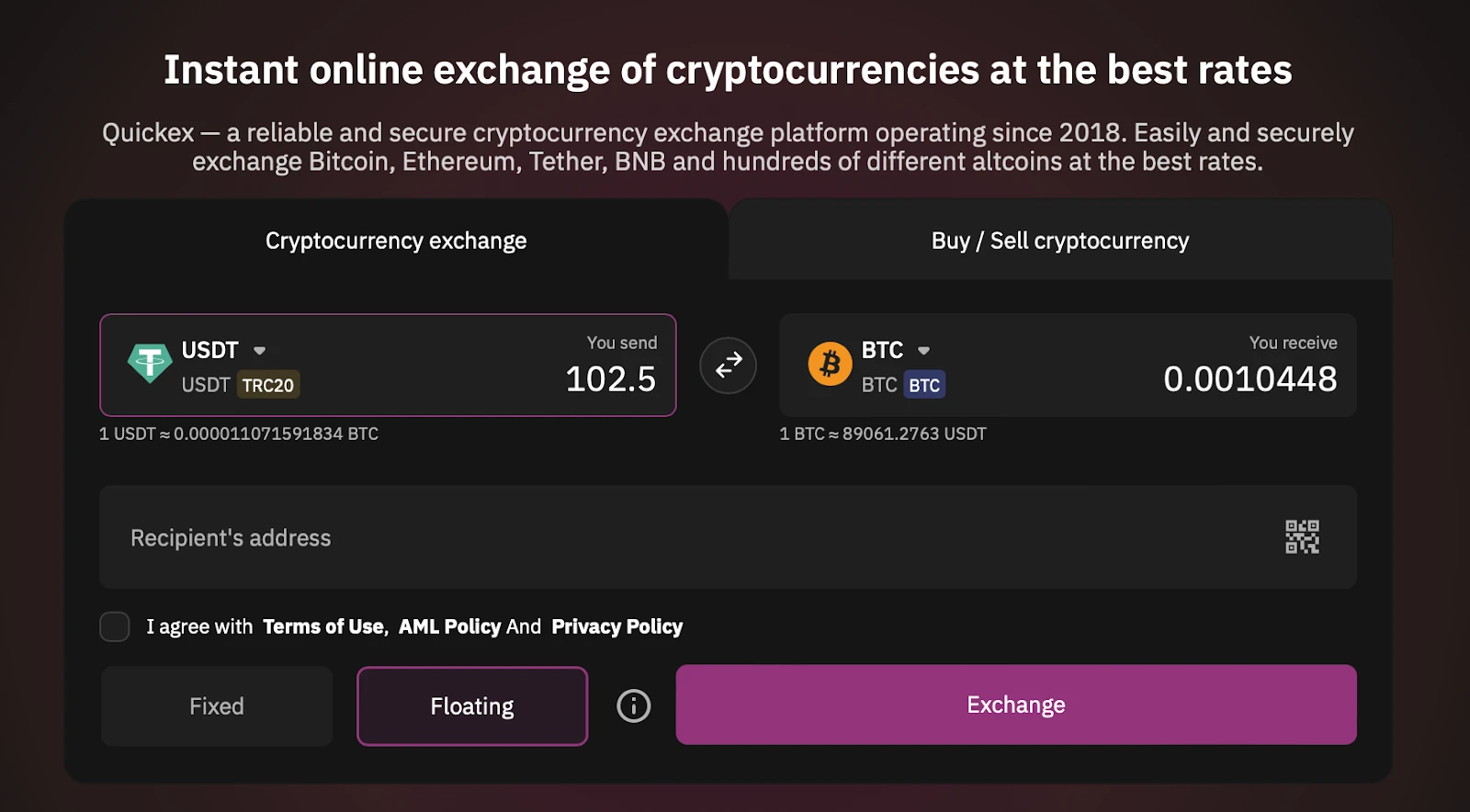
When questioning what makes the best bitcoin exchanges, focus on how fees align with liquidity and speed. Instant options often provide all-inclusive quotes, making them competitive against traditional models.
Emphasizing “no hidden fees,” platforms display comprehensive details in calculators, allowing side-by-side comparisons. To evaluate final price, factor in slippage potential and confirmation times, ensuring the net receipt meets expectations. For insights on top crypto exchanges fees and liquidity, see our comparison here.
Speed, Security, and Compliance
Speed in crypto exchanges is dictated by blockchain dynamics, with instant swaps aiming for 5-30 minute completions post-confirmation. Security layers, including advanced encryption, protect against threats, while compliance balances user privacy with regulatory needs.
AML policies often adopt a risk-based approach, triggering checks only when necessary, allowing no KYC starts for most users.
Confirmation times vary with network congestion, but robust setups mitigate delays. SSL ensures data encryption, and DDoS protections maintain availability. Per Quickex, AML is risk-based, enabling trades without upfront KYC, fostering accessibility while upholding standards.
Choosing Among the Biggest Crypto Exchanges
Navigating the biggest crypto exchanges involves evaluating scale against usability. These platforms boast extensive pairs, high limits, and global support, but may require more steps than instants. Largest crypto exchanges excel in liquidity for major assets like Bitcoin, with features for institutional users.
Consider commissions, which can be tiered, and mobile integration for on-demand access. Availability of diverse assets, including fiat-to-crypto ramps, broadens appeal.
Pairs on largest exchanges number in thousands, with no upper limits for verified accounts. Commissions are competitive, often reduced via volume discounts. Support is 24/7, mobility via apps, and asset availability spans hundreds, including niche altcoins.
Instant Crypto Exchange Beats Traditional Platforms
An instant crypto exchange outperforms traditional ones for quick, private trades where speed trumps advanced tools. Opt for it during volatile periods needing fixed rates or when avoiding KYC streamlines your flow. With non-custodial security, live calculators, and no hidden fees, it suits rebalancing or cross-chain moves in 2025. Reference Quickex for examples of these features in action. For complex strategies, blend with largest crypto exchanges, but instants win on efficiency and user control.









