


 Buy a Licensed Company
  Explore VASP Data
  Talk to an Expert

 Dren Hima
Rochester Institute of Technology (RIT) graduate.
Crypto Analyst, Market Researcher and Editor.
Dren Hima
Rochester Institute of Technology (RIT) graduate.
Crypto Analyst, Market Researcher and Editor.
Avalanche Price Prediction 2026-2030: Can Tech Upgrades Revive AVAX?
Avalanche looks like a contradiction at the end of 2025. The chain is faster, cheaper, and more useful than ever. On-chain metrics are strong. Institutional pilots keep going live. The token still sits around $13-14, more than 90% below its all-time high.
That is why holders keep asking the same thing. Is AVAX dead, or is this the accumulation zone before the institutional narrative finally matters?
Disclaimer: This article is for informational purposes only. It is not financial, investment, or trading advice. Cryptocurrency markets are highly volatile and can lead to significant losses. Always do your own research and never invest more than you can afford to lose.

Quick Avalanche Price Prediction Overview
AVAX trades around $13.7 with a market cap near 5.9 billion. Circulating supply is a bit over 429 million AVAX, with a hard cap of 720 million. Total DeFi value locked is roughly $1.27 billion and stablecoins on Avalanche sit close to 2 billion. Daily DEX volume clears $100 million, and the network handles a couple of million transactions per day.
So you have a top-30 Layer-1, with strong usage numbers, that still sits at less than 10% of its $146 all-time high.
Fundamentally, AVAX is undervalued. Price can stay heavy if the market keeps chasing memes on other chains, but the setup looks like classic “great fundamentals, ugly chart” that has led to big re-ratings in past cycles.
2026 is the make-or-break test of that thesis.
What is Avalanche – The “Internet of Blockchains” Actually Running
Avalanche is a high-throughput Layer-1 designed for custom blockchains, not just one monolithic chain. The core idea is that you have a Primary Network that secures the system, and then a growing universe of independent Layer-1s (previously called subnets) that can each define their own rules.
The Primary Network is split into three chains. The X-Chain handles asset transfers and issuance. The C-Chain runs EVM smart contracts, which is where most DeFi lives today. The P-Chain coordinates validators and all the Avalanche L1s. Consensus uses the Avalanche / Snowman family, where validators sample each other repeatedly until the network converges. In practice, that gives sub-second finality, often in the 400-800 millisecond range, without a leader node.
Avalanche L1s are where the real modular story lives. Every L1 can have its own virtual machine, its own gas token, its own validator set, and its own fee structure. The chains stay connected through Avalanche Interchain Messaging, so assets and messages can move around without messy third-party bridges.
The problem until recently was launch cost. Launching a subnet used to require staking 2,000 AVAX on the Primary Network. At higher AVAX prices, this turned into a serious capital commitment. That model slowed many mid-size teams and forced people back to shared chains.
Avalanche9000 changed that.
Avalanche9000 and ACP-77: the Main Pivot
Avalanche9000, which went live in December 2024, is the biggest upgrade in Avalanche’s history. ACP-77 rewires how Avalanche L1s pay for security. Instead of a giant, upfront 2,000 AVAX stake, L1 validators now pay a subscription-style fee to the P-Chain over time. The result is a cost reduction of around 99.9% to launch an L1 compared to the old subnet model.
Etna and Granite upgrades in 2025 built on that structure with dynamic fees, performance improvements, and better tooling for L1 sovereignty. Builders now treat L1s like they treat new products, not like a once-in-a-lifetime capital project.
That is why 2025 saw an explosion in L1 activity. Tracked projects surpassed 550. Unique contract deployers climbed into the hundreds of thousands. Verified contracts passed 700,000. Total transactions across Avalanche crossed 9 billion. It finally looks like the architecture is being used for what it was designed for.
On top of that, Avalanche has leaned hard into real-world assets and institutional infrastructure. That is the second pillar of the thesis.
Avalanche Price History and Current Performance
Avalanche launched into the 2020-2021 bull run and quickly became one of the main “high-speed smart contract” narratives. AVAX moved from a few dollars to an all-time high just above $146 in November 2021. The story at the time was simple. Ethereum was congested and Avalanche, together with Solana and a few others, offered faster, cheaper blockspace.
The bear market that followed wiped that premium out. AVAX fell back to single digits, TVL shrank, and the chain lost mindshare as the entire altcoin sector reset. Liquidity moved out, macro killed risk appetite, and attention shifted to narratives like “Ethereum merge,” “Layer-2 summer,” and later “Solana comeback.”
Through 2023 and 2024, Avalanche kept building. The team shipped Avalanche9000, Etna, Granite, and multiple ACPs that re-structured L1 economics. The ecosystem added new DeFi projects, perps, gaming experiments, and infrastructure. The market barely cared. AVAX mostly ranged between $10 and $25, with occasional spikes.
By late 2025, the picture looks split. On one side, price sits at around 9-10% of ATH. On the other side, you have $1.27 billion in DeFi TVL, almost $2 billion in stablecoins, $2.5 million daily transactions, and more than 10 million active addresses in November. The platform also recorded its highest monthly burn since 2023, with close to 70,000 AVAX burned in October.
So Avalanche heads into 2026 with fundamentals at or near a cycle high and price stuck in the mid-teens.
Tokenomics and Supply: Deflation Built In
AVAX has a hard supply cap of 720 million. That cap does not change. The genesis supply started around 360 million, and the remaining tokens enter circulation only through staking rewards on the Primary Network.
Fee mechanics are simple but powerful. Every transaction on Avalanche pays a base fee and optionally a priority fee. 100% of those fees are burned. That applies across the networks using AVAX as the gas currency. When total fees burned in a period exceed the staking rewards paid out, net AVAX supply shrinks.
By the end of 2025, staking sits around 45-46% of the circulating supply, with roughly 212 million AVAX staked. Average staking APY is in the mid-single digits to high-single digits, typically between 6.5% and 7.5%. That yield depends on delegation patterns and overall participation. A higher staking ratio over time often compresses APY.
The main overhang from early token unlocks already worked through the market. Team, foundation, and investor cliffs largely finished by mid-2024. New sell pressure now comes mainly from staking flows, ecosystem spending, and ordinary investor rotations. Burns now regularly offset a larger share of that issuance during periods of high activity.
This design gives AVAX a credible path to a deflationary profile as network revenue grows. It does not guarantee price appreciation, but it does mean that sustained on-chain usage directly improves the supply story.
Factors that Could Move AVAX Price in 2026
The first is adoption of Avalanche L1s under the new cost structure. If the 99.9% reduction in launch cost translates into dozens of serious, revenue-generating L1s, then AVAX benefits from recurring P-Chain fees and higher aggregate burn. If the new chains stay idle or mostly farm grants, the impact stays cosmetic.
The second force is institutional adoption, especially around real-world assets. 2025 gave a clear glimpse of that direction. The FIS and Intain Digital Liquidity Gateway targets community banks and helps tokenise loans and structured products. RWA platforms such as Securitize and Centrifuge moved significant amounts of tokenized treasuries and private credit to Avalanche. Lombard re-worked BTC.b, making Bitcoin liquidity move more smoothly across L1s. Hang launched a dedicated loyalty Layer-1, and Record Financial started streaming music royalties in real time to artists.
These are the kinds of use cases regulators and banks care about. They do not move price in a single headline. They do create the groundwork for large, semi-predictable on-chain flows if they scale.
The third force comes from competition. Solana dominates retail mindshare. Most memes, retail-heavy DeFi experiments, and NFT narratives are happening there. Ethereum and its Layer-2 stack dominate developer mindshare and serve as the default environment for new DeFi protocols and many consumer apps. Avalanche has to justify its niche in that environment as the place for application-specific L1s and institution-friendly rails.
If that niche holds and expands, AVAX has room to re-rate. If that niche gets squeezed between Solana and L2s, AVAX risks becoming just another mid-cap Layer-1 in the background.
The last factor is simple market structure. Crypto still trades in cycles. Bitcoin dominance, macro rates, ETF flows, and overall risk appetite will shape whether AVAX even gets a chance to show its fundamental story. A rough macro backdrop could hold price down even if Avalanche keeps shipping.
Avalanche Price Prediction 2026
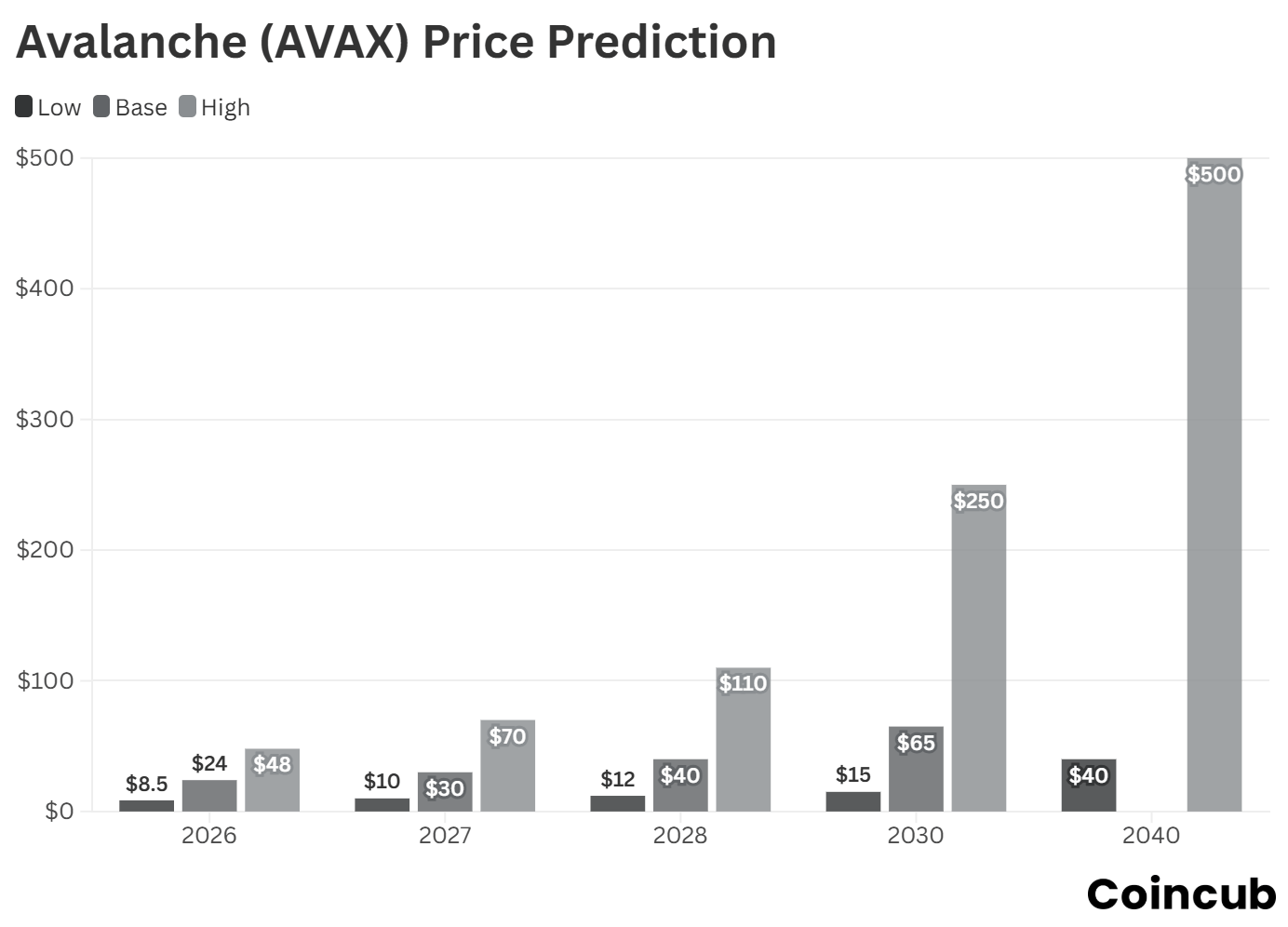
A bearish 2026 sits around $8.50. In that path, AVAX loses the $10 support band for extended periods. Markets stay risk-off. Many L1 launches fail to attract users. Institutional pilots move slowly and do not translate into visible, on-chain volume. Attention and liquidity stay tied up in Bitcoin, Solana, and a small set of L2s. AVAX looks cheap on paper, but there is no strong catalyst to close the gap.
A base case 2026 sits at around $24. In this scenario, Avalanche9000’s impact finally shows up. Several Avalanche L1s for RWAs, loyalty, and media hit escape velocity. Daily activity and fees move higher, burn statistics improve, and the broader market starts to rotate into larger altcoins beyond the top few. AVAX revisits the higher part of its 2024 range and roughly doubles from the current mid-teens.
A bullish 2026 extends to around $48. Here, RWAs and Avalanche L1s prove themselves faster than expected. The FIS and Intain rails, Securitize and Centrifuge product lines, and consumer chains like Hang and Record start to bring sizeable, recurring volume. A strong altseason lifts infrastructure names, not only meme coins. AVAX makes a three to four times move from the current base and re-enters the conversation as a serious leader.
Avalanche Price Prediction 2027-2028
By 2027 and 2028, the core question shifts. Avalanche will either be one of the default homes for RWAs and custom L1s, or it will still be pitching that story without proof.
On the bearish path, AVAX trades in a rough $10-15 band. RWAs grow, but they scatter across many chains with no clear centre. Ethereum and a couple of other networks capture the bulk of institutional volume. Avalanche L1s work technically but stay small in economic terms. The token drifts sideways and acts like a low-beta alt.
On the base path, AVAX moves into the $30-40 range by 2028. The Digital Liquidity Gateway and similar products bring a steady but not explosive flow of tokenized assets. Several Avalanche L1s in loyalty, music, and gaming reach millions of users, often without users even knowing they interact with Avalanche. AVAX becomes a normal part of diversified altcoin baskets for investors who want exposure to “modular RWA infra.”
On the bullish path, AVAX reaches somewhere in the $70-110 band by the late 2020s. That scenario assumes that Avalanche does not only participate in RWAs but leads them outside Ethereum. Multiple L1s hold TVL in the billions. Net issuance trends closer to zero or even deflation over long periods. At that point the market starts to price AVAX more on sustainable cash-flow style narratives than on pure speculation.
Avalanche Price Prediction 2029-2030
By 2030, the market will know whether Avalanche’s positioning worked.
A bearish 2030 has AVAX still around $15. The chain is alive, but activity is modest. RWAs and enterprise flows stay small, or they consolidate around Ethereum and one or two other platforms. Avalanche keeps some loyal users but no dominant niche. Analysts call it a zombie chain and move on.
A base case 2030 puts AVAX around $65. Avalanche wins a durable role as one of the main backbones for institutional and application-specific Layer-1s. The platform holds a stable share of RWA tokenization, loyalty programs, and media rails. Fee revenue is healthy and burns offset a significant chunk of staking rewards across the cycle. The token reclaims roughly half its old all-time high and trades more like a mature infrastructure asset.
A bullish 2030 pushes AVAX toward $250. This is the “full RWA adoption plus L1 explosion” scenario. Tokenization of treasuries, credit, securities, and other assets takes off. Avalanche stands next to Ethereum in most institutional decks as the go-to environment for custom chains. Dozens of L1s on Avalanche have deep liquidity and real-world revenue. In that world, a AVAX market cap at these levels becomes plausible.
Avalanche Price Prediction 2040
For 2040, any number is guesswork. A loose band between $40 and $500 reflects the range between “relevant niche player” and “one of the core settlement and execution layers for RWAs and app-chains globally.” That kind of range only matters for people who think in decades and spread risk across many names.
How Avalanche Compares to Solana and Ethereum L2s
Solana and Avalanche sit close in many portfolios, but the experience and positioning differ.
Solana focuses on a single, very fast chain where everything competes for the same blockspace. Retail users feel that simplicity. One wallet, one main block explorer, one main mental model. That makes it a natural home for meme coins, NFT culture, and high-frequency trading apps.
Avalanche takes the opposite angle. Instead of one super-chain, it offers a mesh of custom L1s with their own parameters, all sitting under the same umbrella. That structure suits brands, banks, and gaming studios that want more isolation, tighter control over fees and MEV, and flexibility around compliance. It asks more from builders but returns more sovereignty.
Against Ethereum and its L2 stack, the comparison is different again. Ethereum is the base settlement layer. L2s like Base, Arbitrum, Optimism, Blast, and others act as scaled execution layers that inherit Ethereum security. Avalanche competes more closely to that band but replaces rollups with L1s that share a common consensus and communication layer.
Investors who already hold ETH plus one or two L2s tend to see AVAX as an adjacent bet. The appeal comes from the sovereign L1 model combined with a clear institutional and RWA focus.
Is Avalanche a Good Investment?
There is no simple yes or no here. The answer depends on how much risk someone wants to take and how long they are willing to wait.
The bull side looks strong on fundamentals. Avalanche offers one of the most complete stacks for sovereign blockchains. The platform already hosts serious experiments in banking, tokenized treasuries, credit, loyalty, and media. Tokenomics have a credible deflation story as usage grows. Most of the heavy unlocks are done. Upgrades ship on time and with visible impact.
The bear side sits in narrative and flows. Retail hype is somewhere else for now. Traders care more about Solana and the newest hot L2s. Institutional deals take years to ramp, and a lot can change in that time. Avalanche still trails Ethereum and Solana in validator count and in perceived decentralization. New L1s can also split attention if many of them never reach product-market fit.
Taken together, Avalanche in December 2025 looks like a contrarian, asymmetric bet for people who believe the next major upcycle will lean on institutions and RWAs rather than only meme coins. The chain has the right plumbing. The token needs patience.
Nothing here removes the need for your own due diligence.
How to Buy and Store AVAX
Most large centralized exchanges list AVAX. People typically buy it on platforms like Binance, Coinbase, Kraken, and other top exchanges, depending on local access and regulation.
Once you buy AVAX, you need to decide how to hold it. Core Wallet is the native Avalanche wallet and gives full support for staking and for interacting with Avalanche L1s. MetaMask works for the C-Chain and for many L1s once you add the right RPCs. For bigger balances, most people combine these with a hardware wallet for key storage.
Tax treatment depends on your country. Realized gains, staking rewards, and even certain swaps may be taxable events.
Frequently Asked Questions (FAQ)
Why is AVAX price down in 2025 if the fundamentals look strong?
AVAX still trades more than 90% below its 2021 high because the last few years crushed altcoin risk and rotated attention into a small set of narratives. Memes, Solana, and a few L2s pulled in most fresh capital. Avalanche spent that period shipping upgrades and landing institutional pilots, which do not deliver fast dopamine for traders. The disconnect comes from timing, not from the raw quality of the tech.
What exactly is Avalanche9000 in simple terms?
Avalanche9000 is the upgrade that reinvented subnets into Avalanche L1s and changed how they pay for security. Before it, teams needed to stake 2,000 AVAX to run a subnet validator. After it, they pay a continuous fee to the P-Chain. That means launching an L1 now costs almost nothing compared to the old model. The result is a surge in new L1s for RWAs, loyalty, media, and gaming.
Can AVAX reach $100 again?
A move back to $100 would require roughly a seven to eight times increase from current levels. That kind of move is possible in a strong altcoin cycle. It would likely need several conditions together: a broad risk-on environment, a full altseason, multiple Avalanche L1s with real traction, and clear recognition of AVAX as a core RWA and institutional asset in portfolios. It is not a guaranteed outcome, but it sits within the bullish scenario band for the next cycle.
Is Avalanche better than Solana?
Avalanche and Solana aim at different sweet spots. Solana feels better for a user who wants one fast chain where everything happens. Avalanche suits builders and institutions that want their own chain with more isolation and control, but still want a shared ecosystem. Investors usually hold them as different bets inside the same basket rather than treating one as a simple replacement for the other.