


 Buy a Licensed Company
 Explore VASP Data
 Talk to an Expert

 Dren Hima
 is Head of Research at Coincub, leading research across digital asset regulation, licensing, market structure, tokenization and institutional adoption.
Guilt by Co-Spend: Bitcoin Coin Control and UTXO Clustering

- A federal court in Washington called co-spend the most widely accepted way to cluster Bitcoin addresses, and the D.C. Circuit upheld that evidence in 2026.
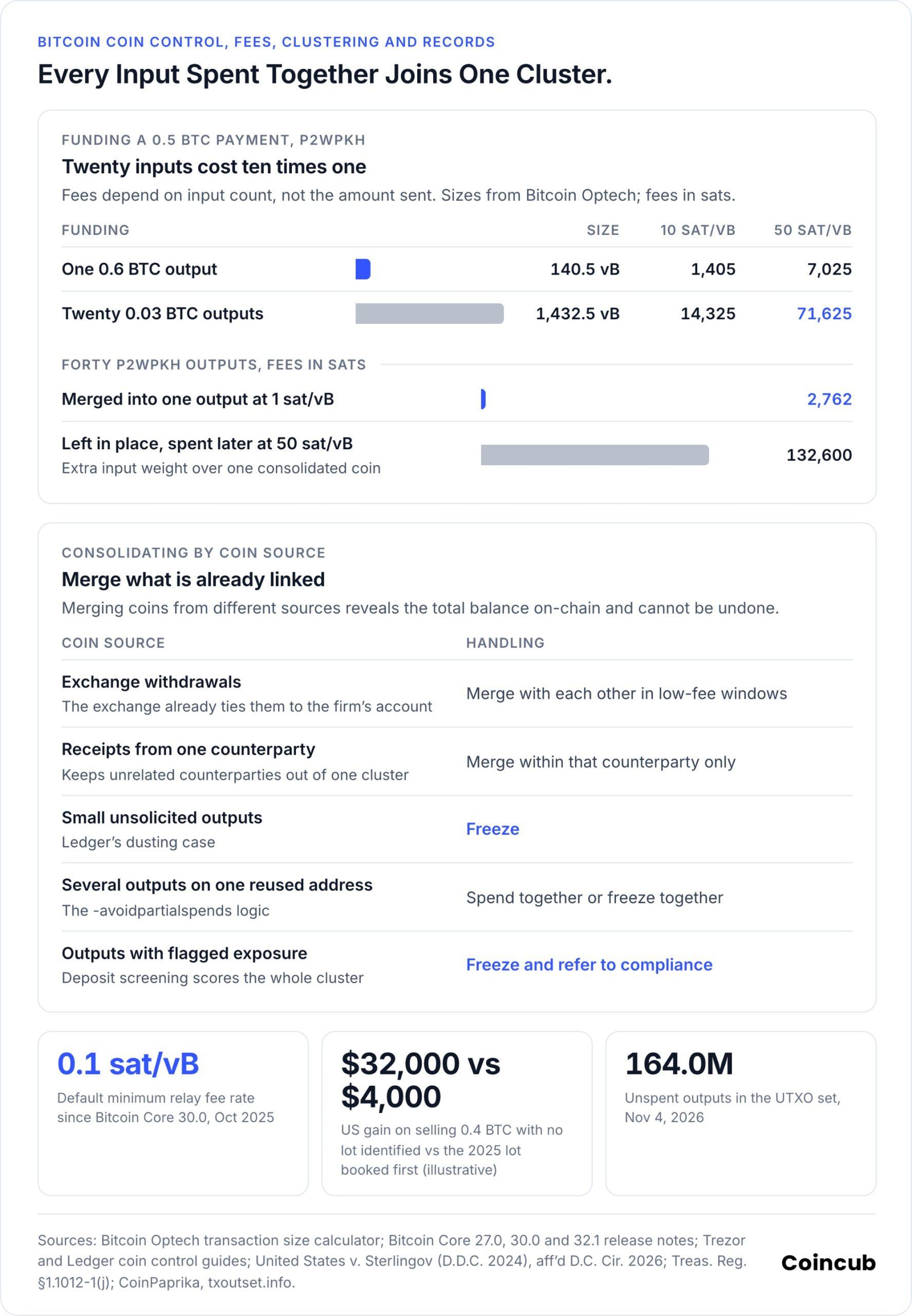
- Twenty P2WPKH inputs cost about ten times the fee of one input.
- Bitcoin Core picks inputs by waste score, and coin control is the step where labels and coin sources decide which outputs spend together.
- Bitcoin Core 30.0 cut the default relay floor to 0.1 sat/vB, and merging forty P2WPKH outputs at 1 sat/vB costs about 2,762 sats.
- US rules identify basis units on books and records by the time of transfer, and consolidation leaves the ledger holding the separate lots.
Every Bitcoin transaction with more than one input tells anyone watching that one party held the keys to all of them. Satoshi Nakamoto conceded as much in section 10 of the white paper, where multi-input transactions “necessarily reveal that their inputs were owned by the same owner.” In February 2024 a federal judge in Washington, ruling on the evidence against Bitcoin Fog operator Roman Sterlingov, described co-spend as “the most widely accepted means of clustering”addresses. The D.C. Circuit upheld the admission of the Chainalysis Reactor testimony built on it in September 2026.
Which coins go into that statement is a wallet decision. Bitcoin Core picks inputs with a fee metric, and Ledger Live spent the oldest coins first until September 2020. Coin control hands the choice to the holder. For a treasury, custody or compliance team, that one choice sets the cost of the payment and decides which of the firm’s coins the chain will link together. It also shapes what a US taxpayer’s records can show about the lot that left the wallet.
Bitcoin’s UTXO set by count, script type and value
Nodes validate every spend against the set of unspent outputs, each an amount locked by a script, and a wallet balance is the sum of the outputs its keys can unlock. CoinPaprika, citing txoutset.info data, put the set at 164.0 million outputs on 4 November 2026, down from a peak of 188.2 million in December 2024.
The composition comes from mempool.space’s UTXO set report, a snapshot at block 892,385 on 14 April 2025, when the set held 173.2 million outputs. Almost half held less than 1,000 sats, 29.6% were inscription-related, and more than 100,000 were Counterparty outputs at least a decade old.
| Script type | Share of outputs | Share of BTC value |
| P2TR (Taproot) | 34.22% | 0.75% |
| P2PKH (legacy) | 28.79% | 32.87% |
| P2WPKH (native SegWit) | 26.53% | 31.02% |
| P2SH | 7.92% | 21.25% |
| P2WSH | 1.05% | 5.64% |
| P2PK | 0.03% | 8.70% |
Taproot outputs lead by count and carry 0.75% of the value. Legacy and native SegWit single-key outputs hold almost two thirds of the bitcoin between them, and P2PK outputs, 0.03% of the count, still hold 8.70%. The ranking by value has kept moving. Galaxy Research, working from its own node as of 12 August 2025, found that P2WPKH had become the format holding the largest share of unspent bitcoin. Four months earlier, the mempool.space snapshot still put P2PKH narrowly ahead.
Each output becomes a separate input when it moves, with its own weight in the fee and its own history on the chain.
Transaction fees by input count and script type
A Bitcoin transaction carries no fee field. The fee is whatever the inputs hold beyond the outputs, priced per virtual byte, and inputs are the heaviest component of most transactions. Bitcoin Optech’s size comparison puts a legacy P2PKH input at 148 vbytes, a native SegWit P2WPKH input at 68 and a Taproot key-path input at 57.5. Taproot outputs cost more to create, at 43 vbytes against 31 for P2WPKH and 34 for P2PKH.
Take a 0.5 BTC payment from a P2WPKH wallet that returns change. The table prices two ways of funding it on Optech’s sizes.
| Funding | Size | Fee at 10 sat/vB | Fee at 50 sat/vB |
| One 0.6 BTC output | 140.5 vB | 1,405 sats | 7,025 sats |
| Twenty 0.03 BTC outputs | 1,432.5 vB | 14,325 sats | 71,625 sats |
The amount sent plays no part in the size. Twenty inputs cost about ten times one input for the same payment, and the multiple holds at every fee rate. Script type is the second lever. The same twenty coins spent as Taproot key-path inputs, with Taproot payment and change outputs, would weigh 1,246.5 vbytes, about 13% less.
Batching applies the same arithmetic to outputs. Ten separate P2WPKH payments, each funded by one input and returning change, weigh 1,405 vbytes in total. One transaction paying all ten from a single input with one change output weighs 419.5 vbytes, about 70% less. The trade-off sits on-chain, since every recipient can see the other nine payments and the change that ties them to one payer.
Small outputs face two floors. Bitcoin Core’s dust rule prices a relay floor at a dust fee of 3,000 sat/kvB, giving 546 sats for a typical legacy output and 294 sats for P2WPKH. Default nodes treat a transaction that creates a smaller output as non-standard and refuse to relay it, although consensus rules would accept it in a block. Trezor’s coin control guide gives users a single minimum of 546 sats per output, the legacy threshold. The economic floor moves with fees. At 50 sat/vB a P2WPKH input costs 3,400 sats to spend, and any P2WPKH output worth less than that loses money every time it moves.
How Bitcoin Core and hardware wallets choose coins
Bitcoin Core runs several selection algorithms on every spend and keeps the candidate with the lowest waste score. Waste prices the inputs at the current fee rate against a long-term rate, then adds the cost of creating and later spending change, or the excess left to miners when there is no change. Branch and Bound hunts for an input set that needs no change output. Below the long-term rate, set by a default -consolidatefeerate of 10 sat/vB, waste favors heavier input sets, and ordinary payments consolidate the wallet as a side effect. Bitcoin Core 27.0 added CoinGrinder for expensive conditions. It searches for the lightest input set, always produces change, and switches on at three times that rate, 30 sat/vB.
Core gives change the script type of the payment output where it can, a rule its developers adopted so change stops standing out by type. The -avoidpartialspends option, off by default, groups outputs paid to the same address and spends all or none of them, which keeps a reused address from being split across several transactions.
Hardware wallet software has used simpler rules. Ledger Live moved off oldest-first selection only when coin control arrived in version 2.11.1, and its developer documentation now lists three automatic strategies. One spends the oldest outputs first, one spends the smallest first, and one searches combinations for the lowest fee until it hits a step limit. Trezor Suite’s automatic mode, according to its coin control guide, aims to prioritize older UTXOs while keeping fees low, and the wallet returns to that mode whenever coin control is switched off.
None of these defaults can see where a coin came from. A wallet knows each output’s value, script and age. The fact that one output is an exchange withdrawal and another is a payment from a counterparty the firm wants kept at a distance lives only in the labels an operator writes. BIP 329, drafted by Sparrow developer Craig Raw, gives those labels a portable JSON Lines export covering transactions, addresses, inputs and outputs. BitBox reminds its users that labels sit outside the wallet backup and have to be exported separately.
Coin control tools for freezing, locking and PSBT signing
Coin control comes down to choosing inputs, excluding others and recording why. Electrum lists each output in a Coins tab, as BitBox’s Electrum guide walks through. A user can add selected coins to coin control so the Send tab draws only on them, or freeze a coin so automatic selection skips it. Electrum’s command line exposes the same controls as freeze and freeze_utxo, one for a whole address and one for a single coin. Bitcoin Core offers a coin control dialog in its GUI, and treasury scripts use the lockunspent RPC to hold outputs out of automatic selection until they are unlocked. Trezor’s guide recommends labeling every incoming and outgoing coin, and those labels are the record that makes the other two actions defensible later.
Selection and signing can happen on different machines. A watch-only wallet builds a PSBT with the chosen inputs, and a hardware device signs it offline. Bitcoin Core 32.1, published on 27 October 2026 after 32.0 was tagged and never released, made version 2 the default for createpsbt, walletcreatefundedpsbt, converttopsbt and psbtbumpfee. A psbt_version argument lets an operator produce the older format for signers that have not caught up. Version 2, proposed by Andrew Chow as BIP 370, lets inputs and outputs be added after a PSBT is created. Version 0 fixed the unsigned transaction at creation.
The device has to display every input and output it signs. A signer that shows less leaves the operator blind signing, trusting that the inputs selected upstream are the inputs on the screen.
Co-spend clustering in chain analysis and exchange screening
The inference Satoshi conceded became the base layer of chain analytics. Sarah Meiklejohn and her co-authors formalized it as the first heuristic in their 2013 IMC paper, with a second heuristic for spotting change addresses. The Sterlingov opinion shows how much weight a cluster can rest on it. The court cited Meiklejohn’s own description of the co-spend heuristic as safe. It found that co-spend accounted for all of the clustering for one darknet market in the case and nearly all of it for two others. It also noted that Chainalysis does not centrally record false positive or false negative rates.
Meiklejohn’s team labeled a one-time output address in a multi-output transaction as the sender’s change. A 2022 follow-up she co-authored refined the test with transaction features, address types and where each wallet places its change. Matching the change type to the payment closes one of those signals, and a changeless spend from Branch and Bound leaves no change to find.
CoinJoin defeats the inference by putting many owners’ inputs into one transaction, and Chainalysis told the court it can detect CoinJoins and skip their co-spends. In 2024 the coordinated services shrank. The Wasabi coordinator run by zkSNACKs shut on 1 June 2024, with the company saying it needed more certainty before going further. The Samourai Wallet founders, arrested that April, were sentenced in November 2025 to five and four years in prison. Prosecutors said the service moved more than $237 million in criminal proceeds.
Coin control needs no coordinator and no counterparty. Its effect is narrower. It keeps coins the holder wants apart out of the same transaction and leaves every input it does spend fully visible.
Exchanges see the result at deposit. Screening tools score exposure to flagged clusters, and the 2026 Chainalysis compliance benchmark found indirect-exposure alert thresholds commonly set 10 to 20 times higher than direct ones. Its example is a firm that alerts on $10 of direct ransomware exposure and waits for $100 of indirect exposure. Nearly half of the organizations onboarded in 2026 configured their alerts at or above the 90th percentile of 2020 strictness, the level Chainalysis calls that era’s gold standard.
One co-spend can move good coins into a bad cluster. Ledger’s coin control release described the dusting case, a tiny unsolicited output sent so the sender can track the recipient once it is spent. Spending that output with treasury coins puts every address in the transaction into one cluster the dust’s sender can follow. Regulated exchanges score that cluster at deposit, alongside the Travel Rule checks they run on transfers from self-hosted wallets.
UTXO consolidation at sub-1 sat/vB fee rates
Consolidation got cheaper in 2025. Miners started including transactions below the old 1 sat/vB relay floor. By the time Bitcoin Core developers proposed lowering it that July, over 80% of hashrate was mining them, according to discussion on the pull request. Bitcoin Core 30.0, released on 10 October 2025, cut the default minimum relay and incremental relay fee rates to 0.1 sat/vB. The dust rate stayed at 3 sat/vB, and the pull request argued that it needs a much longer record of low-fee mining before it moves. The wallet’s own minimum fee rate did not change either, and a Core wallet needs a lower -mintxfee setting before it will build a sub-1 sat/vB transaction.
Galaxy’s report counted about 15% of daily blocks as free blocks, averaging 1 sat/vB or less, in August 2025. Blocks below full weight reached nearly 50% of the total at times. Bitcoin Core 32.1 now combines its block-history fee estimator with a mempool-based one, returns the lower of the two, and feeds that combined estimate to the wallet by default. When recent blocks show a mempool too sparse to read, the new estimator falls back to the higher of the minimum relay fee rate and the current mempool minimum.
Forty P2WPKH outputs merged into a single output make a 2,761.5-vbyte transaction, about 2,762 sats at 1 sat/vB. Left in place and spent later inside a payment at 50 sat/vB, the same forty coins add 132,600 sats of input weight over one consolidated coin. An exchange hot wallet or an institutional custody operation receiving thousands of small deposits carries that future cost until it consolidates.
Trezor warns against consolidating all UTXOs at once, since merging coins from different sources reveals the total balance on-chain and cannot be undone. Consolidating by source keeps most of the fee benefit and limits what each transaction links.
| Coin source | Handling | Basis for it |
| Exchange withdrawals | Merge with each other in low-fee windows | The exchange already ties them to the firm’s account |
| Receipts from one counterparty | Merge within that counterparty only | Keeps unrelated counterparties out of one cluster |
| Small unsolicited outputs | Freeze | Ledger’s dusting case |
| Several outputs on one reused address | Spend together or freeze together | The -avoidpartialspends logic |
| Outputs with flagged exposure | Freeze and refer to compliance | Deposit screening scores the whole cluster |
Replace-by-fee, CPFP and unconfirmed change
Change from an unconfirmed transaction sits inside a transaction the sender can still replace. Full replace-by-fee has been Bitcoin Core’s default since version 28, and version 29 removed the option to turn it off. Version 32.1 deprecates the -walletrbf setting, due for removal in the next major release, and drops the BIP 125 replaceability fields from mempool RPC output. Since 30.0, bumpfee and psbtbumpfee replace a transaction under full RBF without requiring BIP 125 signaling, and 32.1 removed the Enable Replace-By-Fee checkbox from the GUI’s Send tab. Any transaction spending that change disappears if the parent is replaced.
Unconfirmed change is also the main fee-bumping lever. Bitcoin Core 28.0 added one-parent-one-child package relay, letting a child that spends the change carry a parent paying less than a node’s dynamic mempool minimum. Coin control decides whether that child spends only the change or pulls in another confirmed coin, and the second choice adds a co-spend to the record.
Specific identification and UTXO records for US tax
US basis rules have applied wallet by wallet since 1 January 2025. Under Treas. Reg. §1.1012-1(j), units leaving an unhosted wallet are treated as the earliest acquired unless the taxpayer identifies specific units on its books and records no later than the date and time of the transfer. The identifier can be a purchase date or price, and the records must show that the units left the wallet. The date units arrived in the wallet is disregarded, and the original acquisition date controls. For coins held before the switch, Rev. Proc. 2024-28 gave taxpayers a safe harbor to allocate unused basis to the units each wallet or account held on 1 January 2025.
The regulation works in units, and an input selected on-chain counts as an identification only once the books record it. Take an unhosted wallet holding two 0.4 BTC outputs, one bought in 2021 at $20,000 per bitcoin and one in 2025 at $90,000, both prices illustrative. Selling 0.4 BTC at $100,000 with no identification takes the 2021 lot first, a $32,000 gain on $8,000 of basis. Booking the 2025 lot before the sale produces a $4,000 gain on $36,000 of basis. Spending the output that the 2025 purchase funded, at the moment the books record that lot, gives an auditor a chain record and a ledger entry that agree. The same wallet-by-wallet basis rules carry lots and acquisition dates through every move between a taxpayer’s own wallets.
Consolidation weakens that link. Forty outputs bought over three years and merged into one leave the ledger as the only place the separate lots still exist.
The UK takes lot choice out of the calculation through the pooling rules in section 104 of the Taxation of Chargeable Gains Act 1992. HMRC places each token type in a section 104 pool, after same-day and 30-day matching, and a UK holder’s gain on a disposal is the same whichever coins the wallet spends.
Frequently Asked Questions (FAQ)
What is coin control in Bitcoin? +
Coin control is a wallet feature that lets the user choose or exclude specific UTXOs when building a transaction. Electrum, Bitcoin Core, Ledger Live and Trezor Suite all offer it. The chosen coins fund the payment and the rest stay untouched, giving the holder control over fees, over which coins appear together on-chain, and over how spends match the records.
What is the common input ownership heuristic? +
The common input ownership heuristic, also called co-spend, assumes that all inputs in one transaction belong to the same owner, since the sender needed the keys for each. Satoshi Nakamoto described the linkage in the white paper, Meiklejohn's 2013 paper formalized it, and a federal court called it the most widely accepted means of clustering in 2024.
Does coin control make Bitcoin transactions private? +
Coin control limits what a transaction links together and leaves everything it spends visible. Keeping unrelated coins out of one transaction stops the co-spend heuristic from joining them, while each spent coin's history stays on-chain. CoinJoin attacks the heuristic itself by combining inputs from many owners, and coin control works alone with no coordinator.
When should a wallet consolidate UTXOs? +
Consolidation pays off in low-fee periods. Bitcoin Core 30.0 lowered the default relay floor to 0.1 sat/vB, and Galaxy counted about 15% of daily blocks at 1 sat/vB or less in August 2025. Merging forty P2WPKH outputs at 1 sat/vB costs about 2,762 sats, against 132,600 sats of extra input weight if they are spent later at 50 sat/vB. Trezor warns that merging coins from different sources reveals the total balance on-chain and cannot be undone.
What is the Bitcoin dust limit? +
Bitcoin Core's default relay policy treats an output as dust when its value falls below the cost of creating and spending it at a dust fee rate of 3,000 sat/kvB. That gives 546 sats for a typical legacy output and 294 sats for P2WPKH. Default nodes refuse to relay transactions creating smaller outputs, although consensus rules allow them.
How does Bitcoin Core choose which UTXOs to spend? +
Bitcoin Core runs several algorithms, including Branch and Bound and, from 30 sat/vB under default settings, CoinGrinder, then keeps the candidate with the lowest waste score. Waste weighs the fee of spending inputs now against a long-term rate and adds the cost of change. Change takes the payment output's script type where possible.
Can unconfirmed change be spent safely? +
Unconfirmed change can be spent, and spending it with a high-fee child is the standard way to rescue a stuck parent. Bitcoin Core 28.0's one-parent-one-child relay lets that child carry a parent below the dynamic mempool minimum. Full replace-by-fee is the default, and any transaction built on unconfirmed change disappears if the parent is replaced.
Does choosing a UTXO count as specific identification for US taxes? +
A UTXO selection counts only once the books record it. Treas. Reg. §1.1012-1(j) requires the taxpayer to identify specific units on its books and records no later than the transfer, using an identifier such as purchase date or price. Without that entry, units leave an unhosted wallet earliest-acquired first. Coin control helps the chain record and the ledger agree.