Buy a Licensed Company
 Explore VASP Data
 Talk to an Expert

 News Room
Admin Coincub
ECB Official Urges EU Lawmakers to Pass Digital Euro Law by Year End
ECB board member Piero Cipollone urged EU lawmakers to finish talks on the digital euro law by year end, saying a launch date can only be set after adoption. A pilot with 36 payment providers starts in the second half of 2027.

Piero Cipollone, a member of the European Central Bank (ECB) Executive Board, told European Parliament lawmakers on November 10 that quick agreement on the digital euro law is needed before any launch date can be set. He said a delay could postpone the digital euro and deepen Europe’s reliance on foreign payment providers.
- Cipollone said the Single Currency Package could be adopted by the end of the year if trilogue talks conclude swiftly.
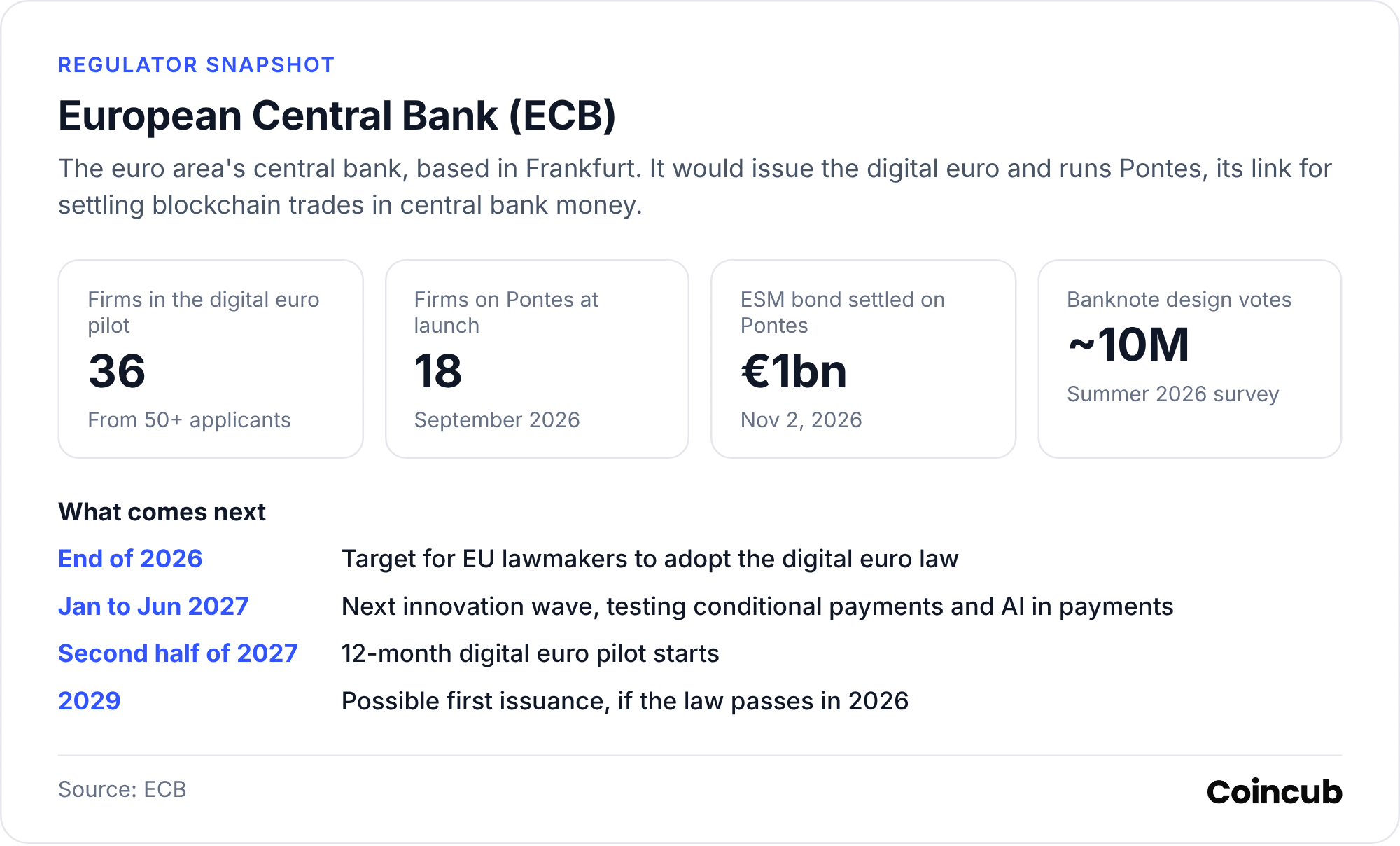
- A digital euro pilot with 36 selected payment service providers is set to start in the second half of 2027.
- The ECB’s Pontes platform settled the European Stability Mechanism’s first digitally native €1 billion benchmark bond on November 2.
ECB presses for the Single Currency Package
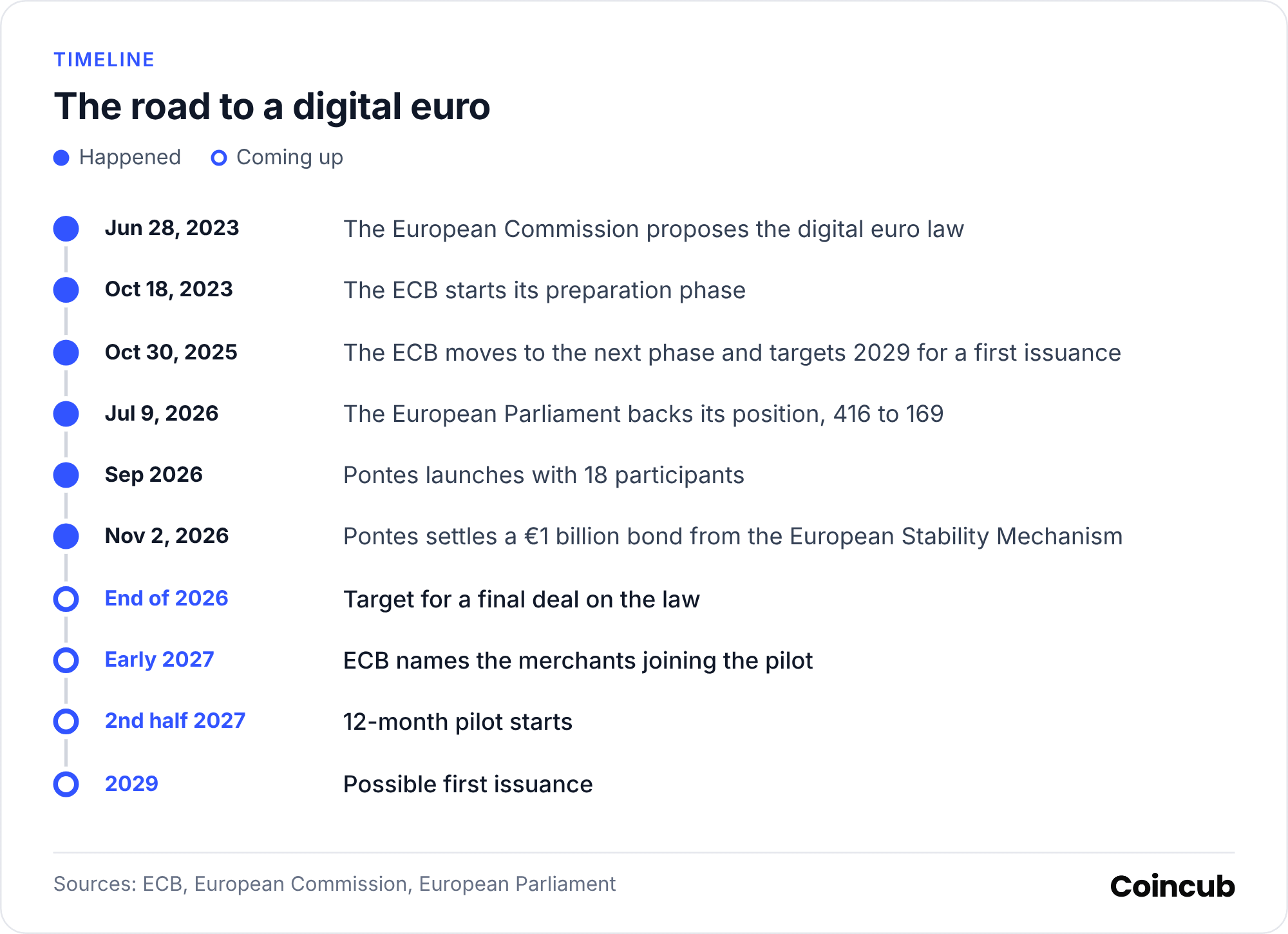
Cipollone spoke to the Committee on Economic and Monetary Affairs of the European Parliament. It was his first appearance since the Parliament adopted its position on the Single Currency Package, which received broad support in a plenary vote on July 9.
The package is the legislation that would create the digital euro, a central bank digital currency. A central bank digital currency is a digital form of money issued directly by a central bank. The package is now in trilogue negotiations, the talks between the Parliament, the Council and the European Commission that finalize EU laws.

Cipollone said adoption by year end, as foreseen in the One Europe, One Market Roadmap, would give the ECB the legal certainty to finish preparations. He said a date for a possible first issuance can be set only after the regulation is adopted. The legal framework is also needed to finalize the digital euro’s design and Rulebook, he said.
Who backs the law and who pushed back
The European Parliament backed its negotiating position on July 9 by 416 votes to 169, with 22 abstentions. Three right-wing groups, the European Conservatives and Reformists, Patriots for Europe and Europe of Sovereign Nations, forced that vote by challenging a committee decision to go straight into talks with EU governments. Rapporteur Fernando Navarrete Rojas, of the center-right European People’s Party, said the digital euro would “complement cash, not replace it.”
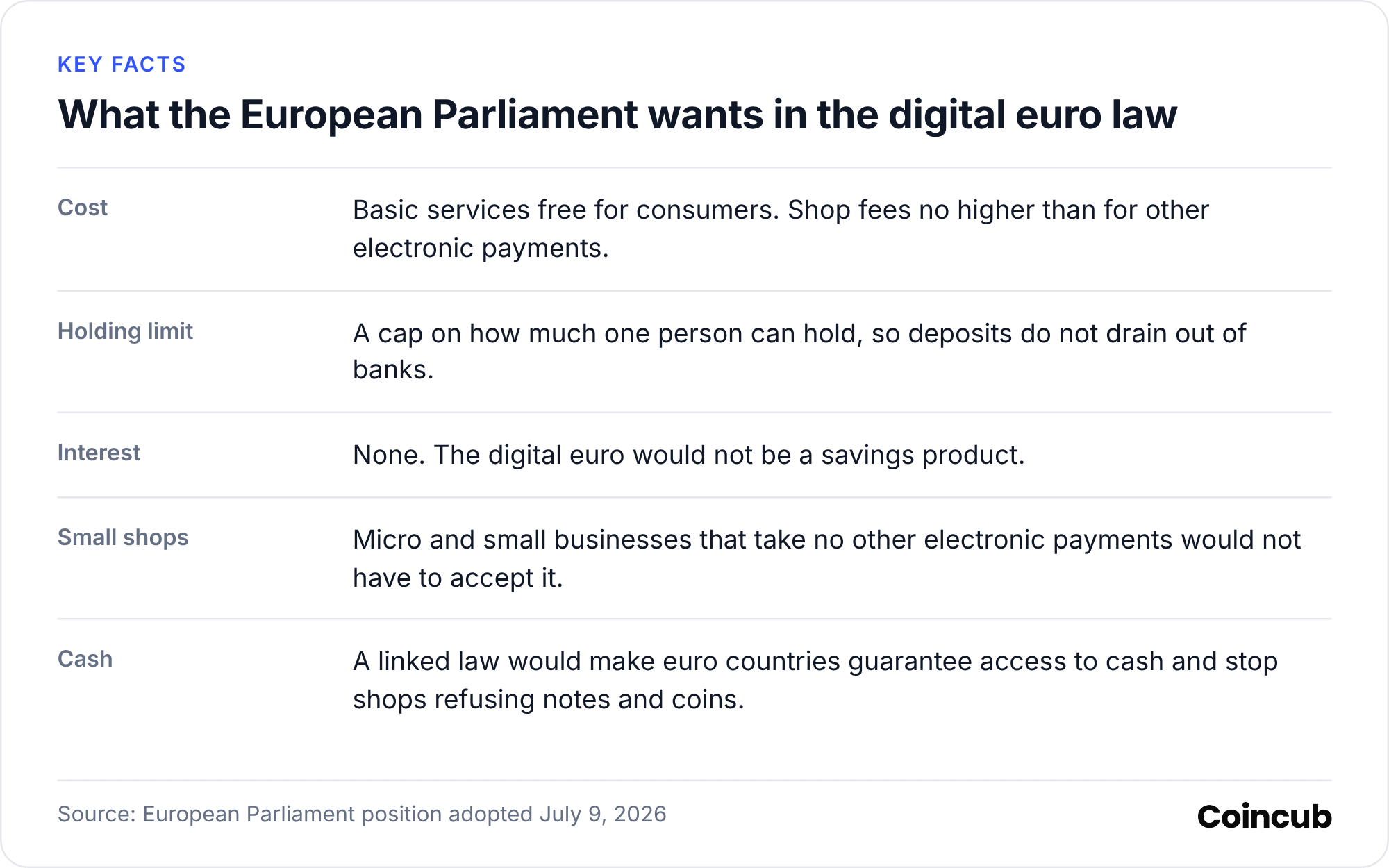
Parliament’s position caps how much digital euro one person can hold, so deposits do not drain out of commercial banks. It would pay no interest, basic services would be free for consumers, and small shops that take no other electronic payments would not have to accept it.
Digital euro pilot and rollout plans
The pilot will test technical functions, operations and user experience using a beta version without legal tender status. It will involve Eurosystem staff, participating payment service providers (PSPs) and selected merchants, such as canteens at the ECB and participating national central banks.
In July the ECB chose 36 PSPs from more than 50 applicants, including banks and non-bank providers. In September it opened a further call for online and mobile merchants to test remote payments, with the final selection due early next year.
The ECB plans to make all relevant use cases technically available from first issuance. Cipollone said market feedback favors a gradual rollout, and he welcomed lawmakers’ intention to give legal clarity on a phased rollout in shops. A new innovation platform call was launched in September, and the next wave, covering conditional payments and artificial intelligence in payments, runs from January to June 2027.
Pontes brings tokenized settlement to central bank money
Launched in September, Pontes links market distributed ledger technology (DLT) platforms, a type of blockchain infrastructure, with the Eurosystem’s TARGET Services. Cipollone said 18 market participants and DLT operators joined on day one, letting tokenized transactions settle in central bank money.
New euro banknotes and cash rules
An ECB survey on ten shortlisted banknote designs, themed “European culture” and “Rivers and birds”, drew almost 10 million responses. The ECB Governing Council is expected to decide the final design around the end of this year, with first notes expected in the early 2030s. Cipollone said the ECB supports strong legal provisions on mandatory cash acceptance, access to cash and resilient cash infrastructure.
What happens next
If lawmakers agree on the law by the end of 2026, the ECB says a 12-month pilot can start in the second half of 2027 and a first digital euro could be issued in 2029. The ECB will name the merchants joining the pilot early next year. The Governing Council is expected to pick the new banknote design around the end of this year, when it will also publish the survey results.