


 Buy a Licensed Company
 Explore VASP Data
 Talk to an Expert

 Dren Hima
 is Head of Research at Coincub, leading research across digital asset regulation, licensing, market structure, tokenization and institutional adoption.
Moving Crypto Between Your Wallets Is Tax-Free. Now Prove It.

- The IRS, HMRC, the CRA and the ATO treat a transfer between wallets you own as non-taxable while ownership stays with you.
- Crypto-paid network fees are disposals in the US and Australia.
- US and German rules tie cost basis to the wallet, and each self-transfer moves specific lots and acquisition dates.
- DAC8 and UK CARF reporting capture 2026 transfers to external wallets, and coins moved into a US broker arrive noncovered.
- Wraps and lock-and-mint bridges can fall outside the self-transfer rule, and UK relief for crypto loans and liquidity pools begins 6 April 2027.
The IRS, HMRC, the Canada Revenue Agency and the Australian Taxation Office each say a transfer that leaves ownership unchanged is not a taxable event.
The agreement stops at the tax result. By 2026 the same transfer is a reporting event in the EU and the UK, a basis event in the US and Germany, and in the US and Australia a disposal of whatever coins paid the network fee. A 2026 withdrawal from a UK exchange to a hardware wallet will reach HMRC in the first CARF report as an aggregated transfer to an external wallet. The exchange keeps the destination address on file for at least five years. Coins deposited into a US broker become noncovered assets, and the Form 1099-DA for their later sale can show proceeds with no basis beside them. The tax on a self-transfer is zero. The burden of proving that a move was a self-transfer sits with the taxpayer, and every regime above now generates the records an auditor will check that proof against.

What the IRS, HMRC, CRA and ATO say about own-wallet transfers
The IRS wrote the rule into FAQ 81 when it added FAQs 47 to 111 on 15 December 2025. A transfer from a wallet, address or account belonging to you to another one belonging to you is non-taxable, except for digital assets used or withheld to pay for transaction services. The rule names accounts alongside wallets and addresses, and that wording brings an exchange withdrawal to a hardware wallet inside it.
HMRC frames the same rule around beneficial ownership. Its Cryptoassets Manual says there is no disposal where the individual keeps beneficial ownership of the tokens throughout, and gives moving tokens between public addresses the individual beneficially controls as its example. The CRA counts the transfer of crypto-assets between wallets that you ownamong transactions that produce no taxable disposition. The ATO adds a reporting answer. A transfer between your own wallets while you keep ownership is not a disposal and does not need to be reported.
| Authority | Transfer between own wallets | Crypto spent on the fee |
| IRS | Non-taxable (FAQ 81) | Disposal, gain or loss recognized (FAQ 97) |
| HMRC | No disposal while beneficial ownership is kept | General rule that paying for services with tokens is a disposal |
| CRA | No taxable disposition | General rule that paying for goods or services is a disposition |
| ATO | Not a disposal, not reported | Disposal with CGT consequences |
All four tests turn on ownership. A transfer to the investor’s own company changes the owner, whoever holds the keys afterward.
Network fees paid in crypto during a transfer
In the United States, FAQ 97 says digital assets used or withheld to pay for transaction services are disposed of, and the holder recognizes gain or loss on them. The IRS carries the carve-out onto the return. On the Form 1040 digital asset question, a taxpayer whose only activity was moving assets between wallets or accounts they own or control checks No, unless they paid a transaction fee with digital assets. Bitcoin, Ethereum and Solana charge fees in their native tokens. A self-transfer on any of them that pays its own fee puts the taxpayer on the Yes side of the question.
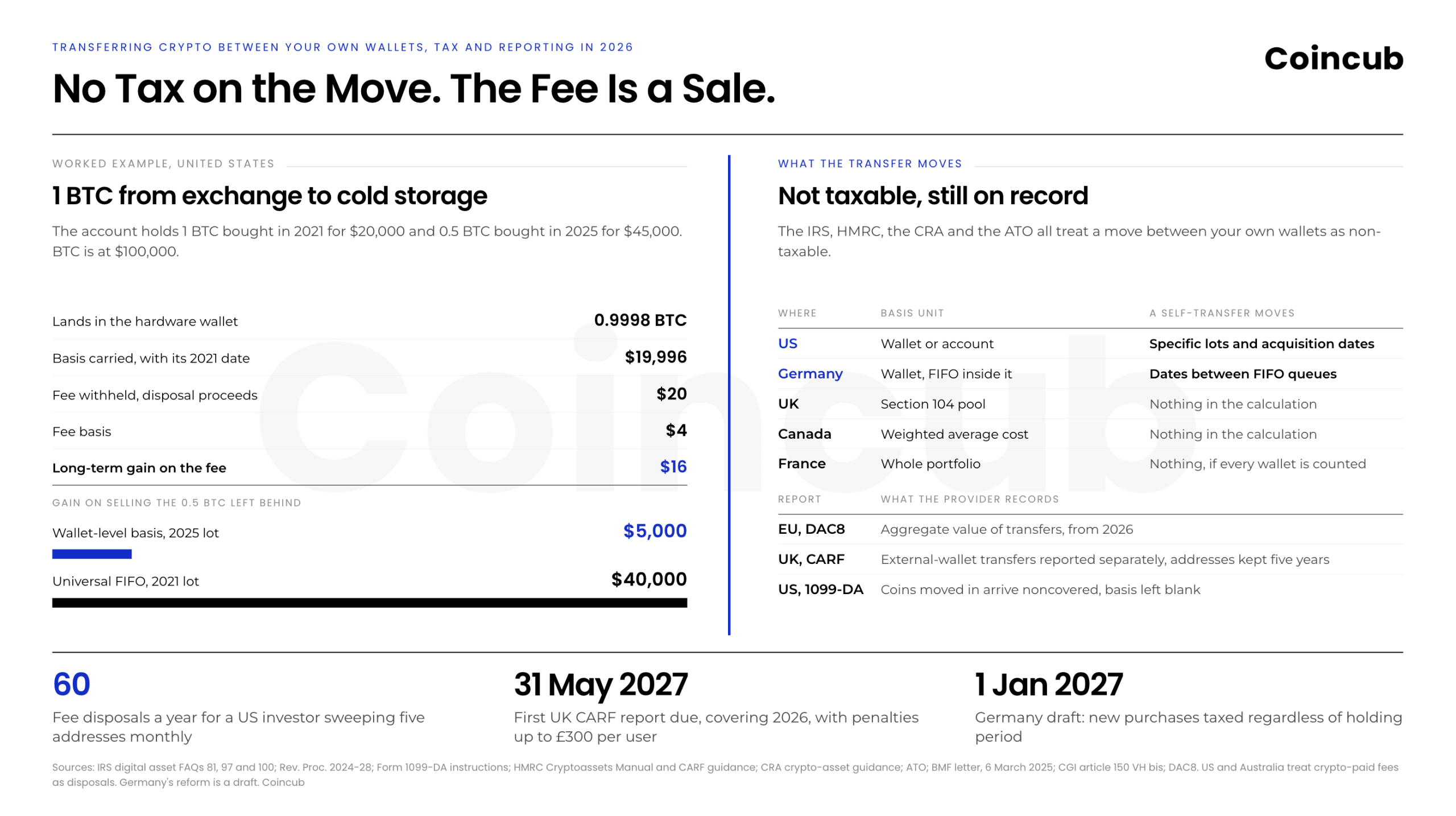
Take an investor holding 1.5 BTC at a US exchange, 1 BTC bought in 2021 for $20,000 and 0.5 BTC bought in 2025 for $45,000. She withdraws 1 BTC to a hardware wallet with bitcoin at $100,000, and the exchange withholds 0.0002 BTC as the network fee. Under the default ordering rule the whole withdrawal comes out of the 2021 lot. The 0.9998 BTC that lands in the hardware wallet carries $19,996 of basis and its 2021 acquisition date. The 0.0002 BTC fee is a disposal with $20 of proceeds against $4 of basis, a $16 long-term gain.
An investor who sweeps five addresses into cold storage every month records 60 such disposals a year, each with its own lot, date and proceeds figure.
When a holding shrinks during a transfer because crypto covered the fee, the ATO treats the fee as a disposal with CGT consequences. Neither HMRC’s disposal guidance nor the CRA’s addresses a crypto-paid transfer fee by name. Both list paying for a service with tokens as a disposal, and a network fee pays for transaction processing.
Wallet-level cost basis in the US and Germany
The US final broker regulations moved basis identification to the wallet for transactions from 1 January 2025. Units are identified inside the wallet or account that holds them, and Rev. Proc. 2024-28 gave taxpayers a one-time safe harbor to allocate unused basis to the units each wallet held on that date. The allocation is irrevocable. A specific allocation had to be finished before the first sale, disposition or transfer of that asset type on or after 1 January 2025, or by the 2025 return’s due date if that came first. A self-transfer in early January 2025 ended the specific-allocation window for that token. For an unhosted wallet, specific identification must happen no later than the sale, disposition or transfer. Without it, the default rule takes the earliest-acquired units in that wallet first, regardless of when they were transferred in.
After the withdrawal her exchange account holds only the 0.5 BTC bought in 2025. Selling it at $100,000 produces a $5,000 gain on $45,000 of basis. Under the universal approach many taxpayers read into the old FAQs, FIFO across all holdings would have matched the sale to the 2021 coins and produced a $40,000 gain. The withdrawal decided which lot she sold.
The Federal Ministry of Finance’s letter of 6 March 2025 allows FIFO where individual identification fails and requires a wallet-by-wallet view, with the chosen method kept inside a wallet until that token is fully sold (Rn. 61 and 62). Moving coins between wallets moves acquisition dates between FIFO queues. The one-year holding period that makes private gains tax-free in Germany runs from those dates.
Wallets drop out of the calculation in the UK. HMRC puts each token type in its own section 104 pool, with same-day and 30-day matching applied first. Basis in Canada is an average. The CRA describes adjusted cost base as usually the weighted average cost of a crypto-asset.
France works from the whole portfolio. Article 150 VH bis of the tax code computes each gain by applying the ratio of the sale price to the value of the entire crypto portfolio against the portfolio’s total acquisition price. A forgotten wallet distorts every taxable sale in France, since the formula needs the value of the whole portfolio at the moment of each one.
| Jurisdiction | Basis unit | What a self-transfer moves |
| US | Wallet or account | Specific lots and acquisition dates |
| Germany | Wallet, with FIFO inside it | Acquisition dates between FIFO queues |
| UK | Section 104 pool per token type | Nothing in the calculation |
| Canada | Weighted average cost | Nothing in the calculation |
| France | Whole crypto portfolio | Nothing, provided every wallet is counted |
Form 1099-DA and transferred-in digital assets
US brokers report gross proceeds on Form 1099-DA for transactions on or after 1 January 2025 and basis on certain transactions from 1 January 2026. Basis reporting is limited to covered securities, which the instructions confine to digital assets acquired in an account where the broker provided custody. A digital asset transferred into the broker is noncovered. Brokers may use customer-provided acquisition information solely for lot-selection purposes, and may not report it as basis or as an acquisition date.
Every coin that moves from self-custody into a US exchange arrives in that category. When it sells, the 1099-DA can carry the full proceeds with the basis left blank. FAQ 100 adds that gain or loss on a disposition is recognized even when the broker reports nothing. The return then has to supply the basis from records that followed the coins through every wallet they passed. Coins bought on the same exchange after 2025 and never moved keep broker-reported basis.
DAC8, CARF and transfers to external wallets
DAC8 has applied across the EU since 1 January 2026, and member states exchange the 2026 data by 30 September 2027. Its quantitative fields include the aggregate fair market value of transfers next to the gross amounts paid and received on acquisitions and disposals. The obligation falls on providers with MiCA authorization and on providers that serve EU users without it, which must register in one member state.
HMRC’s CARF material shows how a self-custody withdrawal appears in the data. Reporting providers must report transfers from a reportable user to an external wallet separately, giving the token type, aggregate units and aggregate fair market value in fiat. A wallet the provider cannot tie to another service provider or a financial institution is reported as external. The addresses stay off the report, and the provider must keep them for at least five years after the reporting period so tax authorities can request them later. The first UK report covers calendar 2026 and is due by 31 May 2027, with penalties of up to £300 per user.
Canada’s Department of Finance released draft legislative proposals on 15 August 2025 to apply CARF from the 2026 calendar year, with first reporting in 2027. The ATO already collects comparable data under its data-matching program, including the wallet address linked to each account and the type and description of each transfer, for every financial year from 2014-15 to 2025-26. It expects records on 700,000 to 1.2 million individuals and entities a year. The US runs Form 1099-DA as its domestic channel, and Coincub’s Global Crypto Tax Report 2025 found it the only jurisdiction targeting first CARF exchanges in 2029, two years after the main group.
In each of these systems the outflow is on record, and the question of who controls the destination is left to the taxpayer.
Swaps, wrapping, bridges and liquidity pools
The self-transfer rule covers movements that keep the same asset. A swap of one token for another is a taxable exchange in the US, and HMRC and the CRA both list it as a disposal. France stands apart. Article 150 VH bis defers tax on exchanges between crypto-assets made without a cash balancing payment, and a French investor who swaps bitcoin for ether with no cash leg has no taxable event that year.
Wrapping divides the jurisdictions. The ATO lists depositing crypto into liquidity pools and wrapping among the disposals investors must report. In the US, Notice 2024-57 lets brokers skip information returns on wrapping and unwrapping, liquidity provider, staking, lending, short sale and notional principal contract transactions until further guidance. The notice states that no inference is intended about how those transactions are taxed. The federal tax treatment of a wrap remains unanswered.
The UK announced its answer to part of the DeFi question on 13 July 2026. From 6 April 2027, certain disposals involving cryptoasset loans and liquidity pools will be treated as no gain, no loss for individuals and trustees, deferring capital gains tax until an economic disposal. Wrapping and bridges are absent from the measure. HMRC’s manual says the answer for a transfer between distributed ledgers depends on the facts. For one-way transfers it applies the derived-asset rule in section 43 of the Taxation of Chargeable Gains Act and attributes allowable costs to the token received on the second ledger.
Bridge design supplies the facts to argue from. Circle’s cross-chain transfer protocol burns USDC on the source chain and mints native USDC on the destination, and the holder ends with the same issuer’s token on another ledger. A lock-and-mint design leaves the original asset in a contract and issues a separate token whose value rests on that contract. That second structure resembles the wrapping the ATO lists as a disposal, and the burn-and-mint route is the stronger candidate for self-transfer treatment wherever the law turns on asset identity.
New units that arrive alongside a transfer, such as staking rewards, need their own entry. In Paschall v. Commissioner, filed on 4 June 2026, the Tax Court held that $33,354 of Cardano staking rewards credited through eToro in 2021 were gross income on receipt. The court rested the holding on section 61 and declined to rely on Rev. Rul. 2023-14. It is a memorandum opinion, decided on stipulated facts without a trial. The reward units take their own basis and holding period from receipt, and moving them with the principal changes neither.
Records that prove a wallet is yours
The CRA’s record-keeping list is the most detailed of the four. It asks for units and asset type, the date and time, the Canadian-dollar value, the nature of each transaction and the other party, who can be identified by address alone. It also wants the addresses of every wallet used and each wallet’s opening balance with its cost and closing balance for the year. Records stay for at least six years from the end of the last tax year they relate to. The CRA also recommends regular exports of exchange history in case a platform closes, leaves Canada or locks the user out.
The ATO asks for digital wallet records and keys, with five years of retention counted from the later of the record’s creation, the transaction’s completion or the year of the CGT event. A coin bought in 2017 and sold in 2027 needs its purchase record kept until at least 2032.
Germany’s letter sets the highest bar for self-custody. Under Rn. 87, handing over a public key without further detail is insufficient proof. Rn. 104 lets the tax office request wallet holdings on reference dates such as 31 December, along with wallet addresses and transaction hashes, and Rn. 103 expects documentation of reallocations within wallets. Rn. 20 separates ledger time from tax time. For a trade on a centralized platform, the platform’s trade time sets the acquisition or disposal date, and the on-chain inflow or outflow recorded later need not match it.
EU anti-money-laundering rules generate the strongest single piece of evidence. For a transfer of more than €1,000 to a self-hosted address, Article 14(5) of the Transfer of Funds Regulation requires the sending provider to assess whether the originator owns or controls that address. Exchanges commonly run the check through a signed message from the wallet or a small test transfer back to the platform, both standard features of Travel Rule compliance tools. A saved copy of that confirmation, filed with the transaction hash, documents ownership of the destination at the moment of transfer.
Each outbound transaction needs its inbound match by hash, amount and timestamp, with the difference booked as the fee disposal and the original lots and dates carried to the destination. Software that books every withdrawal as a sale and every deposit as an acquisition at market value erases the original basis and restarts holding periods.
Germany’s draft reform and other open questions
Germany’s finance ministry has a draft bill that would end the one-year exemption for new purchases. Under the draftdescribed in late September 2026, exchange tokens such as bitcoin and ether acquired from 1 January 2027 would move into capital income. Gains on them would be taxable regardless of holding period, while earlier holdings stay under the current rules. Domestic providers would withhold tax from 1 January 2028. Where a provider lacks reliable acquisition data, withholding would apply to 50% of sale proceeds, and taxpayer-supplied data could be used under certain conditions.
For an investor who moves coins between wallets, the draft splits one token into two tax classes. Units bought before 2027 keep the one-year exemption, and the acquisition date carried through each transfer decides whether a sold unit qualifies. Coins moved from self-custody to a German platform arrive with no acquisition data on the platform’s side, the situation the 50% fallback addresses.
The bill is still a draft. A ministry official told the Bundestag’s petitions committee on 12 October 2026 that it is in inter-ministerial coordination and that the outcome remains open.
Elsewhere the open points are narrower. Notice 2024-57 left the substantive treatment of wrapping open at the IRS, and the UK’s relief for loans and liquidity pools leaves wraps and bridges under a facts-based test. Until those questions close, a self-transfer is as defensible as the file behind it, with the hash, both addresses, proof of control over the destination, the lots and dates that moved, and the fee units that never arrived.
Frequently Asked Questions (FAQ)
Is transferring crypto between my own wallets taxable? +
A transfer between wallets or accounts you own is not a taxable disposal in the US, UK, Canada or Australia, provided ownership stays with you throughout. The IRS, HMRC, the CRA and the ATO all say so in current guidance. Crypto spent on the network fee is treated separately, and a transfer to your own company changes the owner.
Is the network fee on a wallet transfer taxable? +
In the US and Australia, yes. The IRS treats digital assets used or withheld for transaction services as a disposal with gain or loss, and the ATO treats a crypto-paid transfer fee as a CGT disposal. The gain is the fee's value minus the basis of the units spent, which is small per transfer and adds up for anyone consolidating wallets every month.
Do I answer Yes to the digital asset question if I only moved crypto between my wallets? +
You can check No if your only activity was moving assets between wallets or accounts you own or control. The exception is a fee paid with digital assets. Bitcoin, Ethereum and Solana charge fees in their native tokens, and a self-transfer on those networks that paid its own fee moves you to Yes.
Why does my Form 1099-DA show no cost basis for coins I transferred in? +
Coins transferred into a broker are noncovered securities. The broker may use acquisition details you provide only to select lots, and may not report them as basis or acquisition dates. Your own records have to supply the basis on the return.
Will a withdrawal to my hardware wallet be reported to the tax authority? +
EU and UK providers will report it. DAC8 reporting includes the aggregate fair market value of transfers from 2026. UK providers must report transfers to external wallets separately, with token type, units and value, and keep the destination addresses for at least five years. The withdrawal itself remains non-taxable.
Is wrapping or bridging crypto a self-transfer? +
The answer depends on the jurisdiction and the bridge design. The ATO lists wrapping and liquidity pool deposits as disposals. The IRS has deferred broker reporting on wrapping without deciding its tax treatment, and HMRC says bridging depends on the facts. A burn-and-mint bridge that returns the same issuer's token supports a self-transfer argument better than a lock-and-mint wrapper.
What records prove a transfer went to my own wallet? +
Keep the transaction hash, both addresses, the lots and acquisition dates that moved, the fee amount, and evidence that you control the destination. In the EU, the ownership check an exchange runs on transfers above €1,000 to self-hosted addresses makes useful evidence. Germany's guidance says a public key handed over without further detail is insufficient proof.
Does Germany's planned reform change how self-transfers are taxed? +
The draft targets how gains are taxed. Tokens acquired from 1 January 2027 would be taxed as capital income regardless of holding period, while earlier holdings keep the one-year exemption. The acquisition date carried through each wallet transfer would decide which rule applies. The bill was still in inter-ministerial coordination in October 2026.