Buy a Licensed Company
 Explore VASP Data
 Talk to an Expert

 Dren Hima
 is Head of Research at Coincub, leading research across digital asset regulation, licensing, market structure, tokenization and institutional adoption.
South Korea Seeks Fourth Delay to Crypto Tax, Pushing It to 2029
South Korea’s government plans to delay its 22% crypto gains tax to 2029, the fourth postponement, and proposes a three-year loss carryforward. The change needs National Assembly approval.

South Korea’s government plans to delay its 22% tax on crypto gains by two years to 2029, Finance and Economy Minister Lee Hyeong-il said at a press briefing in Seoul on November 5.
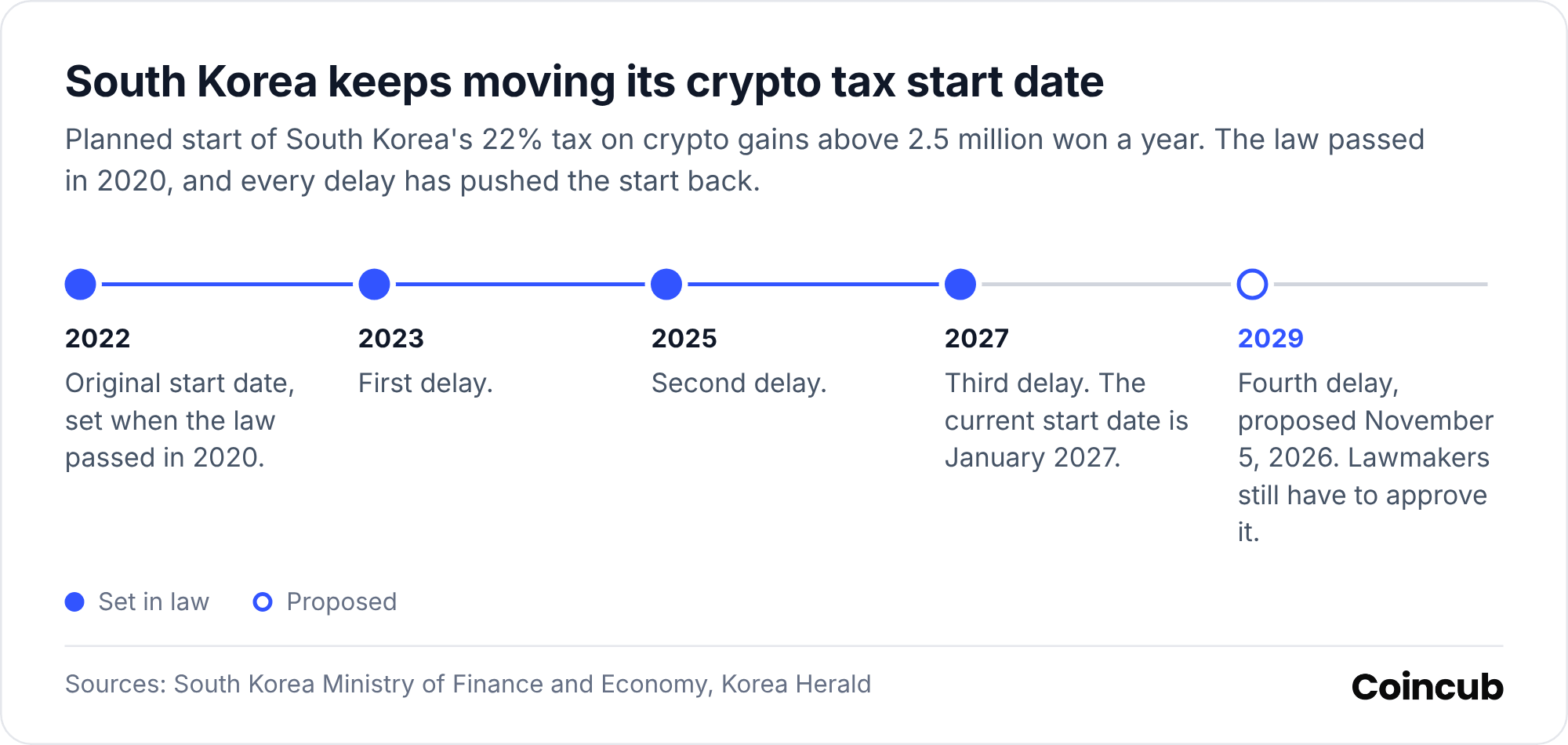
- The tax would start in 2029 and would be the fourth delay since it became law.
- Individuals would pay 22%, including local income tax, on annual net income above 2.5 million won, or about $1,869.
- The government proposes a three-year loss carryforward, so losses realized in 2029 could offset gains through 2032.
What the South Korea government announced on the crypto tax delay
The tax is currently scheduled to take effect in January 2027. To postpone it, the National Assembly must amend the Income Tax Act before then. Lee said the government would seek approval from lawmakers during this year’s regular session.
Lee said: “It weighs heavily on me to propose another delay after the tax has already been postponed three times.”

South Korea legislated the tax in 2020 for a 2022 start. It was later pushed to 2023, 2025 and 2027, as officials conceded that tax systems and investor protections were not ready.
Why the government waits for US data in 2029
The main reason is data on overseas trading. When investors move tokens bought abroad onto a Korean exchange, the exchange may have no record of the purchase price needed to calculate a taxable gain.
That gap closes in 2029, when Korea and the United States begin exchanging information under the OECD-backed Crypto-Asset Reporting Framework (CARF), a global standard for sharing crypto transaction data. The government said introducing the tax earlier could disadvantage Korea’s domestic crypto market.
Lee said that once Korea receives US transaction data in 2029, it will have enough information to tax investors on US exchanges on the same basis as domestic traders.
The government also cited the need to align the tax with the proposed Digital Asset Act, which would set rules for digital asset businesses and strengthen investor protection. Exchanges, investors and lawmakers had pressed for more time, and exchanges said unclear reporting requirements held up system development and testing.
How the proposed loss carryforward would work
The rate is not changing. The tax would apply to income from selling or lending virtual assets such as bitcoin.
Under current law, only losses from the same year can offset gains. An investor could therefore owe tax in a profitable year even after losing more the year before. Under the proposal, losses from 2029 could offset gains through 2032. Losses realized before the tax takes effect would not qualify, and the government cited crypto price volatility as the reason.
The finance ministry said the carryforward follows similar practices in the US and Britain. It also said it will work with the Financial Services Commission to speed up the digital asset law.
What happens next
The government plans to use the extra two years to collect overseas trading records and analyze them alongside domestic tax data. A working group of industry representatives, experts and government officials will review tax rules for different transaction types and ways to simplify filing through the first half of 2027.
If the review finds more legislation is needed, the government plans to submit amendments during the National Assembly’s 2027 regular session. Detailed tax guidelines are due in the first half of 2028.
The 2029 start still depends on the Assembly passing the amendment and on the US data exchange beginning on schedule.