Buy a Licensed Company
  Explore VASP Data
  Talk to an Expert


24/7 Tokenized Asset Trading: 0.55% on Weekends

- Weekends drew 0.55% of volume on the largest tokenized US equity platform through May 2026, against 52% inside US market hours.
- Atomic settlement removes multilateral netting, and every weekend trade has to be prefunded in cash that clears without a bank.
- The Bank of England proposes Sunday CHAPS settlement no earlier than 2029.
- Nasdaq’s tokenized shares share a CUSIP with ordinary shares, trade on the same order book, and settle T+1 at DTC.
- Hong Kong requires an indicative NAV deviation alert and a named market maker before a tokenized fund trades in the evening or at the weekend.
Ondo Global Markets cleared $5.5 billion across 2.8 million trades through May 2026. Weekends accounted for 0.55% of that volume, and roughly 52% of it landed inside US market hours, according to the Bitget Wallet report built on that platform’s data. The venue never closed. The traders went home anyway.
The engineering question was settled years ago. A public chain will move a security token and a payment token in the same transaction at four in the morning on a Sunday, and it will do it in seconds. What has not been settled is who funds the other side of that trade, who quotes a price when the primary market is dark, and who processes a dividend record date at 3am. Those three jobs still run on banking hours, and they set the real trading day for tokenized assets. Every serious build in this space is a bet on which of the three gets fixed first.

Tokenized equity trading volume by session
The Ondo numbers describe a retail-shaped book. Trades under $500 made up nearly 64% of transactions and 5% of volume, while the 0.5% of trades above $50,000 carried 35% of it. More than 180,000 wallets traded, and BNB Chain carried more than 75% of the total. AI-linked equities drove 35% to 40% of recent volume.
Conventional venues show the same shape at a smaller scale. IOSCO’s May 2026 review of extended trading hours found pre-market sessions grew from 0.07% of daily volume in 2020 to 1.07% in 2024, with post-market volume moving from 1.43% to 1.62% across fourteen venues. One US venue reported Q3 2025 spreads wider than regular hours by nineteen times after the close and thirty-three times before the open. Volatility runs hotter too, with a Brazilian venue putting the gap between regular hours and everything outside them at 45.8%. IOSCO describes the demand as primarily retail-driven, with institutional interest limited, and reports that issuers worry about volatility and about how news releases get timed.
The sessions themselves vary more than the headline numbers suggest. US pre-market runs from 4am to 9:30am ET and post-market from 4pm to 8pm, with several alternative trading systems covering 8pm to 4am. In Japan, one venue trades from 5pm to 11:59pm and another runs through to 6am the next morning. Italy, the Netherlands, Spain, Saudi Arabia, Australia and Canada operate narrower pre- and post-market windows. No regulated equity venue in that survey opens on a Saturday.
A December 2025 study of tokenized stocks by Cong, Landsman, Rabetti, Zhang and Zhao found token prices track their underlying shares closely during regular hours and deviate modestly once primary markets close. Price quality holds up better than the volume figures would imply. Weekend token moves anticipated the following Monday open instead of overshooting it. The same paper found short-horizon off-hour returns reverse, which is what happens when one venue carries the whole book.
Why the cash leg sets the trading hours
Netting is what makes a settlement system cheap. A clearing house takes a day of trades, offsets them, and moves a fraction of the gross value. Atomic settlement deletes that economy. Both legs move together or neither moves, so every buyer needs the full cash amount sitting in the wallet at the moment of execution. A firm that trades all weekend has to prefund all weekend, in an asset that clears without a bank. The capital that netting used to free up goes back onto the balance sheet, and it sits there through Saturday and Sunday earning whatever the settlement asset pays.
That constraint explains the shape of every serious build. FINRA cleared Securitize Markets on 4 May 2026 to custody tokenized securities and run atomic swaps against stablecoins inside a broker-dealer. The custody half of that rests on a Division of Trading and Markets statement from 17 December 2025. Staff said they would not object to a broker-dealer deeming itself to have physical possession of a crypto asset security. The conditions are control over transfer on the ledger, a documented assessment of that ledger, and private keys held under written controls. The same statement requires procedures for hard forks and for network malfunctions, which is the regulator conceding that the rail can break.
ICE took the same route from the other end. The NYSE tokenized securities platform announced on 19 January 2026 pairs the Pillar matching engine with blockchain post-trade systems. It targets 24×7 trading of US listed equities and ETFs, funded by stablecoins, with orders sized in dollars and fractional shares supported. The detail worth reading twice sits in the plumbing. ICE named BNY and Citi as partners for tokenized deposits so clearing members can move money outside traditional banking hours. The platform is subject to regulatory approvals and carries no launch date.
Europe shows what happens when the cash leg goes unsolved. ESMA’s review of the DLT Pilot Regime counted three authorized market infrastructures, which between them had issued six DLT share issues worth €11.9 million and one debt issue of €401. Neither of the two operating platforms had access to central bank money. One leaned on commercial bank cash reserves and the other used regulated e-money tokens, the settlement asset class MiCA created. Participants also told ESMA the regime’s caps were too restrictive at €500 million for equity and €1 billion for debt, and neither operating platform had live connectivity to a conventional central securities depository. Around ten further applicants sat in the pipeline, including Axiology, Securitize and LISE. Three years of a bespoke regime produced a market smaller than a single mid-cap block trade.
How far the regulated rails now run
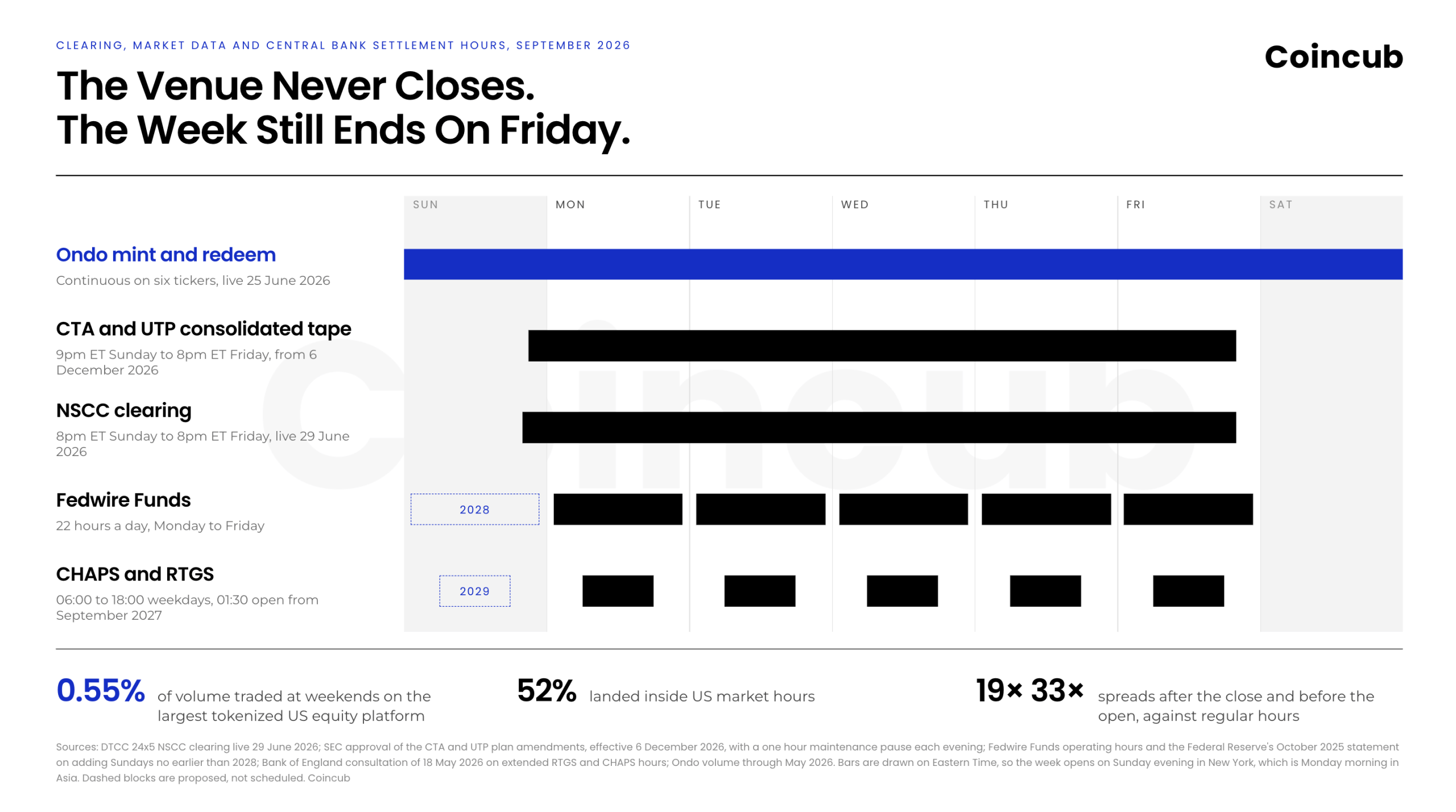
Clearing moved first. DTCC’s NSCC went live with 24×5 clearing on 29 June 2026, running from 8pm ET Sunday to 8pm ET Friday and applying its central counterparty guarantee to trades struck across that window. Note where the week starts. Sunday evening in New York is Monday morning in Asia, so the schedule extends the weekday and leaves the weekend alone.
Market data followed. The SEC approved amendments to the CTA and UTP plans on 7 July 2026. From 6 December 2026 the securities information processors run from 9pm ET Sunday through 8pm ET Friday. A maintenance pause sits between 8pm and 9pm each evening. That is 23 hours a day, five days a week, for the consolidated tape the whole US equity market prices against. 24X National Exchange opened in October 2025 as the first exchange approved for that schedule and has been trading a 4am to 8pm ET session while the rest of the market catches up.
Central bank money is the slow one. The Bank of England’s May 2026 consultation on extending RTGS and CHAPS settlement hours confirmed an 01:30 weekday opening from September 2027. Sunday and bank holiday settlement is proposed for no earlier than 2029, covering Good Friday, Easter Monday, the May and August holidays and Boxing Day, and leaving out Christmas Day, New Year’s Day and Easter Sunday. A 22-hour Sunday-to-Friday window is proposed for no earlier than 2031. The long-run target sits between 22×7 and 23.5×7 and has not been chosen. Britain has tied the two questions together openly. The same paper frames extended hours as support for stablecoin payments and for conditional settlement against external ledgers.
| Rail | Current or approved hours | Weekend coverage | Source date |
| NSCC clearing | 8pm ET Sunday to 8pm ET Friday | None | Live 29 June 2026 |
| CTA and UTP tape | 9pm ET Sunday to 8pm ET Friday | None | Live 6 December 2026 |
| DTC settlement of tokenized shares | T+1, unchanged | None | Approved 23 March 2026 |
| CHAPS and RTGS | 06:00 to 18:00, opening 01:30 from September 2027 | Proposed no earlier than 2029 | Consultation 18 May 2026 |
| Ondo mint and redeem | Continuous on six tickers | Yes | Live 25 June 2026 |
The deepest pools of regulated liquidity are heading for 23/5 and 24/5. The tokenization platforms are already at 24/7. Everything between those two numbers is a weekend with no central bank money behind it.
Two tokenization models and the hours each inherits
The SEC approved Nasdaq’s rule change on 23 March 2026, and the design is deliberately conservative. A tokenized share has to be fungible with its traditional counterpart, carry the same CUSIP and trading symbol, and confer the same rights. It trades on the same order book with the same execution priority, and it takes part in the opening and closing crosses like anything else. It settles at DTC on a T+1 basis under a depository pilot running since a no-action letter dated 11 December 2025, and only DTC eligible participants can hold it. Eligible names are Russell 1000 constituents and ETFs tracking major indices. If an order fails the eligibility test at execution, DTC settles it in traditional form and the wrapper simply falls away.
That model inherits the entire existing liquidity pool on day one and inherits the calendar with it. Nothing about a token wrapper moves the closing auction, the corporate actions calendar, or the T+1 cycle. The exchange rule also lives only as long as the depository pilot does.
The wrapper model makes the opposite trade. Ondo’s 24/7 minting and redemption, live from 25 June 2026, lets eligible users create or exit positions at the prevailing price at any hour, including weekends and holidays. It launched on six tickers covering SPY, QQQ, Circle, Nvidia, Tesla and Alphabet, after running 24/5 and pausing over the weekend in line with traditional markets. Those tokens answer to a transfer agent and a custodian rather than to DTC, which is what lets the clock run. They also start with no inherited order flow, and the weekend share of 0.55% is what that looks like in practice.
Anyone building for continuous markets is choosing which problem to keep. Take the fungible route and the liquidity is free while the hours stay fixed. Take the wrapper route and the hours are free while the liquidity has to be bought, quoted, and defended by somebody willing to hold inventory through a Saturday.
ICE’s design sits between the two. It keeps an exchange matching engine and exchange rules, and it pushes settlement and custody onto chains with bank-issued tokenized deposits underneath. That combination is still waiting on a regulatory approval.
Market making and hedging outside regular hours
A firm quoting a tokenized Nvidia position at 11pm on a Saturday has no open cash equity market to hedge into and no listed options market either. Index futures do not help with single-name exposure, and they are closed for most of the weekend regardless. The position sits unhedged until the underlying reopens, or the quote gets wide enough to pay for the risk of carrying it. Spreads nineteen and thirty-three times wider than daytime spreads are what that pricing looks like when it is written down.
This explains why every regulated version of the idea starts with a money market fund. Its NAV barely moves, and the manager stands behind subscription and redemption at that price. A market maker quoting it overnight runs a small basis position against a slow anchor, with weekend inventory risk measured in basis points. A single-name equity token has no NAV, no manager on the other side, and no anchor once the exchange closes.
Financing is the second half of the problem. A continuous book with atomic settlement holds cash against every open position at all times, since there is no overnight netting run to collapse the gross into a net. The cash has to be a settlement asset the venue accepts, which means a stablecoin or a tokenized deposit. Both carry an issuer, a reserve policy, and a redemption process of their own, and the market maker takes that exposure for as long as the position is open.
Stack those together and the weekend book has three costs the weekday book does not. No hedge, prefunded inventory, and a settlement asset with its own credit profile. The 0.55% figure is the market pricing all three and deciding to wait for Monday.
Hong Kong’s conditions for an off-hours session
The Securities and Futures Commission issued a circular on 20 April 2026 permitting secondary trading of tokenized authorized investment products through auto-matching on licensed virtual asset trading platforms. SFC chief executive Julia Leung described the effect plainly, saying the initiative lets a traditional securities product trade “in the evening and on weekends,” supported by regulated stablecoins and tokenized deposits “to facilitate round-the-clock liquidity.” The first products in scope are tokenized money market funds, and the base is small. Thirteen such vehicles were publicly offered in the city as of March 2026, holding around HK$10.7 billion across their tokenized share classes.
The conditions describe the regulator’s model of an off-hours session. Platforms have to run a price deviation alert that warns investors when the execution price moves significantly away from real-time or near real-time indicative NAV. They need automated pre-trade and regular post-trade monitoring to prevent excessive price swings. Fund managers have to use best endeavors to appoint at least one market maker, and termination of that appointment needs at least three months’ notice. Investors have to be told they can still subscribe or redeem at NAV in the primary market.
That is a rulebook written for thin liquidity. An anchor price that does not depend on an open exchange, a quoting obligation with notice periods attached, and a primary-market escape hatch when the secondary book fails. The three-month notice provision is the part with teeth, since it stops a market maker from stepping away the week volatility arrives.
The settlement asset is the piece still under construction. The Hong Kong Monetary Authority granted its first two stablecoin issuer licenses on 10 April 2026, to Anchorpoint Financial and HSBC. Both licensees have pointed at the second half of 2026 for the launch of their Hong Kong dollar stablecoins. The framework that names regulated stablecoins as the weekend cash leg arrived ten days after the first licenses to issue them.
Operational gaps in off-hours trading
Corporate actions are the unglamorous blocker. IOSCO found that the majority of venues offering extended hours do not have frameworks for managing corporate actions during those sessions. A stock split, a dividend record date, or a halt pending news has a defined process inside the trading day and an improvised one outside it. Tokenized wrappers inherit that gap and add a second ledger to reconcile against the register.
Staffing is a real cost and gets discussed less than the technology. Eleven venues told IOSCO they face significant difficulty securing and retaining skilled staff for irregular hours. Surveillance carries the same problem, with thinner books making manipulation easier to attempt and cross-market patterns harder to see when only one leg of the market is open. Back and middle office capacity shows up in the same survey as a constraint on how far venues are willing to extend.
Then there is the price itself. When the primary market is closed, a tokenized asset’s reference price comes from an oracle, a market maker’s book, or a fund’s indicative NAV. Some venues fall back on the previous closing price to damp disorderly moves. Every one of those choices imports a dependency that did not exist during the trading day, and the off-hour return reversals in the academic data are the visible edge of it.
An exchange stops trading by operator action, and a licensed platform running auto-matching can do the same. A token circulating on a permissionless venue has no operator to make that call, so the pause has to be written into the contract before anyone needs it. Hong Kong sidesteps this by keeping the session on licensed platforms with the pre-trade and post-trade controls its circular requires. Designs that let the same token trade anywhere inherit the harder version of the problem.
The evidence splits on the demand question, and honest forecasting should say so. Retail flow into extended sessions has grown steadily on both conventional venues and tokenized ones. Institutions have not followed, and IOSCO’s venue survey attributes that to liquidity. Whether deep weekend liquidity arrives because someone finally built the funding rails, or whether the rails stay half-built because weekend liquidity never justified the capital, is not a question the current data answers.
What the data does answer is where the bottleneck sits today. The chains work. The clearing house runs five days a week, and the tape will run twenty-three hours a day from December. The settlement asset that works on a Saturday is a stablecoin issued under a license granted this year, or a tokenized deposit at a bank still building the product. Until those line up, 24/7 tokenized asset trading describes an open venue with very little in it.
Frequently Asked Questions (FAQ)
Can tokenized assets really trade 24/7 today? +
Some can. Ondo has offered continuous minting and redemption on a small set of tokenized US equity and ETF tokens since June 2026, and Hong Kong permits evening and weekend secondary trading of tokenized authorized funds on licensed platforms. Tokenized shares approved for trading on Nasdaq settle at DTC on a T+1 basis and trade in the exchange's normal sessions.
What stops regulated exchanges from running 24/7? +
The cash leg and the post-trade calendar both stop short of a full week. Central counterparty clearing in the US now runs 24 hours a day, five days a week, and central bank settlement in Britain is not scheduled to cover Sundays before 2029. Corporate actions processing, market maker staffing, and surveillance coverage are all built around a defined trading day.
Does tokenization make settlement faster? +
It can, and it depends on the model. Atomic on-chain settlement moves the asset and the payment in one transaction with no lag. Tokenized shares that stay fungible with ordinary shares keep the T+1 cycle of the depository that settles them.
What does atomic settlement cost? +
It removes multilateral netting. A clearing house nets a day of trades and moves a fraction of the gross value, while atomic settlement requires the full amount prefunded at execution. Continuous trading means continuous prefunding, which ties up working capital that netting used to free.
How much tokenized equity trading happens on weekends? +
Weekend trading was 0.55% of volume on the largest tokenized US equity platform through May 2026. About 52% fell inside US market hours, and the rest spread across pre-market, post-market, and overnight sessions on weekdays. The pattern holds across conventional venues offering extended sessions, where pre-market and post-market trading each account for roughly 1% to 2% of daily volume.
Why are off-hours spreads so much wider? +
A market maker quoting a single-name equity token overnight cannot hedge in the cash market or the listed options market, so the inventory sits unhedged until the underlying reopens. One US venue measured spreads nineteen times wider after the close and thirty-three times wider before the open.
Do tokenized stock prices hold up when the primary market is closed? +
They hold up broadly, with more slippage. Academic work on tokenized stocks found prices track the underlying closely during regular hours, deviate modestly off-hours, and show short-horizon reversals when only one venue is open. Weekend price moves anticipated the next Monday open instead of overshooting it.
Which regulator has gone furthest on round-the-clock tokenized trading? +
Hong Kong has gone furthest. Its April 2026 framework permits evening and weekend trading of tokenized authorized products and attaches conditions for those sessions, including indicative NAV deviation alerts and an obligation on fund managers to seek a market maker. It starts with money market funds, whose NAV gives the session a price anchor that survives a closed exchange.
What should a firm building for 24/7 markets solve first? +
The settlement asset comes first. A venue that cannot move regulated cash on a Saturday cannot settle a Saturday trade, whatever the ledger does. That points at a licensed stablecoin issuer or a tokenized deposit program at a bank, and both are still scarce. Hedging capacity is the second item, since a quote with no way to lay off risk gets priced like one.