



 Buy a Licensed Company
  Explore VASP Data
  Talk to an Expert

 Dren Hima
 is Head of Research at Coincub, leading research across digital asset regulation, licensing, market structure, tokenization and institutional adoption.
Dren Hima
Dren Hima is Head of Research at Coincub, leading research across digital asset regulation, licensing, market structure, tokenization and institutional adoption.
Money Transmitter License Cost by State: The Fee Is Never the Cost

- The model law says a license “is not transferable or assignable,” which is why an equity purchase preserves the licensed entity and an asset purchase leaves the buyer applying from scratch, and the MTMA contains no merger or succession provision at all, so a deal in which the licensee stops existing has no statutory answer.
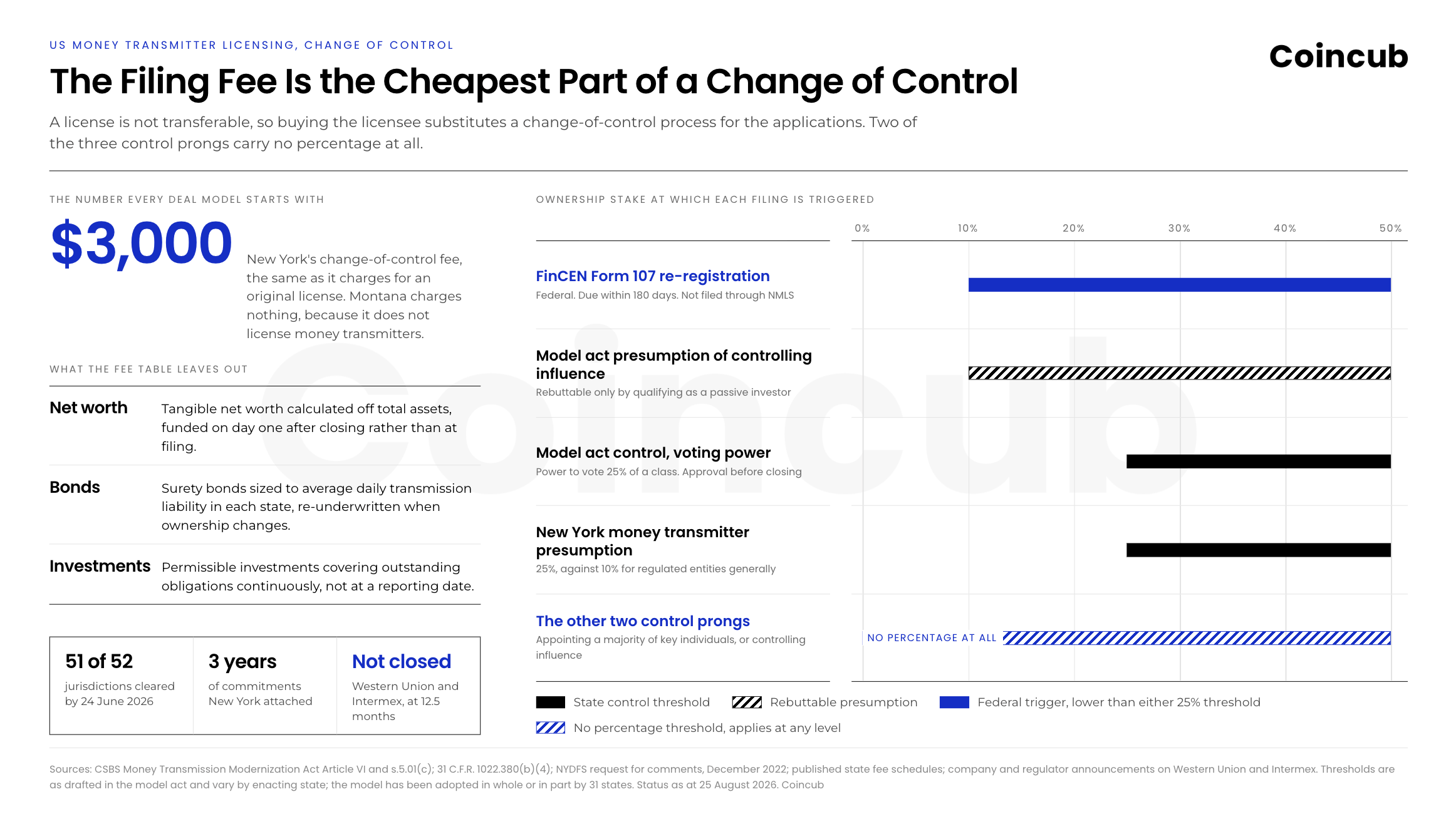
- Control turns on governance rights rather than cap-table arithmetic, since 25% of the vote, the power to appoint a majority of key individuals, or a “controlling influence” each trigger it independently, and a 10% stake is presumptively controlling unless the holder attests to passivity.
- The streamlined acquisition route converts a 60-day application into a 30-day deemed-approval notice for an already-vetted acquirer, but “well managed” is never defined anywhere in the model and Texas narrowed the lane to transactions where both parties already hold a Texas license.
- FinCEN re-registration is triggered by a transfer of more than 10% of voting power or equity, which is lower than the model’s 25% control threshold and lower than New York’s own money transmitter presumption, and it does not run through NMLS, so it will not show on the state approval tracker.
- Western Union had approval or non-objection from 51 of 52 US jurisdictions on Intermex by June 2026 and still had not closed in August, after New York attached three years of behavioral commitments and California suspended an approval it had already granted.
Western Union has spent more than a year buying a company that 51 out of 52 US jurisdictions already cleared it to buy. It agreed to acquire International Money Express on 10 August 2025 at $16.00 a share, and by 24 June 2026 money transmission regulators in 51 applicable U.S. states and territories had approved the deal or declined to object, with a single state still pending. That state was New York, where the sitting mayor had written to the Department of Financial Services in April urging it to reject the application for control of Intermex’s money transmitter license outright.
New York cleared it on 13 August 2026, and the price was an Assurance of Discontinuance with the Attorney General plus three years of behavioral commitments covering a retail footprint in the state, continued remittance service to the relevant Latin American and Caribbean corridors, limits on price changes in those corridors, periodic reporting to DFS, and a requirement to obtain prior approval from the NYDFS of certain types of acquisitions going forward. On the same day, California’s Department of Financial Protection and Innovation suspended an approval extension it had granted two weeks earlier, saying it wanted to look again at a transaction it had first consented to roughly six months before. As of 24 August 2026 the deal has not closed.
The economic case for buying a licensed entity exists, because the buyer preserves an existing legal person, its NMLS record, its bonds and its licensing history instead of filing fifty-odd de novo applications. What the buyer substitutes in is a differently shaped regulatory process rather than a smaller one, running through the same supervisors, on their calendar, with leverage that a new applicant never has to face. A greenfield applicant negotiates over whether it qualifies. An acquirer negotiates over what the state can extract while it holds the deal.

The license does not move, and nobody wrote down what happens if the licensee disappears
Everything downstream follows from one sentence in the model law, Section 5.01(c) of the CSBS Money Transmission Modernization Act, which says a license “is not transferable or assignable” and is why an equity purchase and an asset purchase produce opposite outcomes from identical commercial logic. Buy the shares and the licensed person continues to exist, holding everything it held the day before, subject to whoever now controls it. Buy the assets and the licenses stay with a seller you no longer care about, leaving the buyer to run the full application cycle it thought it had bought its way out of.
Statutory mergers are where this gets genuinely uncomfortable, because corporate law vests assets and liabilities in the survivor by operation of law and practitioners reason from that habit. The MTMA does not address the situation at all. Reading the model act section by section, there is no merger provision, no succession provision, and no language contemplating a surviving entity. The words merger, successor and surviving entity do not appear anywhere in it, and the same gap sits in the enacted Texas and Minnesota versions. Article VI governs who may come to control a licensee and Section 5.01(c) says the license cannot move, but nothing in between tells you what happens when the licensee itself stops existing, so the outcome falls to whatever the relevant state banking department decides, one department at a time, and the only safe structure is one where the licensed target survives closing untouched until every regulator has accepted the post-closing chart in writing.
Cap-table arithmetic does not answer the control question
The MTMA defines control across three prongs, and the one people plan around is the least useful of them. The power to vote 25% of a class triggers it, and so does the power to elect or appoint a majority of key individuals, and so does the power “to exercise, directly or indirectly, a controlling influence over the management or policies of a licensee.” A 10% stake creates a rebuttable presumption that the holder falls inside that third prong, rebuttable only by qualifying as a passive investor, which requires the holder to have no power to appoint a majority, no managerial role, no controlling influence, and to attest to all three in a form the commissioner prescribes or commit to them in writing. Those thresholds are also aggregated across immediate family, including in-laws and anyone sharing the person’s home, which quietly ends a category of founder-adjacent structuring.
So a minority stake papered at 9.9% or 24.9% answers nothing on its own, because the veto rights, board seats, information rights and consent thresholds that make a minority investment worth doing are the exact facts the controlling-influence prong is written to catch. The model gives a way out that deal teams underuse, since under Section 6.01(m) a person may ask the commissioner in writing, before filing anything, for a determination on whether the proposed transaction would make it a person in control, and a negative determination takes the transaction outside the approval requirement entirely.
A short list of transactions sits outside the approval requirement by operation of the statute, and it is more useful than it looks. Section 6.01(j) exempts proxies solicited for a single shareholder meeting, acquisitions by devise or descent, acquisitions by a personal representative or court-appointed officer, public offerings, acquisitions by a federally insured depository or other institution covered by the licensing exemption, transactions the commissioner determines are outside the requirement on public-interest grounds, and internal reorganizations where the ultimate person in control stays the same. Most of those still carry a post-closing notice obligation within fifteen days under Section 6.01(k), and the two that do not (proxies and public-interest determinations) are the two nobody structures around. Holdco insertions and fund-level reshuffles are the everyday use, and the exemption turns on ultimate control staying put, which is a question about the top of the chart rather than the entity being inserted.
New York runs a different set of numbers, which is worth knowing before anyone builds a national assumption. DFS said in a December 2022 request for public comments that its presumption of control sits at 10% for regulated entities generally but at 25% for licensed money transmitters, and asked whether that should change. It does not appear to have been finalized, so the higher threshold still governs, and a sponsor can hold a stake in a New York-licensed transmitter that would presumptively be control almost anywhere else.
The streamlined lane is the only real discount, and it is narrower than it reads
Section 6.01(l) is the provision a serial acquirer should be underwriting to, because it converts a 60-day application into a 30-day notice. The conventional route gives the commissioner 60 days from the date an application is deemed complete to approve or deny, with the application approved by operation of law if the deadline passes, subject to a good-cause extension with no stated outer limit. The streamlined route applies to an acquirer that is already approved to engage in money transmission under the act, or that was identified as a person in control in a prior application approved by the commissioner or by an accredited state through a multistate process, and its notice is deemed approved if not disapproved within 30 days.
The second gateway is the commercially useful one, since it lets a sponsor or holdco that has been vetted as a control person somewhere use the fast lane without ever having held a license itself. But the conditions are real and several of them sit outside the acquirer’s control, since the model requires no license revocation or suspension in the previous five years, the target and (where relevant) the acquirer projected to meet net worth, bond and permissible-investment requirements after closing, no material changes to the target’s business plan as a result of the acquisition, and, where the acquirer is a licensee, a “well managed” designation with at least a satisfactory compliance rating at its most recent examination by an accredited state.
Well managed is never defined. It does not appear in the definitions article of the model or in the enacted Texas version, which leaves the single condition an acquirer cannot self-assess sitting in the fastest lane of the statute as unpapered discretion. And the lane narrows further state by state, since Texas conditions its streamlined process on the person to be acquired and the person acquiring control both being money transmission licensees, which read literally closes off the prior-control-person route that a non-licensee sponsor would use.
Outside the MTMA states there are five separate procedural models in circulation, and Goodwin’s Mike Whalen sorted them in a 2023 note on change-of-control filings into prior approval before closing, advance notice with no approval requirement, advance notice where the regulator may then demand approval before closing, post-closing notice, and post-closing notice where the regulator may demand approval after the fact. Nobody publishes a count of which states sit in which bucket, and the absence of that tally is itself informative, because it means the sequencing question of what can close before which filing clears has to be answered jurisdiction by jurisdiction against enacted text. Whalen’s practical read is that clean filings often clear in 30 to 60 days, which describes the median well and says nothing useful about the deals that stall.
The federal filing that sits outside NMLS
State approval says nothing about the accuracy of the federal registration, and the trigger is lower than most state thresholds. Under 31 C.F.R. § 1022.380(b)(4), an MSB must re-register with FinCEN following a transfer of more than 10% of the voting power or equity interests of the business, unless it is one that reports such transfers to the SEC, and separately following any change in ownership or control that requires re-registration under state law, and following a more than 50% increase in its number of agents during a registration period. Form 107 is due not later than 180 days after the change, and the calendar year of the triggering event becomes year one of a fresh two-year registration period.
Three things fall out of that for a transaction. The 10% federal trigger is lower than the 25% control threshold in the model act and lower than New York’s own money transmitter presumption, so a deal can clear every state without a control application and still require a federal re-registration. The agent-count trigger catches consolidations that nobody thinks of as ownership events, which is exactly the profile of a deal that merges two authorized-delegate networks. And none of this runs through NMLS, so it will not appear on the state-by-state approval tracker that the deal team is watching.
The fee table is the wrong number
Money transmitter license cost by state is the question every deal model starts with and the one that explains the least. New York charges $3,000 for an original money transmitter license under Banking Law 641.3 and $3,000 for a change of control under 652-a.1, which is the state saying in its own fee schedule that it does not regard the acquisition as the cheaper transaction. New Mexico publishes $2,000 for an original license and $2,000 for a change of control, with renewals at half that. Louisiana, which only began licensing transmitters on 1 July 2026, charges $1,500 for a change of control. Idaho’s application fee is $100. Montana charges nothing at all, because its Division of Banking and Financial Institutions states flatly that Montana does not regulate money transmitters, while warning that other Montana licenses may still bite depending on what the business does.
Filing fees are the smallest line in the model and they constrain nothing. The binding items are tangible net worth calculated off total assets, surety bonds sized to average daily transmission liability in each state, and permissible investments that have to cover outstanding obligations continuously rather than at a reporting date. Those are balance-sheet commitments the buyer funds on day one after closing, and they scale with the business rather than with the number of jurisdictions, which is how an acquisition that saves a five-figure sum on filings can demand a capital injection several orders of magnitude larger.
The planning ranges circulating in this market (roughly $250,000 to $350,000 of first-year direct cost for a broad US footprint and $225,000 to $280,000 recurring) are modeled from public sources and practitioner information rather than published by any regulator, and they exclude internal labor, counsel, AML build and examination invoices. They are fine as an order-of-magnitude sanity check and useless as a line item, and any state-level fee table that shows a single tidy number for every jurisdiction is reporting an estimate with the hedging stripped out.
You are buying the examination file
The cost that sinks these deals is the one the seller has already incurred. Sigue Corporation is the reference case, and it is worth reading the interim consent order rather than the summaries. Sigue represented that it had failed to maintain adequate net worth or tangible net worth to remain qualified to be licensed and had failed to maintain permissible investments sufficient to cover roughly $4.9 million of outstanding transmission liabilities across the participating states, plus whatever was outstanding in New York, with no unencumbered tangible assets available to satisfy them and no belief that it would have any in future. Forty-plus jurisdictions signed, and the first operational demand in the order was for Sigue to hand over executed declarations to every regulator that wanted to file a bond claim, within ten calendar days.
Acquired books carry their own history. FinCEN assessed a $390 million civil money penalty against Capital One in January 2021 over a check-cashing business the bank stood up after acquiring several regional banks, and while the failure was the acquirer’s own post-closing supervision rather than the sellers’ conduct, that distinction is cold comfort in diligence, because the acquirer inherited a customer base whose risk it had not underwritten and then owned the consequences for six years. Running the other direction, the Federal Reserve suspended consideration of M&T Bank’s acquisition of Hudson City Bancorp over weaknesses in M&T’s own BSA/AML program, kept the application alive across three years of merger-agreement extensions, and then said in the approving order that it did not expect to do that again and would prefer applicants withdraw pending resolution of supervisory concerns.
No FinCEN administrative ruling or enforcement action squarely addresses a successor’s responsibility for a predecessor’s AML program, so the allocation of pre-closing AML exposure in a money transmitter deal is a matter of contract, escrow and state examination practice rather than settled federal guidance. Diligence has to reach transaction-level sampling, prior examination reports, SAR and CTR testing and delegate concentration, because none of that is discoverable from the NMLS record and all of it survives closing.
Exemptions do not survive the funds flow
A target operating without a license because it claims an exemption is selling something that cannot be bought. Payroll processing shows the pattern clearly, because four states have now written a version of the same carve-out and the versions are not interchangeable. Iowa’s, enacted by House File 2262 and effective on approval on 10 April 2024, exempts an agent of a payor only where a written agreement directs the agent to provide the service, the payor holds the agent out to payees as doing so, and the payor’s obligation to the payee is not extinguished if the agent fails to remit. Maryland’s Chapter 21 of 2026 is close to word for word and takes effect 1 October 2026. Nevada’s AB 430 exempts a person engaged solely in providing payroll processing services, without those conditions, from 1 October 2025. Minnesota’s carve-out is a flat status exemption for a payroll processing services provider with no conditions attached at all.
Nebraska is the one to be careful with, because it is routinely grouped with the others and is a different animal. LB 717, effective 18 July 2026, exempts payroll processors that employ fewer than twenty full-time-equivalent staff on the service or serve fewer than fifty Nebraska-resident employees, with clean criminal and license-revocation history and no other money transmission activity in the state. It is a small-provider carve-out, so a target relying on it stops being exempt the moment an acquirer scales it, which is the opposite of what an acquirer is buying it to do.
California’s regulator put the constraint plainly in a 2018 opinion letter, holding that the payor’s obligation cannot be extinguished twice, so if payment to the platform satisfies the customer’s obligation to the merchant, payment to the next intermediary in the chain cannot also satisfy it. Post-closing integration is precisely what rearranges who receives funds and when the obligation discharges, which means the exemption has to be re-tested against the pro-forma funds flow rather than inherited from the seller’s legal memo.
Signing under one statute and closing under another
Thirty-one states have enacted the MTMA in whole or in part as of 26 February 2026, covering transmitters that account for 99% of reported money transmission activity, and the list keeps moving inside the window of an ordinary deal. Louisiana’s Money Transmission Act replaced a 1966 statute on 1 July 2026 and Virginia’s full adoption took effect the same day. Oklahoma’s runs from 1 November 2026 and Alaska’s from 1 July 2027, per the CSBS legislative updatecurrent to August 2026, with Delaware and Michigan still in the introduction column and Michigan’s two bills splitting on whether payroll processors are exempt.
A transaction signed in August 2026 with a twelve-month regulatory tail can therefore close under a control regime that did not exist at signing, in states where the threshold, the notice period and the availability of the streamlined route all changed underneath it. So run a legislative bring-down immediately before closing, alongside the usual representation about license status, and treat any fifty-state chart older than a quarter as a draft.
Pricing the three cases
De novo licensing costs new application fees, bond premiums and collateral, capitalization, implementation, and a lead time set by the slowest state in the intended footprint rather than the average one. Buying the licensee costs the premium attributable to licensing, change-of-control filings across every jurisdiction, control-person diligence, whatever the surety demands when it re-underwrites the new ownership, and the remediation the examination file has already earned. Operating through an exempt or partnered structure costs contractual dependency and concentration risk in place of licensing, and re-opens every state question the moment the funds flow changes.
Madison Dearborn’s purchase of MoneyGramran from February 2022 to June 2023, with the US money transmission approvals landing around the ten-month mark and the international ones taking the rest. Robinhood took just under twelve months to close Bitstamp. Western Union is past twelve and a half months on Intermex and counting. Against that, Ripple’s acquisition of Standard Custody, announced in February 2024 explicitly to add a trust charter and money transmitter licenses to its portfolio, closed in four months. The variable is the size of the retail footprint and the number of states with a consumer constituency to protect, so a narrow licensed target clears in a quarter and a national remittance network takes a year, whatever the two deals cost per license.
That leaves one question for a buyer looking at a licensed platform, because the premium is being paid to skip an application queue and the queue is the cheap part. What the acquirer takes on instead is the capital stack, the bond arrangements, the delegate network, the examination history and the remediation already priced into the target’s next exam cycle, plus a regulator that has just been handed the one moment in the licensee’s life when it has maximum leverage and a public record of using it.
Frequently Asked Questions (FAQ)
Does buying an already licensed money transmitter avoid state licensing? +
It avoids the de novo applications, not the regulators. The buyer substitutes change-of-control filings, background investigations and approvals across every jurisdiction the target is licensed in, and in states following the model act those approvals are conditions precedent rather than post-closing notices.
Can a money transmitter license be transferred in an asset sale? +
No. Section 5.01(c) of the CSBS model act states that a license is not transferable or assignable. The seller keeps the licensed entity, and the buyer needs its own authorizations before conducting regulated activity.
What happens to the license in a merger where the licensee does not survive? +
The model act does not say. There is no merger provision, no succession provision and no reference to a surviving entity anywhere in it, and the same gap appears in the enacted Texas and Minnesota versions, so the treatment is a state-by-state question for each banking department rather than a statutory one.
What stake triggers a change-of-control filing? +
Under the model, 25% of the voting shares or interests, plus the power to appoint a majority of key individuals, plus any controlling influence over management or policies, each independently. A 10% stake creates a rebuttable presumption of controlling influence, rebuttable by qualifying as a passive investor. New York sets its money transmitter presumption at 25% rather than the 10% it applies to most regulated entities.
How long does money transmitter change-of-control approval take? +
In model-act states the commissioner has 60 days from the completion date to approve or deny, with the application approved by operation of law if the deadline passes, subject to a good-cause extension with no stated outer limit. The streamlined notice route is deemed approved after 30 days. In practice, a narrow licensed target can close in a quarter, and a national retail remittance network has taken twelve to sixteen months in the recent record.
Does clearing every state also clear the federal position? +
No. An MSB must re-register with FinCEN following a transfer of more than 10% of the voting power or equity interests, following any state-law ownership change that requires re-registration, and following a more than 50% increase in agents during a registration period, with Form 107 due within 180 days of the change.
What does a money transmitter license cost by state? +
Filing fees are the least informative number in the model. New York charges $3,000 for an original license and $3,000 for a change of control, New Mexico $2,000 for each, Louisiana $1,500 for a change of control, Idaho $100 for an application, and Montana nothing at all because it does not license money transmitters. The binding costs are tangible net worth, surety bonds sized to average daily transmission liability, and permissible investments that must cover outstanding obligations continuously.
Can an acquirer rely on the target's payroll processing exemption? +
Only after re-testing it. Iowa and Maryland condition the exemption on a written agency agreement, holding out, and the payor's obligation surviving a failure to remit. Nevada and Minnesota impose no such conditions. Nebraska's is a small-provider carve-out limited by headcount, so it stops applying once an acquirer scales the business.









