Buy a Licensed Company
  Explore VASP Data
  Talk to an Expert


South Korea’s Crypto Tax Delay: When Does the Grace Period End?

- The multi-year grace period is officially scheduled to end on December 31, 2026. Unless political pressure forces a fourth 11th-hour delay, taxation on all virtual asset gains begins on January 1, 2027.
- Investors will be taxed at a total rate of 22% (comprising a 20% national income tax and a 2% local income tax) on annual gains that exceed the basic deduction threshold of 2.5 million won.
- While the tax applies to 2027 activity, you won’t write a check immediately. The first official tax filing and payment period for crypto gains is set for May 2028.
- The tax isn’t just triggered when you “cash out” to won. Trading one digital asset for another is considered a taxable event, making meticulous record-keeping of every swap essential for compliance.
- Despite ongoing noise from the ruling People Power Party about potentially scrapping the tax entirely, the Ministry of Economy and Finance has confirmed the 2027 start date is firm and is already building the reporting infrastructure with local exchanges.
The Deadline Crypto Investors Are Watching
South Korea’s crypto tax grace period is currently scheduled to end on December 31, 2026. Taxation on virtual asset gains will then begin on January 1, 2027. After years of postponements, the country’s Ministry of Economy and Finance has now confirmed that the 2027 start date is firm.
The question has shifted in tone. Investors no longer ask whether the tax will arrive. Instead, they ask whether it will survive last-minute political pressure before the deadline hits.
This issue matters for several reasons. South Korea hosts one of the world’s most active retail crypto markets, with roughly 13 million registered investors. The tax has been delayed three times already, each delay shaping investor expectations. The latest position points clearly to a 2027 rollout. However, lawmakers and industry groups continue to challenge the plan, which leaves a layer of uncertainty hanging over millions of traders.

Why Does South Korea Want to Tax Crypto?
South Korea’s government has long treated crypto gains as a form of taxable income. As digital assets moved from niche speculation into mainstream retail investing, the case for taxation grew stronger.
Crypto trading expanded rapidly across the country during the past several years. By the first half of 2025, verified users on local exchanges had reached around 10.77 million people, close to one fifth of the population. That scale changed the political conversation around digital assets.
Policymakers wanted tax consistency. Income from stocks, real estate, and other investments already faced taxation, so leaving crypto outside the system created an imbalance. Lawmakers also worried about fairness between everyday workers and traders earning large profits from digital assets.
The tax targets income from the sale, transfer, exchange, or lending of virtual assets. Authorities classify these gains as “other income” under the Income Tax Act. The broader goal extends beyond revenue collection. Regulators want to bring crypto fully into the regulated financial system, alongside traditional investment products.
This shift also reflects international momentum. South Korea recently signed the OECD’s Crypto-Asset Reporting Framework, which links 48 countries through automatic exchange of virtual asset transaction data starting in 2027.
How the Crypto Tax Is Supposed to Work
Before discussing the delay itself, readers need to understand what exactly is being delayed. The mechanics of the tax are relatively simple, although the application across different crypto activities remains complex. The tax applies an annual basic deduction of 2.5 million won. Anything earned above that threshold becomes taxable. The total rate sits at 22 percent, which combines a 20 percent national income tax with a 2 percent local income tax.
South Korean law classifies these gains as “other income” rather than capital gains. This category shapes how investors must report their earnings and how exchanges document transactions.
The tax applies to gains from selling, transferring, exchanging, or lending virtual assets. Trading one cryptocurrency for another also counts, not only conversions back into fiat currency. Investors must therefore track every taxable event throughout the year. The first expected filing period falls in May 2028. That filing will cover all taxable crypto income earned during 2027.
Here is a simple example. Suppose an investor records 10 million won in taxable crypto gains during 2027. The first 2.5 million won would fall under the annual exemption. The remaining 7.5 million won would face the 22 percent rate, producing a tax bill of 1.65 million won. Several activities still lack clear classification. Airdrops, staking rewards, mining income, hard forks, and DeFi earnings sit in a gray area. Regulators have not yet finalized how each category will be treated, which is one reason critics argue the framework remains unfinished.
Why Did South Korea’s Crypto Tax Get Delayed?
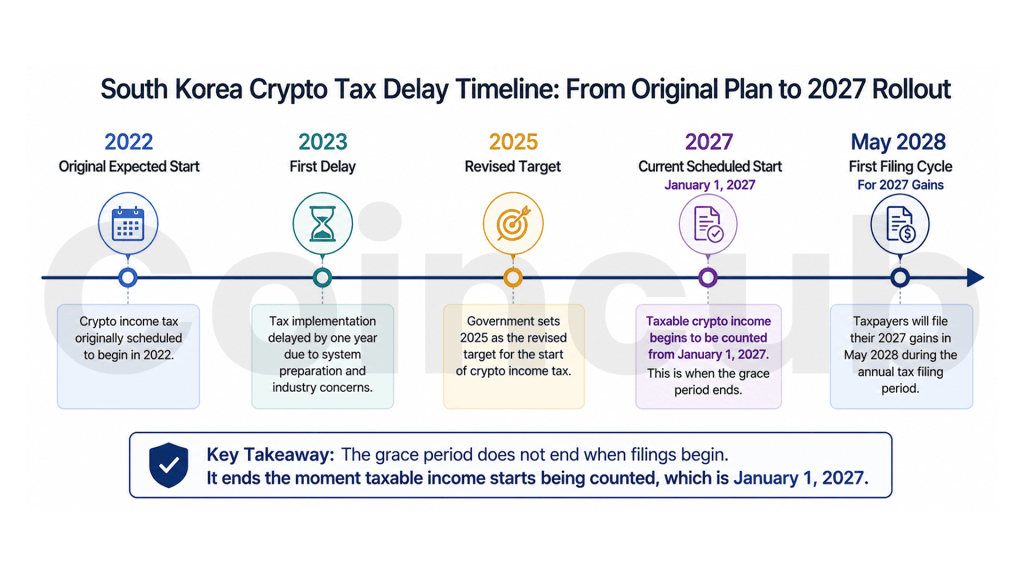
To understand the current 2027 deadline, you need to trace the path that brought South Korea here. The tax has moved across four different start dates since lawmakers first approved it in 2020.
| Period / Decision Point | Planned or Revised Start Date | What Happened | Why It Matters |
| Original policy direction | 2022 | Lawmakers passed the crypto tax law in 2020, with implementation set for 2022. | Established crypto income as a recognized tax category. |
| First major delay | 2023 | Regulators and exchanges argued they needed more time to build reporting systems. | Started the pattern of postponement that would repeat. |
| Second delay | 2025 | Implementation was pushed again amid political debate and investor pushback. | Showed how strongly the industry could lobby for delays. |
| Third delay | 2027 | Lawmakers agreed to a further two-year deferral in late 2024. | Sets the current grace period ending on December 31, 2026. |
| First filing cycle | May 2028 | Investors will report 2027 taxable crypto income. | Marks the moment the tax becomes visible to taxpayers. |
Each delay reflected a different political moment. The first postponements focused on technical readiness. Later delays became openly political, with parties using the issue to attract younger voters who trade crypto actively.
The 2024 decision proved especially notable. The ruling People Power Party originally pushed for a three-year delay until 2028. The Democratic Party initially opposed any further postponement before agreeing to the government’s two-year proposal. That compromise produced the current 2027 start date.
The Current Situation: Is the Delay Still Active?
Yes, the delay remains active. However, the government is now openly preparing for implementation rather than another postponement.
The grace period runs through December 31, 2026. Crypto income earned from January 1, 2027 onward will be taxable under the existing law. The first full reporting cycle will arrive in May 2028.
Moon Kyung-ho, director of the Finance Ministry’s income tax division, recently confirmed the schedule. Speaking at a parliamentary forum in early May 2026, he told attendees that the ministry would proceed with virtual asset taxation as scheduled. That statement marked the first direct public confirmation from the ministry since the latest delay was approved.
Tax authorities are also building the systems needed to support implementation. The National Tax Service has held working-level meetings with the country’s major exchanges: Dunamu (Upbit), Bithumb, Coinone, and a few others. These meetings aim to produce a draft notice for legislative review.
So, When Does the Grace Period End?
The grace period is scheduled to end on December 31, 2026, with taxable crypto income beginning on January 1, 2027.
Why the Delay Happened
The repeated postponements share several common causes. Some involve practical infrastructure problems. Others stem from political calculation and investor sentiment.
Regulators needed more time to create clear reporting systems. Tracking crypto activity across many exchanges and wallet types presents a much harder problem than tracking traditional brokerage accounts. The country’s tax authorities lacked the tools to verify gains accurately.
Exchanges also pushed for delays.
They argued they could not yet generate the transaction records needed for fair taxation. Cost basis calculations across multiple platforms proved especially difficult, since investors often move assets between exchanges and wallets. Investors and lawmakers raised fairness concerns too. Critics argued that crypto traders would face harsher treatment than stock investors, who currently enjoy generous tax exemptions in South Korea. That comparison fueled public opposition.
Cross-border activity created another problem. Many South Koreans trade on overseas exchanges or use DeFi protocols, which sit outside domestic regulatory visibility. Without international data sharing, the tax could fall mainly on investors using local platforms, while others avoided it entirely.
Policymakers also had to balance fairness with market competitiveness. They worried that an early tax launch would drive trading volume offshore, hurting local exchanges and reducing future tax revenue.
The delay was therefore both a political pause and a practical response. It reflected genuine doubts about whether South Korea had the infrastructure to enforce the tax fairly across all investor types.
Political Pushback: Could the Tax Be Delayed Again?
The 2027 date looks firm, but the political debate continues. Some lawmakers still argue for abolition or significant redesign of the framework.
The ruling People Power Party recently introduced a bill to scrap the planned 22 percent crypto tax entirely before the 2027 rollout. That effort signals ongoing political resistance, even as the Finance Ministry moves ahead with preparations. Whether the bill gains traction will depend heavily on parliamentary dynamics over the next year.
Critics raise several familiar points. They argue that crypto investors face less favorable treatment than stock investors. They also worry about capital flight, with traders potentially shifting funds to overseas platforms where gains are not taxed.
Industry analysts have warned that another delay remains possible. Kim Kab-lae, a senior researcher at the Korea Capital Market Institute, recently said that core deficiencies in the framework remain unresolved. He suggested that a fourth postponement could damage public trust in the tax system itself.
Supporters of the tax counter these arguments. They point out that crypto profits should be taxed like other forms of income, especially as the asset class grows in scale. They also note that infinite delays would undermine the credibility of the entire tax framework.
The most accurate framing sits between these views. The law points clearly to a 2027 start, and the ministry is actively preparing. However, political risk has not disappeared. Investors should not plan around another delay as their base-case scenario.
What Investors Should Prepare Before 2027
The smart move now is practical preparation rather than waiting for political clarity. Investors who get organized early will face far less stress when the first filing arrives in May 2028.
Start by keeping detailed records. Purchase prices, sale prices, transaction dates, fees, and wallet transfers all matter. Without accurate cost basis data, calculating taxable gains becomes extremely difficult.
Download transaction histories from every exchange you use. Accounts sometimes close, data sometimes becomes harder to retrieve, and platforms occasionally change their reporting tools. Securing historical data now protects you from future gaps.
Track crypto-to-crypto trades carefully. Many investors focus only on conversions back into Korean won, but trades between different cryptocurrencies count as taxable events too. Missing these records can create problems later.
Watch for further guidance on staking, lending, airdrops, NFTs, and DeFi income. These categories still lack full clarity. The National Tax Service may issue more detailed rules before 2027, and investors should follow those updates closely.
Pay attention to cost basis treatment for assets held before January 1, 2027. Special rules may apply to legacy holdings, which could affect how gains are calculated once the tax begins.
Consider professional tax advice if you trade across multiple exchanges or use complex strategies. The combination of overseas platforms, DeFi activity, and varied income types makes self-reporting harder than it looks. None of this counts as financial advice, but good record-keeping always pays off.
What the Delay Means for Exchanges and the Crypto Market in South Korea
The delay shapes behavior across the entire South Korean crypto market. Exchanges, investors, and service providers all face shifting incentives as 2027 approaches.
Domestic exchanges must strengthen their tax-reporting tools. They will play a direct role in providing transaction records, lending income data, and other reportable activity. Building these systems takes time and investment.
Investors will demand better downloadable tax reports from their platforms. Exchanges that deliver clean, accurate records will attract more users. Those with weak reporting tools may lose customers ahead of the deadline.
Tax software providers may see increased demand too. South Korea’s market is large enough to support specialized crypto tax tools, especially given the complexity of multi-exchange trading and DeFi activity.
Trading behavior could shift before the 2027 start date. Some investors may realize gains during 2026 to lock in tax-free profits while the grace period still applies. Others may reduce activity due to the added complexity of future reporting obligations.
A small group of traders may also shift funds to overseas exchanges. However, the OECD’s Crypto-Asset Reporting Framework will limit how effective that strategy can be from 2027 onward. International data sharing will give Korean authorities much better visibility into offshore trading.
The Grace Period Has an End Date, For Now
South Korea’s crypto tax grace period is scheduled to end on December 31, 2026. Taxable crypto income will begin on January 1, 2027, and the first filing will arrive in May 2028 for income earned during that year.
The Finance Ministry has now publicly confirmed the 2027 start date, signaling that preparations are moving ahead. Political pushback continues, and another delay cannot be ruled out completely. However, investors who plan around the announced timeline will be better positioned than those who hope for further postponement.
For now, South Korea’s crypto tax delay gives investors time, but not an indefinite exemption.
Frequently Asked Questions (FAQs)
Is cryptocurrency allowed in South Korea?
Yes, cryptocurrency is fully legal and strictly regulated in South Korea. The government enforces comprehensive consumer protection and anti-money laundering laws, requiring all virtual asset service providers to register with financial authorities. Furthermore, under the 2026 Economic Growth Strategy, South Korea recently lifted its nine-year ban on corporate crypto investments and is actively regulating stablecoins and crypto ETFs.
Is there tax on crypto in Korea?
Yes, South Korea has a 22% tax on cryptocurrency gains, but it is not currently active. The tax applies to annual virtual asset income exceeding 2.5 million won (roughly $1,750). After facing significant political pushback and multiple postponements, the official implementation date is currently scheduled for January 1, 2027, meaning the first tax filings will occur in May 2028.
Is Korea tax-free for foreigners?
No, South Korea is not tax-free for foreigners, as non-residents and expatriates must pay income tax on Korean-sourced earnings. However, South Korea offers a highly favorable tax concession: eligible foreign workers can elect to pay a flat income tax rate of 19% (20.9% when including local taxes) on their employment income for up to 20 years, rather than the standard progressive tax rates that reach up to 45%.