


 Buy a Licensed Company
  Explore VASP Data
  Talk to an Expert

 Atis Shala
Atis is a senior analyst and community lead with four years of experience in crypto. He has a bachelor from the Rochester Institute of Technology.
Atis Shala
Atis is a senior analyst and community lead with four years of experience in crypto. He has a bachelor from the Rochester Institute of Technology.
Portugal’s New Tax Rules: Is the Crypto Honeymoon Over?
- Long-term investors who hold their cryptocurrency for more than a year before selling for fiat currency generally still enjoy a 0% tax rate on their capital gains.
- Unlike many other jurisdictions, Portugal does not treat crypto-to-crypto trades as taxable events; taxes are deferred until you eventually cash out to fiat or use crypto to pay for goods and services.
- If you sell crypto held for less than 365 days or earn passive income through staking and lending, you should expect to pay a flat tax rate of 28%.
- High-volume professional traders and miners face much steeper progressive tax rates that can climb as high as 53%, though they are permitted to deduct business-related expenses.
- Even if your gains qualify for the 0% exemption, you are now legally required to report these transactions on your annual tax return (Modelo 3); the no rules era has officially ended.
The End of an Era or Just a Reality Check?
For years, Portugal held an almost mythical status in the crypto community. Investors traded stories about it the way surfers trade stories about a perfect break. It was the place where you could cash out a life-changing Bitcoin position and owe the tax authority nothing at all. That reputation drew thousands of people to Lisbon, Porto, and Madeira, and it made Portugal shorthand for “European crypto paradise.”
Then the 2023 State Budget changed the script. Portugal introduced a dedicated tax regime for crypto assets, and the zero-tax era quietly closed. By 2026, those rules have settled into something stable and predictable rather than experimental. The shock has worn off, and a clearer picture has taken its place.
Here is the thesis worth holding onto: the Wild West honeymoon might be over, but Portugal remains one of the most structurally advantageous countries in Europe for crypto investors, provided they understand the rules. The advantages did not vanish. They simply come with conditions now.

The Golden Era: When Portugal Was a Tax-Free Haven
To understand why people felt let down, you have to understand how good things once were. Before 2023, Portuguese tax law simply had no category for cryptocurrency. The Portuguese Tax Authority, known as the AT, did not treat crypto as currency, and it did not treat crypto as a financial asset either. It fell through the cracks of the system entirely.
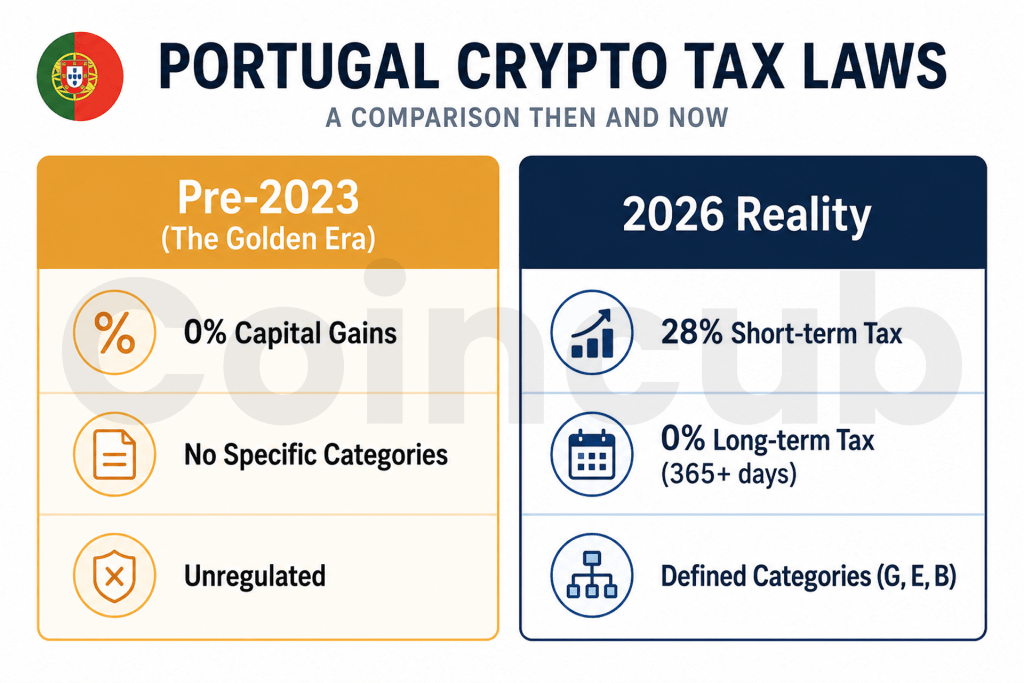
That gap had a striking consequence. Because crypto gains did not fit any established income category, individuals paid 0% tax on them. You could buy Bitcoin, hold it for a month, sell it for a substantial profit, and owe nothing. No capital gains tax, no income tax, nothing. The absence of a rule became the rule.
Word spread quickly, and the effect was dramatic. Digital nomads, Web3 developers, and early Bitcoin adopters began arriving in waves. Lisbon turned into a genuine hub for blockchain conferences and startups. Porto attracted remote workers who wanted a lower cost of living without sacrificing infrastructure. Madeira went further still and began cultivating its own crypto-friendly community, complete with a much-publicized Bitcoin beach project.
For a few years, the arrangement felt almost too good to last. As it turned out, it was. A regulatory vacuum tends to attract attention, and eventually it attracts legislation. Portugal was never going to remain an unregulated island forever, especially inside the European Union.
Understanding the Current Legislation in Portugal
So why did Portugal change course? The answer comes down to alignment and clarity. As crypto adoption grew, sitting on an unregulated regime became increasingly awkward for an EU member state. The European Union was moving toward standardized frameworks, and Portugal needed its tax treatment to fit that direction. Regulators also wanted clarity for its own sake, because a vague system creates disputes, uneven enforcement, and uncertainty for honest taxpayers.
The 2023 State Budget delivered that clarity. Rather than taxing all crypto activity in one blunt way, the new law sorts crypto income into specific buckets under the Personal Income Tax Code. Three categories carry most of the weight: Category G for capital gains, Category E for passive capital income, and Category B for professional or business activity. Each bucket has its own logic and its own rate, and figuring out which one applies to you is the central task of crypto tax planning in Portugal.
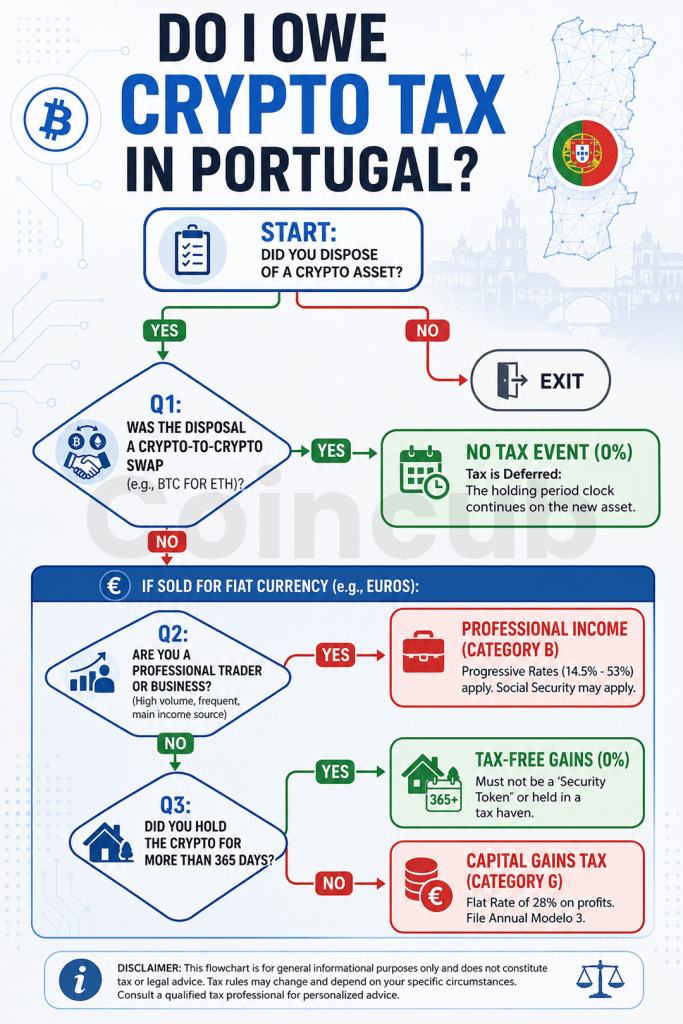
Now for the silver lining, and it is a significant one. Crypto-to-crypto transactions remain largely outside the tax net. When you swap one token for another, Portugal generally does not treat that as a taxable moment. Instead, the original cost basis carries over to the new asset, and tax is deferred until you eventually cash out to fiat or spend the crypto. For active DeFi users who move between tokens constantly, this is a major structural advantage. You are not triggering a tax bill every time you rebalance a position.
That single feature does a lot of work in keeping Portugal competitive. Many countries tax every swap, which turns active portfolio management into an accounting nightmare. Portugal, by contrast, lets the activity happen and waits for the exit.
Breaking Down the Tax Categories (The Core Guide)
This is the heart of the system, so it deserves the most attention. Three categories determine almost every outcome, and the differences between them are large. Getting your activity classified correctly is the difference between owing nothing and owing a substantial share of your gains.
Category G: Capital Gains and the 365-Day Rule
For the casual investor, Category G is the one that matters most, and one number governs it: 365 days. If you sell crypto for fiat after holding it for less than a year, the gain is taxed at a flat 28%. This is the rule that ended the honeymoon, and it applies to most retail investors who realize profits within a one-year window.
The exemption, however, is where Portugal still shines. If you hold a crypto asset for 365 days or more before selling it for fiat, the capital gain is generally tax-free. Not reduced, but exempt. Very few countries in the Western world offer anything comparable. The United States, Canada, and Australia all tax long-term crypto gains, so a genuine long-term holder can still pay 0% in Portugal, which keeps the country firmly on the map.
That exemption comes with conditions worth knowing. It does not apply to tokens classified as securities, which follow the rules for financial instruments instead. It also does not apply when the counterparty or wallet provider sits in a jurisdiction on Portugal’s tax “blocklist,” or when the holder is a tax resident outside the EU, the European Economic Area, or a country with a tax-information-sharing agreement with Portugal. For most ordinary residents holding mainstream crypto on mainstream platforms, though, the long-term exemption holds.
One subtle point trips people up constantly. The taxable event is the sale of crypto for fiat on the exchange, not the moment you withdraw euros to your bank account. Many investors assume they are safe until the money hits their bank, and that assumption is wrong.
Category E: Capital Income from Staking and Yield
Passive income follows a different path. When you earn staking rewards, lending interest, or returns from liquidity pooling, that income generally falls under Category E. The rate is a flat 28%, applied when the income is converted to fiat.
The classification here is less tidy than it sounds. Staking and yield products vary enormously in how they are structured, and the tax treatment can depend on those details. Some arrangements get interpreted under Category E as capital income, while others may be pulled into Category B if the activity looks organized and business-like. For genuine grey areas, the safer move is to rely on the platform’s own documentation and a written opinion from a Portuguese tax adviser, rather than guessing. The headline, though, is straightforward: passive crypto yield is taxed, and 28% is the rate to expect.
Category B: Self-Employment and Professional Activity
Category B is where things get serious, and where casual investors least want to land. This category covers people whose crypto activity rises to the level of a profession or business: high-volume traders, miners with dedicated facilities, validators, and anyone offering crypto services professionally.
How does the tax authority decide you belong here? It looks at the nature of your activity rather than any single label. Relevant factors include the frequency and volume of your transactions, how systematic and organized your strategy looks, and whether crypto is your primary source of income. Constant day-trading, a serious mining operation, or market-making activity all point toward Category B. The AT assesses this case by case, so there is no clean numerical threshold.
The consequences of that classification are significant. Instead of a flat 28%, Category B income joins the progressive personal income tax brackets, which climb from 14.5% all the way to 53% at the top. Social security obligations can apply as well. The trade-off is that Category B taxpayers can deduct legitimate business expenses, such as electricity, hardware depreciation, and trading losses. Portugal’s simplified regime, the regime simplificado, can also lower the effective rate for some taxpayers by taxing only a coefficient of gross income.
Here is how the three categories compare:
| Category | Type of Activity | Typical Rate | When Tax Applies |
| Category G | Capital gains from selling crypto for fiat | Flat 28% if held under 365 days; 0% if held 365+ days | On sale of crypto for fiat or use to pay for goods/services |
| Category E | Passive income (staking, lending, liquidity pooling) | Flat 28% | When rewards or interest are converted to fiat |
| Category B | Professional or business activity (high-volume trading, mining, validation, crypto services) | Progressive, 14.5% to 53% | On net profit, as part of annual income |
The pattern is clear. Casual long-term investors can do extremely well. Passive earners pay a predictable flat rate. Professionals face the full weight of the progressive system.
Real Estate, Visas, and the Digital Nomad Impact
Crypto tax rules do not exist in isolation, and for many people relocating to Portugal, the surrounding framework matters just as much.
Start with property. Portugal has moved toward allowing individuals to buy real estate directly with cryptocurrency, supported by notarial adjustments that accommodate these transactions. The mechanics still involve some friction. Property transactions in Portugal are conventionally conducted in euros, so the notarial paperwork and legal documentation may still need to reference euro values even when the payment itself is made in Bitcoin. For property transfer tax purposes, the taxable value is generally the market value of the crypto on the transaction date. The door is open, in other words, but you should expect a euro-denominated paper trail alongside the crypto payment.
The expat tax picture has shifted meaningfully. The famous Non-Habitual Resident program, the NHR, closed to most new applicants on January 1, 2024, and its transitional phase has since wound down. Anyone who registered in time keeps NHR benefits for the full ten-year run. New arrivals, however, look to the replacement regime, formally the Tax Incentive for Scientific Research and Innovation, widely called IFICI or NHR 2.0. IFICI offers a 20% flat rate on qualifying Portuguese-source professional income for up to ten years, plus broad exemptions on many types of foreign income. The catch is that IFICI is far more selective. It targets highly qualified professionals in specific fields such as technology, engineering, and scientific research, so eligibility depends on your profession rather than simply your visa.
The D8 Digital Nomad Visa
That brings in the visas themselves. The D8 Digital Nomad Visa is the main route for non-EU remote workers, requiring a minimum monthly income of roughly 3,680 euros from foreign sources. The D7 suits those with passive income, and the Golden Visa remains an investment-based path. None of these visas grants a tax rate by itself. Tax residency, triggered by spending more than 183 days in Portugal or maintaining a habitual home there, is what actually pulls you into the Portuguese system. Once you are a tax resident, the crypto rules in this article apply to you in full, and whether you also get IFICI’s 20% rate depends on your line of work.
One more competitive point deserves mention. Portugal does not levy a general wealth tax, so simply buying and holding crypto creates no annual tax liability. There is AIMI, an additional levy, but it targets high-value Portuguese real estate, not digital assets. For wealthy crypto holders, the absence of a wealth tax is a quiet but real advantage.
Corporate Crypto Taxes: Doing Business in Web3
Individuals are only half the story. Portugal also wants Web3 companies, and the corporate framework reflects that ambition.
A Portuguese company that trades or mines crypto does not get special treatment in the way a long-term individual holder does. Instead, crypto revenue goes into the standard Corporate Income Tax base, known as IRC. On the mainland, the standard CIT rate generally sits in the range of roughly 20% to 21%, and municipal surtaxes can add a few points on top. Corporate miners face a specific wrinkle: they are typically taxed on 95% of their gross income from block rewards. Companies can, of course, deduct legitimate business expenses, which softens the effective burden.
Madeira is where the corporate story gets genuinely interesting. The International Business Centre of Madeira, the IBCM, offers qualifying companies a reduced corporate tax rate of just 5% on income from eligible international activities. That is one of the lowest legitimate corporate rates in the European Union. The rate is not unconditional. Companies must meet substance requirements, including local job creation and a minimum investment, and the 5% rate applies only up to income ceilings tied to the number of employees. Companies that do not qualify for the IBCM regime still benefit from Madeira’s standard rate, which runs lower than the mainland’s. For a Web3 startup willing to build real local substance, the Madeira route keeps Portugal firmly competitive against any European rival.
It is worth noting that the IBCM regime operates on defined timelines. New entities can be licensed under the current framework until the end of 2026, with benefits running for years beyond that. The regime has been renewed repeatedly since the 1980s, but the deadlines are real and worth planning around.
Staying Compliant, Record-Keeping and Reporting in Portugal
Favorable rules only help if you can actually prove you qualify for them. Compliance is where good intentions meet hard documentation.
The burden of proof sits squarely on you. The clock for the 365-day rule starts the moment a token arrives in your wallet, which means acquisition dates are critical. If you cannot show when you acquired an asset, you cannot prove you held it long enough for the exemption. Tracking your cost basis matters just as much, and most investors use the FIFO method, first in, first out. If you spread activity across several exchanges and wallets, keep a single unified journal: date, asset, amount, price, fee, and transaction type for every move. Reconstructing this later, during filing season, is painful and error-prone.
Filing happens through the annual tax return, the Modelo 3, generally submitted between April and June for the previous year’s income. Different crypto activities map to different annexes. Capital gains go in Annex G, passive capital income in Annex E, and professional activity in Annex B. Importantly, since 2024, residents must report crypto transactions even when the gains are long-term and exempt. Tax-free no longer means no paperwork.
Skipping all this carries real risk. Failure to report can bring fines plus interest, and the enforcement environment is tightening fast. EU frameworks like DAC8 are expanding automatic information exchange on crypto assets, and exchanges operating in Portugal and the wider EU increasingly share customer data with tax authorities. The old strategy of staying quiet and hoping no one notices is fading quickly. Accurate filing is now the only sensible approach.
So, Is the Portugal Tax Honeymoon Over?
So, is the honeymoon over? In the literal sense, yes. The days of absolute zero tax with zero rules are gone, and they are not coming back. But that framing misses the larger point. Portugal traded a brief, chaotic honeymoon for something more durable: a stable, predictable, and still highly favorable long-term marriage.
The final verdict depends on who you are. For long-term holders, the HODLers, the 365-day exemption means you can still legally pay 0% on capital gains, which is rare anywhere in the developed world. Web3 startups, on the other hand, see the mainland framework as reasonable and the Madeira route is genuinely excellent for them. For active day traders, the picture is harder, since Category B and progressive rates demand real strategic planning. Portugal is no longer a free-for-all, but for most crypto investors who do their homework, it remains a top-tier destination.
Frequently Asked Questions (FAQs)
How to avoid capital gains in Portugal?
You can avoid capital gains tax on cryptocurrency in Portugal by holding your assets for more than 365 days before selling for fiat. Additionally, crypto-to-crypto swaps are generally tax-deferred and do not trigger a taxable event.
Is cryptocurrency allowed in Portugal?
Yes, cryptocurrency is fully legal and regulated in Portugal. The country has integrated digital assets into its tax code and even permits direct real estate purchases using Bitcoin, provided transactions follow specific notarial guidelines and euro-denominated documentation.
Is Portugal tax-free for foreigners?
Portugal is not entirely tax-free, but it offers significant incentives for foreigners. New residents may qualify for the IFICI (NHR 2.0) 20% flat tax rate, and the country notably does not levy a general annual wealth tax.
Do you have to pay tax on crypto in Portugal?
Yes, under specific conditions. Profits from crypto held for less than 365 days and passive income like staking are taxed at 28%. However, individuals selling mainstream crypto held for over a year are typically exempt from tax.
Is cryptocurrency allowed in Portugal?
Cryptocurrency is completely legal in Portugal. The government has established a clear regulatory framework that distinguishes between casual investing, passive income, and professional trading, while fostering a growing hub for digital nomads and Web3 startups across the region.