Buy a Licensed Company
  Explore VASP Data
  Talk to an Expert

 Atis Shala
Atis is a senior analyst and community lead with four years of experience in crypto. He has a bachelor from the Rochester Institute of Technology.
Atis Shala
Atis is a senior analyst and community lead with four years of experience in crypto. He has a bachelor from the Rochester Institute of Technology.
Germany’s 1-Year Rule: How to Cash Out Your Crypto Tax-Free
- Unlike most Western nations, Germany offers a fully legal path to tax-free crypto profits. If you hold a cryptocurrency for more than 365 days, any gains realized upon selling are completely exempt from taxation, regardless of the amount.
- Cryptocurrencies are classified as “private assets,” not capital assets. If you sell before the one-year mark, your profits are added to your total annual income and taxed at your personal progressive income tax rate (up to 45%).
- Germany offers a €1,000 tax-free exemption for short-term trades, but it is a strict limit (Freigrenze), not an allowance. If your total short-term crypto gains reach €1,000.01, the entire sum becomes fully taxable from the very first euro.
- Exchanging one digital asset for another (e.g., trading Bitcoin for Ethereum) or using crypto to purchase goods constitutes a taxable disposal. This immediately resets the 365-day holding clock for the newly acquired asset.
- A landmark 2022 ruling confirmed that using your assets for staking or lending does not extend the 1-year holding requirement. However, the staking rewards themselves are treated as miscellaneous income and taxed at their market value upon receipt.
- The tax office defaults to the First-In, First-Out (FiFo) method. To protect long-term, tax-free coins from being accidentally consumed by short-term trading, investors must maintain meticulous records and are strongly advised to keep long-term holdings in a separate wallet.
Is Germany a Crypto Tax Haven?
When most people think of Germany, they picture a country with some of the heaviest tax burdens in the developed world. Income tax rates climb past 40%, the social security system takes a generous bite out of every paycheck, and the government watches financial activity closely. So it tends to surprise people when they discover that Germany quietly sits among the most favorable jurisdictions on earth for long-term cryptocurrency investors. While countries like the United States, the United Kingdom, and Australia all levy capital gains taxes on crypto profits regardless of how long you held the asset, Germany offers a fully legal, government-endorsed path to paying absolutely nothing.
The mechanism behind this is the “1-Year Rule,” and it is both simple in concept and demanding in execution. Hold your cryptocurrency for at least 365 days before selling, and any profit you realize, whether it is a few hundred euros or several million, lands in your pocket completely tax-free. No flat withholding tax. No percentage owed to the state. Zero.
But maximizing this advantage requires more than just patience. You need to understand exactly how the German government classifies digital assets, know precisely which actions trigger a taxable event, and maintain the kind of meticulous records that can prove your holding period to a tax inspector.

How Germany Classifies Cryptocurrency
The foundation of Germany’s generous treatment of crypto lies in how the law categorizes it. In most countries, authorities treat cryptocurrencies similarly to stocks or financial instruments, applying capital gains taxes and withholding rules borrowed from equity markets. Germany takes a fundamentally different approach.
Under German tax law, cryptocurrencies do not qualify as capital assets (Kapitalvermögen). That distinction matters enormously, because capital assets in Germany fall under the flat 25% Abgeltungssteuer, the withholding tax applied automatically to dividends, interest, and stock sale profits. Crypto sits outside that system entirely.
Instead, the German Income Tax Act (Einkommensteuergesetz, or EStG) classifies cryptocurrencies as “other economic goods” or private assets. Section 23 of the EStG governs what the law calls “private sales transactions” (private Veräußerungsgeschäfte). This section originally covered physical assets like real estate and collectibles, but the tax authorities extended its logic to digital assets.
A private sales transaction, in the eyes of the Bundeszentralamt für Steuern (BZSt), describes the buying and selling of a private asset within a defined speculative window. Outside that window, the sale carries no tax consequence. For most physical assets under Section 23, that window spans ten years. For cryptocurrencies, the speculative window runs exactly one year.
Once you hold a cryptocurrency beyond that 365-day window, you step outside the definition of a taxable private sales transaction altogether. The gain simply ceases to be a taxable event under German law.
Mastering the 1-Year Rule
The mechanics of the holding period are straightforward in principle. You purchase a cryptocurrency on day one. From that moment, a 365-day countdown begins. On day 366, any sale of that specific asset triggers zero tax on the profit, regardless of the size of that profit.
The precision of this rule runs deeper than most investors initially appreciate. The clock does not track just calendar dates. German tax authorities track transactions down to the minute where records allow. If you bought one Bitcoin on the 15th of January 2024 at 14:32, you need to sell it on the 15th of January 2025 at 14:33 or later to satisfy the holding requirement.
The more critical question is what actions reset that clock entirely.
Trading your cryptocurrency for euros counts as a disposal and ends the holding period for that specific asset. Swapping one cryptocurrency for another, say exchanging Bitcoin for Ethereum, also constitutes a taxable disposal. In that case, you have legally sold your Bitcoin and purchased Ethereum in a new transaction, meaning the Ethereum clock starts fresh from zero. Using cryptocurrency to pay for goods or services triggers the same result.
What Resets The Clock?
Several actions do not reset the clock. Purchasing cryptocurrency with euros simply starts a new clock for those specific coins. Moving assets between your own wallets or between exchanges that you control counts as a non-event from a tax perspective. You are not selling or exchanging anything. The coins travel, but the holding period travels with them.
One particularly important clarification came from the German Federal Ministry of Finance (BMF) in its March 2022 circular. Before this guidance, some tax advisors speculated that lending or staking your cryptocurrency could extend the holding period from one year to ten years, applying a different clause within Section 23. The BMF explicitly ruled this out. Staking or lending your crypto does not extend the holding period. Your one-year clock continues to run unaffected, and assets you held for over a year before staking them remain tax-free upon disposal.
This was a significant win for the German crypto community and removed a major source of uncertainty for long-term holders who also participate in decentralized finance.
Short-Term Trading and the 1,000 Euro Exemption
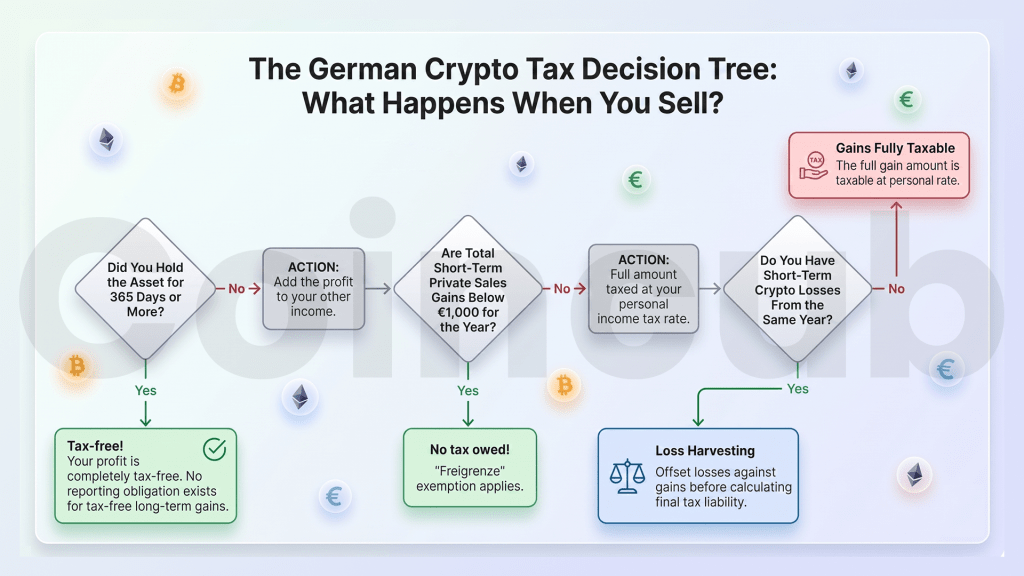
Investors who sell before the 365-day mark enter a less forgiving tax environment. Short-term gains from cryptocurrency do not receive the flat 25% capital gains rate applied to stocks. Instead, the German tax system adds those gains directly on top of your regular income and taxes the combined total at your personal income tax rate.
Germany’s income tax system uses a progressive scale. The rate starts at 14% for incomes above the basic personal allowance, climbs through several brackets, and reaches 45% for the highest earners. On top of that, the solidarity surcharge (Solidaritätszuschlag) applies in some cases. A successful short-term crypto trader sitting in the top tax bracket could therefore hand nearly half of their profits to the government.
The law does offer one small relief mechanism for short-term gains: a 1,000 euro annual exemption limit. If your total short-term gains from private sales transactions across the full calendar year stay below 1,000 euros, you pay no tax on them at all.
However, the critical detail here is the nature of this threshold. German tax law calls it a Freigrenze, an exemption limit, and it operates very differently from a Freibetrag, a standard tax-free allowance. With a Freibetrag, you pay no tax on the exempt portion, and you pay tax only on the amount that exceeds the threshold. A Freigrenze works the other way around entirely. If your short-term gains reach 1,000.01 euros, the entire sum becomes taxable, starting from the first euro. You lose the exemption completely the moment you cross the line.
This distinction catches a lot of casual investors off guard. Someone who makes 999 euros in short-term crypto profits owes nothing. Someone who makes 1,001 euros owes tax on all 1,001 euros.
Short-Term Gains and Losses: A Quick Reference
| Scenario | Tax Outcome |
| Sold after 365+ days, any profit amount | 0% tax, completely exempt |
| Short-term gains below 1,000 EUR total | 0% tax under Freigrenze |
| Short-term gains of exactly 1,000 EUR | 0% tax (at the limit, not over) |
| Short-term gains above 1,000 EUR | Full amount taxed at personal income rate |
| Short-term crypto loss in same calendar year | Offsets short-term crypto gains |
| Short-term crypto loss carried forward | Can offset future short-term crypto gains |
One useful planning tool available to short-term traders involves loss harvesting. If you hold a position that currently sits in a loss, selling it before year-end crystalizes that loss. The loss then offsets your short-term gains within the same calendar year, reducing your taxable income from crypto. Losses that exceed gains in a given year do not disappear. The tax office carries them forward and lets you apply them against future short-term crypto gains in subsequent years.
Staking, Airdrops, and Crypto Income
The 1-Year Rule governs the buying and selling of assets you already own. A separate category of tax treatment covers situations where you earn cryptocurrency directly, and the distinction between the two matters considerably.
Staking rewards, mining rewards, liquidity mining returns, and referral bonuses all fall under Section 22 of the EStG, which covers “other income” (sonstige Einkünfte). The tax office treats these as income at the moment you receive them. You calculate the taxable amount by taking the market value of the received coins in euros at the precise time of receipt, and you add that figure to your total income for the year. Your standard personal income tax rate applies.
The law provides a separate, smaller exemption for this type of miscellaneous income: 256 euros per calendar year. Staking rewards and similar receipts that total less than 256 euros in a given year fall below the taxable threshold.
The treatment of airdrops depends on whether you had to do anything to receive them. When a project distributes tokens to wallet holders without any required action on the recipient’s part, German tax guidance generally treats the receipt as a non-taxable event at zero acquisition cost. When an airdrop requires you to complete a task, register, or take any deliberate action to claim the tokens, the authorities treat it more like earned income and assign a taxable value at receipt.
Hard forks, where a blockchain splits and existing holders receive new coins automatically, typically receive treatment similar to non-action airdrops. The newly received coins carry a zero cost basis, and the one-year holding clock starts from the date of the fork.
Strategic Record-Keeping: FiFo and Wallet Separation
The German tax office places the burden of proof squarely on the investor. If you cannot demonstrate that you held a specific asset for more than 365 days, the authorities will assume you did not. That assumption converts your gain from tax-free to fully taxable at your personal income rate.
When you buy the same cryptocurrency multiple times at different prices and dates, a question arises: which coins did you sell? The German tax authority defaults to the FiFo method, which stands for First-In, First-Out. Under FiFo, the system treats the first coins you bought as the first coins you sold. If you bought 1 BTC in January 2023 and another 1 BTC in January 2024, and you sell 1 BTC in February 2024, the tax office treats the January 2023 coin as the sold asset. That coin has crossed the one-year threshold, so the gain is tax-free.
FiFo can work powerfully in your favor when you have older coins sitting in your portfolio. It can also create headaches if you hold multiple purchases across different exchanges without clean records, because the system applies FiFo across the entire portfolio unless you maintain separate wallets.
Wallet Separation
This brings up one of the most effective structural strategies available to German crypto investors: wallet separation. By keeping your long-term holdings in a dedicated cold storage wallet, completely separate from any exchange account you use for active trading, you create a clean paper trail. The long-term wallet never touches a taxable transaction. The trading wallet holds only assets purchased recently and intended for short-term activity. This separation prevents FiFo calculations from accidentally consuming your long-term, tax-free coins when you execute a short-term trade on an exchange.
Crypto tax software built for the German market can automate FiFo calculations across multiple wallets and exchanges, tracking every acquisition date and price to the minute. Given the volume of transactions that even moderate DeFi participation generates, attempting to track all of this manually in a spreadsheet creates serious risk of error.
Final Thoughts on The German 1 Year Tax Rate
Germany rewards cryptocurrency investors who exercise patience above all else. The 1-Year Rule gives long-term token holders a legitimate, government-acknowledged path to realizing substantial gains without triggering any tax liability, an advantage that barely exists in comparable Western economies.
The practical steps to capturing this advantage come down to three disciplines. First, track every transaction with dedicated crypto tax software that applies FiFo and timestamps each trade accurately. The tax office expects precision, and software removes the human error that manual records introduce. Second, separate your long-term holdings from your trading activity through distinct wallets, keeping your aged coins physically isolated from any exchange where a swap could accidentally reset a clock. Third, understand the income side of crypto fully, particularly the tax treatment of staking rewards and airdrop income, because conflating “gains” with “income” leads to misreported tax filings.
Germany’s framework is generous to those who understand it. The investors who capture the full benefit are the ones who treat record-keeping as seriously as they treat their entry price.
Frequently Asked Questions (FAQs)
What are the new tax rules in Germany 2026?
In 2026, the general tax-free personal allowance increased to €12,348. For crypto, the short-term tax exemption limit remains €1,000. Additionally, the EU’s CARF directive begins taking effect, requiring exchanges to automatically share user transaction data with German tax authorities.
Is crypto taxed in Germany for one year?
Yes, if you sell or swap cryptocurrency within 365 days of purchasing it, the profits are taxed as regular income at your progressive tax rate (up to 45%). However, short-term total gains under €1,000 remain entirely tax-free.
What is the capital gains tax on crypto past 1 year?
The tax rate on cryptocurrency held for more than one year is exactly 0%. Under German tax law, digital assets are classified as private assets, meaning any profits realized after a 365-day holding period are completely exempt from taxation.
Is Germany a crypto-friendly country?
Germany is widely considered one of the most crypto-friendly countries globally for long-term investors. Because the government does not charge any tax on crypto held longer than a year, it heavily incentivizes a “buy and hold” investment strategy.
Is crypto legal in Germany for foreigners?
Yes, it is entirely legal for foreigners and non-citizens to buy, sell, and hold cryptocurrency in Germany. Anyone using German-based exchanges must simply complete standard KYC (Know Your Customer) identity verification to comply with local BaFin regulations.