Buy a Licensed Company
  Explore VASP Data
  Talk to an Expert

 Bonniey Josef
Bonniey is a Psychologist and Crypto Copywriter with extensive experience in writing content that educates and entertains.
Bonniey Josef
Bonniey is a Psychologist and Crypto Copywriter with extensive experience in writing content that educates and entertains.
What Is a Perpetual DEX? Complete Guide for 2026
Quick Summary:
Perpetual DEXs are decentralized exchanges for trading perpetual futures (leveraged positions on crypto prices with no expiry) without giving up custody of your funds.
In 2025, DEX perpetual volume surged 346% to $6.7 trillion while centralized exchange open interest fell 20.8%.

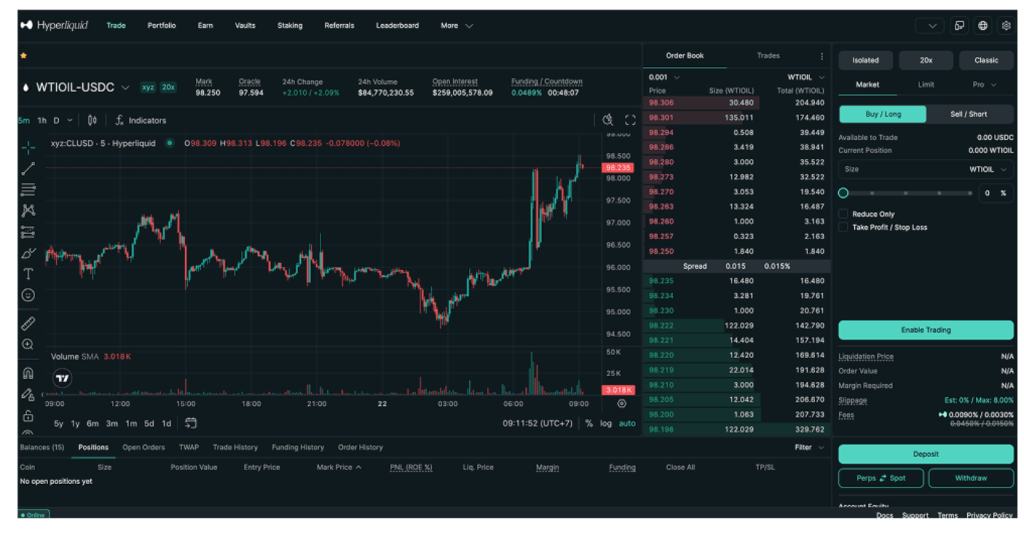
In March 2026, Grayscale filed for a spot HYPE ETF, JPMorgan published a report noting DEXs are taking market share from centralized exchanges, and Hyperliquid’s oil perpetual hit $1.7B in daily volume while traditional futures markets were closed.
How Do Perpetual DEXs Work?
A perpetual DEX lets you trade leveraged futures through smart contracts instead of centralized infrastructure. Connect a wallet, deposit collateral (typically USDC or ETH), and open long or short positions. Your margin sits in an auditable smart contract, not on a company’s balance sheet.
Positions never expire. A funding rate, a periodic payment between longs and shorts, keeps the contract price anchored to spot. When the perp trades above spot, longs pay shorts. When below, shorts pay longs. No settlement dates, no rollovers.
The architecture varies: Hyperliquid runs an on-chain order book on a purpose-built L1, GMX uses a liquidity pool model on Arbitrum, and others match off-chain but settle on-chain.
What Can You Trade on Perpetual DEXs?
What separates this cycle is what is being traded. Permissionless listings like Hyperliquid’s HIP-3 let anyone launch a perpetual market for any asset with a price feed. Only 7 of the platform’s top 30 markets are crypto pairs. The rest are crude oil, silver, gold, the S&P 500, and pre-IPO equities like SpaceX and Anthropic.
HIP-3 open interest crossed $1.43B in March 2026, up 100x in six months, and when Middle East tensions escalated while CME was closed for the weekend, Hyperliquid’s CL-USDC oil perpetual hit $1.7B in daily volume.
It is now the platform’s third most traded contract. These platforms are no longer just crypto exchanges.
Perpetual DEXs vs Centralized Perp Exchanges
The core trade-off is custody versus convenience. On a CEX like Binance or Bybit, you deposit funds into the platform’s wallets and trust them to honor withdrawals. On a perpetual DEX, your collateral lives in a smart contract you can exit at any time. Until recently, that self-custody came with slower execution, thinner liquidity, and clunkier interfaces.
That gap has closed. Hyperliquid processed $2.9 trillion in volume during 2025, more than double Coinbase International. Sub-second finality, 200,000+ orders per second, 313 perpetual pairs. The “DEXs are slow” argument is dead.
| Perpetual DEX | Centralized Exchange | |
| Custody | Self-custody via smart contracts | Platform holds your funds |
| KYC | Typically none | Required in most jurisdictions |
| Transparency | On-chain, fully auditable | Opaque internal systems |
| Liquidity | Deep on major pairs, thinner on long tail | Deep across more pairs |
| Speed | Sub-second on modern L1s | Near-instant |
| Market Access | Permissionless listings (any asset with a price feed) | Curated listings |
Top Perpetual DEX Platforms
Decentralized perpetual exchanges now account for a meaningful share of global derivatives volume.
Hyperliquid leads with roughly 50% of the DEX derivatives market and over $4 trillion in cumulative volume, while newer entrants like Lighter, Aster, and EdgeX are gaining ground with zero-fee models, multi-chain aggregation, and privacy-focused execution. Jupiter Perps, GMX, dYdX, and Vertex round out the top tier.
DEX perps by the numbers:
- $6.7 trillion in DEX perp volume in 2025, up 346% year-over-year
- 229.6% surge in DEX open interest, even as CEX open interest declined
- $7.24 trillion total perpetual futures market by January 2026, a 75% expansion in two years
- $11 billion in average daily volume across top perp DEXs.
You can track how these platforms stack up in real time using perpetual exchange aggregators.
For a live look at volume rankings, open interest, fees, and revenue across the top decentralized perpetual exchanges, see the CoinPerps Perp DEX comparison.
Benefits of Trading Perpetual Futures on a DEX
- No counterparty risk: Your assets are governed by code, not a company’s solvency. The FTX collapse proved this matters. More recently, the pattern has reinforced itself: HYPE is up 54% year-to-date in 2026 while BTC has fallen 23%. Capital is flowing to the infrastructure layer, not away from it. Grayscale has filed for a spot HYPE ETF, the third such filing for the token.
Capital efficiency in both directions. Perps let traders profit from falling prices as easily as rising ones. During Q4 2025’s drawdown, CEX spot volume collapsed from $2.21T to $0.95T. Perp DEX volumes held strong, peaking at $1.18T in October. Hyperliquid’s monthly volume actually increased from $169B in December to over $200B in both January and February 2026, even as competitor platforms like Aster and Lighter saw sharp declines.
Permissionless access. Anyone with a wallet can trade. No sign-ups, no identity verification. Hyperliquid’s HIP-3 goes further, letting anyone launch a perpetual market for any asset with a price feed, without approval or listing fees.
Expanding beyond crypto. Perp DEXs now list commodities, pre-IPO equities (SpaceX, Anthropic, OpenAI), and equity index perpetuals. S&P Dow Jones Indices officially licensed its index for a derivative contract on Hyperliquid this month, and the platform’s oil perpetual hit $1.7B in daily volume in March 2026 while CME was closed. Bitwise research found 64% of commodity traders stay active past three months versus 27% for crypto perps, suggesting this user base is structurally stickier. JPMorgan noted DEXs are now taking share from mid-tier centralized exchanges.
Risks of Perpetual DEXs
Transparency as a vulnerability. Visible positions, order sizes, and liquidation levels enable front-running, sandwich attacks, and liquidation hunting. Hyperliquid trader James Wynn reportedly lost close to $100M in leveraged BTC liquidations in mid-2025 after his positions were tracked and traded against publicly.
Smart contract exploits. In July 2025, GMX V1 lost $42 million to a reentrancy exploit that manipulated vault accounting and inflated GLP token prices. The attacker returned the funds for a $5M bounty, but the incident exposed legacy vulnerabilities in a protocol that had been live since 2021 and audited multiple times.
Market manipulation. Hyperliquid’s community liquidity vault was drained three separate times in 2025 through coordinated attacks on low-liquidity tokens. The November POPCAT incident alone created $4.9M in bad debt. The pattern is repeatable: high leverage, thin books on smaller pairs, and community-funded liquidation pools.
Liquidation cascades. In October 2025, a U.S. tariff announcement triggered $19 billion in forced liquidations across exchanges. Hyperliquid absorbed $10.3B of that, the most of any single platform.
Other risks to consider:
- Oracle dependence: Price feed failures from Chainlink or Pyth can trigger unfair liquidations
- Data trust: Aggregators report conflicting volume figures, and wash trading driven by airdrop incentives inflates metrics on some platforms
- Wallet security: A Hyperliquid whale lost $21M in October 2025 after a private key compromise. Self-custody means the security burden falls entirely on the user
Are Perpetual DEXs Regulated?
Not directly. Most perp DEXs operate as permissionless protocols with no KYC, no custody of user funds, and no registration with financial regulators. That is both the appeal and the regulatory risk.
The gap is closing fast. In July 2025, Coinbase became the first U.S. exchange to list perpetual futures under CFTC rules. In March 2026, CFTC Chairman Michael Selig announced a formal framework for crypto perps is coming “within weeks,” aiming to bring offshore liquidity back to regulated U.S. markets.
Decentralized platforms are preparing. Hyperliquid hired former Blockchain Association general counsel Jake Chervinsky to lead a policy center. The regulatory window that enabled permissionless perp DEX growth is narrowing, and U.S.-based traders in particular should watch CFTC developments closely.
Frequently Asked Questions
1. Do you pay taxes on perpetual DEX trades?
Yes. Every closed position is a taxable event whether the exchange reports it or not. In the US, DEX perps are taxed as standard capital gains. They don’t qualify for the 60/40 split that CFTC-regulated futures receive. Funding payments you receive are also likely taxable income. DEXs don’t issue 1099-DAs, so tracking cost basis and PnL is entirely on the trader.
2. Can you trade stocks and commodities on a perpetual DEX?
Yes. Hyperliquid’s HIP-3 allows permissionless markets for any asset with a price feed. As of March 2026, only 7 of the platform’s top 30 markets are crypto pairs. The rest include crude oil, gold, silver, and a licensed S&P 500 perpetual via S&P Dow Jones Indices and Trade[XYZ]. Pre-IPO equity perps for SpaceX and Anthropic are also live. All markets trade 24/7.
3. How much does it cost to hold a perpetual futures position?
The main ongoing cost is funding rates, not trading fees. Funding is a periodic payment (every 1 to 8 hours) exchanged between longs and shorts to keep the contract price anchored to spot. Rates typically range from 0.01% to 0.1% per interval but spike during volatile or crowded trades. On a $10,000 position at 0.03% every 8 hours, that is roughly $9 per day, and it scales with leverage. Trading fees on platforms like Hyperliquid run 0.02% to 0.05% per trade.